



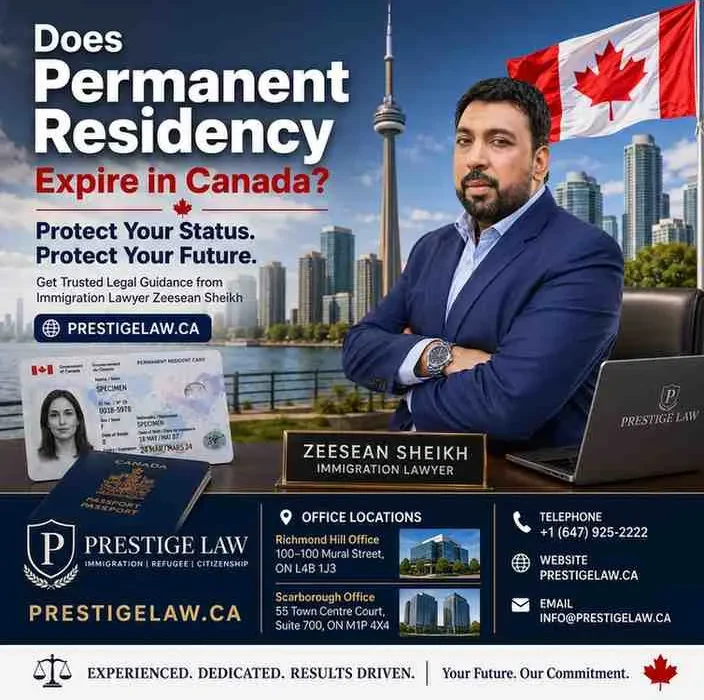
Does Permanent Residency Expire in Canada?
If you are living in Canada as a permanent resident, one of the most important questions you will ever ask is: Does permanent residency expire in Canada? The short and straightforward answer is — your permanent resident (PR) status does not expire, but your PR card does. This distinction is critical, and understanding it could be the difference between remaining in Canada legally and losing your immigration status altogether.
Many newcomers and long-time residents confuse the PR card with PR status. They are not the same thing. Your status as a permanent resident is an ongoing legal designation granted to you by the Government of Canada. However, the physical card used to prove that status — the Permanent Resident Card — is issued with a validity period of five years. When your PR card expires, you do not automatically lose your status. But failing to maintain the residency obligations tied to that status can absolutely result in losing it — sometimes without warning.
At Prestige Law, immigration lawyer Zeesean Sheikh has guided hundreds of permanent residents across Canada through the complexities of PR card renewals, compliance with residency obligations, and status restoration. Whether you are concerned about your own situation or seeking guidance for a family member, this comprehensive guide will walk you through everything you need to know.
Understanding Permanent Resident Status vs. the PR Card
To fully grasp how permanent residency works in Canada, you must first understand the difference between two distinct concepts: your permanent resident status and your PR card.
Permanent resident status is the legal right granted to a foreign national to live, work, and study in Canada indefinitely. Once granted, this status continues unless it is officially revoked by a government authority — typically through an admissibility hearing or through voluntary renunciation. Status itself does not expire on a fixed date.
The Permanent Resident Card, on the other hand, is a government-issued photo identification document that confirms your status. Most PR cards are valid for five years, although some may be issued with a one-year validity in specific circumstances. When your PR card expires, it means you simply no longer have a valid travel document to re-enter Canada from abroad. It does not cancel your status — but it creates serious complications if left unaddressed.
Think of it this way: losing your driver’s licence does not mean you forget how to drive, but it does mean you cannot legally operate a vehicle until you renew it. Similarly, an expired PR card does not mean you are no longer a permanent resident — but it does mean you may not be able to prove your status or travel internationally without difficulty.
The Residency Obligation: The Real Threat to Your PR Status
Here is where many permanent residents run into serious trouble. Under Canadian immigration law, all permanent residents must meet what is known as the residency obligation. This requirement states that you must be physically present in Canada for at least 730 days out of every five-year period.
These 730 days do not need to be consecutive. They can be accumulated over a rolling five-year window. However, they must be days spent physically in Canada, with some notable exceptions:
- Days spent outside Canada while accompanying a Canadian citizen spouse or common-law partner
- Days spent outside Canada while employed by a Canadian business or the federal/provincial government
- Days spent outside Canada while accompanying a permanent resident spouse or common-law partner employed by a Canadian business or government
If you fail to meet this residency obligation, your permanent resident status can be questioned and potentially revoked. This is entirely separate from the PR card expiry issue, and it is the more serious of the two concerns.
Zeesean Sheikh at Prestige Law regularly advises clients who have spent significant time outside Canada — whether for work, family obligations, or health reasons — on how to assess their residency compliance and protect their status before issues arise.
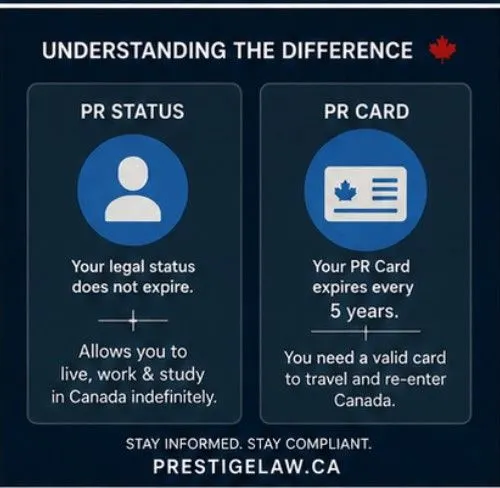
What is the difference between PR status and a PR card?
Your PR status is your legal right to live, work, and study anywhere in Canada. Your PR card is simply the document that proves it. PR cards are typically valid for five years, though some are issued for one year.
When the card expires, you remain a permanent resident — but you cannot board a commercial flight or international carrier back to Canada without a valid card or a Permanent Resident Travel Document (PRTD).
As a permanent resident of Canada, your rights include the ability to:
- Live, work, or study anywhere in Canada
- Access most social benefits that Canadian citizens receive, including health care coverage
- Apply for Canadian citizenship once you meet the eligibility requirements
- Receive protection under Canadian law and the Canadian Charter of Rights and Freedoms
When Does a PR Card Expire?
A standard PR card is valid for five years from the date of issue. Once it expires, you will not be able to use it to board a flight back to Canada from another country. Airlines are required to check for valid travel documents before allowing passengers to board, and an expired PR card will not be accepted.
In some cases — such as when a permanent resident has not yet met their residency obligations at the time of the card renewal application — Immigration, Refugees and Citizenship Canada (IRCC) may issue a one-year PR card instead of a five-year one. This is a signal that your residency compliance is being closely monitored. Does Permanent Residency Expire in Canada?
If you are outside Canada when your PR card expires, you have a few options:
- Apply for a Permanent Resident Travel Document (PRTD) — This is a single-use travel document that allows you to return to Canada when your PR card has expired or been lost while abroad.
- Return to Canada and renew your PR card from within the country — This is always the preferred option.
It is important to note that you cannot renew your PR card from outside Canada. The renewal must be done from within Canadian borders, which is why many permanent residents find themselves in a difficult position when their card expires while they are abroad.
How to Renew Your PR Card in Canada
Renewing your PR card is a straightforward process if you are inside Canada and meet your residency obligations. Here is a step-by-step overview of how the process works: Does Permanent Residency Expire in Canada? Does Permanent Residency Expire in Canada?
Step 1: Confirm Your Eligibility. Before applying, ensure you have met the 730-day residency requirement within the past five years. Gather your travel history, employment records, and any documentation that supports your time in Canada.
Step 2: Gather the Required Documents. You will need to submit several documents, including:
- A completed application form (IMM 5444)
- Two recent passport-size photographs. Does Permanent Residency Expire in Canada? Does Permanent Residency Expire in Canada?
- Your expired or expiring PR card. Does Permanent Residency Expire in Canada? Does Permanent Residency Expire in Canada?
- Supporting documents confirming your residency (pay stubs, tax returns, utility bills, lease agreements)
- Travel history showing your entries and exits from Canada
Step 3: Submit Your Application. Applications are submitted online through the IRCC portal. Processing times can vary, but as of 2024, the standard processing time has ranged from several weeks to several months, depending on IRCC’s workload and the completeness of your application. Does Permanent Residency Expire in Canada? Does Permanent Residency Expire in Canada?
Step 4: Receive Your Decision. If your application is approved, your new PR card will be mailed to your Canadian address. If IRCC has concerns about your residency compliance, they may request additional documents or schedule an interview before a decision is made.
Zeesean Sheikh strongly recommends applying for your PR card renewal at least six months before it expires to avoid being caught in a difficult situation — particularly if you plan to travel internationally. Does Permanent Residency Expire in Canada?
What Happens If You Lose Your Permanent Resident Status?
Losing permanent resident status is one of the most serious immigration consequences a person can face in Canada. If IRCC or a visa officer determines that you have not met your residency obligation, they can issue a removal order or refer the matter to an Immigration Division hearing.
However, losing your status is not always immediate or automatic. There are several stages at which intervention can make a significant difference: Does Permanent Residency Expire in Canada? Does Permanent Residency Expire in Canada?
At a Port of Entry: If you return to Canada after a long absence and a border officer determines you may not have met your residency obligation, they may refer you to a secondary examination. At this stage, you have the opportunity to present humanitarian and compassionate (H&C) grounds as a reason to allow you to retain your status. Does Permanent Residency Expire in Canada?
During a PR Card Renewal Application: If IRCC finds during your renewal application that you have not met the residency requirement, they will issue a notice of intent not to renew your card. You can respond to this notice with documentation and arguments in your favour.
At an Appeal: If you receive a removal order or a refusal of your PR card renewal, you can appeal to the Immigration Appeal Division (IAD). The IAD considers H&C factors, which may include the length of time you have been a permanent resident, your family ties in Canada, your establishment in the country, and the best interests of any children involved.
This is where having experienced legal representation becomes essential. Zeesean Sheikh at Prestige Law has successfully represented clients before the Immigration Appeal Division and helped permanent residents retain their status even in complex and difficult circumstances.

Humanitarian and Compassionate Grounds: A Lifeline for Some Residents
Canadian immigration law recognises that life does not always follow a predictable path. Illness, family emergencies, political instability in a home country, or professional commitments abroad can all keep a permanent resident outside Canada for longer than anticipated.
Under the Immigration and Refugee Protection Act (IRPA), the humanitarian and compassionate (H&C) ground allows immigration authorities and the IAD to exercise discretion in favour of a permanent resident who has not technically met the residency obligation but whose circumstances warrant special consideration. Does Permanent Residency Expire in Canada?
Factors that may be considered under H&C grounds include:
- Serious illness of the resident or a family member requiring care abroad
- Care responsibilities for elderly parents or dependants outside Canada
- Business or employment obligations that required an extended absence
- The degree of establishment in Canada before leaving
- The best interests of children who are Canadian citizens or permanent residents
- Whether the absence was beyond the resident’s control
Making a successful H&C argument is not simple. It requires careful documentation, persuasive writing, and a thorough understanding of how immigration officers and the IAD evaluate these factors. This is not something you should attempt without qualified legal support.
Permanent Residency and Citizenship: Understanding the Path Forward
Many permanent residents in Canada are ultimately working toward one goal: Canadian citizenship. Understanding how your PR status connects to citizenship eligibility is important for long-term planning.
To be eligible for Canadian citizenship, you must have been physically present in Canada for at least 1,095 days out of the five years immediately before the date of your application. You must also have filed income taxes for at least three years within those five years and meet language requirements in English or French.
Maintaining your residency obligation as a permanent resident not only protects your PR status but also keeps you on track toward citizenship eligibility. If you spend too much time outside Canada, you may not only risk your PR status — you may also push back your citizenship eligibility timeline significantly. Does Permanent Residency Expire in Canada? Does Permanent Residency Expire in Canada?
Zeesean Sheikh advises permanent residents who are considering travel or relocation outside Canada to consult with a qualified immigration lawyer before making any decisions that could affect their residency compliance.
Common Mistakes Permanent Residents Make
Over years of practice, Zeesean Sheikh has observed several recurring mistakes that permanent residents make — often without realising the consequences until it is too late. Does Permanent Residency Expire in Canada? Does Permanent Residency Expire in Canada?
Assuming that long-term residency means permanent security. Even residents who have lived in Canada for a decade or more can lose their status if they fail to meet the residency obligation for any five years. There is no “grandfather” exemption based on years lived in Canada. Does Permanent Residency Expire in Canada? Does Permanent Residency Expire in Canada?
Not keeping a travel record. Many residents cannot accurately reconstruct their travel history when they need to apply for a PR card renewal or citizenship. Keeping a detailed log of all entries and exits — including dates, destinations, and the purpose of each trip — is essential.
Waiting too long to renew the PR card. Some residents wait until their card has already expired before applying for renewal. This can leave them unable to travel internationally until the new card arrives, which can cause significant disruption to personal and professional plans.
Failing to understand the employer exception. Residents who work for Canadian companies or government abroad often qualify for exceptions to the residency obligation — but they must properly document their employment relationship to claim this exemption.
Not seeking legal advice early enough. Many residents only contact a lawyer after they have received a refusal or a removal order. At that point, the options — while still available — are far more limited. Early legal consultation can prevent problems before they become crises.
Why You Need an Immigration Lawyer for PR Issues
Canada’s immigration system is complex, constantly changing, and unforgiving of mistakes. IRCC processes millions of applications each year, and officers apply strict standards to each case. A poorly prepared application, missing documentation, or an inadequate response to a notice of intent can result in a refusal that is difficult and expensive to overturn. Does Permanent Residency Expire in Canada?
An experienced immigration lawyer does far more than fill out forms. He assesses your entire immigration history, identifies risks before they become problems, develops strategies to maximise your chances of success, and advocates on your behalf before immigration authorities and tribunals. Does Permanent Residency Expire in Canada? Does Permanent Residency Expire in Canada?
Zeesean Sheikh brings years of dedicated immigration law experience to every client he serves. His deep understanding of IRCC processes, immigration jurisprudence, and the Immigration Appeal Division sets him apart as a trusted resource for permanent residents across Canada.
About Prestige Law and Zeesean Sheikh
Zeesean Sheikh is a highly experienced Canadian immigration lawyer based in Ontario. He is committed to providing comprehensive, client-focused immigration legal services to individuals and families navigating Canada’s complex immigration system. With offices in Richmond Hill and Scarborough, Prestige Law serves clients across the Greater Toronto Area and beyond.
Whether you are renewing a PR card, responding to a residency compliance concern, appealing a refusal, or planning your path to Canadian citizenship, Zeesean Sheikh and the team at Prestige Law are here to help you every step of the way.
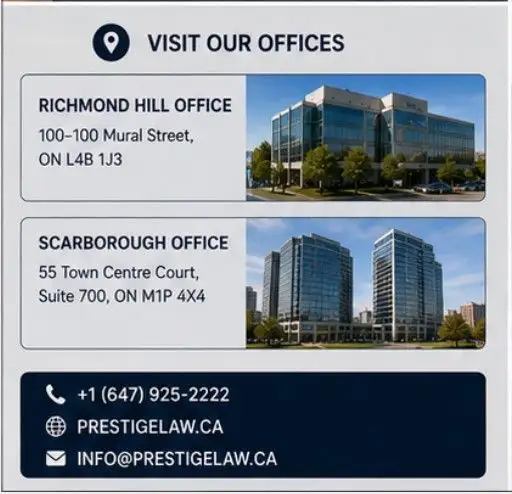
Office Locations:
📍 Richmond Hill: 100–100 Mural Street, ON
📍 Scarborough: 55 Town Centre Court, Suite 700, ON
📞 Telephone: +1 (647) 925-2222
🌐 Website: prestigelaw.ca
Frequently Asked Questions (FAQs)
1. Does permanent residency expire in Canada? Your permanent resident status does not expire on its own. However, your PR card — which is the document proving your status — expires every five years. If you fail to meet the residency obligation of 730 days within five years, your status can be revoked. Does Permanent Residency Expire in Canada? Does Permanent Residency Expire in Canada?
2. What happens if my PR card expires while I am outside Canada? If your PR card expires while you are abroad, you will need to apply for a Permanent Resident Travel Document (PRTD) from the nearest Canadian visa office or embassy. This single-use document allows you to return to Canada. You should then apply to renew your PR card once you are back in Canada.
3. Can I lose my permanent residency if I travel too much? Yes. If your time outside Canada causes you to fall below the 730-day physical presence requirement within any five years, your permanent resident status may be at risk. There are some exceptions for those accompanying Canadian citizen spouses or those working for Canadian companies abroad. Does Permanent Residency Expire in Canada?
4. How do I renew my PR card in Canada? You can renew your PR card by submitting an application to IRCC online. The application requires identity documents, travel history, proof of residency in Canada, and photographs. You must be inside Canada when you apply.
5. How long does it take to renew a PR card? Processing times vary. IRCC provides updated estimates on its website. In recent years, processing times have ranged from a few weeks to several months. Applying well before your card expires is always strongly recommended.
6. Can I apply for a PR card renewal if I have not met my residency obligation? You can still apply, but IRCC may refuse to renew your card or issue a one-year card instead of a five-year one. In some cases, IRCC may initiate proceedings to question your status. Legal advice is strongly recommended in this situation. Does Permanent Residency Expire in Canada? Does Permanent Residency Expire in Canada?
7. What is humanitarian and compassionate consideration in immigration? Humanitarian and compassionate (H&C) consideration allows immigration authorities to exercise discretion in favour of a permanent resident or applicant who would otherwise not qualify, based on personal circumstances that justify special relief. H&C grounds are assessed on a case-by-case basis and require strong documentation.
8. Can I appeal if my PR card renewal is refused? Yes. If your PR card renewal is refused because IRCC believes you have not met your residency obligation, you may be able to appeal to the Immigration Appeal Division (IAD). You should consult an immigration lawyer immediately if you receive a refusal notice.
9. Does my PR status affect my eligibility for Canadian citizenship? Yes. Maintaining your PR status and meeting the physical presence requirements is critical for citizenship eligibility. You need to be physically present in Canada for at least 1,095 days within the five years before applying for citizenship.
10. How can Prestige Law help me with my PR renewal or status issue? Prestige Law, led by immigration lawyer Zeesean Sheikh, provides full legal support for PR card renewals, residency obligation assessments, appeals before the Immigration Appeal Division, and humanitarian and compassionate applications. Contact Prestige Law at +1 (647) 925-2222 or visit prestigelaw.ca to schedule a consultation.
Understanding whether permanent residency expires in Canada — and what that actually means for your daily life and long-term plans — is one of the most important things you can do to protect your future in this country. Your status may not have an expiry date stamped on it, but it is still fragile in ways that surprise many residents. The residency obligation is real, the consequences of failing to meet it are serious, and the window to correct problems is not always as wide as people assume. Does Permanent Residency Expire in Canada?
If you have any concerns about your PR card, your residency compliance, or your path to citizenship, do not wait. Reach out to an experienced immigration lawyer who can review your situation with fresh eyes and give you an honest, informed assessment of where you stand and what your options are. Does Permanent Residency Expire in Canada? Does Permanent Residency Expire in Canada?
Zeesean Sheikh and the team at Prestige Law are ready to help you navigate every aspect of your permanent residency journey — with the professionalism, integrity, and dedication that your future in Canada deserves. Does Permanent Residency Expire in Canada?
📍 Richmond Hill: 100–100 Mural Street, ON
📍 Scarborough: 55 Town Centre Court, Suite 700, ON
📞 Telephone: +1 (647) 925-2222
🌐 Website: prestigelaw.ca