




The Top Five States Where Americans Qualify for a Canadian Passport Through Ancestry
Millions of Americans have Canadian roots they may not even know about, and depending on where their parents or grandparents were born, they could be sitting on an unused right to Canadian citizenship and a Canadian passport. Because Canada and the United States share the longest international border in the world, generations of families have moved back and forth between the two countries for work, marriage, and migration. As a result, many US citizens living in border states today are direct descendants of Canadian-born parents or grandparents, which under Canadian citizenship law may make them eligible to claim citizenship by descent. In this article, we break down the five US states where this kind of ancestral connection to Canada is most common, explain how the Canadian citizenship by descent rules actually Contact Us Today. Top 5 US States for Canadian Citizenship by Descent
Why Ancestry Matters for Canadian Citizenship
Before diving into the state-by-state breakdown, it helps to understand why ancestry is such a powerful pathway to Canadian citizenship in the first place. Under the Citizenship Act, a person born outside Canada to a Canadian citizen parent may automatically be a Canadian citizen by descent, even if they were born in the United States and have never set foot in Canada. This is sometimes called the “first generation limit,” because in most cases citizenship by descent can only be passed down one generation to a child born abroad. However, there are important exceptions, especially for people whose parent was working for the Canadian government, the Canadian Armed Forces, or was themselves born to a Canadian parent who was serving abroad.
For many American families, the connection is simple: a parent or grandparent was born in Canada, moved to the United States at some point in their life, and eventually became a US citizen, often without realising that their children might still hold a claim to Canadian citizenship. Because citizenship by descent does not require the Canadian-born parent to have maintained Canadian citizenship, retained ties to Canada, or even known about their child’s potential eligibility, this is one of the most overlooked immigration opportunities available to Americans today.
A Canadian passport offers significant practical benefits, including visa-free or visa-on-arrival access to a large number of countries, the right to live and work anywhere in Canada without a visa or work permit, access to Canada’s public healthcare system once provincial residency requirements are met, and the ability to pass Canadian citizenship on to future generations in certain circumstances. For families with strong historical ties to Canada, these benefits can make pursuing proof of citizenship a worthwhile investment of time.
How We Determined the Top Five States
To identify the states where Americans are most likely to qualify for Canadian citizenship through ancestry, we looked at a combination of factors: historical migration patterns between Canada and the United States, geographic proximity to the Canadian border, documented patterns of cross-border family settlement going back to the early and mid-twentieth century, and the concentration of residents who report Canadian ancestry in census-style data. States that share a long land border with Canada, or that were historically popular destinations for Canadians relocating south for work in manufacturing, agriculture, or fishing industries, tend to have the highest concentrations of residents with a Canadian-born parent or grandparent.
With that framework in mind, here are the five states where Americans are statistically most likely to have a legitimate claim to Canadian citizenship through their family history.
1. Michigan
Michigan tops the list for good reason. The state shares an extensive border with Ontario, separated in places only by a river or a short bridge crossing, and the Detroit-Windsor corridor has been one of the busiest and most historically significant cross-border regions in North America for over a century. Generations of families settled on both sides of this border to work in the automotive industry, with many Canadian citizens moving to Michigan for manufacturing jobs while maintaining close family ties back in Ontario.
It is extremely common in Michigan to find families where a grandparent was born in Windsor, Sarnia, or another nearby Ontario community before the family relocated permanently to Detroit, Flint, or other parts of southeastern Michigan. Because so much of this migration happened within living memory, many Michigan residents have a parent or grandparent whose Canadian birth certificate is still relatively easy to obtain, which is often the single most important document needed to begin a citizenship by descent application.
2. New York
New York’s long shared border with Ontario and Quebec, combined with its major population centres close to the border, makes it a strong contender for residents with Canadian ancestry. Cities like Buffalo, Niagara Falls, and Plattsburgh have long histories of cross-border family connections, with many residents able to trace a parent or grandparent back to communities in southern Ontario or Quebec.
The historical ties between Quebec and northern New York are particularly notable, as French-Canadian families moved across the border in significant numbers throughout the nineteenth and twentieth centuries seeking work in textile mills, agriculture, and later in service industries. For many New York families today, this means a great-grandparent’s Canadian birth may be just outside the first-generation limit, but a grandparent’s Canadian birth could still create a valid and provable claim to citizenship by descent for their American-born children.
3. Washington State
On the opposite side of the country, Washington State shares a substantial border with British Columbia, and the Vancouver-Seattle corridor has functioned as a single economic region for much of the last century. Many families in the Pacific Northwest have relatives who moved between British Columbia and Washington for work in forestry, fishing, shipping, and later in the technology sector.
Because British Columbia and Washington are so closely linked economically and culturally, it is common to find Washington residents whose parent was born in Vancouver, Victoria, or smaller BC communities before the family settled permanently in Seattle, Bellingham, or other parts of the state. For these families, obtaining a Canadian birth certificate for the Canadian-born parent is often the first and most important step toward confirming eligibility for citizenship by descent.
4. Maine
Maine’s proximity to the Maritime provinces, particularly New Brunswick, has resulted in one of the strongest historical patterns of Canadian-American family ties anywhere in the country. For generations, families in Maine and New Brunswick moved back and forth across the border for seasonal work, marriage, and settlement, particularly in industries like logging, fishing, and textile manufacturing.
Many residents of northern and eastern Maine can trace a grandparent or even a parent back to a small town in New Brunswick, often with surnames that remain common on both sides of the border to this day. Because these communities are so close geographically, many families maintained ties across the border for decades, which can make it easier to locate the documentation needed to support a citizenship by descent application, including Canadian birth records, baptismal records, and old immigration documents.
5. Minnesota
Minnesota rounds out the top five due to its historical connections to Manitoba and Ontario, particularly through agricultural migration in the early twentieth century. Families moved between the Canadian prairies and Minnesota for farming opportunities, and later generations often settled permanently on the American side of the border while maintaining family ties to communities like Winnipeg and other parts of southern Manitoba.
For Minnesota residents exploring their family history, it is not uncommon to discover that a grandparent was born in a small Manitoba or Ontario town before the family relocated to the Red River Valley or other agricultural regions of Minnesota. As with the other states on this list, the key to confirming eligibility lies in locating the Canadian-born relative’s birth certificate and tracing the direct line of descent to the applicant.

What to Do If You Think You Qualify
If you believe you may have a parent or grandparent who was born in Canada, the first step is to gather as much documentation as possible about that family member, including their full name, date and place of birth, and any available identity documents. From there, the process generally involves the following steps.
First, confirm the Canadian-born relative’s birth in Canada by obtaining an official birth certificate from the relevant provincial vital statistics office. This document is foundational to any citizenship by descent application, as it establishes the Canadian connection that everything else is built upon.
Second, gather documentation establishing the direct line of descent from the Canadian-born relative to the applicant, which typically includes birth certificates, marriage certificates, and any legal name change documents connecting each generation.
Third, determine whether the applicant falls within the first-generation limit or qualifies under one of the recognised exceptions, such as the Canadian-born parent having served in the Canadian Armed Forces or worked for the Canadian government abroad at the time of the applicant’s birth.
Fourth, submit an application for a citizenship certificate, often referred to as proof of citizenship, to Immigration, Refugees and Citizenship Canada. This certificate serves as official confirmation of citizenship and is generally required before applying for a Canadian passport.
Fifth, once proof of citizenship has been granted, apply for a Canadian passport through the standard passport application process, which requires the citizenship certificate along with identity documents and passport photos meeting Canadian government specifications.
This process can involve significant research, particularly when records are old, incomplete, or located in jurisdictions with different record-keeping systems. Working with an immigration lawyer who is familiar with citizenship by descent cases can help streamline the process, identify potential issues before they become roadblocks, and ensure that applications are complete and accurately presented the first time.
Common Mistakes That Delay Citizenship by Descent Applications
Many applicants run into avoidable delays because of small but significant errors in their applications. One of the most common issues is submitting incomplete documentation, such as missing a marriage certificate that links two generations together, which can cause the entire application to be returned or placed on hold. Another frequent issue is failing to account for name changes, whether through marriage, legal name changes, or historical spelling variations that were common in older records.
Applicants also sometimes misunderstand the first-generation limit and submit applications for individuals who are actually outside the eligible generation, only to have the application rejected after months of processing time. Additionally, some applicants assume that because a grandparent was Canadian, they automatically qualify, without realising that citizenship by descent generally only flows directly from a parent, not a grandparent, unless that parent themselves was also born outside Canada to a Canadian citizen serving abroad.
Given these complexities, having a professional review your family history and documentation before submission can save significant time and reduce the likelihood of delays or rejections.
Why Work With an Immigration Lawyer for Citizenship by Descent Claims
While it is technically possible to research and submit a citizenship by descent application without legal assistance, many applicants find that professional guidance makes the process significantly smoother, particularly when family records are decades old or located across multiple jurisdictions. An experienced immigration lawyer can help identify which family members in your lineage may create a valid claim, locate and request historical records from Canadian provincial archives, prepare a complete and well-organised application package, and respond effectively to any requests for additional information from Immigration, Refugees and Citizenship Canada.
At Prestige Law, our team works with clients across the United States who are exploring their Canadian ancestry and want clarity on whether they qualify for citizenship by descent. Whether your family history points to Ontario, Quebec, British Columbia, New Brunswick, Manitoba, or anywhere else in Canada, our lawyers can help you understand your options and guide you through every stage of the process, from initial research to your final Canadian passport application.
Frequently Asked Questions
Can I get a Canadian passport if my grandparent was born in Canada?
In most cases, Canadian citizenship by descent only passes down one generation to a child born outside Canada. This means that if your parent was born in the United States to a Canadian-born grandparent, your parent may be a Canadian citizen by descent, but you may not automatically qualify unless an exception applies. However, every family situation is different, and it is worth having your specific case reviewed.
Do I need to live in Canada to keep my Canadian citizenship?
No. Canadian citizenship by descent does not require the individual to live in Canada, and there is generally no residency requirement to maintain citizenship once it has been confirmed through a citizenship certificate.
How long does it take to get proof of Canadian citizenship?
Processing times vary depending on the complexity of the application and current government processing volumes, but applicants should generally expect the process to take several months from submission to a final decision.
What documents do I need to prove my Canadian ancestry?
At a minimum, you will typically need the Canadian-born relative’s birth certificate, along with birth, marriage, or name change documents connecting each generation between that relative and the applicant.
Can I apply for a Canadian passport directly without proof of citizenship?
No. A citizenship certificate, or proof of citizenship, is generally required before a first-time Canadian passport application can be submitted for someone claiming citizenship by descent.
Is there a deadline to claim Canadian citizenship through ancestry?
There is no general deadline to apply for proof of citizenship if you have a valid claim through descent, though it is always advisable to confirm eligibility and gather documentation as early as possible, since records can become harder to locate over time.
What if my family’s records are in French or use old spellings?
This is common, particularly for families with Quebec or Acadian roots. Provincial archives can often provide certified translations or assist with locating records under historical name variations, and a lawyer experienced in these cases can help navigate this process.
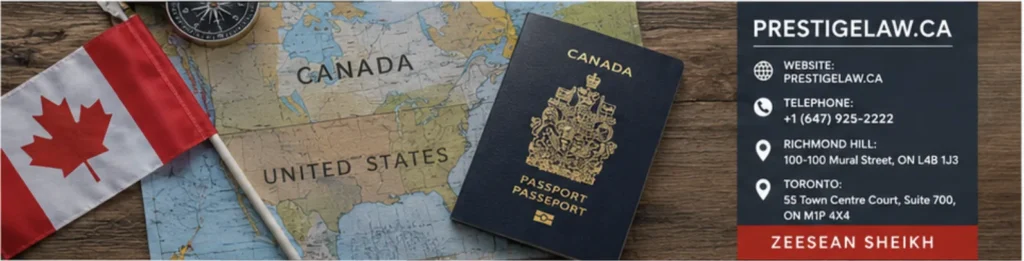
For Americans living in Michigan, New York, Washington, Maine, Minnesota, and many other border states, a Canadian passport may be closer than they realise. The long, shared history between Canada and the United States means that countless families have a Canadian-born parent or grandparent somewhere in their family tree, and that connection can translate into real citizenship rights for the next generation.
If you think you might have a claim to Canadian citizenship through ancestry, the best first step is simply to start gathering information about your family history, particularly any details about where and when your parents and grandparents were born. From there, a qualified immigration lawyer can help you understand your options and guide you through the process of confirming your citizenship and applying for your Canadian passport.
Contact Prestige Law
📍 Richmond Hill: 100–100 Mural Street, ON. 📍 Toronto: 55 Town Centre Court, Suite 700, ON. 📞 Telephone: +1 (647) 925-2222 🌐 Website: prestigelaw.ca