



IRCC Reports Increased Wait Times for Work Permits and Study Permits
For thousands of people planning to work or study in Canada, a small change in an immigration processing timeline can create a major disruption. One additional week may affect a university start date, an employment opportunity, international travel, housing arrangements or a family’s financial plans.
Immigration, Refugees and Citizenship Canada, commonly known as IRCC work and study permit wait times, regularly updates its estimated processing times for temporary residence applications. According to figures current as of July 28, 2026, processing times increased for certain work permit and study permit applicants, particularly those applying from Pakistan and Nigeria. At the same time, some applicants experienced stable or slightly improved timelines.
These changes do not mean that every application will take exactly the amount of time displayed by IRCC. Processing estimates are general indicators rather than guaranteed decision dates. The actual time required to process a case may depend on where the applicant applies from, the type of permit requested, whether the application is complete and whether IRCC work and study permit wait times requires additional documents, medical examinations, interviews or security screening.
Applicants in Toronto and throughout Canada should therefore avoid treating a published processing time as a fixed deadline. A carefully prepared application, submitted with the correct supporting evidence, remains one of the most important ways to reduce the risk of avoidable complications. prestigelaw.ca
Latest IRCC Work Permit Processing Times
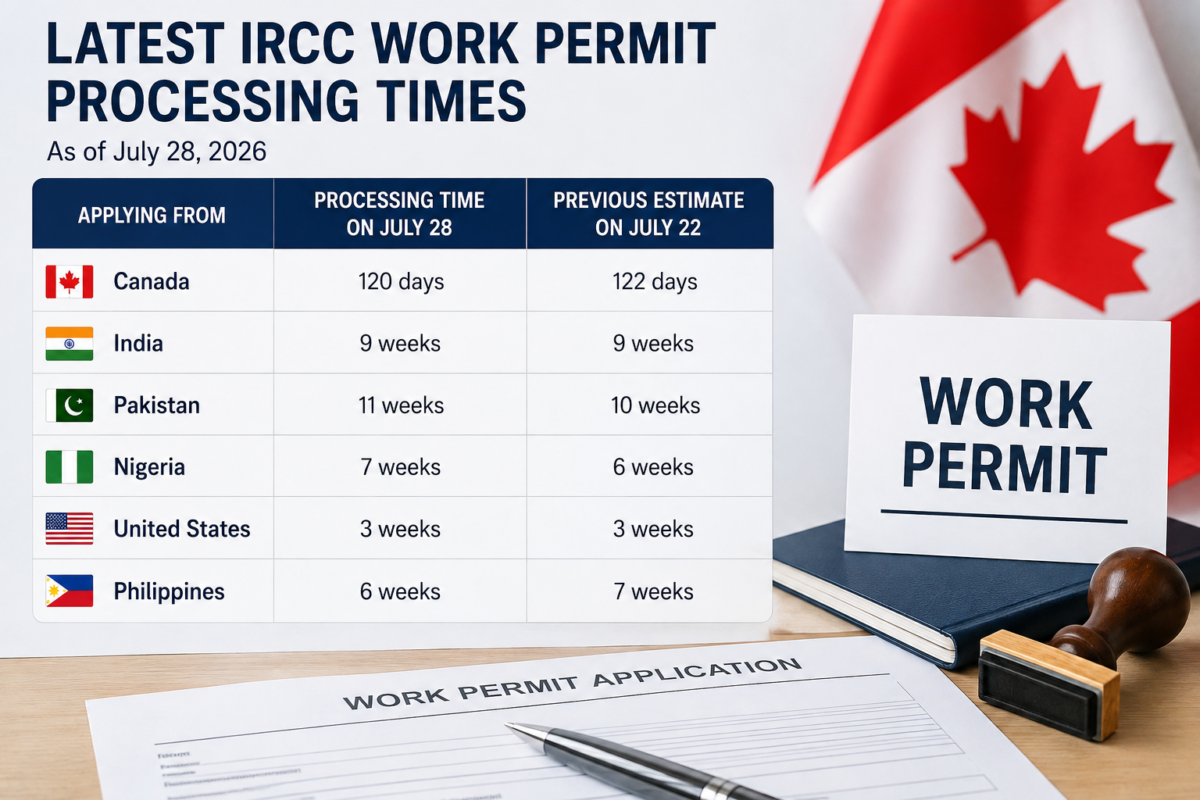
The July 28, 2026 update showed mixed results for work permit applicants. Processing times became shorter for applications submitted from inside Canada and from the Philippines. However, applicants applying from Pakistan and Nigeria saw their estimated wait times increase by one week.
The reported work permit processing estimates were:
| Applying From | Processing Time on July 28 | Previous Estimate on July 22 |
| Canada | 120 days | 122 days |
| India | 9 weeks | 9 weeks |
| Pakistan | 11 weeks | 10 weeks |
| Nigeria | 7 weeks | 6 weeks |
| United States | 3 weeks | 3 weeks |
| Philippines | 6 weeks | 7 weeks |
The figures show why applicants should examine the timeline connected to their specific location rather than relying on a general statement about Canadian work permit processing. For example, an applicant applying from India was shown an estimated processing time of nine weeks, while an applicant applying from the United States was shown three weeks.
Applications submitted from within Canada were estimated at 120 days. Although this was a two-day improvement from the previous estimate of 122 days, four months can still be a significant period for a worker waiting for an extension or a change to the conditions of a permit.
The published service standards referenced for work permit applications were 120 days for eligible applications submitted inside Canada, including certain initial applications and extensions, and 60 days for applications submitted outside Canada. A service standard is an operational objective and should not be understood as a promise that every case will be finalised within that period.
Latest IRCC Study Permit Processing Times
Study permit applicants also experienced some changes. After approximately four weeks of relatively stable estimates, processing times increased by one week for applicants applying from Pakistan and Nigeria.
The reported study permit processing estimates were:
| Applying From | Processing Time on July 28 | Previous Estimate on July 22 |
| Canada | 7 weeks | 7 weeks |
| India | 5 weeks | 5 weeks |
| Pakistan | 7 weeks | 6 weeks |
| Nigeria | 6 weeks | 5 weeks |
| United States | 5 weeks | 5 weeks |
| Philippines | 4 weeks | 4 weeks |
Processing times remained unchanged for applicants applying from Canada, India, the United States and the Philippines. However, an unchanged estimate should not be interpreted as a guarantee that an individual application will be approved within that period.
For international students, timing is especially important because a delayed decision may interfere with registration deadlines, tuition payments, housing contracts and travel plans. A student who receives a decision after the beginning of the academic term may need to request a deferral from the designated learning institution.
IRCC explains that when a student defers enrolment, the deferral should be approved by the designated learning institution and the student should obtain an updated letter of acceptance. The updated document must then be submitted to IRCC through the applicant’s online account or the IRCC work and study permit wait times web form.
Why Are IRCC Processing Times Changing?
IRCC processing times can move upward or downward from one update to the next. A one-week increase does not necessarily indicate that every visa office is experiencing the same problem. Processing estimates are affected by several operational and case-specific factors.
One major factor is application volume. Study permit submissions often rise before the fall and winter academic intakes. Work permit volumes may also change because of seasonal labour needs, employer recruitment patterns, policy changes and international mobility programs.
IRCC reported that, as of May 31, 2026, it had finalised 74,370 new study permit applications since the beginning of the year, while 31,665 remained awaiting finalisation. During the same period, IRCC finalised 140,775 work permit applications, with 35,040 still pending. These figures relate to new temporary residence applications and do not include extensions. IRCC work and study permit wait times
The complexity of an individual application can also affect the timeline. Some applications can be assessed using the documents initially submitted. Others may require additional review because of employment history, financial evidence, previous immigration refusals, criminal or medical concerns, questions about the authenticity of documents or doubts about whether the applicant meets the requirements of the requested permit.
Processing may also take longer when an applicant does not complete biometrics promptly, submits an incomplete form, pays the wrong fee or fails to provide a required document. In study permit cases, IRCC may need to confirm the validity of the letter of acceptance with the designated learning institution. In work permit cases, officers may need to review the job offer, Labour Market Impact Assessment, employer compliance information or the basis for an LMIA exemption.
Processing Times Are Estimates, Not Guaranteed Deadlines
One of the most common misunderstandings is that an IRCC processing time represents the maximum time the department is legally permitted to take. It does not.
A processing time is an estimate intended to help applicants understand how long similar applications may take under normal circumstances. An individual application may be completed sooner or may remain in processing beyond the published estimate.
IRCC work and study permit wait times uses different methods to calculate processing estimates. Historical processing times generally reflect how long it took the department to finalise a large proportion of previously completed applications. Forward-looking estimates are designed to predict how long a newly submitted application may take based on the existing inventory and available processing capacity.
For many temporary residence categories, historical estimates are calculated using recently processed cases. IRCC has explained that backwards-looking times for temporary residence programs may be based on applications finalised during an eight- or sixteen-week period.
A service standard is different. It represents the period within which IRCC aims to process a specified percentage of applications under normal circumstances. It is an institutional performance target, not a guaranteed outcome for every applicant.
This distinction matters when deciding whether an application is genuinely delayed. Being beyond a service standard does not automatically prove that IRCC acted improperly, and being within the published estimate does not necessarily mean there is no reason to review the file.
What Increased Wait Times Mean for Work Permit Applicants
A longer work permit timeline can affect both foreign workers and Canadian employers. A worker may be unable to begin employment as planned, while an employer may face staffing shortages or need to revise a start date.
Applicants outside Canada should avoid making irreversible travel or employment arrangements based only on an estimated processing date. Purchasing a non-refundable flight or resigning from existing employment before receiving the necessary approval may create unnecessary financial risk.
Applicants who are already in Canada must pay close attention to the expiry date shown on their current immigration document. Where legally available, submitting an extension application before the current permit expires may allow the person to remain in Canada under maintained status while IRCC processes the application. However, the activities a person may continue during maintained status depend on the type of application submitted and the conditions of the previous permit.
Maintained status is a technical legal concept. It should not be assumed that every person who submits an application can continue working. The application must generally be submitted before the existing status expires, and the applicant must continue complying with the applicable conditions.
Una panoramica chiara sul casino online Italia e sui siti con concessione valida.
A person who allows their temporary resident status to expire may need to consider restoration, if eligible. Restoration is not the same as an ordinary extension and does not automatically authorise the person to continue working while waiting for a decision.
What Increased Wait Times Mean for International Students
Study permit delays can be particularly stressful because academic programs operate according to fixed schedules. A student may have already paid tuition, arranged accommodation and planned international travel before receiving a final decision.
Students should apply as early as reasonably possible after receiving the required admission documents from a Canadian designated learning institution. IRCC work and study permit wait times itself encourages international students to apply promptly after acceptance because study permit application volumes fluctuate throughout the year.
Applicants must also ensure that their letter of acceptance is valid and that any required provincial or territorial attestation letter is included. Financial documentation should clearly demonstrate the applicant’s ability to pay tuition, living expenses and transportation costs without relying on unauthorised employment in Canada.
A persuasive study permit application should explain why the selected program is reasonable in light of the applicant’s education, employment experience and plans. It should also address the temporary nature of the requested stay and any relevant family, financial or professional ties.
When a study permit decision is delayed beyond the institution’s registration deadline, the student should communicate directly with the school. A deferral should be formally approved, and an updated letter of acceptance should be sent to IRCC. Simply deciding to attend a later intake without updating the application may create inconsistencies in the file.
Common Problems That Can Make an Application Take Longer
Even when overall IRCC work and study permit wait times increase, applicants can still take steps to avoid causing additional delays in their own cases. The most common preventable problems include incomplete forms, missing signatures, inconsistent dates, unclear document scans and untranslated records.
Work permit applicants should confirm that the employment documents match the selected application category. The job title, duties, salary, work location and period of employment should be consistent across the employment contract, offer of employment and any LMIA or employer compliance submission.
Study permit applicants should ensure that their financial evidence is recent, traceable and easy to understand. Large deposits without an explanation may lead to questions about the source and availability of the money. Applicants relying on a parent or another sponsor should include evidence of the relationship, the sponsor’s financial capacity and a clear statement of support.
Previous visa refusals must be disclosed accurately. Attempting to hide a refusal can create a much more serious problem than the original refusal itself. Applicants should also answer questions about criminal history, military service, medical history and previous immigration applications truthfully.
IRCC may return an incomplete application, request missing information or conduct further review. For study permits, IRCC specifically warns that it will not process the application until the required documents have been submitted and that waiting to provide missing materials will cause delays.
How to Check Your IRCC Application Status
Applicants should monitor their online IRCC account for messages and document requests. IRCC may impose a deadline for responding, and missing that deadline can negatively affect the application.
Study permit applicants may also be able to use the IRCC work and study permit wait times application status tracker. An applicant generally needs a Unique Client Identifier and application number to create an account for the tracker.
The processing-time tool should be checked periodically because temporary residence estimates are updated regularly. However, repeatedly checking the estimate will not show the exact location of an individual file or predict its decision date.
When an application has exceeded the normal published processing time, an applicant may submit an IRCC web form requesting an update. The inquiry should be concise and include the application number, UCI and a clear explanation of the request. Sending repeated web forms before the normal processing time has passed is unlikely to accelerate routine processing.
Applicants should also avoid submitting a duplicate application merely because the estimated processing time has changed. Unless there is a specific legal or strategic reason to submit a new application, a duplicate filing may create confusion, additional cost and inconsistent information.
Can an Applicant Request Urgent Processing?

IRCC does not grant urgent processing simply because an applicant prefers a faster decision. A person requesting urgency usually needs to provide evidence of exceptional circumstances and explain why ordinary processing would cause serious consequences.
An approaching academic intake, a job offer or purchased travel tickets will not automatically result in expedited processing. IRCC determines whether a request meets the applicable criteria, and there is no guarantee that an urgent request will be accepted.
Some work permit categories may qualify for faster processing under specific government programs. IRCC notes that certain eligible applicants may receive priority treatment through measures such as the Global Skills Strategy. In 2026, IRCC work and study permit wait times also identified specialised faster-processing initiatives for certain licensed physicians and eligible doctoral-level study permit applicants. These programs have specific eligibility requirements and should not be confused with general expedited processing.
What Happens When an Application Is Significantly Delayed?
A processing delay does not necessarily mean that the application will be refused. It may indicate that the file is waiting in an inventory, undergoing background checks, awaiting document verification or requiring a more detailed officer review.
When a file has remained unresolved well beyond the published processing time, the applicant may consider requesting case information, submitting a web form or obtaining the Global Case Management System notes where appropriate.
In exceptional situations involving an unreasonable delay, a legal remedy known as mandamus may be considered. A mandamus application asks the Federal Court to order a government decision-maker to perform a legal duty, such as deciding on an application.
Mandamus is not granted simply because an applicant is frustrated or because the published processing time has passed. The court considers factors such as the length of the delay, the reasons for it, the steps taken by the applicant and whether the delay is unreasonable in the circumstances. Anyone considering Federal Court proceedings should obtain case-specific legal advice before taking action.
How Prestige Law Can Assist Toronto Applicants
Changing IRCC wait times can make an already complicated process more difficult to plan. The most effective response is not to panic but to understand the applicant’s current status, identify any deadlines and ensure that the immigration strategy remains legally sound.
Prestige Law assists individuals, students, workers, families and employers in Toronto and across Canada with Canadian immigration matters. Depending on the circumstances, assistance may include reviewing a study permit or work permit application, addressing a previous refusal, responding to an IRCC document request, assessing maintained status or restoration options and evaluating prolonged processing delays.
Every immigration application depends on its own facts. General processing-time information cannot determine whether a particular person is eligible to work, study, remain in Canada or request urgent action.
Frequently Asked Questions About IRCC Permit Wait Times
IRCC has reported increased wait times for work permits and study permits, urging applicants to remain informed about their current status and deadlines. It is essential to ensure that immigration strategies are legally sound, particularly in light of these prolonged processing delays.
The timeline depends on the applicant’s location, the type of work permit and the complexity of the file. According to estimates current as of July 28, 2026, the reported timeline was 120 days for applications from inside Canada, nine weeks from India, eleven weeks from Pakistan, seven weeks from Nigeria, three weeks from the United States and six weeks from the Philippines. These estimates can change.
How long does a Canadian study permit take?
As of July 28, 2026, the reported estimates included seven weeks for applications from Canada, five weeks from India, seven weeks from Pakistan, six weeks from Nigeria, five weeks from the United States and four weeks from the Philippines. These figures are estimates rather than guaranteed decision dates.
Can I contact IRCC when my application is delayed?
An applicant may contact IRCC through the appropriate online channel. A web-form inquiry is generally more meaningful after the application has exceeded the normal processing time or when important information must be added to the file.
Will submitting another application make the process faster?
Usually, submitting a duplicate application does not make the original application move faster. It may create additional fees, inconsistent information or administrative confusion. Applicants should obtain advice before submitting a replacement application.
Can I work while waiting for a work permit extension?
Some applicants who submit an eligible extension application before their existing status expires may be allowed to continue working under maintained status. Eligibility depends on the applicant’s circumstances, the timing of submission and the conditions of the previous permit.
Can I begin studying while waiting for my first study permit?
A foreign national normally needs the required authorisation before beginning studies in Canada, unless a specific legal exemption applies. Applicants should not assume that submitting an application permits them to study.
Final Thoughts
The latest increase in IRCC work and study permit wait times is a reminder that immigration planning should begin early. Published estimates can change quickly, and even a minor increase can affect employment, education, travel and temporary resident status.
Applicants should submit complete and consistent applications, respond promptly to IRCC requests and continue monitoring their online accounts. Those already in Canada should pay particular attention to permit expiry dates and avoid assuming that a pending application automatically authorises them to continue working or studying.
The July 28, 2026 figures provide a useful snapshot, but processing estimates are updated regularly. Applicants should verify the current time shown by IRCC before making important decisions.
For case-specific advice concerning a work permit, study permit, extension, refusal or delayed immigration application, contact Prestige Law in the Toronto area through prestigelaw.ca.
This article provides general information only and does not constitute legal advice. Immigration requirements and processing times may change. Legal advice should be obtained based on the specific facts of each case.