



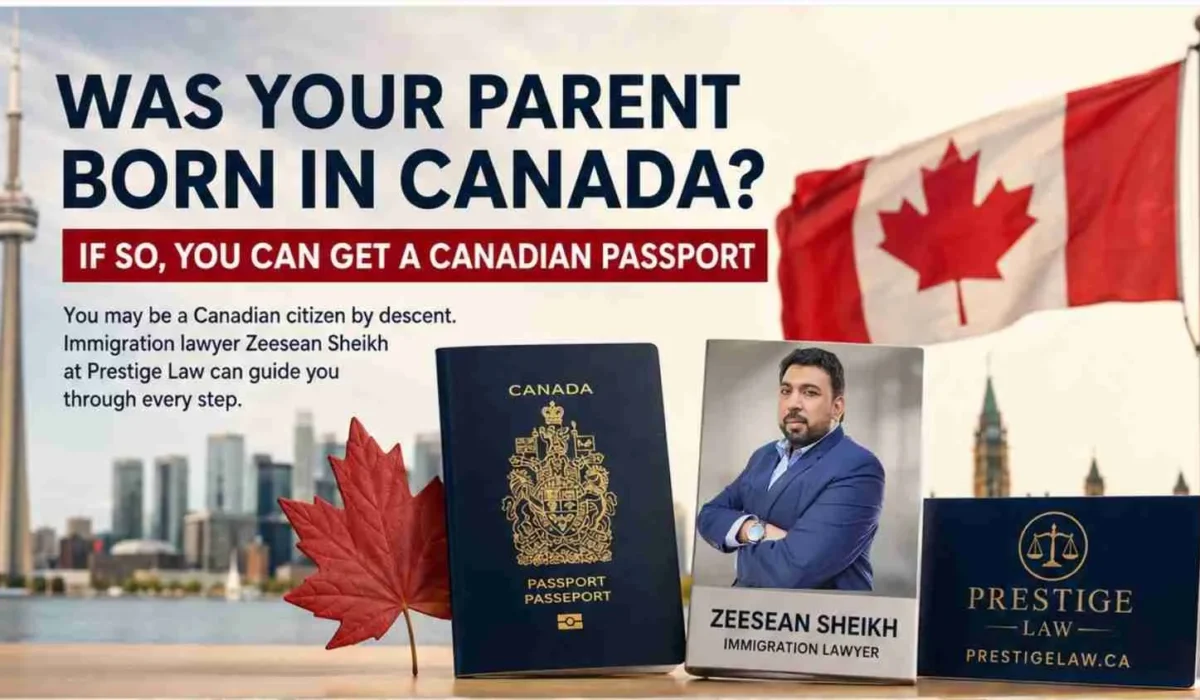
Was Your Parent Born in Canada? If So, You Can Get a Canadian Passport
Introduction: Your Canadian Identity May Already Be Waiting for You
Many people around the world do not realise that Canadian citizenship — and a Canadian passport — may already be within their legal reach. If one or both of your parents were born in Canada, you could be a Canadian citizen by descent, regardless of where you were born, where you grew up, or what passport you currently hold.
This is not a loophole. It is not a shortcut. It is a well-established provision under Canadian law — the Citizenship Act of Canada — that recognises the birthright of children born to Canadian citizens, even when those children are born abroad. Thousands of people across the world qualify for Canadian citizenship and simply do not know it yet.
This article is designed to explain — clearly, accurately, and completely — who qualifies for a Canadian passport through a Canadian-born parent, how the application process works, what documents you need, what mistakes to avoid, and how a qualified Canadian immigration lawyer can help you claim what is rightfully yours.
At Prestige Law, immigration lawyer Zeesean Sheikh has helped countless individuals and families navigate the Canadian citizenship and passport process. Whether you are in Canada or abroad, his firm provides expert legal counsel to ensure your application is thorough, accurate, and successful.
What Does “Citizenship by Descent” Mean? Canadian Passport via Canadian-Born Parent
Citizenship by descent refers to Canadian citizenship acquired not by being born on Canadian soil, but by being born to a parent who is a Canadian citizen. Under the Citizenship Act, a child born outside of Canada to at least one Canadian-citizen parent may automatically be a Canadian citizen — provided certain legal conditions are met.
This means:
- You do not need to have ever visited Canada to be a Canadian citizen.
- You do not need to have lived in Canada.
- You do not need to have attended a Canadian school or paid Canadian taxes.
Your citizenship is determined by the citizenship status of your parent at the time of your birth.
This is a powerful and often overlooked legal right. Many people born in countries such as the United Kingdom, the United States, India, Pakistan, Australia, the Philippines, Jamaica, Nigeria, and elsewhere have one or both parents who were born in Canada, and those children (even adult children) may be fully entitled to a Canadian passport.
The Legal Framework: The Canadian Citizenship Act
To understand your eligibility, it is important to understand the law that governs it.
First Generation Limit Rule
Canada’s Citizenship Act, as amended in 2009, introduced what is known as the “first generation limit” on citizenship by descent. This rule was introduced to prevent the indefinite passing of Canadian citizenship across generations without any meaningful connection to Canada.
Under this rule:
- Children born outside Canada to a Canadian citizen parent who was also born in Canada or naturalised = Eligible for citizenship by descent.
- Children born outside Canada to a Canadian citizen parent who was also born outside Canada = Generally not eligible (unless the parent had a strong Canadian connection)
In simple terms, if your parent was born in Canada, you fall into the first generation of Canadians born abroad, which means you are eligible for Canadian citizenship and, consequently, a Canadian passport.
If your parent was also born outside of Canada but was themselves a citizen by descent, then you are in the second generation born abroad, and under current rules, citizenship is not automatically passed to you. There are, however, legal avenues being explored and exceptions worth discussing with a qualified lawyer.
Key Date: April 17, 2009
This date is significant. The first-generation limit was introduced on April 17, 2009, through Bill C-37. If you were born before this date, different rules may apply, and you may have rights under the older version of the Act. If you were born after this date, the post-2009 rules apply to you.
If you are unsure how these rules apply to your situation, immigration lawyer Zeesean Sheikh at Prestige Law can review your specific circumstances and provide a clear, accurate legal opinion.
Are You Eligible? Key Questions to Ask Yourself
Before beginning any application, ask yourself the following questions:
1. Was your parent born in Canada?
If yes, your parent is a Canadian citizen by birth. This is the most straightforward path.
2. Was your parent a Canadian citizen at the time of your birth?
Even if your parent was born in Canada, they may have renounced citizenship or lost it under older laws. This needs to be verified.
3. Were you registered as a Canadian citizen at birth?
Some parents register their children with Canadian consulates at the time of birth. If this were done, you may already be on record as a Canadian citizen.
4. Have you ever applied for Canadian citizenship before?
If not, you will need to apply for a Citizenship Certificate (also known as a Proof of Citizenship) before applying for a passport.
5. Do you hold a criminal record that could affect your eligibility?
Certain criminal convictions can affect citizenship applications. Legal advice is strongly recommended if this applies to you.
Step-by-Step: How to Get Your Canadian Passport Through a Canadian-Born Parent
Step 1: Confirm Your Parents’ Canadian Birth Status
The first step is to confirm that your parent was, in fact, born in Canada. You will need documentary evidence, such as:
- Your parents’ Canadian birth certificate (issued by the province or territory of birth)
- Your parents’ Canadian passport (past or current)
- Canadian baptismal records (in some older cases)
- Immigration records showing your parents’ return to Canada (if they emigrated)
Step 2: Obtain Your Own Birth Certificate
You will need your official birth certificate — issued by the country in which you were born. This document must typically be an original or certified copy, and in some cases, a notarised translation may be required if it is not in English or French.
Step 3: Apply for a Canadian Citizenship Certificate
Before you can apply for a Canadian passport, you must have official proof of your Canadian citizenship. This is done by applying for a Citizenship Certificate through Immigration, Refugees and Citizenship Canada (IRCC).
The application requires:
- Completed application form (CIT 0001)
- Proof of your parents’ Canadian citizenship
- Your birth certificate proving your relationship to your Canadian parent
- A copy of any documents establishing your identity
- Applicable government fees
Processing times vary and can range from several months to over a year, depending on the complexity of your case and current IRCC workloads.
Step 4: Receive Your Citizenship Certificate
Once IRCC approves your application and confirms your citizenship, they will issue a Citizenship Certificate bearing your name. This is your formal proof that you are a Canadian citizen.
Step 5: Apply for Your Canadian Passport
With your Citizenship Certificate in hand, you can now apply for a Canadian passport through Service Canada or the Passport Program. You will need:
- A completed passport application form
- Two passport-sized photos meeting specific Canadian requirements
- Your Citizenship Certificate
- A valid government-issued photo ID
- Payment of passport fees
Standard processing takes approximately 8–10 weeks, though urgent and express options are available in qualifying circumstances.
Why This Matters: The Value of a Canadian Passport
A Canadian passport is consistently ranked among the most powerful travel documents in the world. As of 2025, Canadian passport holders enjoy:
- Visa-free or visa-on-arrival access to over 185 countries, including the United States, the United Kingdom, the European Union (Schengen Area), Japan, Australia, and many more
- Access to Canadian consular assistance abroad in the event of an emergency
- The right to live and work in Canada without any immigration requirements
- Access to Canadian social services, including healthcare and education
- The ability to sponsor family members for permanent residency in Canada
- Protection under the Canadian Charter of Rights and Freedoms
For individuals who were born in countries with more restrictive travel documents or unstable political environments, obtaining a Canadian passport can be genuinely life-changing — opening doors to travel, business, education, and security that were previously inaccessible.
Common Mistakes to Avoid When Applying
The Canadian citizenship and passport process involves strict documentation requirements. Even minor errors can cause delays of months or, in some cases, result in a refusal. Here are the most common mistakes applicants make:
Mistake 1: Not Verifying the Parent’s Citizenship Status First
Many people assume their parents are Canadian citizens because they were born in Canada, but they never verify it formally. Your parent may have dual citizenship, or there may be records that need to be obtained from provincial vital statistics offices. Always confirm before applying.
Mistake 2: Submitting Incomplete or Incorrect Forms
IRCC forms are highly detailed and leave little room for error. Missing fields, incorrect dates, or inconsistencies between documents can lead to processing delays or application returns.
Mistake 3: Using Poor-Quality Photos
Passport photo requirements in Canada are very specific. Non-compliant photos are one of the most common reasons for application rejections.
Mistake 4: Not Providing Certified Translations
If any of your supporting documents are not in English or French, you must provide certified translations. Failure to do so will result in your application being returned.
Mistake 5: Misunderstanding the First Generation Rule
Some applicants mistakenly apply under citizenship by descent when they do not qualify (for example, because their parent was also born outside Canada). This results in wasted time and fees. A proper legal assessment is essential before applying.
Mistake 6: Ignoring Previous Citizenship Applications
If you or a parent has ever applied for Canadian citizenship or been involved in an immigration matter in Canada, this must be disclosed. Omission — even unintentional — can have serious consequences.
Special Situations and Complex Cases
What If My Parent Emigrated from Canada as a Child?
This is more common than many people think. A parent who was born in Canada may have moved abroad as a young child and spent most of their life outside Canada. This does not affect their Canadian citizenship status, and it does not affect your eligibility, as long as they were a Canadian citizen at the time of your birth.
What If My Parent Is Deceased?
It is still possible to apply for a Canadian Citizenship Certificate if your Canadian-born parent is deceased. You will need to provide documentation such as a death certificate, historical records, and supporting evidence of the parent-child relationship.
What If My Parents Were Not Married?
Canadian law recognises citizenship by descent for children born outside of wedlock, provided the relationship to the Canadian-citizen parent can be established through official documentation.
What if I were adopted?
The rules for adopted children are slightly different. In some circumstances, an international adoptee may qualify for citizenship, but the specific legal pathway depends on when and how the adoption was completed. Immigration lawyer Zeesean Sheikh can advise on the applicable rules in your case.
What If I Am Already a Citizen of Another Country?
Canada generally permits dual citizenship. Obtaining a Canadian passport does not require you to renounce your existing citizenship — though you should verify the laws of your other country of citizenship, as some nations do not permit dual nationality.
Why Work With an Immigration Lawyer?
While it is technically possible to apply for a Citizenship Certificate and passport on your own, many applicants find the process confusing, time-consuming, and fraught with potential errors. The benefits of working with a qualified immigration lawyer include:
- Accurate eligibility assessment before you invest time and money in an application
- Expert guidance on which documents to gather and how to present them
- Professional preparation of application forms to minimise errors
- Legal representation if IRCC requests additional information or raises concerns
- Efficient handling of complex or unusual cases, including deceased parents, adoptions, or prior immigration history
- Peace of mind knowing your application is in qualified, experienced hands
About Zeesean Sheikh and Prestige Law
Zeesean Sheikh is a seasoned Canadian immigration lawyer based in Ontario, with offices in both Richmond Hill and Toronto. Through his firm Prestige Law, he has built a reputation for providing clear, knowledgeable, and compassionate legal services to clients navigating the complexities of Canadian immigration and citizenship law.
Mr Sheikh understands that citizenship applications are not just legal transactions — they are deeply personal milestones that can shape an individual’s and family’s entire future. He takes a thorough, client-first approach to every case, ensuring that each applicant fully understands their rights, their options, and the steps required to achieve their goal.
Whether you are applying for a Canadian citizenship certificate for the first time, seeking a Canadian passport through a Canadian-born parent, or dealing with a complex multi-generational citizenship question, Prestige Law is equipped to help.
Contact Prestige Law
📍 Richmond Hill: 100–100 Mural Street, ON 📍 Toronto: 55 Town Centre Court, Suite 700, ON 📞 Telephone: +1 (647) 925-2222 🌐 Website: prestigelaw.ca
Frequently Asked Questions (FAQs)
Q1: Can I get a Canadian passport if my mother or father was born in Canada?
Yes. If either of your parents was born in Canada and held Canadian citizenship at the time of your birth, you may be eligible for Canadian citizenship by descent. You would first need to apply for a Citizenship Certificate through IRCC, and then apply for a Canadian passport.
Q2: Does it matter which province or territory in Canada my parent was born in?
No. Canadian citizenship applies equally across all provinces and territories. Whether your parent was born in Ontario, British Columbia, Quebec, Alberta, or any other province, your eligibility for citizenship by descent is the same.
Q3: I was born in another country. Can I still apply for a Canadian passport?
Yes. Being born outside of Canada does not disqualify you from Canadian citizenship if you qualify by descent through a Canadian-born parent. Many Canadians live abroad and hold Canadian passports.
Q4: What if my parent was born in Canada, but I don’t have their birth certificate?
You can request a birth certificate from the provincial or territorial vital statistics office where your parent was born. In some cases, other documents (such as baptismal records, census records, or school records) may serve as supporting evidence. An immigration lawyer can advise on acceptable alternatives.
Q5: How long does it take to get a Canadian Citizenship Certificate?
Processing times vary but typically range from several months to over a year, depending on the complexity of your case and IRCC’s current workload. Urgent requests may be available in exceptional circumstances.
Q6: Can I hold dual citizenship — Canadian and my current citizenship?
In most cases, yes. Canada permits dual (and even multiple) citizenship. However, you should verify whether your country of current citizenship permits this, as some nations require you to renounce foreign citizenship.
Q7: What if my parent is deceased? Can I still apply?
Yes. You can still apply for citizenship by descent even if your Canadian-born parent has passed away. You will need documentation to establish the relationship and your parents’ Canadian birth, such as death certificates, historical records, and notarised documents.
Q8: Is there an age limit for applying for Canadian citizenship by descent?
No. There is no age limit. Whether you are 18 or 70 years old, if you qualify for citizenship by descent, you can apply at any time.
Q9: What is the “first generation limit”, and does it affect me?
The first-generation limit, introduced in 2009, means that Canadian citizenship by descent can generally only be passed to the first generation born abroad. If your parent was born in Canada, you are the first generation born abroad and are eligible. If your parent was themselves born outside Canada (and was a citizen by descent), you are the second generation and may not be eligible automatically. Consult a lawyer to confirm your specific situation.
Q10: How can Prestige Law help me with my Canadian passport application?
Immigration lawyer Zeesean Sheikh at Prestige Law provides a full range of citizenship and passport services, including eligibility assessments, document preparation, application submission, and representation before IRCC. He can help you understand your rights and navigate the process from start to finish.
Do Not Leave Your Canadian Citizenship Behind
If your parent was born in Canada, your Canadian citizenship may already exist — it simply needs to be claimed. A Canadian passport is one of the most powerful travel and identity documents in the world, and the right to hold one may be your legal birthright.
Do not leave it unclaimed because the process seems complicated or because you are unsure where to start. The Canadian government has established clear pathways for citizens by descent to confirm their status and obtain official documentation — including a passport.
The key is to begin with accurate information and professional legal guidance.
Zeesean Sheikh and the team at Prestige Law are ready to help you take that first step. Whether you are applying from Canada or from abroad, his office offers the expertise, experience, and personal attention your case deserves.
Ready to Claim Your Canadian Citizenship?
Contact Prestige Law today to schedule a consultation with immigration lawyer Zeesean Sheikh.
📍 Richmond Hill: 100–100 Mural Street, ON
📍 Toronto: 55 Town Centre Court, Suite 700, ON
📞 Telephone: +1 (647) 925-2222
🌐 Website: prestigelaw.ca