



Maintaining Your Canadian PR Status

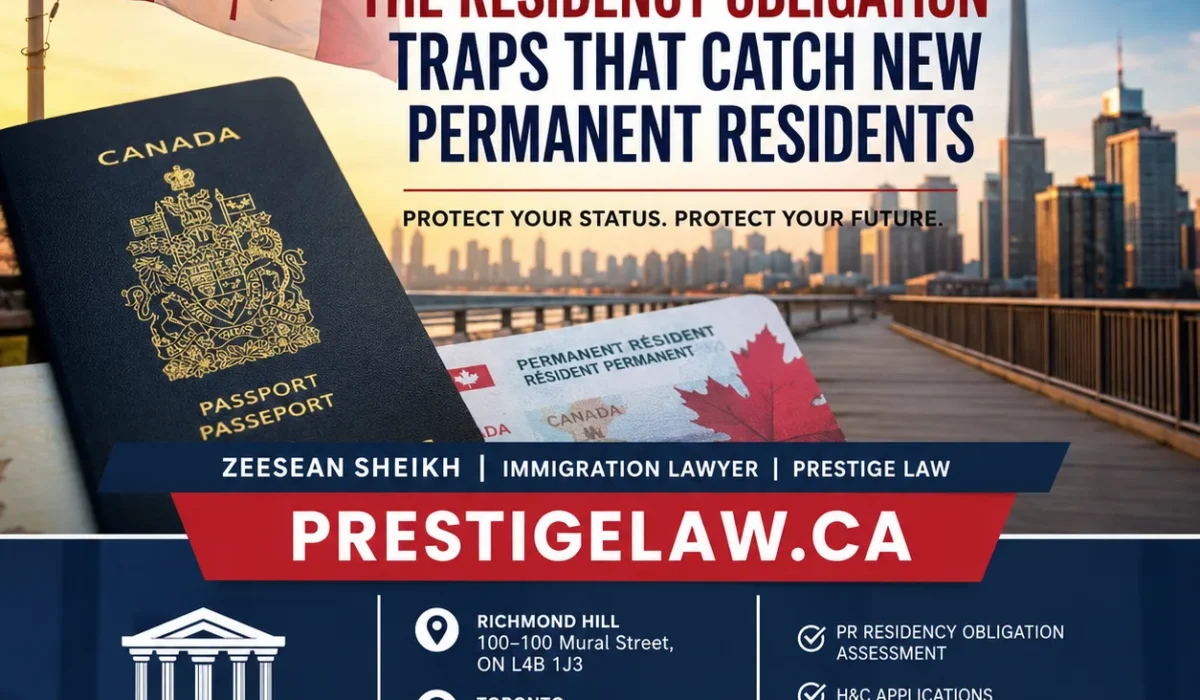
The Residency Obligation Traps That Catch New Permanent Residents
By Zeesean Sheikh | Immigration Lawyer | Prestige Law | prestigelaw.ca
Becoming a Canadian permanent resident is a milestone that many people work toward for years — sometimes decades. It represents safety, opportunity, stability, and the promise of a future in one of the most welcoming nations in the world. But what many new permanent residents discover, often too late, is that achieving PR status is only the beginning. Keeping it requires an ongoing commitment that is far more complex than most immigration guides acknowledge. The Canadian residency obligation is a legal requirement that catches thousands of permanent residents off guard every year, putting their status — and their future — at serious risk. Whether you are living abroad for work, caring for family overseas, or simply unaware of how the rules are counted, the residency obligation trap is real, and it can cost you everything you worked so hard to gain. This article explains exactly how the residency obligation works, the most common mistakes new permanent residents make, what happens when you fall short, and how an experienced Canadian immigration lawyer can help you protect your status before it is too late. Canadian PR Residency Obligation Traps
What Is the Canadian Residency Obligation?
Under the Immigration and Refugee Protection Act (IRPA), every Canadian permanent resident is required to be physically present in Canada for a minimum of 730 days within any five years. This is known as the residency obligation, and it applies continuously — not just once when you first become a PR.
The 730 days do not need to be consecutive. You can travel, work abroad, or visit family outside Canada, as long as your total physical presence inside Canada over any rolling five-year window meets or exceeds two years. However, the calculation is not always as simple as counting days on a calendar, and this is where many permanent residents fall into traps they did not know existed.
It is also important to understand that the residency obligation applies every time you use your PR card or try to re-enter Canada. If your card is expired and you are outside the country, you will need to apply for a PR Travel Document (PRTD) — and that application triggers a full assessment of your residency compliance. If you cannot demonstrate that you have met the 730-day requirement, your application may be refused, and you may find yourself stranded abroad with no legal way to return as a permanent resident.
How the 730-Day Rule Is Calculated — and Why It Confuses So Many People
The most misunderstood aspect of the residency obligation is how the five-year window works. Many permanent residents assume that the five years begin on the date they received their PR status and end exactly five years later. In reality, the five-year window is rolling, meaning it is calculated backwards from whatever date IRBA officers are reviewing your case.
This means that if a border officer or visa officer is assessing your residency compliance on the day you apply to renew your PR card, they will count backwards exactly five years from that date and calculate your physical presence within that specific window. If you were mostly out of Canada during that period — even if you were present for long stretches before or after — you may fall short of 730 days.
Here is a practical example. Imagine a permanent resident who arrived in Canada in 2018, lived here full-time for three years, then moved abroad for work in 2021 and returned in early 2024. When they apply to renew their PR card in 2024, the officer counts back five years to 2019. If the majority of their absence was between 2021 and 2024, they may not have 730 days of Canadian presence within that specific 2019–2024 window — even though they spent years here before.
This rolling calculation is one of the most common residency obligation traps that catches otherwise responsible permanent residents completely off guard.
The Six Most Common Residency Obligation Traps
1. Extended Work Assignments Outside Canada
Many permanent residents accept overseas employment contracts without realising the impact on their PR status. International assignments that last 12 months or more can quickly erode your 730-day count, especially if they coincide with a five-year assessment window that is particularly heavy on absences.
The exception here — that time spent abroad working for a Canadian business or the federal or provincial government can count toward your residency obligation — is frequently misunderstood. This exception requires the employer to be a Canadian company (not simply a foreign subsidiary), and the work must be directly tied to that Canadian operation. Many permanent residents assume the exception applies when it does not, leading to significant residency shortfalls.
2. Caring for Elderly or Ill Family Members Abroad
Life does not pause because of immigration obligations. Many permanent residents find themselves spending months or even years caring for a sick parent, a spouse, or a child in their country of origin. While this is an entirely understandable human situation, IRCC treats absences for family caregiving the same as any other absence — they count against your 730-day requirement unless a specific accompanying exception applies.
The exception that allows time abroad to count is when the permanent resident is accompanying a Canadian citizen spouse, common-law partner, or parent. But this exception is strict. The accompanying person must hold Canadian citizenship — not just another PR — and the relationship must be clearly documented. Many applicants discover these requirements only after they have already missed the threshold.
3. Believing the PR Card Renewal Itself Proves Compliance
A renewed PR card does not guarantee that your residency obligation is satisfied. IRCC can issue a renewed PR card and still subsequently determine that you are non-compliant with the residency obligation if questions arise later — for example, at a port of entry or when you apply for citizenship. Many permanent residents interpret receiving a new card as official confirmation that everything is in order, only to face scrutiny at a future date.
4. Misunderstanding What Counts as a Day in Canada
A “day” in Canada for residency obligation purposes means a calendar day during which the permanent resident was physically present in Canada. Partial days — for example, arriving in Canada late at night or leaving early in the morning — can still count as a full day, but only if you were actually physically on Canadian soil during that calendar day. Stopovers at Canadian airports that do not involve clearing customs do not count.
Additionally, time spent on a work permit before becoming a permanent resident does not count toward the 730-day PR residency obligation. Only time spent after the date your PR status was granted is included.
5. Failing to Keep Travel Records
CBSA (Canada Border Services Agency) keeps records of entries into Canada, but not always exits. This means that when officers are assessing your residency compliance, they may rely on incomplete records — and you may be asked to prove your presence in Canada through your own documentation.
Permanent residents who do not keep organised travel records — including passport stamps, boarding passes, hotel receipts, bank statements showing Canadian transactions, and employment records — often struggle to demonstrate their actual presence in Canada when it matters most.
6. Assuming Humanitarian Grounds Will Automatically Protect You
When a permanent resident cannot meet the 730-day requirement, they may apply on humanitarian and compassionate (H&C) grounds to retain their status despite being non-compliant. While H&C consideration is built into the IRPA framework and officers are legally required to consider it, approval is far from guaranteed. Officers weigh the best interests of any children involved, the hardship of losing status, the degree of establishment in Canada, and many other factors. Without strong legal representation and well-prepared documentation, H&C applications are frequently refused.
What Happens When You Fall Short of the Residency Obligation?
If IRCC determines that you have not met the 730-day requirement, the consequences can be severe.
At a Port of Entry: A border officer who believes you may be non-compliant can write a report and refer you to an admissibility hearing before the Immigration Division. If the Immigration Division finds you non-compliant, they may issue a departure order, which — if not appealed within the required timeframe — can become a deportation order.
Outside Canada: If you are outside Canada with an expired PR card and apply for a Permanent Resident Travel Document (PRTD), a visa officer abroad will assess your residency compliance. If they determine you are non-compliant and there are insufficient H&C grounds, they will refuse your PRTD application and issue a departure order. You will effectively lose your PR status and may be unable to return to Canada as a permanent resident.
PR Card Renewal: While IRCC does not routinely require proof of 730-day compliance for PR card renewals, providing false information on a renewal application — or triggering a review — can initiate a compliance investigation.
In all of these scenarios, the right to appeal to the Immigration Appeal Division (IAD) exists, but it must be exercised within strict deadlines and requires compelling evidence and skilled advocacy to succeed.
The Residency Obligation and Your Path to Citizenship
The residency obligation for permanent residents is separate from — and often confused with — the physical presence requirement for Canadian citizenship. To apply for citizenship, you must have been physically present in Canada for at least 1,095 days (three years) out of the five years before your application. The calculation for citizenship is also different: each day spent in Canada as a temporary resident or protected person before becoming a PR counts as a half-day (up to a maximum of 365 days).
If you have been struggling to maintain your residency obligation as a PR, you will likely also face challenges meeting the citizenship requirement. Addressing your residency compliance proactively is therefore not just about protecting your PR status — it is about preserving your long-term path to Canadian citizenship and the rights that come with it.
Protecting Your PR Status: What You Should Do Right Now
Whether you are a new permanent resident planning your first trip abroad, a long-term PR who has spent significant time outside Canada, or someone who has received a compliance notice from IRCC, there are concrete steps you should take immediately.
Calculate your current residency days. Do not wait for IRCC to raise the issue. Count the days you have spent in Canada within the past five years using a reliable calendar tool, and compare that number to 730. If you are close to or below the threshold, seek legal advice immediately.
Gather and organise your travel records. Collect all passports, boarding passes, entry and exit stamps, employment letters, lease agreements, tax returns filed in Canada, and any other documentation that establishes your physical presence in Canada over the past five years.
Understand the exceptions that may apply to you. If you have spent time abroad working for a Canadian business, or accompanying a Canadian citizen family member, these periods may count toward your 730-day requirement — but only if they are properly documented and legally applicable to your situation.
Do not rely on online calculators alone. While IRCC provides online tools to estimate your residency compliance, these tools do not account for the nuances of your individual situation, including applicable exceptions, humanitarian factors, or how a particular officer is likely to assess your case.
Speak with a qualified Canadian immigration lawyer before you travel. If you are planning an extended stay outside Canada, get legal advice first. A lawyer can assess your current residency count, advise you on the risks, and help you plan your travel in a way that protects your PR status.
How Prestige Law Helps Permanent Residents Protect Their Status
At Prestige Law, immigration lawyer Zeesean Sheikh works directly with permanent residents across Canada and internationally to assess residency obligation compliance, develop legal strategies to protect PR status, and represent clients before the Immigration Appeal Division when necessary.
Zeesean Sheikh has extensive experience navigating the complex intersection of international work, family obligations, and Canadian immigration law. He understands that life does not always conform to immigration requirements — and that with the right legal guidance, many permanent residents who believe they have lost their status can still find a path forward.
Whether you need a thorough residency obligation assessment, assistance preparing a humanitarian and compassionate application, representation at a PRTD refusal hearing, or guidance on how to rebuild your Canadian presence before a compliance issue arises, Prestige Law provides clear, practical, and strategic legal advice tailored to your specific circumstances.
Prestige Law is not just an immigration firm — it is your partner in protecting the life you have built in Canada.
Contact Prestige Law Today
If you are concerned about your Canadian permanent resident status, do not wait until a border officer, a PRTD refusal, or an admissibility hearing forces the issue. Early legal intervention is almost always more effective — and less costly — than emergency representation at the last minute.
📍 Richmond Hill: 100–100 Mural Street, Richmond Hill, ON 📍 Toronto: 55 Town Centre Court, Suite 700, Toronto, ON 📞 Telephone: +1 (647) 925-2222 🌐 Website: prestigelaw.ca
Zeesean Sheikh — Immigration Lawyer | Prestige Law. Serving permanent residents across Canada and internationally.
Frequently Asked Questions About the Canadian Residency Obligation
Q1: What happens if I have not met the 730-day residency requirement?
If you have not met the 730-day requirement within five years, you may be found non-compliant with the residency obligation. Depending on where and how this is discovered — at a port of entry, during a PRTD application abroad, or during another immigration proceeding — a departure order may be issued. You have the right to appeal to the Immigration Appeal Division, where H&C factors will be considered. Speaking with an immigration lawyer as early as possible is strongly recommended.
Q2: Can time spent working abroad count toward my residency obligation?
Yes, under specific conditions. Time spent outside Canada can count if you were employed full-time by a Canadian business or the Canadian federal or provincial government and were assigned to work abroad. The employer must be a genuine Canadian operation, and the work must be directly tied to that Canadian business. Proper documentation, including an employer letter confirming the assignment, is essential.
Q3: Does my PR card renewal confirm that I meet the residency obligation?
Not necessarily. IRCC may issue a PR card renewal without conducting a thorough residency compliance review. Receiving a new PR card does not guarantee that you are in compliance with the 730-day requirement. Compliance can still be assessed at future checkpoints, including at the border and when you apply for citizenship.
Q4: Can I count the time I spent in Canada on a work or study permit toward the 730 days?
No. Only time spent in Canada after your PR status was granted counts toward the residency obligation. Time spent as a temporary resident — on a visitor visa, work permit, or study permit — before you became a permanent resident does not count.
Q5: What is a Permanent Resident Travel Document (PRTD), and when do I need one?
A PRTD is a travel document issued by a Canadian visa office abroad that allows a permanent resident to board a flight to Canada when their PR card has expired. Applying for a PRTD triggers a review of your residency compliance by a visa officer. If you are found non-compliant and H&C factors are insufficient, your application will be refused, and a departure order may be issued.
Q6: What are humanitarian and compassionate (H&C) grounds, and will they save my PR status?
H&C grounds are a legal mechanism within the IRPA that allows officers to exercise positive discretion when a permanent resident cannot meet the residency obligation due to exceptional circumstances. Factors considered include the best interests of any children affected, the degree of hardship if status is lost, establishment in Canada, and family ties. H&C consideration is not automatic protection — it requires a compelling, well-documented case, and is most effectively pursued with the assistance of an experienced immigration lawyer.
Q7: How far in advance should I consult an immigration lawyer about my residency obligation?
Ideally, before you make any significant travel plans that could put you outside Canada for an extended period. If you are already outside Canada and concerned about your PR status, consult a lawyer immediately — before applying for a PRTD or attempting re-entry. Early consultation gives your lawyer the most options to work with.
Q8: Does spending time in Canada as a refugee claimant or protected person count toward the 730 days?
Time spent in Canada as a protected person (recognised refugee) before becoming a permanent resident does not count toward the 730-day PR residency obligation. Only time after your PR status was officially granted is included in the calculation.
Q9: Can I lose my PR status if I stay in Canada but simply do not use my PR card?
The residency obligation is tied to physical presence in Canada, not to the use of your PR card. As long as you are physically present in Canada for 730 days within any five years, you are complying with the obligation — regardless of whether you actively use your PR card. However, your PR card is required to board commercial transportation to Canada if you are outside the country, so keeping it valid is practically essential for international travel.
Q10: Is it possible to regain PR status after it has been lost?
Once PR status is formally lost — following an unchallenged departure order or a dismissed appeal — it cannot be reinstated automatically. You would generally need to apply for permanent residence again from scratch, starting a new immigration process. This underscores why it is so important to address residency compliance issues before they reach the point of a formal status loss.
When Should You Be Most Alert About Your Residency Obligation?
There are specific moments in a permanent resident’s life when the residency obligation becomes particularly critical, and when having qualified legal guidance can make the difference between keeping your status and losing it entirely.
Before Applying for PR Card Renewal
Your PR card is typically valid for five years. When you apply to renew it, IRCC will process your application — and while they do not always conduct a granular review of your travel history, submitting a renewal application while non-compliant is risky. If IRCC flags concerns, or if the information you provide raises questions, you may be asked to provide detailed documentation of your travels. Preparing in advance and verifying your compliance status before applying is a prudent step.
Before and After Extended International Travel
Any planned absence from Canada lasting more than a few months should trigger a residency obligation review. Before you leave, calculate how the proposed trip will affect your five-year rolling count. If the trip would push you close to or below 730 days, you need to factor that in — or reconsider the length of your absence. After returning from an extended trip, it is equally important to update your calculations so you know exactly where you stand before your next departure.
When Your Circumstances Abroad Change Unexpectedly
Life is unpredictable. What begins as a planned three-month visit to care for a family member can stretch into a two-year stay due to a health crisis, financial hardship, or circumstances beyond your control. When this happens, many permanent residents are reluctant to contact an immigration lawyer because they fear the news will be bad. In reality, the sooner you seek legal advice, the more options you have. Lawyers can help you document H&C factors in real time, gather evidence while it is still fresh, and develop a strategy for protecting your status even in difficult circumstances.
When You Are Applying for Canadian Citizenship
The citizenship application process involves a thorough review of your physical presence in Canada — and any discrepancies or concerns about your residency obligation as a PR can surface during that process. If IRCC discovers during your citizenship application that you were non-compliant with your PR residency obligation during the relevant period, it can trigger a separate admissibility concern that jeopardises both your citizenship application and your PR status simultaneously.
If You Have Received Any Communication from IRCC About Your Status
Any letter, notice, or inquiry from IRCC or CBSA regarding your residency compliance, your admissibility to Canada, or your PR card application should be treated as urgent. Do not respond without first consulting a qualified immigration lawyer. The responses you provide, and the documentation you submit, can significantly affect the outcome of any subsequent proceedings.
The Immigration Appeal Division: Your Last Line of Defence
If a departure order has been issued against you due to non-compliance with the residency obligation, you have the right to appeal to the Immigration Appeal Division (IAD) of the Immigration and Refugee Board of Canada. The IAD can consider not only whether you technically met the 730-day requirement, but also whether, given all the circumstances of your case, there are sufficient humanitarian and compassionate grounds to allow you to retain your PR status despite the non-compliance.
The IAD appeal process involves filing a Notice of Appeal within 30 days of the departure order being issued (or 60 days if the order was made outside Canada). From there, the case proceeds through pre-hearing conferences, disclosure of evidence, and ultimately a hearing before an IAD member.
At a hearing, the IAD will consider factors such as:
- The reason for the non-compliance and whether it was within your control
- How long you have been a permanent resident and your degree of establishment in Canada
- Whether you have family in Canada who depend on you
- The best interests of any children directly affected
- Your ties to Canada compared to your ties to the country where you spent time
- Whether you have respected other aspects of Canadian immigration law
- Any evidence of rehabilitation or steps taken to restore compliance
Success at the IAD is not guaranteed — but it is absolutely achievable with well-prepared legal representation, compelling documentary evidence, and a clear, honest account of your circumstances. Zeesean Sheikh at Prestige Law has the experience and strategic insight needed to present your case in the strongest possible light before the IAD.

Understanding the Accompanying Spouse or Parent Exception in Detail
One of the most valuable — and most misunderstood — exceptions to the residency obligation is the provision that allows time spent outside Canada to count toward the 730-day requirement when a permanent resident is accompanying their Canadian citizen spouse, common-law partner, or parent.
For this exception to apply, several conditions must be precisely met:
The companion must be a Canadian citizen. A permanent resident who travels abroad with another permanent resident does not qualify for this exception. The accompanying person must hold full Canadian citizenship, not just PR status.
The relationship must be legally recognised. For spouses, the marriage must be legally valid and recognised under Canadian law. For common-law partners, the couple must have cohabited for at least one year in a conjugal relationship, which must be clearly documented. For the parent exception, the permanent resident must be a child accompanying their Canadian citizen parent.
The accompaniment must be genuine. Simply being legally married to a Canadian citizen while living in separate countries does not trigger this exception. The permanent resident must actually be residing with and accompanying the Canadian citizen abroad.
The time must be properly documented. Evidence of joint residence, shared finances, communications records, and any other documentation establishing that the permanent resident and Canadian citizen were genuinely living together abroad is essential when claiming this exception.
Many permanent residents assume they qualify for this exception based on a superficial understanding of the rule. The precise legal requirements mean that many people who believe they are compliant — because they were technically “with” a Canadian citizen — are in fact not protected by this exception. A careful legal review is essential before relying on it.
Key Takeaways
- The residency obligation requires 730 days of physical presence in Canada within any rolling five-year period — not from a fixed start date.
- The five-year window is assessed backwards from the date of review, making it a rolling calculation that can shift continuously.
- Common traps include overseas work assignments, extended family caregiving abroad, misunderstanding the accompanying exceptions, and failing to keep accurate travel records.
- A renewed PR card does not confirm residency compliance.
- Humanitarian and compassionate grounds can preserve PR status in some cases, but success requires strong legal preparation.
- Early legal advice is the most effective way to protect your permanent resident status.
Prestige Law | Immigration Law Firm Zeesean Sheikh — Immigration Lawyer📍 Richmond Hill: 100–100 Mural Street, ON📍 Toronto: 55 Town Centre Court, Suite 700, ON📞 +1 (647) 925-2222🌐 prestigelaw.ca