




Ontario Overhauls OINP Streams, Invitation Criteria Through Immigration Regulations

In a historic regulatory move that marks the single largest restructuring of the Ontario Immigrant Nominee Program (OINP) since the program was first established, the Province of Ontario formally revoked all nine existing OINP immigration streams on May 30, 2026, through an amendment to Ontario Regulation 421/17, while simultaneously introducing sweeping new rules governing how targeted and general invitation draws will be conducted, how employers must register before sponsoring foreign workers, and how the OINP director’s authority has been expanded to shape the future of provincial immigration in Ontario — changes that affect thousands of skilled workers, international graduates, healthcare professionals, entrepreneurs, and job-offer candidates who had been building their pathways to permanent residence under the old system and who must now navigate an entirely new regulatory landscape with no fully confirmed replacement streams yet in place. Ontario OINP Overhaul 2026
By Zeesean Sheikh, Immigration Lawyer | Prestige Law | Published: June 3, 2026
What Just Happened: Ontario’s OINP Reset Explained
On May 30, 2026, Ontario took a dramatic step in reshaping how foreign nationals qualify for a provincial nomination to Canadian permanent residence. Through amendments to Ontario Regulation 421/17 under the Ontario Immigration Act, 2015, the province officially revoked all nine nomination stream categories that had been the backbone of the OINP for years. This is not a minor policy adjustment. Every existing pathway — from the well-known Human Capital Priorities stream to the International Student with a Job Offer stream — has been wiped from the regulation simultaneously.
The regulatory change was the product of a process that began in December 2025, when the OINP launched a formal stakeholder consultation on a two-phase redesign. That consultation closed on January 1, 2026. Following a review of feedback, Ontario passed enabling legislation under the Working for Workers Seven Act, 2025, and formally introduced the regulatory amendment — O. Reg. 47/26 — on March 16, 2026, setting May 30 as the hard effective date.
For candidates who were actively managing their OINP profiles, waiting for invitations, or preparing applications, this development raises urgent and complex legal questions. At Prestige Law, we are monitoring every development in real time and providing clear, actionable guidance to affected clients across Ontario.
The Nine OINP Streams That Were Revoked on May 30, 2026
The following nomination categories were formally removed from Ontario’s immigration regulation as of May 30, 2026:
- Foreign Worker Category
- International Student with a Job Offer Category
- In-Demand Skills Category
- Master’s Graduate Category
- Ph.D. Graduate Category
- Human Capital Priorities Category
- French-Speaking Skilled Worker Category
- Skilled Trades Category
- Entrepreneur Category
Each of these streams had its own distinct eligibility criteria, draw structures, and processing timelines. Together, they formed the entire selection architecture of the OINP. Their simultaneous revocation means that anyone who has not yet received a formal Invitation to Apply (ITA) or submitted a complete application cannot access these pathways any longer, regardless of how well they previously scored in the Expression of Interest (EOI) pool.
This is significant: Ontario has not confirmed whether existing EOI profiles will carry over to any future streams, whether candidates will need to re-register, or whether profiles will be withdrawn entirely — echoing a similar process that occurred in July 2025 during the Employer Portal transition.
Two Major Regulatory Changes Now in Effect
1. Targeted Draws: Expanded Authority for the OINP Director
The amended regulation formally authorises the OINP director to conduct both general and targeted invitation draws across all future OINP streams. Under the previous structure, the OINP largely operated general draws — every candidate in the pool was ranked by overall score, and the top-scoring applicants received ITAs.
Under the new framework, the OINP director has the power to define specific labour market or human capital attributes for a given draw. Candidates who do not meet those attributes will not be ranked in that draw. Only the highest-ranking candidates who meet the targeted criteria will receive an invitation to apply.
This is a fundamental philosophical shift. The province is moving away from a broad, points-only ranking system toward a targeted, labour-market-responsive model where each draw can be customised to serve Ontario’s most pressing workforce needs. Ontario already previewed this approach in early 2026 with targeted healthcare draws and skilled trades draws, signalling how the new system will function in practice.
2. Employer Verification: Formal Codification of Job Offer Requirements
The second major operational change formally codifies the employer verification requirement into Ontario’s immigration regulations. Under the new rules, any candidate applying through a category that requires an Ontario job offer cannot submit an application unless their employer is officially registered with the OINP director. Employers must complete registration and provide a qualifying job offer before the candidate can proceed.
This was already functioning in practice following the July 2025 launch of the OINP Employer Portal, but it was an operational reality rather than a binding regulatory requirement. It is now formally embedded in the regulation, making it a legal prerequisite — not merely an administrative step — for job-offer-based nomination pathways.
For employers, this means proactive registration is essential. For candidates, it means that without a registered employer, no job-offer-based application can move forward, regardless of how strong the candidate’s profile may be.
What Comes Next: The Proposed Replacement Streams
Ontario has not yet officially launched any replacement streams or published confirmed eligibility criteria. However, based on the December 2025 stakeholder consultation, the following two-phase redesign has been proposed and is expected to guide the new OINP framework:
Phase One: Consolidated Employer Job Offer Stream
The first phase proposes merging the three existing employer-driven streams — the Foreign Worker, International Student with a Job Offer, and In-Demand Skills categories — into a single, unified Employer Job Offer (EJO) stream. This stream would operate under two distinct tracks:
- TEER 0 to 3 Track (Skilled): Designed for higher-skilled occupations falling within National Occupational Classification TEER levels 0 through 3. This track would target management roles, professional positions, and technical occupations with stronger educational and experience requirements.
- TEER 4 to 5 Track (Essential Workers): Designed for semi-skilled and essential service roles in TEER levels 4 and 5. This acknowledges that Ontario’s labour shortages extend beyond high-skill sectors and that workers in food service, transportation, personal care, and retail industries are also critical to the province’s economic functioning.
Final eligibility rules, minimum requirements, and point structures for this stream have not been published as of June 2026.
Phase Two: Three New Strategic Streams
The second phase proposes replacing the remaining OINP streams — the graduate, human capital, and French-language pathways — with three new, purpose-built categories:
- Priority Healthcare Stream: A direct nomination pathway for regulated healthcare professionals who hold valid registration with their respective Ontario regulatory body, potentially without requiring a job offer. Ontario previewed this approach on February 2, 2026, when it issued targeted invitations to 129 physician candidates under specific NOC codes. The proposed full stream would extend to nurses, laboratory technologists, therapists, and other regulated health professions facing acute shortages.
- Entrepreneur Stream: A redesigned pathway for business investors and entrepreneurs, intended to support business succession, regional economic growth, and job creation — particularly in smaller Ontario communities. Previous entrepreneur streams under the OINP required significant personal net worth and investment commitments; the new proposal is expected to maintain a rigorous financial threshold while expanding accessibility to regional business applicants.
- Exceptional Talent Stream: A qualitative, non-points-based pathway for individuals in academia, innovation, science, technology, and the creative industries who have achieved international recognition in their fields. Eligible accomplishments may include significant academic publications, prestigious international awards, patented innovations, or notable artistic works with wide recognition. This stream represents a sharp departure from traditional immigration point systems and signals Ontario’s intent to compete globally for world-class talent.
These proposed streams carry no confirmed launch dates, and Ontario has not yet published final eligibility rules for any of them. Candidates planning their immigration journey must treat these as anticipated — not guaranteed — pathways until official announcements are made.
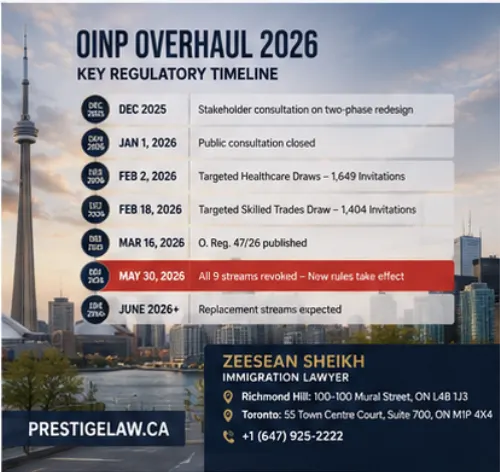
Key Regulatory Timeline: How We Got Here
Date Event
Dec 2025 Ontario launched stakeholder consultation on two-phase OINP redesign.
Jan 1, 2026 Public consultation period closed; Ontario began finalising regulatory amendments.
Feb 2, 2026 OINP issued targeted healthcare draws — 1,649 invitations previewing the new model.
Feb 18, 2026 Targeted Skilled Trades draw issued — 1,404 invitations
Mar 16, 2026 O. Reg. 47/26 formally published; May 30 confirmed as effective date
May 30, 2026 All nine OINP streams officially revoked; new draw authority and employer verification rules take effect
June 2026+ Replacement streams expected — no confirmed launch dates as of publication
Who Is Affected — and What You Should Do Right Now
Candidates With a Pending Application (ITA Already Received Before May 30)
If you submitted a complete OINP application before May 30, 2026, your file is expected to be assessed under the rules that were in effect at the time of your submission. However, it is critical to note that Ontario’s amended regulation does not contain explicit transitional provisions guaranteeing this. If you are in this category, retaining immigration counsel to monitor your file and respond promptly to any OINP correspondence is strongly recommended.
Candidates in the EOI Pool Without an ITA
Candidates who were building their profiles in the Expression of Interest pool but had not yet received an invitation to apply face the greatest uncertainty. Their previous eligibility under any of the nine revoked streams no longer applies. There is no confirmed mechanism for these profiles to transition to the new streams. Ontario has not announced whether these candidates will need to re-register entirely. The prudent step is to monitor the OINP website actively and consult a licensed immigration lawyer to assess alternative federal or provincial pathways.
Employers Who Sponsor Foreign Workers
Employers who rely on the OINP to recruit and retain skilled foreign workers must now ensure they are registered through the OINP Employer Portal. Registration is not optional — it is a regulatory prerequisite for sponsoring any candidate under a future job-offer-based OINP stream. Employers who have not yet completed registration should do so as soon as possible and work with immigration counsel to understand how the new Employer Job Offer Stream will affect their hiring timelines.
International Graduates (Master’s and PhD.)
The Master’s Graduate and PhD. Graduate streams have been revoked. Graduates who were counting on these pathways as their primary route to permanent residence must now pivot. Under the proposed new framework, graduate-level candidates without a job offer may potentially qualify under the Exceptional Talent stream, but that pathway’s final rules have not been published. Exploring federal Express Entry options — particularly the Federal Skilled Worker Program and the Canadian Experience Class — is an important parallel strategy for international graduates at this time.
Healthcare Professionals
Healthcare professionals are among the most favourably positioned under the proposed new framework. The Priority Healthcare Stream, previewed through the February 2026 physician draws, is expected to provide a direct, employer-independent nomination route for regulated health professionals registered with their Ontario regulatory body. If you are a nurse, therapist, technologist, or physician with valid Ontario registration, this upcoming stream may represent your strongest OINP opportunity yet.

Why This Overhaul Matters for Canada’s Broader Immigration Landscape
Ontario’s OINP reform does not happen in isolation. It reflects a nationwide shift in how Canadian provinces are approaching immigration selection. Across Canada, Provincial Nominee Programs are moving away from passive point-ranking systems toward active, targeted, labour-market-responsive models. Ontario’s overhaul — the most comprehensive in the OINP’s history — accelerates that trend and positions the province to compete more aggressively for the skilled talent it needs.
The new targeted draw authority, in particular, mirrors the federal government’s own moves toward category-based selection in the Express Entry system. By empowering the OINP director to define specific human capital or labour market attributes for each draw, Ontario can effectively run occupation-specific nomination campaigns — rapidly responding to shortages in sectors like healthcare, construction, and technology without waiting for general candidate pools to organically surface the right candidates.
For prospective immigrants, the message is clear: the era of broad-based, points-only immigration pathways is ending. Targeted, sector-specific, and qualitative assessments are becoming the new norm. Navigating this environment successfully requires not just meeting eligibility criteria but understanding how to position your profile strategically — which is precisely where experienced immigration legal counsel makes a decisive difference.
How Prestige Law Can Help You Navigate the OINP Overhaul
The regulatory changes effective May 30, 2026, represent one of the most significant disruptions to Ontario’s immigration system in recent memory. For thousands of candidates and employers, the path forward is genuinely uncertain — and the stakes are high. This is not a situation for guesswork or generic online advice.
At Prestige Law, immigration lawyer Zeesean Sheikh and his team bring deep expertise in Ontario’s provincial immigration system and Canadian federal pathways. We offer personalised legal assessments, proactive profile strategy, and responsive support at every stage of your immigration journey. Whether you need urgent guidance on your pending OINP application, help evaluating alternative federal pathways, or strategic planning for when replacement streams launch, Prestige Law is here to provide clarity and direction.
Our approach is not simply to file paperwork. We take the time to understand your individual circumstances — your education, work history, family situation, and long-term goals — and craft a legal immigration strategy that gives you the best possible chance of success in a rapidly evolving regulatory environment.
Contact Prestige Law — Your Trusted Ontario Immigration Lawyers
If you have questions about how the OINP overhaul affects your specific situation, do not wait. Book a consultation with Prestige Law today.
📍 Richmond Hill: 100–100 Mural Street, ON
📍 Toronto: 55 Town Centre Court, Suite 700, ON
📞 Telephone: +1 (647) 925-2222
🌐 Website: prestigelaw.ca
Frequently Asked Questions (FAQs) About Ontario’s OINP Overhaul
Q: Did Ontario actually close all OINP streams in 2026? A: Yes. On May 30, 2026, the Province of Ontario formally revoked all nine nomination stream categories under Ontario Regulation 421/17. This includes the Foreign Worker, International Student with a Job Offer, In-Demand Skills, Master’s Graduate, PhD. Graduate, Human Capital Priorities, French-Speaking Skilled Worker, Skilled Trades, and Entrepreneur streams. Every existing OINP nomination pathway has been eliminated simultaneously, marking the largest restructuring of the program since its creation.
Q: What are the new OINP streams replacing the old ones? A: Ontario has proposed — but not yet officially launched — four new pathways: a unified Employer Job Offer stream with two TEER-based tracks (Phase 1), and three new streams in Phase 2: Priority Healthcare, Entrepreneur, and Exceptional Talent. As of June 2026, no confirmed eligibility rules or launch dates have been published for any replacement stream. Candidates should monitor the OINP website and consult immigration counsel for real-time updates.
Q: What happens to my OINP Expression of Interest profile after the streams were revoked? A: Ontario has not confirmed what will happen to existing EOI profiles. The province has not announced whether profiles will carry over to new streams, whether candidates need to re-register, or whether profiles will be withdrawn as they were during the July 2025 Employer Portal transition. Until Ontario makes a formal announcement, candidates with active EOI profiles should avoid assuming continuity and consult an immigration lawyer to assess alternative pathways.
Q: I received an ITA before May 30, 2026. Is my application still valid? A: If you received a valid ITA and submitted a complete application before May 30, 2026, your file is generally expected to be assessed under the rules in effect at the time of submission. However, the amended regulation does not include explicit transitional provisions confirming this, which means there is a degree of legal uncertainty. It is strongly recommended that you work with an immigration lawyer to monitor your file and respond promptly to any OINP requests.
Q: What is the new targeted draw system under the OINP, and how does it work? A: Under the new targeted draw framework, the OINP director has the authority to define specific labour market or human capital attributes for each draw. Candidates who do not possess those attributes will not be ranked in that particular draw. Only the top-ranking candidates who meet the targeted criteria will receive invitations. This replaces the old general draw model where all candidates in the pool were ranked together by overall score. Ontario previewed this system with targeted healthcare and skilled trades draws in early 2026.
Q: Do employers need to register with the OINP to sponsor foreign workers? A: Yes. The amended regulation now formally requires that any employer wishing to support a foreign national’s nomination through a job-offer-based OINP stream must be registered with the OINP director. This is no longer merely an operational process but a binding regulatory prerequisite. Employers must register through the OINP Employer Portal and provide a qualifying job offer before any candidate can submit a nomination application.
Q: Can I still apply to Canada through federal pathways if the OINP streams are revoked? A: Yes. The OINP revocation does not affect federal immigration pathways. Express Entry programs — including the Federal Skilled Worker Program, Federal Skilled Trades Program, and Canadian Experience Class — remain fully operational. Many candidates who were relying on the OINP may find that a federal pathway is their strongest option during the transition period. A licensed immigration lawyer can help you assess your eligibility and identify the best available route to permanent residence.
Q: Is the Priority Healthcare Stream available now for nurses and other healthcare workers? A: The Priority Healthcare Stream has not yet been officially launched with confirmed eligibility rules. However, Ontario provided a preview of this approach on February 2, 2026, when it issued targeted invitations to 129 physician candidates. The proposed stream is expected to cover a broader range of regulated health professionals, including nurses, laboratory technologists, and therapists, who hold valid registration with their Ontario regulatory body. Eligible healthcare professionals should prepare their documentation now so they are ready to apply when the stream is formally announced.
Q: What is the Exceptional Talent Stream and who qualifies? A: The proposed Exceptional Talent Stream is designed for individuals with internationally recognised achievements in academia, research, science, technology, and the creative arts. Unlike traditional immigration streams, this pathway uses a qualitative assessment rather than a points-based formula. Potential qualifying accomplishments include significant peer-reviewed publications, prestigious international awards, patented inventions with commercial impact, or artistic works of wide recognition. This stream has not yet launched; eligibility rules and application requirements remain to be confirmed by Ontario.
Q: How can Prestige Law help me with the OINP overhaul? A: Prestige Law offers personalised immigration legal consultations for individuals and employers navigating the OINP transition. Immigration lawyer Zeesean Sheikh and the Prestige Law team can assess your current OINP status, review your options under federal pathways, advise on employer registration requirements, and build a strategic immigration plan tailored to the evolving regulatory landscape. You can reach Prestige Law at our Richmond Hill or Toronto offices, by telephone, or through our website at prestigelaw.ca.
Related Immigration Topics on Prestige Law
- Express Entry 2026: How to Maximise Your CRS Score After OINP Changes
- Employer Registration with OINP: A Step-by-Step Guide for Ontario Businesses
- Canadian Experience Class vs. Ontario PNP: Which Path Is Right for You?
- LMIA-Exempt Work Permits in Ontario: Options While OINP Streams Are on Hold
- Spousal Open Work Permits: Keeping Your Family Together During Immigration Transitions
📞 +1 (647) 925-2222 | 🌐 prestigelaw.ca 📍 Richmond Hill: 100–100 Mural Street, ON | 📍 Toronto: 55 Town Centre Court, Suite 700, ON