




Start Here to Avoid Information Overload for Your First Month in Toronto as an International Student

Arriving in Toronto as an international student is exciting — and overwhelming. From SIN numbers to study permits, banking to bus routes, your first 30 days will test your patience, your planning, and your paperwork. This guide cuts through the noise. Here is everything you actually need to know, in the order you actually need it, so you can settle in with confidence and stay legally protected from day one.
Why Your First Month in Toronto Sets the Tone for Everything That Follows
Toronto is one of the most diverse cities in the world. It is also one of the most administratively complex places to land as a newcomer. International students face a unique pressure: you are not just a tourist, and you are not yet a permanent resident. You are in a defined legal category — a temporary resident on a study permit. That status comes with rules, deadlines, and responsibilities that most universities only partially explain during orientation week.
The cost of getting things wrong in that first month is real. Missing a document deadline, working more hours than your permit allows, or failing to update your address with Immigration, Refugees and Citizenship Canada (IRCC) can create complications that follow you for years — affecting future work permits, post-graduation applications, and even permanent residency.
This guide was created in partnership with Prestige Law, a Canadian immigration law firm with offices in Toronto and Richmond Hill, to give international students a clear, reliable, and legally sound starting point. Lawyer Zeesean Sheikh and the team at Prestige Law work with newcomers every day. This article reflects the most common questions they receive from students in their first weeks in Canada.
Step 1: Understand Your Immigration Status Before You Unpack Toronto Guide for International Students
Before you worry about finding a grocery store or setting up Wi-Fi, you need to understand exactly what your study permit says — and what it does not say.
What Your Study Permit Actually Means
Your study permit is not a visa. It is a document that authorises you to study at a specific designated learning institution (DLI) in Canada. Your visa (or electronic travel authorisation) is what gets you into the country. Once you are here, your study permit governs what you are allowed to do.
Key things to verify immediately upon arrival:
- Check your expiry date. Most study permits are issued for the length of your program plus 90 days. Confirm this matches your actual program end date.
- Check the DLI number on your permit. It should match your institution. If you transferred schools, your permit may need to be updated.
- Check your work conditions. Most full-time students at eligible institutions can work up to 24 hours per week off-campus during academic sessions and full-time during scheduled breaks — but only if this is explicitly listed as a condition on your permit.
- Check your co-op or practicum conditions. If your program includes mandatory work placements, you may need a separate co-op work permit.
What to Do If Something Is Wrong
Do not wait. Immigration errors do not fix themselves. If your permit has incorrect information — wrong program dates, missing work authorisation, or the wrong school listed — contact an immigration lawyer as soon as possible.
Prestige Law assists international students with urgent permit corrections, status clarifications, and IRCC communications. Do not attempt to resolve complex immigration issues through online forums or unofficial advice.
📍 Toronto Office: 55 Town Centre Court, Suite 700, ON 📍 Richmond Hill Office: 100–100 Mural Street, ON 📞 Telephone: +1 (647) 925-2222 🌐 Website: prestigelaw.ca
Step 2: Get Your Social Insurance Number (SIN) Within the First Two Weeks
Your Social Insurance Number is the key that unlocks nearly everything in Canada — banking, employment, taxes, and government services. As an international student with a valid study permit that includes work authorisation, you are eligible to apply for a SIN.
How to Apply for a SIN
You can apply for a SIN at a Service Canada location. Toronto has multiple locations across the city. You will need:
- Your valid passport
- Your study permit (with work authorisation conditions listed)
- Proof of your Canadian address
Processing is typically same-day at in-person locations. Your SIN is issued as a paper document — store it safely and never share the number unnecessarily.
SIN Starting with 9
International students are usually issued a SIN that begins with the number 9. This is a temporary SIN, valid only as long as your study permit remains valid. If your permit is renewed or extended, you will need to update your SIN expiry accordingly at a Service Canada office.
Step 3: Open a Canadian Bank Account Immediately
Without a Canadian bank account, you cannot receive a direct deposit from an employer, pay rent by e-transfer, or build a credit history. Most major Canadian banks offer student accounts specifically designed for newcomers, often with reduced or waived monthly fees.
Documents You Typically Need
- Passport
- Study permit
- Canadian address (even a temporary one such as a student residence works)
- SIN (helpful but not always required at the point of opening)
Which Banks Are Most International Student-Friendly?
All five major Canadian banks — RBC, TD, Scotiabank, BMO, and CIBC — have newcomer banking programs. Compare monthly fees, ATM access, digital app quality, and student account benefits. Many offer a free period of 12 months for new students.
Consider also opening a credit card with a low limit immediately. Canadian credit history is separate from your home country history, and building it early matters if you plan to apply for a mortgage or a premium card in the future.
Step 4: Register with Your University’s International Student Office
Your institution’s international student services office is one of your most important resources — and one of the most underused. Most students only visit when something goes wrong. The smarter approach is to register, attend orientation sessions, and build a relationship with advisors before any problems arise.
Your international student office can help with:
- Confirming your enrollment status for IRCC purposes
- Issuing enrollment letters needed for banking and government services
- Advising on co-op work permit applications
- Connecting you to on-campus mental health and legal aid resources
- Flagging upcoming permit renewal deadlines
Step 5: Find a Place to Live — With Your Eyes Open
Whether you are in student residence, a private rental, or a shared house, understanding your rights as a tenant in Ontario is essential. Toronto’s rental market is competitive and expensive, and international students are sometimes targeted by predatory landlords who count on newcomers not knowing local housing laws.
Ontario Tenant Rights You Should Know
The Residential Tenancies Act governs most rental agreements in Ontario. As a tenant, you have the right to:
- A written lease in plain language
- Reasonable notice before landlord entry (typically 24 hours)
- A safe and well-maintained unit
- Return of your last month’s rent deposit if you move out according to the lease terms
Rent increases in Ontario are regulated. Landlords cannot increase rent during a lease term, and annual increases are capped by the government’s rent increase guideline.
Red Flags in the Toronto Rental Market
Be cautious of:
- Landlords asking for more than first and last month’s rent upfront
- No written lease offered
- Requests for cash-only payments
- Listings with unusually low rents in central neighbourhoods
If you believe you have been taken advantage of, the Landlord and Tenant Board (LTB) handles disputes. Prestige Law can also advise on tenant rights and legal options if you are in a difficult rental situation.
Step 6: Set Up Health Coverage — Do Not Skip This
Ontario does not automatically cover international students under its provincial health plan (OHIP). You must wait 3 months after establishing residency in Ontario before OHIP coverage begins — and even then, coverage eligibility for students depends on your specific status.
What to Do in the Meantime
Most Canadian universities and colleges automatically enrol international students in a student health and dental plan through the student union. This coverage typically begins the moment your academic year starts. Check with your student association to confirm enrollment and understand what is covered.
For students who are not enrolled in a university plan, or who need supplemental coverage, private health insurance options are available through companies like Guard.me, StudentCare, and others that specialise in international student coverage.
What OHIP Covers (Once You Are Eligible)
OHIP covers most medically necessary services including doctor visits, hospital care, and specialist referrals. It does not cover prescription medication, dental care, vision care, or ambulance fees for most residents. These gaps are why a supplemental plan matters.
Step 7: Learn the Toronto Transit System Before You Need It
The Toronto Transit Commission (TTC) operates Toronto’s subway, buses, and streetcars. The regional network also includes GO Transit (commuter rail and buses) and MiWay, Brampton Transit, York Region Transit, and others depending on where you live.
The Presto Card
The Presto card is a reloadable transit card that works across most transit systems in the Greater Toronto Area. Load it online, at a Presto machine, or at certain retail locations. Using Presto is generally cheaper than paying cash fares.
As a student, you may qualify for a discounted Presto fare — check with your institution whether they have a partnership with the TTC for reduced student fares.
Getting Around Without a Car
Most students live, study, and work without owning a car in Toronto. The city is largely walkable in central areas, and transit connections between major campuses and downtown neighbourhoods are reliable. Apps like Google Maps and Transit provide real-time TTC tracking.
Step 8: Know Your Work Rights — And Do Not Exceed Them
Working illegally or in excess of your permitted hours is one of the most serious mistakes an international student can make in Canada. It is considered a breach of your study permit conditions and can result in your permit being cancelled and future immigration applications being denied.
The Rules as of June 2026
As of the current date, international students enrolled full-time at designated learning institutions are permitted to work up to 24 hours per week off-campus during regular academic sessions. During scheduled breaks (winter holidays, summer, and reading week), you may work full-time.
Important: These rules can change. IRCC has adjusted student work hour limits in recent years. Always verify current rules directly through the IRCC website or with an immigration lawyer before beginning employment.
On-Campus Work
Working on-campus at your own institution is generally not subject to the same hour restrictions as off-campus work, though conditions vary. Verify your specific permit conditions.
Co-op and Practicum Work
If your program requires a co-op placement or practicum, you typically need a co-op work permit in addition to your study permit. Apply well in advance — processing times vary. Prestige Law regularly assists students with co-op permit applications.
Step 9: Stay Legally Protected — Know When to Call an Immigration Lawyer
Most immigration issues that become serious problems started small and were ignored. International students often avoid seeking legal advice because they assume it is expensive, intimidating, or unnecessary. In reality, early legal advice is almost always cheaper and less stressful than dealing with a problem after it has grown.
When You Should Contact Prestige Law
Contact an immigration lawyer if:
- Your study permit has incorrect information or conditions
- You missed a permit renewal deadline
- You received a letter from IRCC about your status
- Your employer is asking you to work more hours than your permit allows
- You want to switch schools or programs and are not sure how it affects your permit
- Your co-op offer requires a work permit you do not yet have
- You plan to apply for a Post-Graduation Work Permit (PGWP) and want to start the process correctly
- You have been accused of violating your permit conditions
- You want to understand your pathway to permanent residency
Zeesean Sheikh and the team at Prestige Law have guided hundreds of international students through exactly these situations. The firm’s approach is practical, transparent, and focused on protecting your long-term immigration status in Canada.
📍 Richmond Hill: 100–100 Mural Street, ON 📍 Toronto: 55 Town Centre Court, Suite 700, ON 📞 Telephone: +1 (647) 925-2222 🌐 Website: prestigelaw.ca
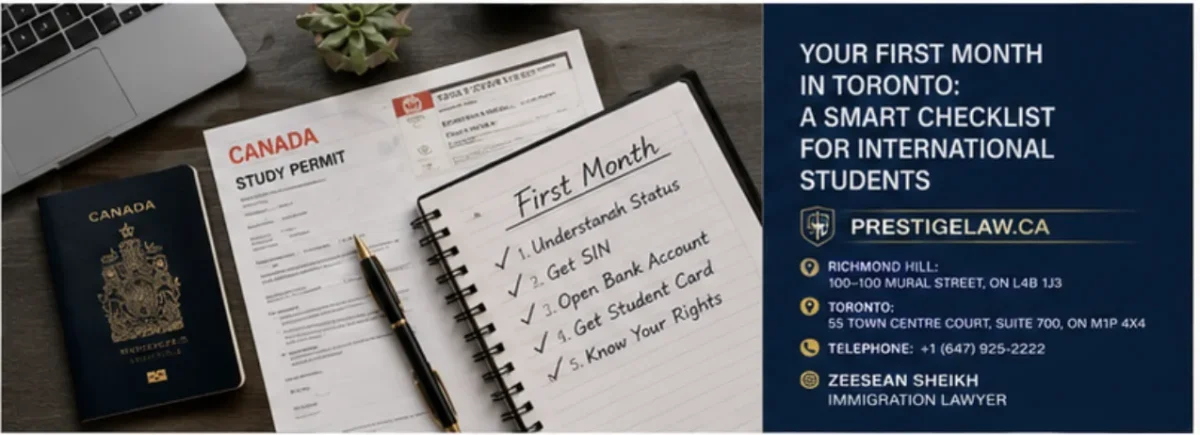
Step 10: Build Your Settlement Checklist — Week by Week
Rather than trying to do everything at once, structure your first month around clear weekly goals.
Week 1 Priorities
- Review your study permit for accuracy
- Apply for your SIN at Service Canada
- Open a Canadian bank account
- Register with your institution’s international student office
- Set up your university email and online student portal
- Confirm your health insurance enrollment
Week 2 Priorities
- Set up your Presto card
- Explore your neighbourhood and locate the nearest pharmacy, grocery store, and walk-in clinic
- Download IRCC’s online portal app and create or log into your account
- Confirm your mailing address with IRCC if you have moved
Week 3 Priorities
- Review your permit expiry date and note it in your calendar with a 4-month advance reminder
- Speak with your international student advisor about co-op permits if applicable
- Research Canadian tax obligations (international students who work in Canada are required to file a tax return)
- Set up a budget based on your actual rent, transit, and grocery costs in Toronto
Week 4 Priorities
- Confirm your employment eligibility with an advisor or lawyer if you plan to work
- Begin building credit by using a Canadian credit card responsibly
- Connect with student community organisations for your home country or region — settlement is easier with community
- Review the PGWP eligibility requirements for your program to understand what you are working toward
Understanding Toronto Neighbourhoods: Where International Students Actually Live
Toronto is a city of distinct neighbourhoods, each with its own character, cost of living, and transit access. Here is a brief orientation for incoming students.
Downtown Core and Surrounding Areas
Areas like the Financial District, Waterfront, and Church-Wellesley are close to major universities but are among the most expensive to rent in. Shared housing is common. Expect to pay a premium for convenience.
Scarborough
Home to the University of Toronto Scarborough campus, Scarborough offers more affordable rents than downtown and a large South Asian and Southeast Asian community, making it one of the most culturally familiar places for many international students. Transit connections to downtown take longer but are manageable.
North York
Near York University’s Keele campus and well-connected by subway, North York offers a balance of affordability and transit access. It is one of the most diverse areas in the city.
Mississauga and Brampton
Just west of Toronto, these cities are home to many international students attending institutions like Sheridan College or the University of Toronto Mississauga. Rents are lower than downtown Toronto, and the communities are large and established.
Canadian Culture: What International Students Often Find Surprising
Understanding Canadian cultural norms reduces social friction and helps you integrate more comfortably.
Directness Is Valued, but Politely
Canadians are generally polite and non-confrontational, but they value clear, direct communication in professional settings. In academic and workplace contexts, asking direct questions and advocating clearly for yourself is expected and respected.
Weather Is Serious Business
If you are arriving from a tropical or warm climate, Toronto winters will require active preparation — not just a jacket. Invest in proper winter boots, thermal layers, and waterproof outerwear before November. Transit shelters help, but walking even a few minutes in January wind chill without proper clothing is genuinely dangerous.
Tipping Culture
Canada has a tipping culture similar to the United States. In sit-down restaurants, a tip of 15 to 20 per cent is standard. Food delivery, hair salons, and rideshare services also typically expect a gratuity.
Canadian Taxes
Sales tax in Ontario is the Harmonised Sales Tax (HST), currently 13 per cent. It is applied to most goods and services and is not always shown in the listed price. Budget accordingly.
Filing Taxes as an International Student in Canada
If you work in Canada, you are required to file a Canadian tax return. This is true even if you only worked for part of the year. Many international students are also entitled to refunds on tax withheld from their pay, as well as education-related credits.
The tax year in Canada runs January 1 to December 31, with returns due by April 30 of the following year. The Canada Revenue Agency (CRA) provides online tools and community tax clinics often run by student associations at no cost.
Keep all T4 slips (issued by your employer) and T2202 forms (tuition tax receipts from your institution) in an organised file. These are essential for filing your return accurately.
Post-Graduation Planning: Think About It Now, Not Later
Your choices during your study period directly affect your post-graduation immigration options. Understanding this early allows you to make smarter decisions throughout your program.
The Post-Graduation Work Permit (PGWP)
The PGWP allows graduates of eligible Canadian programs to work in Canada for up to three years after completing their studies. It is one of the most valuable pathways toward permanent residency. Eligibility depends on:
- The length and type of your program
- Your institution being a designated learning institution
- Maintaining full-time enrollment throughout your studies
- Applying within 180 days of receiving official confirmation of program completion
Maintaining full-time student status throughout your program is critical for PGWP eligibility. Part-time semesters (unless specifically permitted) can affect your application. Discuss your program plan with an immigration lawyer early.
Express Entry and Provincial Nominee Programs
Canada has multiple pathways to permanent residency for graduates with Canadian work experience. The Express Entry system and various Provincial Nominee Programs (PNPs) — including Ontario’s Human Capital Priorities stream and others — are designed to attract talented graduates. Understanding how your program, your work experience, and your language scores interact within these systems is complex and deeply personal. An immigration lawyer can help you develop a realistic roadmap.
Frequently Asked Questions from International Students in Toronto
Can I work 40 hours a week during summer break as an international student?
Yes, if your study permit includes off-campus work authorisation, you may work full-time during officially scheduled academic breaks, including the summer. Confirm the specific break dates with your institution and ensure your permit conditions allow off-campus work.
What happens if my study permit expires before I finish my program?
You must apply to renew your study permit before it expires. If you apply before the expiry date, you are covered by “maintained status” (sometimes called “implied status”) while your application is being processed. However, this only applies if you applied before the expiry — not after. Do not miss the deadline.
Can I change universities or programs without updating my study permit?
Changing your designated learning institution or switching from a full-time to part-time program may require updating your permit. Transferring to a different DLI definitely requires a new or amended permit. Always consult an immigration professional before making changes to your enrollment.
Do I need a separate work permit for a co-op placement?
Yes, in most cases. If your co-op placement is off-campus and part of your program, you need a co-op work permit in addition to your study permit. Apply early — processing times vary and missing a placement start date has real consequences.
What is the difference between a study permit and a student visa?
A student visa (or Temporary Resident Visa) allows you to enter Canada. A study permit authorises you to study at a specific institution in Canada. Some countries’ citizens do not need a TRV and instead require an Electronic Travel Authorisation (eTA). Once you are in Canada, your study permit governs your activities.
Can I apply for permanent residency while I am still a student?
In most cases, students are not eligible for permanent residency through Express Entry until they have Canadian work experience. However, some provincial nominee streams target students in specific programs or regions. Planning your pathway to PR should begin during your studies, not after.
What happens if I work without authorisation or exceed my permitted hours?
Working without authorisation or exceeding your permitted hours constitutes a violation of your study permit conditions. This can result in a permit cancellation, removal from Canada, and a bar on future immigration applications. It is one of the most serious mistakes an international student can make. If you are unsure whether a job offer is within your permit conditions, speak with an immigration lawyer before accepting.
Can Prestige Law help me if I have already made an immigration mistake?
Yes. Prestige Law regularly assists students who have inadvertently violated their permit conditions, missed deadlines, or received compliance letters from IRCC. The sooner you seek legal advice after an issue arises, the more options are available to you. Contact the firm directly to discuss your situation.
Why International Students Choose Prestige Law
Prestige Law is a Canadian immigration law firm led by lawyer Zeesean Sheikh, with offices in Toronto and Richmond Hill. The firm has built a reputation for clear communication, practical legal advice, and a genuine understanding of the challenges facing international students navigating Canada’s immigration system.
Students work with Prestige Law for:
- Study permit applications and renewals
- Co-op and off-campus work permit applications
- PGWP applications and strategy
- Express Entry profile building and submission
- Provincial Nominee Program applications
- Status restoration after permit violations
- Spousal and dependent permit applications
- Permanent residency applications
- Citizenship applications
The firm’s two Greater Toronto Area offices make in-person consultations accessible for students throughout Toronto, Richmond Hill, and surrounding communities.
Contact Prestige Law Today
If you have questions about your study permit, your work authorisation, your PGWP eligibility, or any other immigration matter, reach out to Prestige Law. Your first conversation with the firm can bring clarity to situations that feel overwhelming when you try to navigate them alone.
📍 Richmond Hill: 100–100 Mural Street, ON 📍 Toronto: 55 Town Centre Court, Suite 700, ON 📞 Telephone: +1 (647) 925-2222 🌐 Website: prestigelaw.ca

Your First Month Is a Foundation, Not a Finish Line
Toronto is a city that rewards preparation. International students who arrive knowing their rights, understanding their obligations, and having a clear first-month action plan set themselves up for success not just academically, but legally and professionally.
Your study permit is not just paperwork — it is the foundation of your entire Canadian journey. Protecting it, understanding it, and planning around it from day one is the single most important step you can take.
When questions arise — and they will — the team at Prestige Law is ready to help. Lawyer Zeesean Sheikh and his colleagues understand that immigration questions rarely arise at convenient times, and they are committed to providing international students with clear, professional, and personalised legal guidance they deserve.
Welcome to Toronto. Start here, stay informed, and build something lasting.
This article is intended for general informational purposes only and does not constitute legal advice. For advice specific to your immigration situation, please consult a licensed Canadian immigration lawyer. Prestige Law welcomes inquiries from international students at any stage of their Canadian journey.
© Prestige Law | prestigelaw.ca | Toronto & Richmond Hill, Ontario, Canada