





Thousands of American Felons Have the Right to Enter Canada Without Rehabilitation, Under Canada’s New Citizenship Law
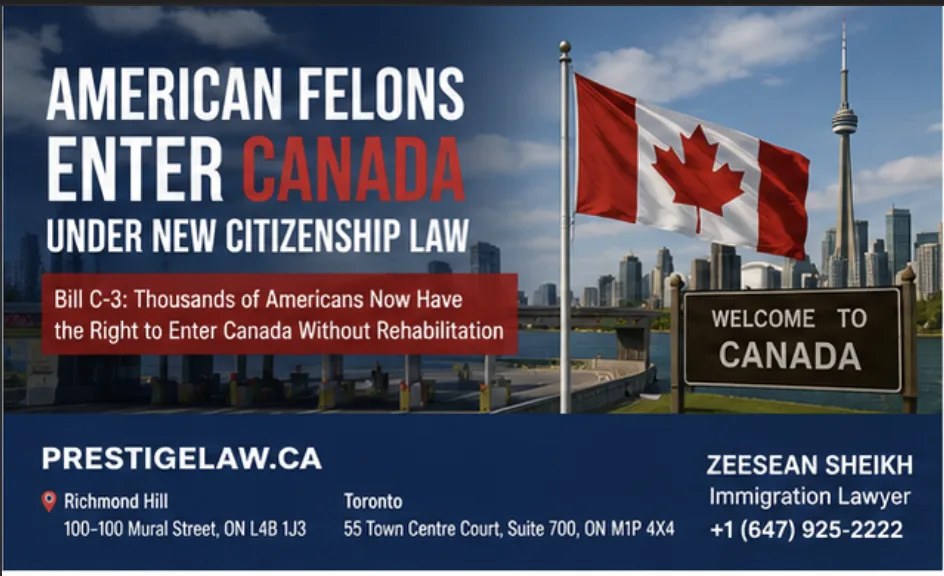
Canada’s landmark citizenship legislation, Bill C-3, has created an extraordinary and largely overlooked legal reality: thousands of Americans with felony convictions now hold an automatic right to enter Canada — with no rehabilitation required, no Temporary Resident Permit needed, and no admissibility hearing standing in their way. American Felon Enter Canada Under Citizenship Law
This is not a loophole. It is the law.
What Is Canada’s New Citizenship Law? Understanding Bill C-3
On November 20, 2025, Bill C-3 — formally titled An Act to Amend the Citizenship Act — received Royal Assent. It came into force on December 15, 2025, fundamentally rewriting how Canada determines citizenship by descent.
Before this law, Canadian citizenship by descent was governed by a rule called the first-generation limit. Under that rule, only the first generation born outside Canada could inherit citizenship from a Canadian-born parent. If your parent was born in Canada and you were born in the United States, you were a Canadian citizen. But if both you and your parent were born outside Canada, you were not — even if your grandparent was born in Montreal, Toronto, or Vancouver.
Bill C-3 erased that limit, retroactively and permanently, for anyone born before December 15, 2025.
The legal basis for this sweeping change was a 2023 constitutional ruling. On December 19, 2023, the Ontario Superior Court of Justice ruled in Bjorkquist et al. v. Attorney General of Canada that the first-generation limit violated the Canadian Charter of Rights and Freedoms. The court found it created two unequal classes of citizens — those born in Canada and those born abroad — and gave them unequal rights to pass citizenship to their children. The Federal Government agreed, setting in motion the legislative process that produced Bill C-3.
The result: Canadian citizenship now flows through an unbroken chain of descent, with no generational cap for births that occurred before the law came into force.
How Many Americans Are Now Eligible for Canadian Citizenship?
The numbers are staggering. Estimates suggest that millions of Americans — potentially tens of millions — have Canadian ancestry that now qualifies them for automatic citizenship under Bill C-3. Whether through a grandparent who emigrated to the United States in the early twentieth century, a great-grandparent from Quebec, or an ancestor who crossed the border generations ago, a single Canadian-born ancestor in a direct line of descent may be all that is required.
A person must prove their lineage through an unbroken documentary chain — birth records, marriage certificates, naturalisation documents — demonstrating that Canadian citizenship passed from one generation to the next without interruption. If that chain is intact, citizenship is not granted. It is recognised. Under Bill C-3, the law treats these individuals not as people acquiring a new status, but as people who were always Canadian citizens, unjustly denied documentation.
This distinction matters enormously when it comes to the criminal inadmissibility framework — and it is precisely where the issue of American felons enters the picture.
Why American Felons Can Now Enter Canada Without Rehabilitation
Under Canada’s Immigration and Refugee Protection Act (IRPA), foreign nationals with criminal records face significant barriers to entering Canada. Serious crimes — violent felonies, drug trafficking offences, crimes that carry a maximum sentence of ten years or more under Canadian law — render a foreign national criminally inadmissible. That inadmissibility can be permanent.
To overcome it, a foreign national generally has two options:
Criminal Rehabilitation: An application demonstrating that at least five years have passed since the completion of all sentencing, and that the individual poses no future risk. It is a formal, document-heavy process with significant processing times and no guarantee of approval.
Temporary Resident Permit (TRP): A short-term, discretionary permit allowing entry for a specific, compelling reason — a business event, a family emergency, a funeral. It does not resolve inadmissibility permanently, and approval is far from automatic.
For a citizen, however, none of this applies.
Under Section 19(1) of IRPA, the Canada Border Services Agency (CBSA) is legally obligated to admit any recognised Canadian citizen. A criminal record — whether it involves a misdemeanour, a DUI, a drug offence, or a violent felony — cannot be used to deny entry to a person who holds valid proof of Canadian citizenship. Their United States criminal history, however serious, becomes legally irrelevant to their right of entry the moment they hold a valid Canadian citizenship certificate.
As citizens, they have the right to enter Canada. They need only satisfy border officials of their identity and their Canadian citizenship. They can never be required to prove rehabilitation. The entire criminal inadmissibility framework that governs foreign nationals simply does not apply to them.
This is not a comfortable fact. But it is an accurate one.
The Scale of the Issue: Thousands of Americans Already in the Process
In the months since Bill C-3 came into force, thousands of Americans have initiated applications for proof of Canadian citizenship. Many are motivated by practical considerations: a backup passport, access to Canadian healthcare and education, or participation in Canada’s International Experience Canada (IEC) youth work permit program, which covers more than thirty-six countries.
Processing times for proof of citizenship applications have increased substantially as a result of the surge in demand. As of mid-2026, IRCC is reporting processing times of approximately twelve months — up from five months in mid-2025. Once a citizenship certificate is obtained, a Canadian passport can be issued within ten to twenty business days.
Among these thousands of applicants are individuals with criminal records in the United States. Some may have felony convictions for serious offences. Under the law as it now stands, their criminal histories present no legal obstacle to their Canadian citizenship applications, and once recognised as citizens, they have an absolute right to enter Canada.
What This Means at the Border American Felon Enter Canada Under Citizenship Law
The practical implications at the border are significant. A person who, until December 15, 2025, would have been flagged at the Canadian border, denied entry, and required to pursue a complex and lengthy rehabilitation application — can now present a valid Canadian citizenship certificate and must be admitted.
CBSA officers retain the ability to ask questions and verify identity and citizenship. What they cannot do is deny entry to a person who is legally recognised as a Canadian citizen based on their foreign criminal record.
The FBI shares its National Crime Information Centre (NCIC) database with the Royal Canadian Mounted Police (RCMP), which in turn passes that data to the CBSA. Under the old framework, this information-sharing arrangement was the mechanism through which Americans with criminal records were routinely flagged at the border. For foreign nationals, that flag triggers the inadmissibility review process. For recognised Canadian citizens, however, the same flag cannot legally result in a denial of entry. CBSA may note the record and ask questions, but the legal outcome is determined by citizenship status, not criminal history.
It is worth emphasising what this does not mean. Canadian citizens who commit crimes in Canada remain subject to Canadian criminal law and may face consequences under that law. Additionally, if a Canadian citizen is convicted of a serious crime in Canada and sentenced to a term of imprisonment of five years or more, the government may pursue revocation of citizenship in exceptional circumstances. But for a recognised Canadian citizen of American descent arriving at the border, their pre-existing United States criminal record — regardless of its severity — does not affect their right to enter the country.
This represents a profound shift in how a meaningful population of Americans will interact with the Canadian border in the years ahead. Immigration and border security practitioners have described it as one of the most significant unintended consequences of a law that was, by all accounts, designed with justice rather than security in mind.
Who Qualifies Under Bill C-3? Key Eligibility Requirements
Not every American with Canadian ancestry automatically qualifies. Understanding the eligibility criteria is essential before pursuing an application.
You must have been born before December 15, 2025. The removal of the generational limit applies only to births before the law came into force. Children born after that date to a Canadian parent who was themselves born outside Canada will need to meet a new “substantial connection” requirement — specifically, that the Canadian parent had accumulated at least 1,095 days of physical presence in Canada.
You must trace an unbroken line of Canadian citizenship descent. The chain of citizenship transmission must be unbroken. Each person in the chain must have held Canadian citizenship at the time the next generation was born. Gaps in the chain — for example, a grandparent who renounced citizenship before your parent was born — break eligibility.
You must provide documentary proof. Bill C-3 does not issue citizenship certificates automatically. Applicants must apply through Immigration, Refugees and Citizenship Canada (IRCC) and submit the documentary evidence establishing their lineage: birth certificates, marriage records, naturalisation documents, and any other records demonstrating the chain of descent.
Your citizenship must be recognised before you travel. The right of entry as a citizen requires recognised Canadian citizenship. Applying for citizenship does not confer the right to enter as a citizen during the processing period.
The Criminal Inadmissibility Gap: A Legal and Policy Analysis
The intersection of Bill C-3 and Canada’s criminal inadmissibility rules creates what legal analysts have described as a structural gap in the immigration and border security framework. The inadmissibility provisions of IRPA were designed for the context of foreign nationals — people who seek to enter Canada as visitors, workers, students, or permanent residents. They were not designed to address Canadian citizens.
Under the citizenship framework, once a person is recognised as a Canadian citizen by descent, they enter a legally protected category that IRPA’s inadmissibility rules cannot reach. The legislature that crafted the criminal inadmissibility provisions did not anticipate a scenario in which millions of people with foreign criminal records would retroactively acquire Canadian citizenship. The provisions governing foreign national inadmissibility and the provisions governing citizenship rights operate in separate legal silos, and Bill C-3 has dramatically expanded the population that falls within the citizenship silo rather than the foreign national silo.
To understand why this matters so profoundly, it is useful to consider what criminal inadmissibility looks like under IRPA for a foreign national. Under section 36 of IRPA, a foreign national is inadmissible on grounds of serious criminality if they have been convicted of an offence that, if committed in Canada, would constitute an indictable offence punishable by a maximum term of imprisonment of at least ten years. This captures a wide range of American felony convictions. Drug trafficking, armed robbery, aggravated assault, sexual offences, and many white-collar crimes all potentially fall within this definition.
For such a foreign national, entering Canada requires either completing the Criminal Rehabilitation process — a waiting period of at least five years from the end of all sentencing, followed by a formal application, extensive documentation, and a discretionary review by IRCC — or obtaining a Temporary Resident Permit. The TRP process is itself uncertain, time-consuming, and available only for compelling specific purposes.
None of this applies to a recognised Canadian citizen. The moment IRCC issues a citizenship certificate to an American with even the most serious felony conviction, that individual’s legal relationship to the border changes completely. They do not need rehabilitation. They do not need a permit. They need only present their citizenship documentation and confirm their identity.
Policy analysts and immigration practitioners have noted that Parliament may need to examine whether additional legislative provisions are warranted to address this intersection. The Standing Committee on Citizenship and Immigration (CIMM) flagged this issue in October 2025 as one of the unresolved tensions within the new citizenship framework. In the meantime, the law as it stands means that citizenship rights — including the inviolable right to enter Canada — take precedence over the criminal inadmissibility framework, and that legal reality is operative now.

How to Apply for Proof of Canadian Citizenship Under Bill C-3
If you believe you may qualify for Canadian citizenship by descent under Bill C-3, the process involves several key steps.
Step 1: Establish your lineage. Work backwards through your family tree to identify the Canadian-born ancestor from whom citizenship descends. Gather all available documentation, including birth certificates, marriage certificates, death certificates, and naturalisation records for each person in the chain.
Step 2: Assess whether the chain is unbroken. Confirm that each person in the chain held Canadian citizenship at the time the next generation was born. A qualified Canadian immigration lawyer can assist in identifying whether any historical event — prior marriage rules, previous citizenship laws, renunciation, or other factors — may have broken the chain.
Step 3: Apply to IRCC for proof of citizenship. Submit a formal application to Immigration, Refugees and Citizenship Canada with all supporting documentation. As of mid-2026, processing times are approximately twelve months.
Step 4: Obtain a Canadian passport. Once you receive your citizenship certificate, you may apply for a Canadian passport. As of mid-2026, processing times are ten to twenty business days, not including mailing.
Given the complexity of multi-generational citizenship claims and the significant consequences of errors or gaps in documentation, consulting with an experienced Canadian immigration lawyer before applying is strongly advisable.
Do You Need a Lawyer to Apply for Canadian Citizenship by Descent?
You are not legally required to retain a lawyer to apply for Canadian citizenship by descent. However, given the complexity of Bill C-3 applications — particularly those involving multiple generations, incomplete historical records, or potential chain-breaking events — professional legal assistance can make a decisive difference.
An experienced Canadian immigration lawyer can:
- Assess whether your specific lineage qualifies under Bill C-3
- Identify historical events that may have broken the citizenship chain
- Advise on documentary requirements and help locate difficult-to-find records
- Prepare a comprehensive, accurate application that minimises the risk of delays or rejections
- Advise on the legal implications of dual citizenship for your U.S. tax obligations and other considerations
For those with criminal records who are considering claiming citizenship and entering Canada, legal advice is especially important. Understanding the precise legal rights and responsibilities of Canadian citizenship — including the rights that protect you at the border and the obligations you take on as a dual citizen — requires qualified guidance.
It is worth noting some of the historical complexities that can make Bill C-3 applications more challenging than they initially appear. Before 1947, Canada did not have a standalone Citizenship Act; individuals in Canada held the status of British subjects. Women who married foreign nationals before 1947 often lost their Canadian status automatically. Prior citizenship rules contained retention requirements that could, in certain circumstances, result in the loss of citizenship. Any of these historical factors, if present in a family’s lineage, could affect the chain of citizenship transmission. An experienced lawyer will examine each of these potential chain-breaking events and assess whether they affect eligibility.
Dual Citizenship: Rights, Responsibilities, and Tax Implications
Claiming Canadian citizenship under Bill C-3 makes an American a dual citizen of the United States and Canada. Dual citizenship carries substantial benefits — including a second passport, the right to live and work in Canada indefinitely, access to Canadian healthcare and publicly funded education, and participation in Canada’s work permit programs spanning more than thirty-six countries through the International Experience Canada program.
However, dual citizenship also brings obligations that require careful consideration.
United States Tax Obligations. The United States is one of only two countries in the world — the other being Eritrea — that taxes its citizens on worldwide income, regardless of where they live or work. Becoming a dual Canadian citizen does not extinguish U.S. tax obligations. Americans living or working in Canada must continue to file U.S. federal tax returns and report worldwide income. They may also be required to file Foreign Bank Account Reports (FBARs) for Canadian financial accounts, and to comply with FATCA reporting requirements.
Canadian Tax Obligations. Canada taxes residents, not citizens. Simply holding Canadian citizenship does not, by itself, create Canadian tax obligations. However, if a dual citizen spends sufficient time in Canada to be considered a Canadian tax resident under the Canada-U.S. Tax Treaty, they may be subject to Canadian income tax, with credit available for taxes paid in the United States.
Travel Document Considerations. A dual citizen who travels to Canada should be aware that Canadian border officers may expect them to enter using their Canadian passport once they are recognised as a Canadian citizen. A person who enters Canada as a visitor on a U.S. passport after having been recognised as a Canadian citizen may encounter complications if their citizenship status is identified at the border.
These are matters where professional advice — both legal and tax — is essential. The intersection of Canadian immigration law, U.S. citizenship law, and cross-border tax obligations is complex, and the consequences of navigating it incorrectly can be significant.
Prestige Law: Canadian Citizenship and Immigration Legal Services
Zeesean Sheikh and the legal team at Prestige Law provide experienced, results-driven Canadian immigration and citizenship law services. With offices in Richmond Hill and Toronto, Prestige Law assists clients across North America — including Americans seeking to claim Canadian citizenship by descent under Bill C-3 — with every stage of the immigration and citizenship process.
Whether you are assessing your eligibility under the new citizenship law, gathering the documentation needed to prove a multi-generational lineage, or navigating the intersection of a criminal record and your rights as a Canadian citizen, Prestige Law provides the informed, professional guidance you need.
Zeesean Sheikh — Immigration Lawyer
📍 Richmond Hill: 100–100 Mural Street, ON 📍 Toronto: 55 Town Centre Court, Suite 700, ON 📞 Telephone: +1 (647) 925-2222 🌐 Website: prestigelaw.ca
Frequently Asked Questions
Can an American felon enter Canada under Bill C-3? Yes — if they are recognised as a Canadian citizen by descent under Bill C-3. Once a person holds valid proof of Canadian citizenship, the Canada Border Services Agency is legally obligated to admit them under Section 19(1) of IRPA. A United States criminal record, including a felony conviction, cannot be used to deny entry to a recognised Canadian citizen.
Does a felony automatically disqualify someone from applying for Canadian citizenship by descent? No. A criminal record in the United States does not affect eligibility for Canadian citizenship by descent. Eligibility is determined solely by the applicant’s lineage. IRCC’s criminal inadmissibility rules apply to permanent residency and visitor applications, not to citizenship by descent applications.
How many generations back can Canadian citizenship by descent extend under Bill C-3? For anyone born before December 15, 2025, there is no generational limit. As long as the chain of citizenship transmission is unbroken, citizenship can pass through as many generations as needed to reach a Canadian-born ancestor.
What documents do I need to prove Canadian citizenship by descent? You will typically need birth certificates for every person in the chain of descent, marriage certificates, death certificates where relevant, and naturalisation records for any ancestor who became a Canadian citizen through naturalisation rather than birth.
What is the current processing time for a Canadian citizenship by descent application? As of mid-2026, IRCC is reporting processing times of approximately twelve months for proof of citizenship applications. Once a certificate is issued, a Canadian passport can typically be obtained within ten to twenty business days.
Do I need a lawyer to apply for Canadian citizenship by descent? You are not legally required to retain a lawyer. However, given the complexity of multi-generational lineage claims and the importance of documentary accuracy, professional legal assistance is strongly recommended — particularly for those with criminal records or incomplete family records.
What is the difference between Criminal Rehabilitation and citizenship rights under Bill C-3? Criminal Rehabilitation is a formal application process allowing foreign nationals to overcome criminal inadmissibility. Citizenship rights under Bill C-3 bypass this framework entirely. Recognised Canadian citizens cannot be subjected to criminal inadmissibility rules; their right to enter Canada is absolute under IRPA Section 19(1).
Will Bill C-3 citizenship protect me if I commit a crime in Canada? No. Canadian criminal law applies equally to all persons in Canada, regardless of citizenship status. Bill C-3 citizenship affects your right of entry and immigration status; it does not provide immunity from Canadian criminal law.
Can my children also claim Canadian citizenship under Bill C-3? If your children were born before December 15, 2025, and you are recognised as a Canadian citizen by descent, your children may also be eligible. If your children were born after December 15, 2025, a new “substantial connection” requirement applies — you must have accumulated at least 1,095 days of physical presence in Canada for citizenship to pass to them automatically.
How does dual U.S.-Canadian citizenship affect my U.S. tax obligations? The United States taxes its citizens on worldwide income regardless of where they live. Holding dual Canadian citizenship does not eliminate U.S. tax obligations. If you become a dual citizen and spend time in Canada, you may need to file returns in both countries and comply with FBAR and FATCA requirements. Consulting a cross-border tax adviser is strongly recommended.

Key Takeaways
Canada’s Bill C-3 has created a significant and largely unexamined intersection between citizenship rights and criminal inadmissibility rules. For Americans with Canadian ancestry — including those with felony convictions — the law provides an automatic right of entry that bypasses the criminal inadmissibility framework entirely.
This reality is the direct result of the law’s underlying logic: the people who qualify under Bill C-3 were always Canadian citizens. The law did not grant them something new; it removed an unconstitutional restriction that had denied them what was always rightfully theirs. In that sense, the criminal inadmissibility gap is not an anomaly in the narrowest sense — it is the natural consequence of restoring rights to a class of citizens who were wrongly denied recognition.
At the same time, it represents a material change in the border security and immigration enforcement landscape that deserves clear, honest acknowledgement. Canadians and the policymakers who represent them are entitled to understand what the law says. Applicants who qualify are entitled to understand the full scope of the rights they hold. And those with criminal records considering Canadian citizenship by descent are entitled to informed legal counsel about what those rights mean in practice.
The law is clear. The rights are real. And for thousands of Americans — including those with serious criminal records — Canada’s new citizenship law has changed everything about how they can engage with the country to the north.
Whether you are exploring your eligibility for Canadian citizenship by descent, assessing the implications of a criminal record, or seeking to understand your rights and obligations as a dual citizen, the experienced legal team at Prestige Law is ready to assist.
Contact Prestige Law today: 📞 +1 (647) 925-2222
🌐 prestigelaw.ca
📍 Richmond Hill: 100–100 Mural Street, ON | Toronto: 55 Town Centre Court, Suite 700, ON