





Canada Plans to Fast-Track Work Permits for AI Professionals

Canada’s federal government has launched one of the most ambitious immigration reforms in the country’s history. Under Prime Minister Mark Carney’s newly unveiled national strategy — AI for All — Canada is committing to process work permits for artificial intelligence professionals in 20 business days or less, a dramatic improvement over the standard two-to-six-month timeline that has historically cost Canadian employers their top international candidates. For globally competitive AI talent, this development changes everything. And for those navigating the immigration pathway, expert legal guidance from a trusted Canadian immigration firm has never been more important.
What Is Canada’s AI for All Strategy?
On June 4, 2026, Prime Minister Mark Carney stood before Canada’s innovation community and announced a strategy that would reshape the country’s position in the global artificial intelligence economy. The strategy, formally titled Canada’s National Artificial Intelligence Strategy: AI for All, is a comprehensive five-year blueprint built on three guiding principles: building trust, creating opportunities, and reinforcing Canadian sovereignty over its data and digital future. Canada Fast-Track Work Permits for AI Professionals
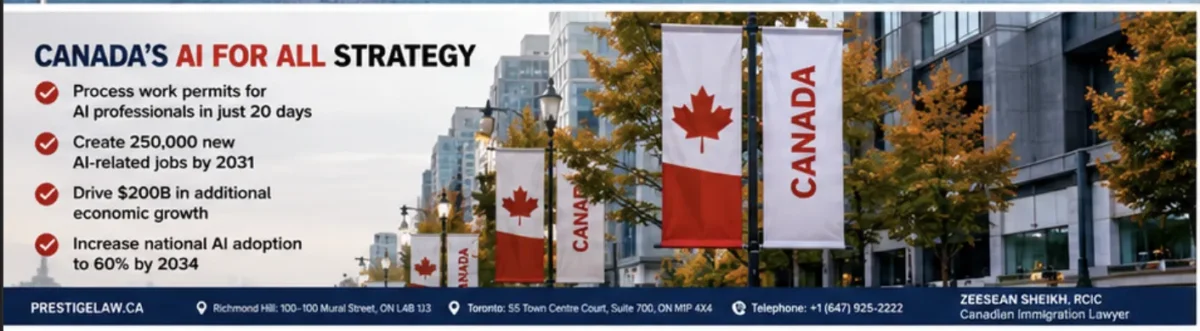
The announcement was notable not only for its scope but for the clarity of its ambition. Canada’s current national AI adoption rate stands at just over 12 per cent. The government’s target is to push that figure to 60 per cent by 2034. To achieve this, Canada needs talent — and lots of it. The AI for All strategy sets out to create 250,000 new AI-related jobs over the next five years and inject an additional $200 billion into the Canadian economy.
For immigration professionals and international tech workers watching from abroad, however, the most consequential element of this announcement is what it means for work permit processing. Canada is building accelerated entry pathways under its existing Global Talent Stream specifically for highly skilled AI professionals — and the processing window being targeted is just 20 business days from start to finish.
Key Numbers at a Glance
Stat What It Means
20 Days Total processing time for AI work permits (LMIA + permit combined)
$200B Targeted additional economic growth from the AI for All strategy
250,000 New AI-related jobs Canada aims to create by 2031
60% Target national AI adoption rate by 2034 (up from 12% today)
12+ Countries Canada has signed AI cooperation agreements with since 2025
Understanding the Global Talent Stream: Canada’s Fast-Track Mechanism
The vehicle through which Canada will fast-track work permits for AI professionals is the Global Talent Stream (GTS), a specialised pathway within the Temporary Foreign Worker Program administered by Employment and Social Development Canada (ESDC) and Immigration, Refugees and Citizenship Canada (IRCC).
The GTS is not new — it has been operating since 2017 and was designed precisely to address the reality that highly skilled technology talent moves quickly and cannot afford to wait months for paperwork. What makes the AI for All announcement significant is the explicit government commitment to expand the GTS specifically to accommodate the surge in AI-sector hiring and to align permanent residency measures so that fast-track workers can ultimately build careers in Canada, not just fill temporary contracts.
How the 20-Day Processing Window Works
Under the expanded GTS pathway for AI professionals, the total 20-business-day target is divided into two sequential phases:
- Phase 1 — Labour Market Impact Assessment (LMIA): The Canadian employer files an expedited LMIA application. This assessment, which confirms that no suitable Canadian citizen or permanent resident is available for the role, is processed within 10 business days under the GTS fast-track.
- Phase 2 — Work Permit Processing: Once a positive LMIA is received, the IRCC targets processing of the actual work permit application within 10 business days.
This combined 20-day window represents a dramatic reduction compared to the standard Temporary Foreign Worker Program, where LMIA and permit processing together can take two to six months. For Canadian employers competing for AI talent against companies in the United States, the United Kingdom, or Germany — where tech visa processes can involve lottery systems and unpredictable timelines — this is a meaningful competitive advantage.
Who Is Eligible? Qualifying Roles and NOC Codes
The GTS pathway is not available to every applicant. To qualify under the fast-track stream for AI professionals, candidates and their sponsoring employers must meet specific criteria tied to Canada’s National Occupational Classification (NOC) system.
The following roles are already listed under Category B of the GTS occupations list and are well-positioned for the AI fast-track:
- Data Scientists — NOC 21211
- Software Engineers and Designers — NOC 21231
- Machine Learning Engineers and AI Researchers
- Computer Systems Engineers — NOC 21311
- Database Analysts and Data Administrators — NOC 21223
- Cybersecurity Specialists and AI Infrastructure Professionals
It is important to note that the government has not yet published a separate AI-specific work permit category or a new application form distinct from the existing GTS process. What has changed is the political commitment to expand and prioritise this stream for AI-sector talent, alongside economic targets that give it structural urgency. Applicants working with an experienced immigration lawyer can ensure their documentation, job offer, and NOC classification are correctly aligned from the outset, reducing the risk of delays or refusals.
Employer Requirements
The fast-track process is employer-driven. The Canadian employer must:
- Hold a valid, positive LMIA before the work permit application is submitted.
- Demonstrate that the role meets the TEER 0 or TEER 1 classification (management or professional occupations)
- Offer a salary at or above the prevailing wage for the NOC code in the relevant province.
- Provide documentation confirming the genuine need for specialised AI expertise that is not readily available in the Canadian labour market.
The Path from Work Permit to Permanent Residency
One of the most significant aspects of the AI for All strategy is its explicit commitment to building a permanent technical workforce in Canada. Rather than simply offering short-term work permits that leave skilled professionals in an immigration holding pattern, the federal government has signalled that AI professionals will have a clear, prioritised pathway to permanent residency.
The primary routes from the GTS work permit to permanent residency for AI professionals are:
Canadian Experience Class (CEC): After accumulating at least 12 months of Canadian skilled work experience, GTS permit holders become eligible to apply for permanent residency through the CEC under the Express Entry system. This is the fastest and most commonly used PR pathway for internationally trained professionals already working in Canada.
STEM-Targeted Express Entry Draws: The IRCC has increasingly used category-based selection draws to prioritise candidates in STEM occupations. AI professionals working in Canada on GTS permits who meet the NOC and point-score thresholds are well-positioned to receive Invitations to Apply (ITAs) through these targeted draws.
Provincial Nominee Programs (PNPs): Several provinces — including Ontario, British Columbia, and Alberta — operate tech-focused PNP streams that allow employers to nominate AI professionals for provincial nominations, which significantly boost an applicant’s Comprehensive Ranking System (CRS) score in Express Entry.
For many AI professionals, Canada’s combination of a fast work permit entry and a structured pathway to permanent residency is far more attractive than the US H-1B lottery system or the UK’s Skilled Worker route, both of which involve greater uncertainty, higher costs, or longer timelines.
Canada vs. the World: A Global Talent Race
Canada’s AI for All strategy did not emerge in a vacuum. It is a direct response to an intensifying international competition for artificial intelligence talent. The United States, United Kingdom, Germany, France, and Singapore have all implemented or announced targeted measures to attract AI professionals in recent years. Canada’s decision to anchor its competitive offer around processing speed is a strategic choice — one that acknowledges the reality that top AI talent often has multiple competing offers and chooses jurisdictions that move quickly.
Since early 2025, Canada has formalised AI cooperation agreements with more than 12 countries, including Australia, the United Kingdom, Germany, India, and the European Union. These partnerships are not merely symbolic. They create international pipelines of talent and establish Canada as a serious participant in the global AI governance conversation, which matters to researchers and senior AI professionals who care about working in an environment shaped by responsible innovation principles.
For Indian AI professionals in particular — the largest source country for tech immigration to Canada — this announcement is especially relevant. The combination of a fast work permit, a clear PR pathway, established diaspora communities in cities like Toronto and Vancouver, and strong university research institutions makes Canada a compelling destination.
Why Professional Legal Guidance Is Essential
Canada’s immigration system rewards precision. A misclassified NOC code, an incorrectly structured job offer letter, a missing document, or a procedural error in the LMIA application can add weeks or months to a process designed to take 20 days. For AI companies competing to hire top talent, these delays have real commercial consequences. For individual applicants, they can mean lost opportunities.
Working with an experienced Canadian immigration lawyer from the beginning of the process is not merely a convenience — it is a strategic decision that protects both the employer’s investment in the hire and the applicant’s career trajectory. An immigration lawyer can assess whether the role genuinely qualifies for the GTS fast-track, ensure the employer’s LMIA documentation is complete and compliant, advise on wage threshold requirements, and coordinate the timing of the work permit application so that there are no gaps in the candidate’s authorisation to work.
For international AI professionals and Canadian employers navigating this new landscape, Prestige Law is positioned to provide comprehensive, end-to-end immigration guidance.
How Prestige Law Can Help You Navigate Canada’s AI Work Permit Process
At Prestige Law, our immigration practice is led by Zeesean Sheikh, a Canadian immigration lawyer with extensive experience guiding technology professionals and their sponsoring employers through Canada’s most complex immigration pathways. We understand that for AI professionals and the companies that hire them, immigration is not a routine administrative task — it is a business-critical process that demands accuracy, speed, and strategic thinking.
Our Services for AI Professionals and Tech Employers
- Eligibility assessment for the Global Talent Stream AI fast-track
- LMIA application preparation and employer compliance review
- Work permit application drafting and submission
- Express Entry profile optimisation for CRS score maximisation
- Category-based draw strategy for STEM and AI occupations
- Provincial Nominee Program assessment (Ontario, BC, Alberta, and others)
- Spousal open work permit applications for accompanying family members
- Permanent residency applications under CEC and other federal streams
- Immigration compliance audits for tech employers hiring international talent
Whether you are a data scientist in Bengaluru evaluating a Canadian job offer, a machine learning engineer in London seeking a faster immigration pathway than the UK Skilled Worker route, or a Toronto-based technology company trying to bring the world’s best AI minds onto your team, Prestige Law is equipped to guide you through every step of the process.
📍 Richmond Hill: 100–100 Mural Street, Richmond Hill, ON 📍 Toronto: 55 Town Centre Court, Suite 700, Toronto, ON 📞 Telephone: +1 (647) 925-2222 🌐 Website: prestigelaw.ca
Frequently Asked Questions
Q: What is Canada’s AI for All strategy? A: AI for All is Canada’s national artificial intelligence strategy, announced by Prime Minister Mark Carney on June 4, 2026. It is a five-year plan to grow Canada’s AI economy, targeting $200 billion in additional economic growth, 250,000 new AI-related jobs by 2031, and an increase in national AI adoption from 12 per cent to 60 per cent by 2034. One of its key immigration components is the expansion of the Global Talent Stream to fast-track work permits for AI professionals in 20 business days.
Q: How long does it take to get a Canadian work permit for an AI professional under the new fast-track? A: Under the expanded Global Talent Stream pathway, the total target processing time is 20 business days. This combines a 10-business-day expedited Labour Market Impact Assessment with a 10-business-day work permit processing window. This is significantly faster than the standard Temporary Foreign Worker Program, which can take two to six months.
Q: What jobs qualify for Canada’s AI work permit fast-track? A: Roles that qualify include data scientists (NOC 21211), software engineers (NOC 21231), machine learning engineers, AI researchers, computer systems engineers (NOC 21311), database analysts (NOC 21223), and cybersecurity specialists. The job must be classified under TEER 0 or TEER 1 and must meet the prevailing wage requirement for the relevant NOC code in the province where the work will be performed.
Q: Can AI professionals sponsored under the Global Talent Stream get permanent residency in Canada? A: Yes. After accumulating 12 months of Canadian skilled work experience, GTS permit holders are eligible to apply for permanent residency through the Canadian Experience Class under Express Entry. The IRCC also conducts category-based selection draws targeting STEM occupations, and several Provincial Nominee Programs offer tech-focused streams that can significantly accelerate the PR process.
Q: Does the employer or the applicant initiate the AI work permit process? A: The process is employer-led. The Canadian employer must first obtain a positive Labour Market Impact Assessment, which confirms that the role cannot be filled by a Canadian citizen or permanent resident. Once the LMIA is approved, the applicant can submit the work permit application. An experienced immigration lawyer can help both the employer and the applicant navigate each step efficiently.
Q: What is the Global Talent Stream and is it different from the new AI fast-track? A: The Global Talent Stream is an existing pathway within Canada’s Temporary Foreign Worker Program that has been available since 2017. The AI for All strategy does not create a separate new stream — it expands and prioritises the GTS specifically for AI-sector talent and commits to aligning permanent residency measures with the fast-track entry process. AI professionals can access the GTS today; what the new strategy adds is political commitment and expanded capacity.
Q: How does Canada’s AI work permit compare to the US H-1B visa? A: Canada’s GTS fast-track is significantly more predictable and faster than the US H-1B process. The H-1B involves an annual lottery with a cap of 85,000 visas, meaning applicants may not be selected even if they are fully qualified. Canada’s GTS has no lottery and no numerical cap. Processing is targeted at 20 business days, and successful GTS permit holders have a clear pathway to permanent residency through the Canadian Experience Class.
Q: Do I need an immigration lawyer to apply for a Canadian AI work permit? A: While it is possible to apply without legal representation, working with a qualified Canadian immigration lawyer significantly reduces the risk of errors, delays, and refusals. An immigration lawyer can assess your eligibility, ensure your employer’s LMIA documentation is complete and compliant, advise on NOC classification, and coordinate your work permit and future PR strategy. At Prestige Law, our team led by Zeesean Sheikh provides comprehensive guidance tailored to AI professionals and their sponsoring employers.
Q: What cities in Canada are hiring the most AI professionals? A: Toronto is Canada’s largest AI hub, home to the Vector Institute and a dense concentration of technology companies and financial institutions investing in AI. Vancouver is the second major hub, with a strong presence of global tech companies and a thriving AI startup ecosystem. Montreal is internationally recognised for its AI research community, anchored by Mila — the Quebec AI Institute. Ottawa and Calgary are also growing centres for AI-related government and energy sector applications.
Q: How can Prestige Law help with my Canadian AI work permit application? A: Prestige Law, led by immigration lawyer Zeesean Sheikh, provides end-to-end guidance for AI professionals and tech employers navigating Canada’s fast-track immigration process. Our services include eligibility assessments, LMIA preparation, drafting work permit applications, Express Entry profile optimisation, PNP strategy, and permanent residency applications. With offices in Richmond Hill and Toronto, we serve clients across Canada and internationally.

Canada Is Open for AI Talent — Are You Ready?
Canada’s AI for All strategy represents a generational shift in how the country competes for global technology talent. By committing to process work permits in 20 business days, building clear pathways to permanent residency, and signing AI cooperation agreements with more than a dozen countries, Canada is sending an unambiguous message: this is a place where AI professionals are valued, welcomed, and given the tools to build long-term careers.
For AI professionals weighing their options internationally, the combination of Canada’s fast-track work permit, universal healthcare, multicultural cities, world-class universities, and a pathway to citizenship makes it one of the most compelling destinations. For Canadian employers, the expanded GTS is a genuine opportunity to access global talent without the delays that have historically caused them to lose candidates to US or European competitors.
But navigating the process correctly — from NOC classification and LMIA compliance to Express Entry strategy and PNP selection — requires expertise. At Prestige Law, we are committed to helping every client make the most of this moment.
Contact Prestige Law today to begin your assessment. Visit prestigelaw.ca or call +1 (647) 925-2222 to speak with Zeesean Sheikh and his team.
Disclaimer: This article is intended for informational purposes only and does not constitute legal advice. Immigration laws and policies are subject to change. For advice specific to your circumstances, please consult with a qualified Canadian immigration lawyer.