




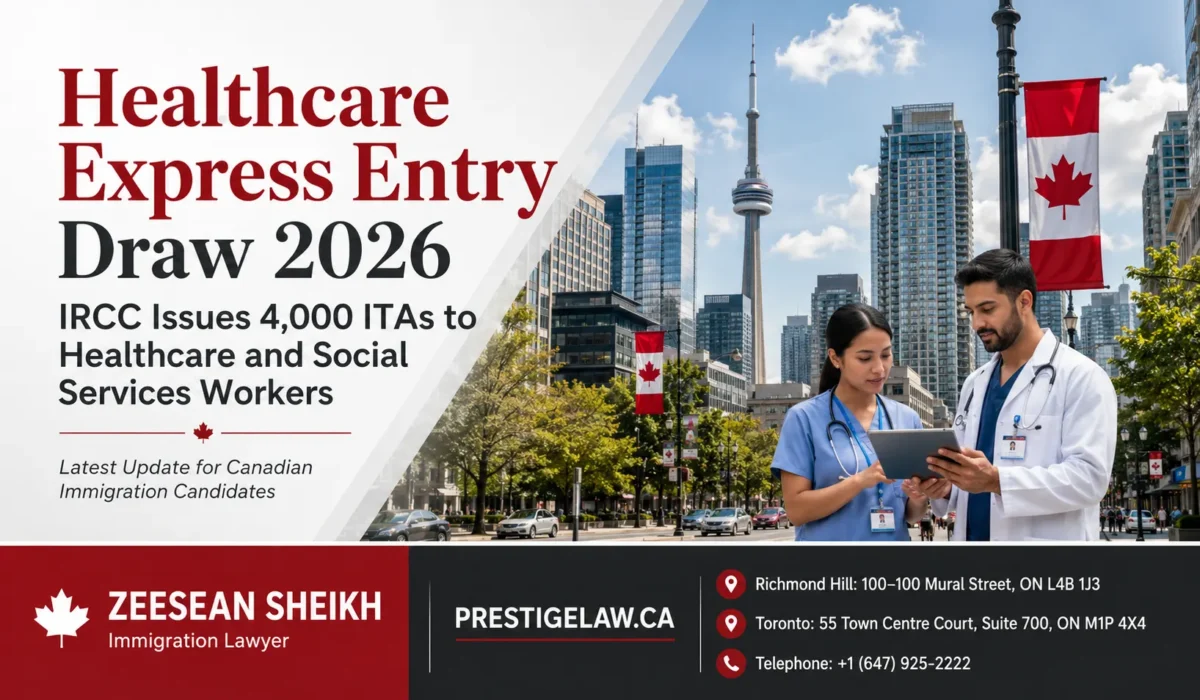
IRCC Issues Invitations to Healthcare and Social Services Workers in Express Entry Draw
Canada’s immigration department has once again turned to its healthcare and social services workforce to fill critical labour gaps, issuing thousands of new invitations to apply for permanent residence through a targeted Express Entry round. For nurses, physicians, social workers, and personal support workers around the world, this draw is one more sign that Canada’s doors remain firmly open to the people who care for its population — provided they understand exactly how the system works, what it demands, and how to position themselves to receive an invitation. Below, we break down everything you need to know about the latest healthcare-category draw, how it fits into the bigger 2026 picture, and what steps to take if you’re hoping to be next. Healthcare Express Entry Draw 2026: IRCC Issues
What Happened: A Closer Look at the Latest Healthcare Draw
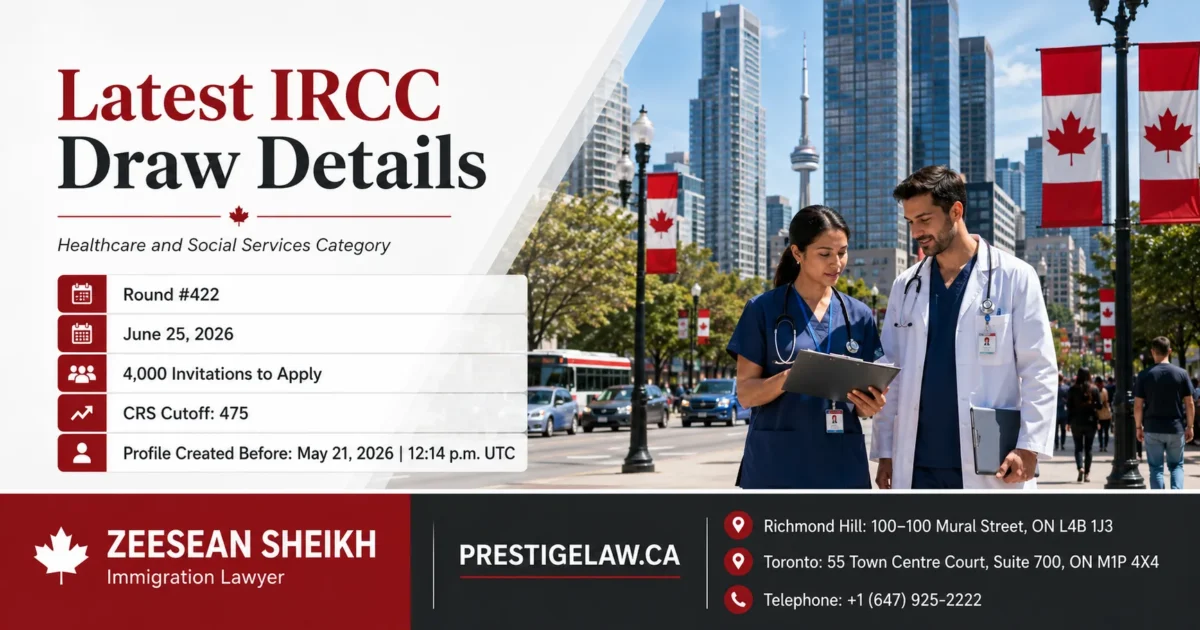
On June 25, 2026, Immigration, Refugees and Citizenship Canada (IRCC) conducted Express Entry Round of Invitations #422, issuing 4,000 invitations to apply through the Healthcare and Social Services category. To be eligible, candidates needed a Comprehensive Ranking System (CRS) score of at least 475, and they had to have created their Express Entry profile before 12:14 p.m. UTC on May 21, 2026.
This was not IRCC’s first healthcare-focused draw of the year. It was, in fact, the second Healthcare and Social Services draw of 2026, and it came with a higher CRS cutoff than the first — 475 compared to 467. That nine-point jump is worth pausing on. It tells us the healthcare candidate pool is getting more competitive, not less, as more qualified applicants create Express Entry profiles and wait for their occupation category to be called.
Zooming out, this round also represented the 34th Express Entry selection round of 2026, and it arrived at a moment when most of the year’s draws have leaned heavily toward candidates already living in Canada — particularly those with Canadian work experience or a provincial nomination. A dedicated healthcare round breaks that pattern, opening a lane specifically for candidates whose competitive advantage is their profession, not necessarily their location or provincial ties.
Through this round, IRCC’s cumulative invitation count for the year climbed to 89,067 Invitations to Apply issued across all draw types in 2026 — a figure that underscores just how aggressively the department is working through its annual immigration levels plan.
Why Category-Based Healthcare Draws Exist Healthcare Express Entry Draw 2026: IRCC Issues
Since 2023, IRCC has run what are known as category-based selection rounds — draws that don’t simply invite the highest-scoring candidates in the entire Express Entry pool, but instead target people with experience in occupations tied to specific economic or labour-market priorities. Healthcare and Social Services has remained one of the most consistently used categories because Canada’s hospitals, long-term care homes, and community service agencies continue to report chronic staffing shortages that domestic hiring alone cannot fill.
The logic behind a category draw is straightforward: rather than compete against tech workers, tradespeople, and francophone applicants in one enormous pool, a nurse, pharmacist, or social worker with the right occupation code gets pulled from a narrower, purpose-built list. Because that list is smaller than the general Express Entry pool, cutoff scores in healthcare rounds have historically landed in the 460 to 480 CRS range — noticeably more attainable than many general, all-program draws.
Eligibility: What You Actually Need to Qualify
Qualifying for a Healthcare and Social Services draw involves two separate layers of eligibility, and missing either one will keep a strong CRS score from translating into an invitation.
Layer one: base Express Entry eligibility. You must already qualify under one of the three federal economic programs managed through Express Entry — most commonly the Canadian Experience Class or the Federal Skilled Worker Program — and have an active profile sitting in the pool.
Layer two: category-specific work experience. On top of general eligibility, IRCC tightened the healthcare category’s work experience threshold partway through the year. As of February 18, 2026, the minimum qualifying work experience for this category rose from six months to one full year of full-time work (or the equivalent in part-time hours) within the past three years, whether that experience was gained in Canada or abroad. One helpful detail for applicants who’ve had career interruptions: that experience doesn’t need to be continuous — gaps or breaks between jobs in the same occupation are acceptable, as long as the cumulative total reaches the 12-month threshold. The experience can also have been gained either inside or outside Canada, which keeps the door open to internationally trained professionals who haven’t yet worked in the country.
Occupations Eligible Under the Healthcare and Social Services Category
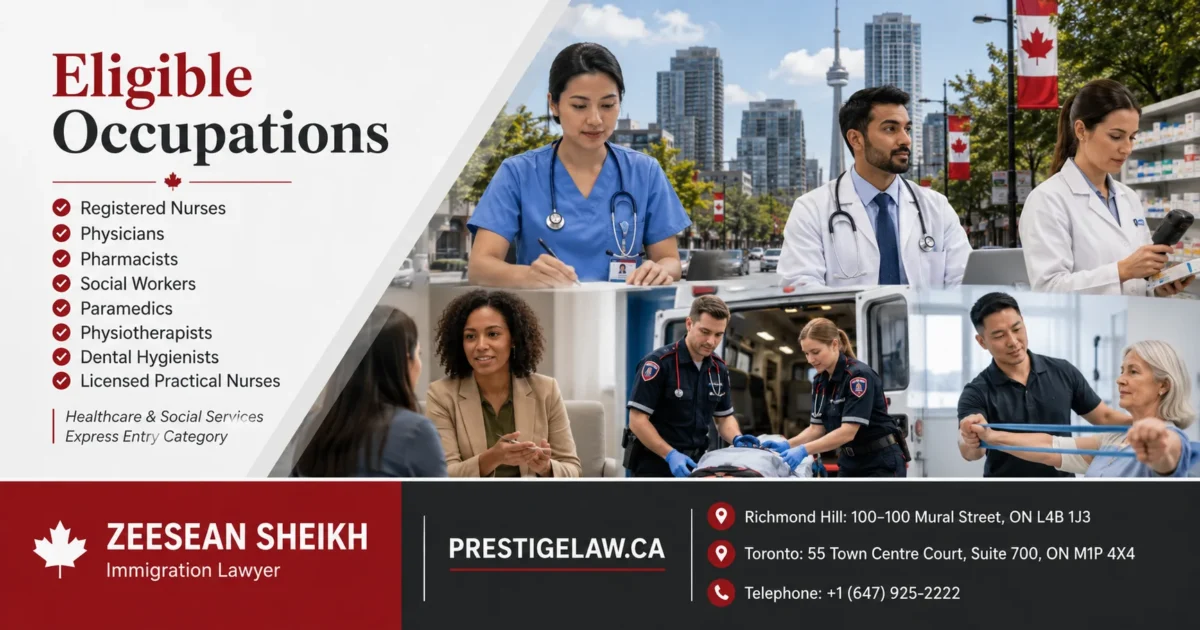
The category covers roughly three dozen occupations across the health and social-services spectrum. Some of the most commonly cited eligible NOC groups include:
- Registered nurses and nurse practitioners
- Physicians, including specialists and general practitioners
- Pharmacists
- Psychologists
- Social workers (NOC 41300) and social and community service workers (NOC 42201)
- Nurse aides, orderlies, and patient service associates (NOC 33102)
- Paramedical occupations, including paramedics (NOC 32102)
- Dental hygienists and dental therapists
- Physiotherapists and occupational therapists
- Licensed practical nurses
Because occupation eligibility is defined by NOC (National Occupational Classification) code rather than job title alone, it’s worth double-checking your specific NOC code against IRCC’s official category list rather than assuming eligibility based on a job title that sounds like a match.

How This Draw Compares to the Rest of 2026
To put the June 25 draw in context, it helps to look at how healthcare-category invitations have trended across the year. The first healthcare round of 2026 took place on February 20 under Round #398, issuing 4,000 invitations at a CRS cutoff of 467. That draw also arrived just two days after IRCC’s mid-cycle policy shift that raised the category’s minimum work experience requirement.
By the time of the June round, IRCC had already issued a substantial share of its planned healthcare allocation for the year. Some independent trackers estimate the department invited roughly 8,000 healthcare and social services candidates across the two 2026 rounds combined, on top of the 8,000 invitations allocated to the category in 2025, when 7,500 of that allocation had already been issued by the time trackers checked in. That pattern suggests IRCC treats the healthcare category as a near-annual fixture rather than a one-off measure — good news for candidates who don’t make the cut this round, since another opportunity is a realistic expectation rather than a hope.
It’s also worth noting that IRCC doesn’t run these draws on a fixed calendar. There is no set schedule for healthcare category draws — IRCC times them according to labour market needs and how many invitations it has already issued for the category that year, which means candidates should treat “waiting in the pool” as an ongoing commitment rather than something to plan around a specific date.
What a Rising CRS Cutoff Actually Means for You
A cutoff moving from 467 to 475 might look like a small shift, but for candidates sitting near the threshold, eight points can be the difference between an invitation and another few months in the pool. A few honest takeaways for anyone tracking this trend:
The healthcare pool is deepening. More candidates are entering Express Entry with qualifying healthcare experience, which naturally pushes cutoffs upward over time, even when IRCC issues the same number of invitations.
Category draws are still meaningfully more accessible than general rounds. For comparison, Canadian Experience Class draws in the first half of 2026 ran between CRS 507 and 518, while healthcare-category cutoffs sat at 467 for earlier rounds — a gap of 40 points or more. Even with the healthcare cutoff climbing to 475, it remains dramatically more attainable than a general, all-program invitation.
Score volatility cuts both ways. A single high-cutoff round doesn’t mean the next one will follow the same trajectory. Category cutoffs respond to how many candidates are in the pool at a given moment and how many invitations IRCC chooses to issue, not to a fixed target score IRCC sets in advance.
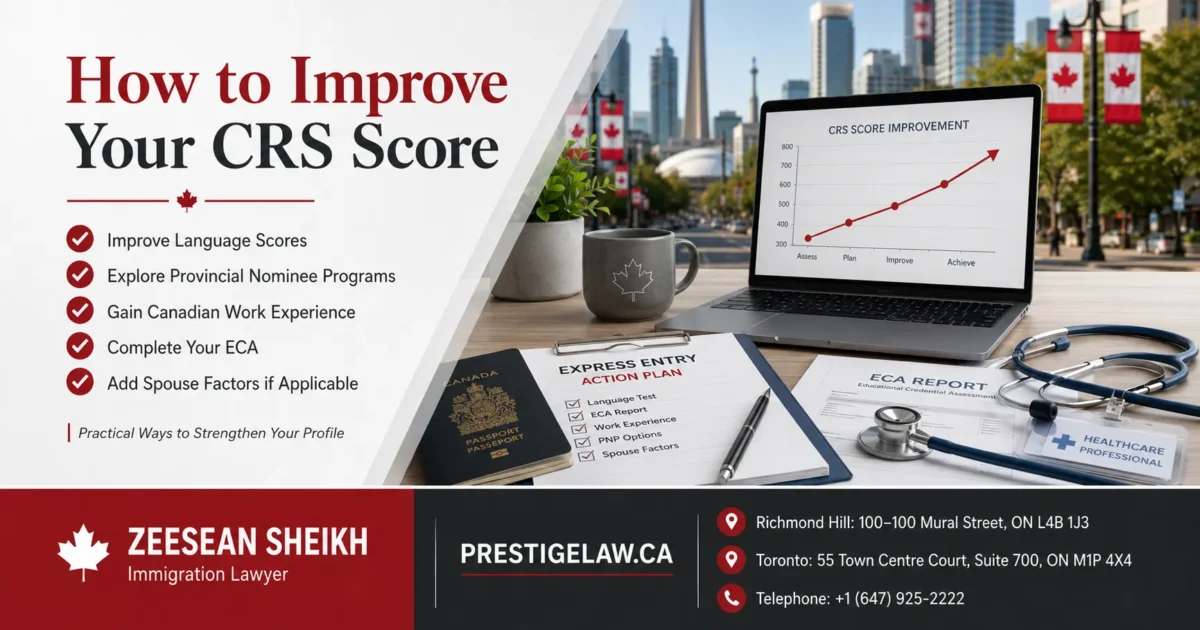
How to Strengthen Your CRS Score Before the Next Draw
If your profile is currently sitting below a competitive healthcare-category threshold, there are concrete, evidence-based ways to close the gap before the next round:
1. Improve your language test results. Comprehensive Ranking System points scale sharply with Canadian Language Benchmark (CLB) levels. Retesting and pushing from CLB 7 to CLB 9 or 10 in English or French can add dozens of CRS points on its own, and strong French ability opens the door to francophone category draws as an additional pathway.
2. Pursue a provincial nomination. A nomination through a Provincial Nominee Program adds a substantial fixed bonus to your CRS score — enough, in most cases, to guarantee an invitation regardless of which draw comes next. Several provinces run healthcare-specific PNP streams that align directly with the same occupations targeted by the federal category, so it’s worth researching whether your target province has an active healthcare nomination stream.
3. Gain additional Canadian work experience. Time working in Canada under a valid work permit adds points on multiple fronts — both directly, through the Canadian work experience factor, and indirectly, by often improving language scores and educational credential recognition.
4. Get your educational credentials formally assessed. An Educational Credential Assessment (ECA) from a designated organization is mandatory for foreign credentials, and processing delays here can hold up an otherwise-ready profile. Starting this early avoids losing points to a stale or expired assessment right when a draw appears.
5. Add a spouse’s factors to a joint application, if applicable. If your spouse or common-law partner has strong education, language ability, or Canadian work experience, structuring your Express Entry profile to capture those factors can add meaningful points that a single-applicant profile would miss entirely.
What Happens After You Receive an Invitation to Apply
Receiving an ITA is a milestone, not the finish line. Once invited, candidates typically have 60 days to submit a complete electronic application for permanent residence, including all required supporting documents — proof of funds, police certificates from every country lived in for six months or longer, medical exam results, and language test results, among others.
Missing documents or incomplete forms are among the most common reasons applications stall well past the department’s target processing time. Because police certificates in particular can take weeks or months to obtain from certain countries, and because medical exams must be completed through an IRCC-approved panel physician, it’s worth beginning that documentation process the moment a profile enters the pool — not after an invitation arrives.
Common Mistakes That Cost Healthcare Candidates Their Invitation
A pattern worth flagging for anyone in the healthcare and social services pool:
- Misreading NOC eligibility. Some candidates assume a job title qualifies without verifying the underlying NOC code against IRCC’s published category list, only to find their profile was never actually eligible for the round they were expecting.
- Letting an ECA or language test expire. Both typically remain valid for a limited window; letting either lapse can silently disqualify an otherwise strong profile without any notification from IRCC.
- Underestimating the new 12-month experience rule. Candidates who qualified under the old six-month threshold before February 2026 may no longer meet category eligibility unless their total qualifying experience has since reached a full year.
- Assuming a spouse can apply independently while relying on the principal applicant’s occupation. Each Express Entry profile stands on its own; a spouse who wants to be considered under their own occupation needs to create a separate profile and be listed as the principal applicant on it.
Why Professional Guidance Matters in a Shifting System
Express Entry’s category-based rounds have made Canadian immigration considerably more occupation-specific — and more procedurally demanding — than the general points-based system many applicants expect. Eligibility now hinges on precise NOC code matching, evolving work-experience thresholds, and provincial program rules that shift from year to year. A profile that looked competitive under last year’s rules may no longer meet this year’s requirements, and a single documentation gap can add months to an otherwise strong application.
This is where working with an experienced Canadian immigration lawyer makes a tangible difference. At Prestige Law, immigration lawyer Zeesean Sheikh works with healthcare professionals, social service workers, and their families to assess Express Entry eligibility, verify occupation and NOC code matches, coordinate credential assessments, and build complete, error-free applications from the profile stage through to permanent residence. For candidates who are close to a competitive CRS score but unsure how to close the final gap — whether through a provincial nomination strategy, a language retest plan, or a review of an existing profile for hidden issues — a focused legal consultation can save months of avoidable delay.
Frequently Asked Questions
What CRS score do I need for the Healthcare and Social Services Express Entry category?
The required score changes with each draw based on the size of the candidate pool. The two 2026 healthcare rounds required CRS scores of 467 and 475 respectively, but earlier draws in the category’s history have ranged as low as the low 400s and as high as the high 470s. There is no fixed minimum — the cutoff is determined by how many eligible candidates are in the pool at the time of the draw.
How often does IRCC run healthcare-specific Express Entry draws?
There’s no set schedule. IRCC times healthcare category draws according to labour market needs and its remaining allocation for the category in that immigration year, which has generally meant one to a few rounds per year since the category was introduced in 2023.
What is the minimum work experience required for the Healthcare and Social Services category?
As of February 18, 2026, candidates need at least 12 months of full-time work experience (or an equivalent amount of part-time experience) within the past three years, gained in an eligible healthcare or social services occupation, in Canada or abroad. This experience does not need to be continuous.
Which occupations qualify under the Healthcare and Social Services category?
Eligible occupations span roughly three dozen NOC codes, including registered nurses, physicians, pharmacists, psychologists, social workers, social and community service workers, nurse aides and orderlies, paramedics, dental hygienists, and physiotherapists, among others.
Can I qualify for this category without a job offer in Canada?
Yes. Candidates can qualify based on foreign work experience alone, provided they meet the category’s occupation and experience requirements and the base eligibility criteria for one of Canada’s federal Express Entry programs.
Do provincial nominations help healthcare workers get invited faster?
Yes. A provincial nomination adds a substantial CRS point bonus that, in most cases, is enough on its own to secure an invitation in a subsequent draw, regardless of the category cutoff. Several provinces run healthcare-specific nomination streams that align with the same occupations targeted by the federal category.
What happens if I don’t have my documents ready when I receive an Invitation to Apply?
Candidates generally have 60 days from the date of invitation to submit a complete application. Missing or incomplete documentation — particularly police certificates and medical exams — is one of the most common causes of delay or refusal, so it’s advisable to prepare these documents while your profile is still in the pool.
Should I hire an immigration lawyer for an Express Entry application?
While it’s not mandatory, professional legal guidance is particularly valuable for candidates navigating category eligibility, NOC code verification, or applications involving family members, prior refusals, or complex work history. An experienced immigration lawyer can also help identify provincial nomination opportunities that fit a candidate’s occupation and background.

Get Personalized Guidance for Your Express Entry Application
Canada’s Healthcare and Social Services Express Entry category continues to offer one of the more accessible pathways to permanent residence for qualified professionals — but eligibility rules, CRS cutoffs, and provincial options shift frequently enough that a well-informed strategy matters. Whether you’re building your first Express Entry profile, reassessing your eligibility under the updated 12-month work experience rule, or exploring a provincial nomination to strengthen your score, professional guidance can help you avoid costly missteps.
Zeesean Sheikh and the team at Prestige Law assist healthcare and social services professionals across Canada and abroad with Express Entry applications, provincial nomination strategy, and full permanent residence guidance.
📍 Richmond Hill Office: 100–100 Mural Street, ON
📍 Toronto Office: 55 Town Centre Court, Suite 700, ON
📞 Telephone: +1 (647) 925-2222
🌐 Website: prestigelaw.ca