



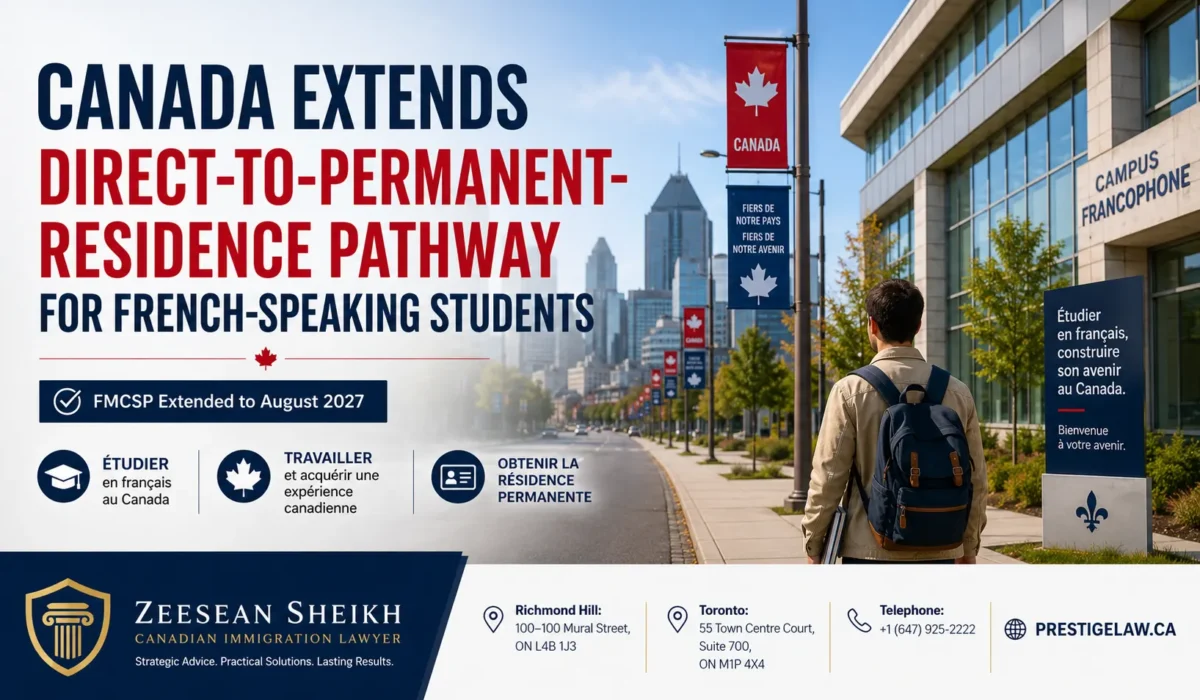
Canada Extends Direct-to-Permanent-Residence Pathway for French-Speaking Students
Canada has extended one of its most generous immigration pilots for international students, giving French-speaking graduates a clearer and faster route to permanent residence. The Francophone Minority Communities Student Pilot (FMCSP), which allows eligible foreign nationals to move directly from their studies to permanent residence without needing a job offer, will now remain open until August 2027 instead of closing in August 2026. Canada Extends PR Pathway for French-Speaking
Announced by Immigration Minister Lena Metlege Diab during a press conference in Winnipeg, Manitoba, this extension reflects Ottawa’s continued commitment to strengthening Francophone communities outside Quebec through targeted immigration. For prospective students, current FMCSP participants, and their families, this is a significant development that reshapes the calculus around studying in French in Canada.
At Prestige Law, we help students, graduates, and skilled workers understand exactly how policy changes like this affect their immigration options. This article breaks down what the FMCSP extension means, who qualifies, how the pathway compares to other Francophone immigration options, and what steps you should be taking right now if you want to benefit from it.
What Is the Francophone Minority Communities Student Pilot?
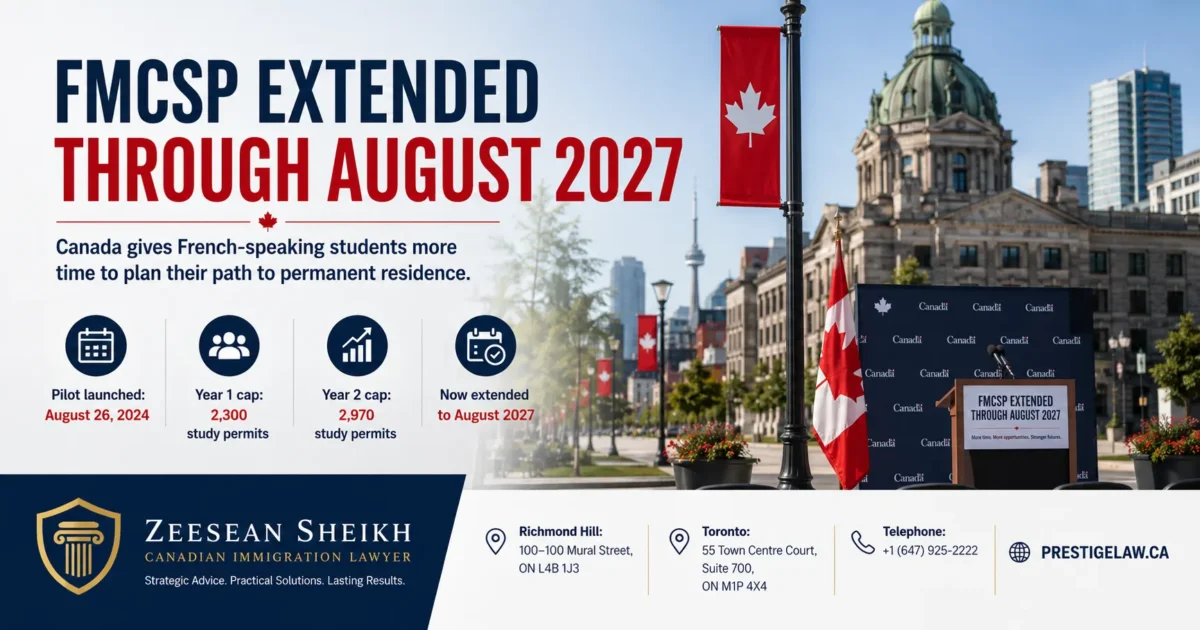
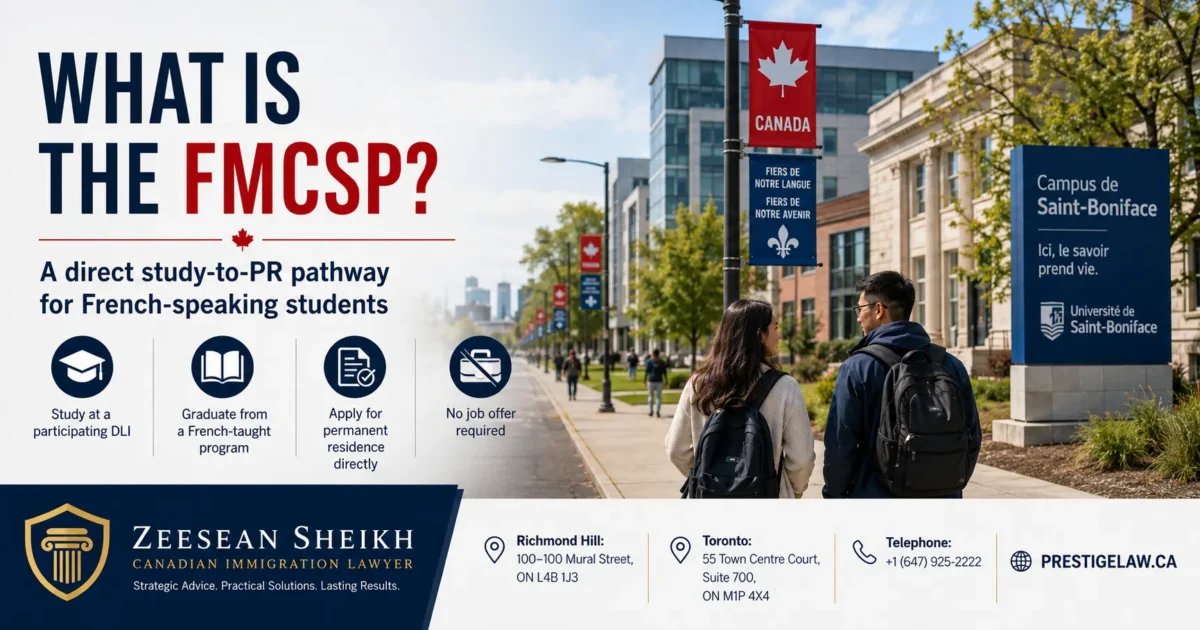
The FMCSP is a dedicated immigration pilot launched by Immigration, Refugees and Citizenship Canada (IRCC) on August 26, 2024. Its purpose is to attract more French-speaking international students to Francophone and bilingual designated learning institutions (DLIs) located outside Quebec, and then give those students a direct path to permanent residence once they graduate.
Unlike the conventional route most international students follow — study permit, then post-graduation work permit, then an application under the Canadian Experience Class — the FMCSP allows eligible graduates to apply for permanent residence immediately after completing their program. There is no requirement to first work in Canada, no requirement for a job offer, and no need to wait through a separate Express Entry cycle.
This is what immigration professionals mean when they describe the FMCSP as a “study-to-PR” pathway: it compresses years of sequential temporary status into a single, streamlined route toward permanent status.
The pilot specifically targets French-speaking students from regions of the world that have historically faced high study permit refusal rates — parts of Africa, the Middle East, and the Americas. IRCC has acknowledged, in response to findings from parliamentary committees, that these applicant pools have been disproportionately affected by refusals under the standard International Student Program, and the FMCSP was designed in part to correct that imbalance while simultaneously serving the labour and demographic needs of Francophone minority communities.
The July 2026 Extension: What Changed
Before this week’s announcement, the FMCSP was scheduled to close on August 25, 2026, or as soon as its second-year application cap of 2,970 study permits was reached — whichever came first. That deadline created real pressure on prospective students trying to plan admissions, visa timelines, and program starts around a closing window.
With the extension announced on July 6, 2026, the pilot will now stay open until August 2027. This gives prospective applicants an additional year to plan their studies, apply for admission to a participating institution, secure a study permit under the pilot, and work toward eligibility for permanent residence — all without the pilot closing mid-program.
Since its 2024 launch, the FMCSP has grown steadily:
- Year one (August 26, 2024 – August 25, 2025): capped at 2,300 study permit applications
- Year two (August 26, 2025 – August 25, 2026): cap raised to 2,970 study permit applications
- Extension (through August 2027): the pilot continues rather than winding down, signalling that the federal government views it as a functioning and worthwhile program rather than a short-term experiment
There are currently 17 participating designated learning institutions, and IRCC has indicated that more may be added as the pilot continues. Confirmed participating institutions include Collège Boréal, Université de Hearst, Collège de l’Île, and the University of Ottawa, among others offering programs taught primarily in French.
Why This Extension Matters
It Signals Long-Term Government Commitment
Pilots that are quietly allowed to lapse send a very different signal than pilots that are actively extended and expanded. By extending the FMCSP a full year ahead of its original closing date, IRCC is telling prospective students, DLIs, and Francophone communities that this is not a temporary experiment — it is becoming a durable feature of Canada’s immigration architecture.
This matters because Canada has set ambitious targets for Francophone immigration outside Quebec: 10.5% of all French-speaking permanent resident admissions by 2028, rising to 12% by 2029. The FMCSP is one of the primary tools being used to hit those targets, alongside category-based Express Entry draws for French speakers and provincial nomination streams. In 2026 alone, Canada has already held three French-language Express Entry draws, issuing roughly 18,000 invitations to apply, with the lowest Comprehensive Ranking System (CRS) cutoff among these draws sitting at just 393 — dramatically lower than most general draws.
It Offers a Lower Language Bar Than Express Entry
One of the most attractive features of the FMCSP, and one that often surprises prospective applicants, is its comparatively modest French language requirement. To qualify under the FMCSP, applicants generally need NCLC (Niveaux de compétence linguistique canadiens) level 5 — an intermediate level suitable for everyday communication and academic coursework.
Compare that to the French-speaking category under Express Entry, where candidates are typically expected to demonstrate a higher level of proficiency, often benchmarked around CLB (Canadian Language Benchmark) 7, to be truly competitive. For students who are conversational but not yet at an advanced fluency level, the FMCSP represents a far more attainable entry point into the Canadian immigration system.
It Removes the Job Offer Barrier
For many international graduates, the single biggest obstacle to permanent residence is securing a qualifying job offer in a country where they have no prior professional network. The FMCSP sidesteps this entirely. Because the pathway is tied to completion of an eligible program of study rather than employment, graduates are not forced into the often-stressful scramble to find an employer willing to support their immigration status before their work permit or maintained status runs out.
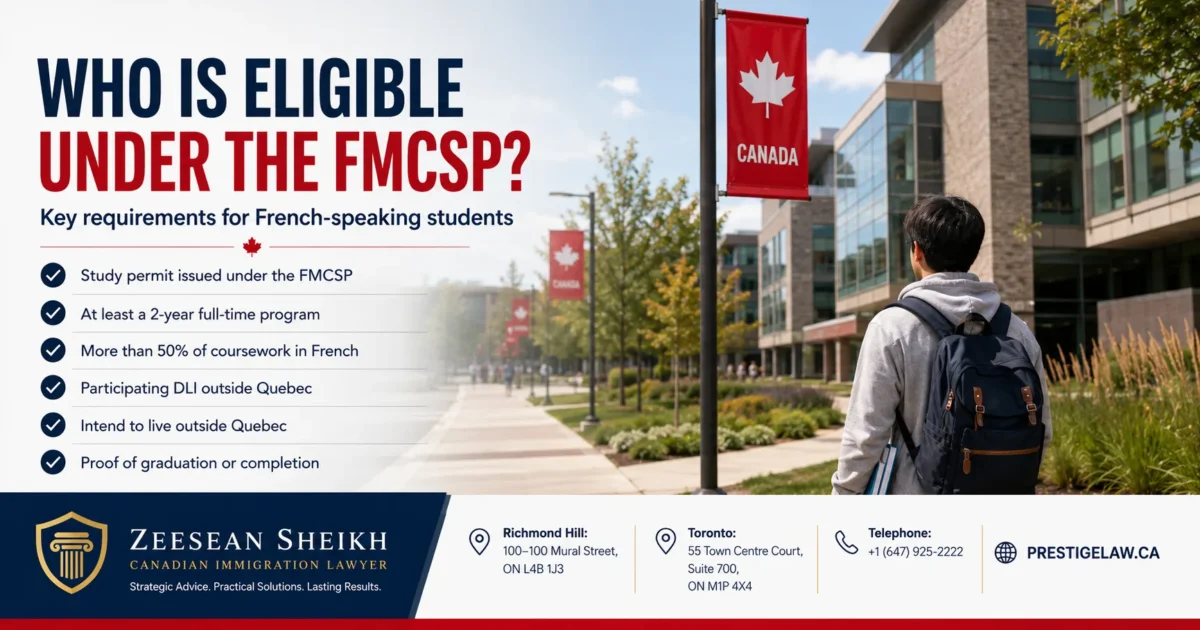
Who Is Eligible Under the FMCSP?
To qualify for permanent residence under the FMCSP, an applicant generally must satisfy the following conditions at the time they submit their application:
- Held a study permit issued under the FMCSP public policy. The applicant must have entered Canada specifically under the Public Policy for French-speaking foreign nationals applying for study permits under the Francophone Minority Communities Student Pilot, and held valid temporary resident status throughout their studies.
- Completed an eligible program of study. The program must be at least two years in duration, delivered on a full-time basis, and taught primarily in French — meaning more than 50% of coursework must be conducted in French. Programs completed no earlier than April 1, 2026 count toward eligibility under the current version of the public policy.
- Studied at a participating designated learning institution. The DLI must have signed a Memorandum of Understanding with IRCC specifically to participate in the FMCSP. Not every French-language institution in Canada is automatically eligible — only those formally designated under the pilot.
- Intend to reside outside Quebec. Because the FMCSP is designed to support Francophone minority communities specifically, applicants must be settling in a province or territory other than Quebec.
- Submit proof of program completion. This can be either the issued degree or diploma itself, or a letter from the DLI confirming that all program requirements have been met.
Applicants who have completed their studies and submitted a PR application, but are still awaiting a decision, may also apply for an FMCSP-specific work permit. This allows them to legally work outside Quebec while their permanent residence application is being processed — an important bridge that prevents graduates from falling into a status gap while IRCC completes its review.
How the FMCSP Compares to Other Francophone Pathways
The FMCSP is one piece of a broader ecosystem of Francophone immigration options in Canada. Understanding how it relates to the others helps applicants choose the right pathway — or combine strategies if one option isn’t immediately available.
Express Entry French-Speaking Category Draws: Introduced in 2023 as part of category-based selection, these draws invite candidates already in the Express Entry pool — through the Federal Skilled Worker Program, Canadian Experience Class, or Federal Skilled Trades Program — who meet French language requirements. This route generally demands higher French proficiency than the FMCSP but is open to a broader population, including workers, not just recent graduates.
Francophone Community Immigration Pilot (FCIP): Launched in January 2025, the FCIP is a direct PR pathway for French-speaking skilled workers, rather than students, who have a job offer from a designated employer in one of several participating rural communities across the country. It requires NCLC 5 French proficiency across all four language abilities and a recognised community recommendation before an application to IRCC can proceed.
Francophone Mobility Program: This is not itself a PR pathway, but a fast, LMIA-exempt work permit stream for French-speaking foreign nationals with a job offer outside Quebec. It’s often used as a stepping stone toward PR through the Canadian Experience Class or a provincial nominee program, and it also requires NCLC 5 proficiency.
Provincial Nominee Programs: Several provinces, including Ontario, operate French-Speaking Skilled Worker Streams under their provincial nominee programs. These often require a higher CLB 7 language benchmark but can be an effective complementary option for candidates who don’t fit neatly into the FMCSP or FCIP criteria.
For international students specifically, the FMCSP remains the most direct route: no job offer, no separate Express Entry draw to wait for, and a language bar that is realistically achievable for someone who has completed two years of coursework taught in French.
The Application Process: Step by Step
While every case has its own nuances, the general sequence for pursuing permanent residence under the FMCSP looks like this:
Step 1 — Secure admission to a participating DLI. Prospective students should confirm that their chosen institution and program are formally part of the FMCSP before applying, since only designated programs count toward eligibility.
Step 2 — Apply for a study permit under the FMCSP public policy. This is a distinct application stream from a standard study permit and should reference the specific public policy to ensure it is processed correctly.
Step 3 — Complete the program of study. The program must run at least two years, be full-time, and be delivered primarily in French.
Step 4 — Gather proof of completion. This means either the final degree or diploma, or a formal letter from the institution confirming all requirements have been met.
Step 5 — Submit the permanent residence application. This should be filed while the applicant still holds valid temporary resident status in Canada, whether through a study permit, work permit, or another valid status.
Step 6 — Apply for an FMCSP work permit if needed. Graduates awaiting a PR decision can apply for a specific open work permit tied to the FMCSP, allowing them to work outside Quebec during the wait.
Step 7 — Await the PR decision and complete landing requirements. Once approved, applicants proceed through the standard confirmation of permanent residence process.
Each of these steps carries its own documentation requirements, timing considerations, and potential pitfalls — particularly around what counts as “primarily taught in French” and how gaps in status are treated. Errors at any stage can result in delays or refusals, which is why many applicants choose to work with an immigration lawyer rather than navigate the process alone.
Broader Context: Canada’s Francophone Immigration Push
The FMCSP extension does not exist in isolation. It’s part of a coordinated, multi-year federal strategy to grow Francophone immigration outside Quebec. In March 2026, Minister Diab announced roughly $1.5 million in funding across three projects under the Francophone Immigration Support Program, including a dedicated PR support initiative for students at the Université de Hearst in Northern Ontario. That same funding round included support for a public information campaign aimed at countering misinformation about Francophone immigration pathways, and up to $575,000 over three years for the Université de l’Ontario français to develop a first-of-its-kind micro-certificate program in Francophone immigration management.
This all builds on an earlier federal commitment to reserve 5,000 federal selection spaces specifically for French-speaking immigrants starting in 2026. Taken together, these measures paint a consistent picture: Ottawa is treating Francophone immigration as a long-term demographic and economic priority, not a one-off initiative, and the FMCSP extension is a direct expression of that priority within the international student population.
For applicants, this broader context matters practically. It suggests continued funding, continued institutional buy-in, and a reduced likelihood that the pilot will be abruptly cancelled — though, as with any immigration program, policy details, caps, and eligibility criteria can still change, and applicants should confirm current requirements before applying.
Common Mistakes That Delay or Derail FMCSP Applications
Because the FMCSP is a relatively new and highly specific pilot, applicants frequently run into avoidable problems, including:
- Assuming any French-language program qualifies. Only programs at a formally designated participating institution, delivered primarily in French, count. A bilingual program with less than 50% French instruction will not meet the threshold.
- Applying under the wrong study permit stream. Applicants must apply specifically under the FMCSP public policy, not a general study permit application, to preserve their eligibility.
- Letting status lapse between study completion and PR submission. Because the PR application must generally be submitted while the applicant holds valid temporary status, timing gaps can jeopardise eligibility.
- Overlooking the “outside Quebec” residency requirement. Applicants intending to settle in Quebec are not eligible under this specific pilot, even if they meet every other criterion.
- Underestimating documentation requirements. Proof of program completion must be precise — either the actual degree or diploma or a compliant institutional letter — and incomplete documentation is a common cause of processing delays.
How Prestige Law Can Help
Immigration pilots like the FMCSP move quickly, and eligibility criteria are often narrower than they first appear. At Prestige Law, our team works directly with international students, recent graduates, and their families to assess eligibility under the FMCSP, prepare study permit and permanent residence applications with the correct documentation, and coordinate the transition from study permit to work permit to permanent residence without gaps in status.
Immigration lawyer Zeesean Sheikh and the team at Prestige Law regularly advise clients on Francophone immigration pathways, including the FMCSP, the Francophone Community Immigration Pilot, and French-language Express Entry draws, helping applicants understand which route fits their specific academic background, language proficiency, and long-term settlement goals.
If you are currently studying under the FMCSP, considering enrolling at a participating institution, or simply trying to understand how this extension affects your immigration timeline, professional legal guidance can help you avoid the common documentation and timing errors that lead to delays.
Frequently Asked Questions
What is the Francophone Minority Communities Student Pilot (FMCSP)? The FMCSP is a federal immigration pilot that allows eligible French-speaking international students who complete an eligible program at a participating institution outside Quebec to apply directly for permanent residence, without needing a job offer or prior Canadian work experience.
How long has the FMCSP been extended? The pilot, originally set to close on August 25, 2026, has been extended to remain open until August 2027.
What French language level do I need for the FMCSP? Applicants generally need NCLC level 5, an intermediate proficiency level, which is lower than the level typically expected in French-speaking Express Entry category draws.
Do I need a job offer to get permanent residence under the FMCSP? No. The FMCSP does not require a job offer. Eligibility is based on completing an eligible French-language program at a participating designated learning institution.
Which institutions participate in the FMCSP? There are currently 17 participating designated learning institutions, including Collège Boréal, Université de Hearst, Collège de l’Île, and the University of Ottawa, with more institutions potentially being added over time.
Can I work while my FMCSP permanent residence application is being processed? Yes. Graduates who have submitted a PR application under the FMCSP can apply for an FMCSP-specific open work permit, allowing them to work outside Quebec while awaiting a decision.
Can I apply for the FMCSP if I want to settle in Quebec? No. The FMCSP is specifically designed to support Francophone minority communities outside Quebec, so applicants must intend to reside in a province or territory other than Quebec.
How is the FMCSP different from Express Entry’s French-speaking category? Express Entry French draws are open to a broader pool of candidates, including workers, but typically require higher French proficiency. The FMCSP is limited to graduates of eligible programs but generally requires only NCLC level 5 and no job offer.
Is there a cap on how many people can apply under the FMCSP? Yes. IRCC has set annual study permit caps for the pilot — 2,300 in its first year and 2,970 in its second year — though the extension keeps the pathway open through August 2027.
Do I need a lawyer to apply under the FMCSP? While it is possible to apply independently, the FMCSP involves specific documentation and timing requirements that differ from standard study permit and PR applications. Many applicants choose to work with an immigration lawyer to reduce the risk of delays or refusals.
Final Thoughts
The extension of the Francophone Minority Communities Student Pilot through August 2027 is a meaningful win for French-speaking international students who want a direct, achievable route to Canadian permanent residence. It reflects a broader, well-funded federal strategy to grow Francophone communities outside Quebec, and it offers real, practical advantages — a lower language threshold, no job-offer requirement, and a much shorter distance between graduation and permanent status than most other immigration routes.
That said, eligibility rules are specific, caps still apply, and documentation errors can cost applicants valuable time. If you’re planning to study in French in Canada, currently enrolled under the FMCSP, or unsure how this extension affects your existing plans, getting tailored legal advice early can make a meaningful difference in how smoothly your path to permanent residence unfolds.
Get in Touch
For personalised guidance on the Francophone Minority Communities Student Pilot or any other Canadian immigration matter, reach out to Prestige Law:
📍 Richmond Hill: 100–100 Mural Street, ON
📍 Toronto: 55 Town Centre Court, Suite 700, ON
📞 +1 (647) 925-2222
🌐 prestigelaw.ca