





Canada Invites French-Speaking Candidates to Apply for Permanent Residence Through Express Entry

Canada has once again turned to its Express Entry system to welcome French-speaking newcomers, issuing thousands of new Invitations to Apply (ITAs) for permanent residence in one of the largest French-language draws of the year. For skilled workers who speak French, this latest round is further proof that language ability continues to be one of the most powerful tools available to strengthen a Canadian immigration application. Whether you’re an overseas professional exploring your options or a temporary resident already living and working in Canada, understanding how these category-based draws work — and how to position your profile to receive an invitation — can significantly shorten your path to permanent residence. This article breaks down everything you need to know about the French-language category, how the Comprehensive Ranking System (CRS) rewards bilingualism, who qualifies, and the exact steps to take after receiving an ITA. French Express Entry Draw 2026
What Happened: Canada’s Latest Express Entry Draw for French Speakers
On July 9, 2026, Immigration, Refugees and Citizenship Canada (IRCC) conducted another French-language proficiency draw, issuing 5,000 Invitations to Apply to candidates in the Express Entry pool. To be eligible for this round, candidates needed a minimum Comprehensive Ranking System score of 420 and needed to have created their Express Entry profile before 8:04 a.m. UTC on May 15, 2026.
This draw stood out for two reasons. First, it was the largest French-language round since early March 2026, when IRCC issued 5,500 invitations at a cutoff of 397. Second, the CRS cutoff of 420 was the highest seen in a French-language draw since October 2025, suggesting that IRCC pulled somewhat deeper into higher-scoring profiles this time around, even while issuing a large number of invitations.
This was the 37th Express Entry draw of 2026 and the seventh dedicated specifically to French-speaking candidates so far this year. Since January, IRCC has issued more than 35,000 ITAs through the French-language category alone — trailing only the Canadian Experience Class as the largest source of invitations in 2026. That volume reflects a clear and sustained federal policy: Canada is actively building its French-speaking population outside Quebec, and Express Entry is the primary lever it is using to do so.
Understanding the French-Language Category in Express Entry
The French-Language Proficiency category is one of several category-based selection streams introduced under Express Entry to help Canada meet specific economic and demographic goals, alongside categories for healthcare workers, trades occupations, and STEM professionals. Unlike general Express Entry draws — which invite the highest-ranked candidates in the pool regardless of occupation or background — category-based draws target candidates who meet a defined set of criteria tied to a national policy priority.
For the French-language category, that priority is clear: supporting the growth and vitality of Francophone minority communities outside Quebec, in provinces such as Ontario, New Brunswick, Manitoba, and Alberta.
Why Canada Prioritizes French-Speaking Immigrants
Canada’s federal government has set an official target of having French-speaking permanent residents make up 6% of all new admissions outside Quebec by 2036. This goal is tied to the broader objective of preserving linguistic duality across the country and reversing the gradual decline of French-speaking populations in provinces where English predominates.
To reach this target, IRCC has leaned heavily on category-based Express Entry draws. In many of these rounds, candidates with strong French skills have been invited at CRS cutoffs well below what is required in general or Canadian Experience Class draws — sometimes by more than 100 points. This gap represents one of the most significant advantages currently available within the Express Entry system.
Minimum Requirements for the French-Language Category
To be flagged as eligible for a French-language draw, a candidate’s Express Entry profile must show:
- A minimum French language proficiency of Niveau de compétence linguistique canadien (NCLC) 7 across all four skill areas — speaking, listening, reading, and writing
- Eligibility under at least one of the three core Express Entry programs: the Federal Skilled Worker Program (FSWP), the Canadian Experience Class (CEC), or the Federal Skilled Trades Program (FSTP)
- A complete and active Express Entry profile at the time the draw is conducted
Candidates do not need to apply separately for this category. IRCC automatically identifies eligible profiles within the pool based on the language test results already submitted, then issues invitations to those who meet the cutoff score for that specific round.
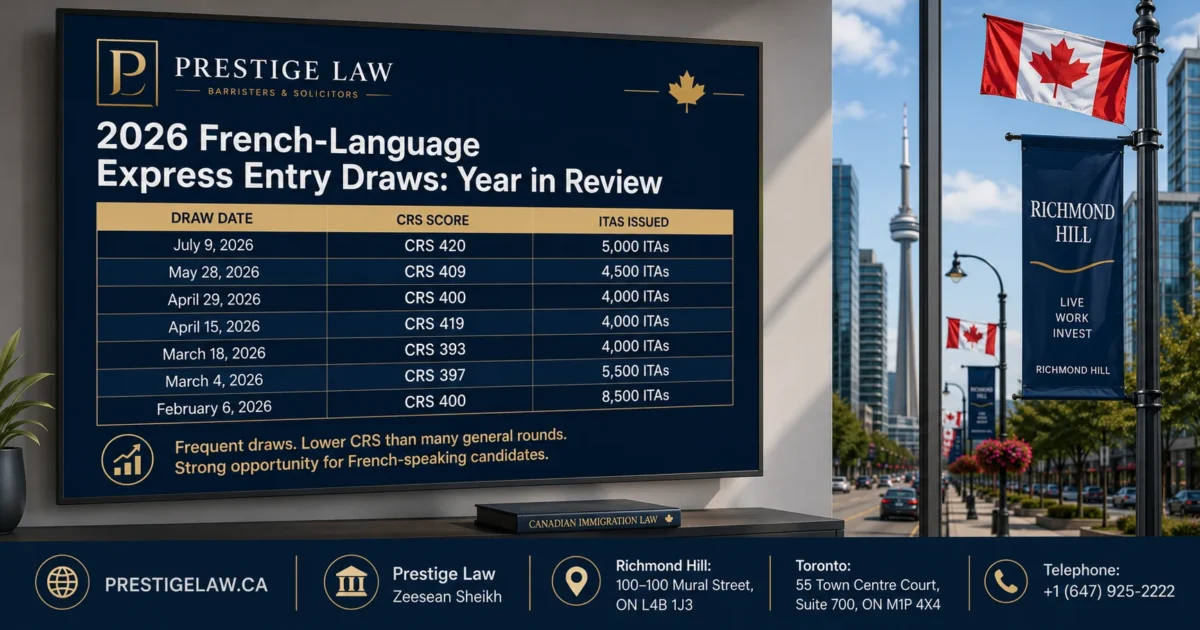
2026 French-Language Express Entry Draws: A Year in Review
To understand how competitive — or accessible — this category has become, it helps to look at how cutoff scores and invitation volumes have shifted throughout the year.
| Draw Date | CRS Cutoff | ITAs Issued |
|---|---|---|
| July 9, 2026 | 420 | 5,000 |
| May 28, 2026 | 409 | 4,500 |
| April 29, 2026 | 400 | 4,000 |
| April 15, 2026 | 419 | 4,000 |
| March 18, 2026 | 393 | 4,000 |
| March 4, 2026 | 397 | 5,500 |
| February 6, 2026 | 400 | 8,500 |
Several patterns emerge from this year’s activity. First, cutoff scores have fluctuated in a relatively narrow band between roughly 393 and 420 — dramatically lower than the 500+ scores typically required in Canadian Experience Class draws this year. Second, invitation volumes have remained substantial throughout 2026, with the February 6 draw alone issuing 8,500 ITAs, the largest category-based draw of its kind in Express Entry history at the time it occurred. Third, the general trend has been toward larger, more frequent French-language rounds compared to prior years, reinforcing that this is not a temporary or one-off initiative but an established pillar of Canada’s immigration strategy.
For candidates with certified French ability, this consistency offers something valuable: predictability. Unlike some category-based streams that have appeared only once or twice this year, French-language draws have occurred roughly every four to six weeks throughout 2026, giving eligible candidates a realistic and recurring opportunity to receive an invitation.
How the Comprehensive Ranking System (CRS) Works for French-Language Candidates
The Comprehensive Ranking System is the point-based tool IRCC uses to rank every profile in the Express Entry pool. Scores are calculated out of 1,200 points and are based on factors including age, education, work experience, language ability, and — critically for this category — additional points tied to French proficiency.
CRS Points for French Language Proficiency
Candidates can earn CRS points in two distinct ways related to French:
Core human capital points: French language ability itself contributes to a candidate’s base language score, calculated using the Canadian Language Benchmark (CLB) equivalencies derived from test results such as the TEF Canada or TCF Canada.
Additional points for bilingualism: Candidates who demonstrate strong ability in both French and English can receive extra CRS points specifically for this combination — currently up to 50 additional points for candidates with strong French (NCLC 7 or higher) and at least modest English ability (CLB 5 or higher), or up to 25 points for candidates with more moderate English skills. These bilingual bonus points are separate from, and additional to, a candidate’s core language points, and they can meaningfully close the gap between a borderline profile and a competitive one.
For many candidates, this bilingual bonus is the single largest CRS boost available outside of a provincial nomination or a valid job offer, making French test preparation one of the most efficient ways to improve a profile’s overall competitiveness.
How to Calculate Your CRS Score
Before relying on a French-language draw, it’s worth calculating your full CRS score using IRCC’s official points grid or a reliable CRS calculator. Key inputs include:
- Age at the time your profile is submitted
- Highest level of completed education, along with an Educational Credential Assessment (ECA) if your credential was earned outside Canada
- Skilled work experience, both in Canada and abroad
- Language test results in English (IELTS, CELPIP, or PTE Core) and French (TEF Canada or TCF Canada)
- A valid job offer supported by a positive Labour Market Impact Assessment (LMIA), where applicable
- A provincial nomination, which adds 600 points and virtually guarantees an invitation in the next general draw
Even candidates who fall short of the general Express Entry cutoff often find that their CRS score comfortably clears the threshold for a French-language draw, particularly once bilingual bonus points are factored in.
Who Qualifies for French-Language Category-Based Selection?
Eligibility for this category depends on qualifying under one of Express Entry’s three core programs.
Federal Skilled Worker Program (FSW)
Designed for candidates with foreign work experience, the FSW program requires at least one year of continuous, full-time (or equivalent part-time) skilled work experience within the last ten years, along with minimum language thresholds and a valid ECA for education completed outside Canada. Candidates applying under this stream who also meet the NCLC 7 French threshold are eligible to be selected in a French-language draw.
Canadian Experience Class (CEC)
The CEC is intended for candidates who already have skilled Canadian work experience — typically at least one year within the past three years, gained through a valid work permit. This is often the fastest route for temporary residents already living in Canada, including international graduates and workers who have transitioned from a study or work permit. Candidates in this stream who also hold NCLC 7 French test results are eligible for French-language draws, often alongside strong CRS scores from their Canadian experience.
Federal Skilled Trades Program (FST)
For candidates working in eligible skilled trades occupations, the FST program requires a valid job offer or certificate of qualification, along with at least two years of full-time trade experience within the past five years. French-speaking trades workers who meet the program’s requirements are similarly eligible for this category.
Regardless of which program applies, the French-language requirement is layered on top of — not instead of — a candidate’s existing Express Entry eligibility. This means candidates should first confirm they meet the baseline requirements for FSW, CEC, or FST before assuming French proficiency alone will secure an invitation.
Required French Language Tests: TEF Canada and TCF Canada
To be considered under this category, candidates must submit results from one of two IRCC-approved French language tests:
TEF Canada (Test d’évaluation de français): Administered by the Chambre de commerce et d’industrie de Paris Île-de-France, this test evaluates reading, writing, listening, and speaking.
TCF Canada (Test de connaissance du français): Administered by France Éducation international, this test similarly assesses all four language skills and is widely accepted as an alternative to the TEF.
Test results must be no more than two years old at the time an application is submitted, and candidates must achieve a minimum of NCLC 7 in each of the four skill areas to qualify under this category — a partial result in only some skills will not meet the threshold. Because testing appointments can book up weeks or months in advance in some cities, candidates seriously considering this pathway should schedule their test as early as possible.
Step-by-Step: How to Apply After Receiving an ITA
Receiving an Invitation to Apply is not the final step — it opens a 60-day window to submit a complete application for permanent residence. Missing this window means losing the invitation and needing to re-enter the pool.
- Confirm your ITA and review your profile for accuracy immediately after being invited.
- Gather required documents, including passport copies, language test results, an ECA (if applicable), proof of funds, police certificates from every country you’ve lived in for six months or more since age 18, and a digital photo meeting IRCC specifications.
- Complete a medical examination with an IRCC-approved panel physician, if you haven’t already done so during the profile stage.
- Submit your application online through your IRCC secure account, along with the applicable government processing fees.
- Respond promptly to any requests for additional information or documentation from IRCC during processing.
- Track your application status through your online account and prepare for landing once approval is confirmed.
Given the strict 60-day deadline, it’s wise to have core documents — particularly police certificates, which can take weeks to obtain from some countries — prepared well before an ITA arrives, especially if your CRS score is close to recent cutoff levels.
Processing Times and What to Expect
Express Entry applications are generally processed within a target of six months from the date a complete application is submitted, though actual timelines can vary depending on application volume, complexity, and whether additional documentation or interviews are required. Recent IRCC data has shown improving processing times for permanent residence applications in several categories, which is a positive sign for candidates currently in the queue. Applicants should nonetheless plan for some variability and avoid making irreversible commitments — such as resigning from current employment abroad — until permanent residence is formally confirmed.

Benefits of French-Speaking Immigration to Canada
Francophone Minority Communities Outside Quebec
Beyond the immigration advantage itself, French-speaking newcomers play a meaningful role in sustaining Francophone communities in provinces like Ontario, New Brunswick, and Manitoba. These communities offer French-language schools, healthcare services, cultural institutions, and community organizations that benefit directly from continued population growth. For newcomers, this can mean an easier social and cultural transition, with established networks and services available in their first language even outside Quebec.
Career and Economic Advantages of Bilingualism
Fluency in both English and French continues to open doors in Canada’s job market, particularly in the federal public service, financial services, education, healthcare, and any client-facing role serving bilingual regions. Employers across the country increasingly value bilingual employees, and federal government positions frequently list bilingualism as a requirement or strong asset. For immigrants building a long-term career in Canada, French proficiency can therefore offer advantages that extend well beyond the immigration process itself.
Common Mistakes That Delay or Jeopardize Applications
Even strong candidates can run into avoidable problems. Some of the most common issues include:
- Submitting language test results with one skill area below NCLC 7, which disqualifies the profile from this category even if the other three skills are strong
- Allowing language test results to expire before an application is finalized, since results are only valid for two years
- Underestimating how long police certificates take to obtain, particularly from certain countries, which can jeopardize the 60-day application deadline
- Failing to update the Express Entry profile promptly after a change in circumstances, such as a new job, additional education, or a change in marital status
- Assuming eligibility without confirming baseline program requirements for FSW, CEC, or FST before relying on the French-language category alone
Working with an experienced immigration lawyer early in the process helps identify and resolve these issues before they become costly delays.
How Prestige Law Can Help
Navigating Express Entry — particularly a specialized stream like the French-language category — involves careful attention to eligibility rules, documentation timelines, and CRS score optimization. At Prestige Law, our team works closely with candidates to assess Express Entry eligibility, review CRS scores for potential improvements, prepare complete and accurate applications, and respond effectively to any requests from IRCC throughout the process. Whether you are just beginning to explore your options or have already received an Invitation to Apply, personalized legal guidance can make a meaningful difference in the outcome and timeline of your application.
Frequently Asked Questions
What CRS score do I need for a French-language Express Entry draw? Cutoff scores change with each draw. Throughout 2026, French-language draws have required CRS scores ranging from roughly 393 to 420, significantly lower than the scores typically needed in Canadian Experience Class or general draws.
What French language test does IRCC accept for this category? IRCC accepts the TEF Canada and the TCF Canada. Candidates must score a minimum of NCLC 7 in all four skill areas — reading, writing, listening, and speaking — to qualify.
Do I need to speak English as well as French to be eligible? No. English is not required to be considered under the French-language category itself, though candidates with both English and French ability can earn additional CRS bonus points for bilingualism, improving their overall ranking.
How often does IRCC hold French-language Express Entry draws? Throughout 2026, IRCC has held French-language draws roughly every four to six weeks, making this one of the more consistent category-based streams in the current Express Entry system.
How long do I have to submit my application after receiving an ITA? Candidates have 60 days from the date of invitation to submit a complete application for permanent residence.
Can I be invited under the French-language category if I don’t have a job offer? Yes. A valid job offer is not required to be eligible for this category, though it can still contribute additional CRS points if one is held.
Does a provincial nomination affect my chances in a French-language draw? A provincial nomination adds 600 CRS points, which effectively guarantees an invitation in the next general Express Entry draw. Candidates with a provincial nomination do not need to rely on the French-language category specifically, though they remain eligible for it if they meet the language requirements.

Prestige Law
Zeesean Sheikh
📍 Richmond Hill: 100–100 Mural Street, ON 📍 Toronto: 55 Town Centre Court, Suite 700, ON
📞 +1 (647) 925-2222
This article is intended for general informational purposes and does not constitute legal advice. Immigration requirements and processing standards are subject to change; contact Prestige Law for guidance specific to your situation.