



IRCC’s Proof of Citizenship Review: What Happened, What Changed, and What to Do If You’re Impacted
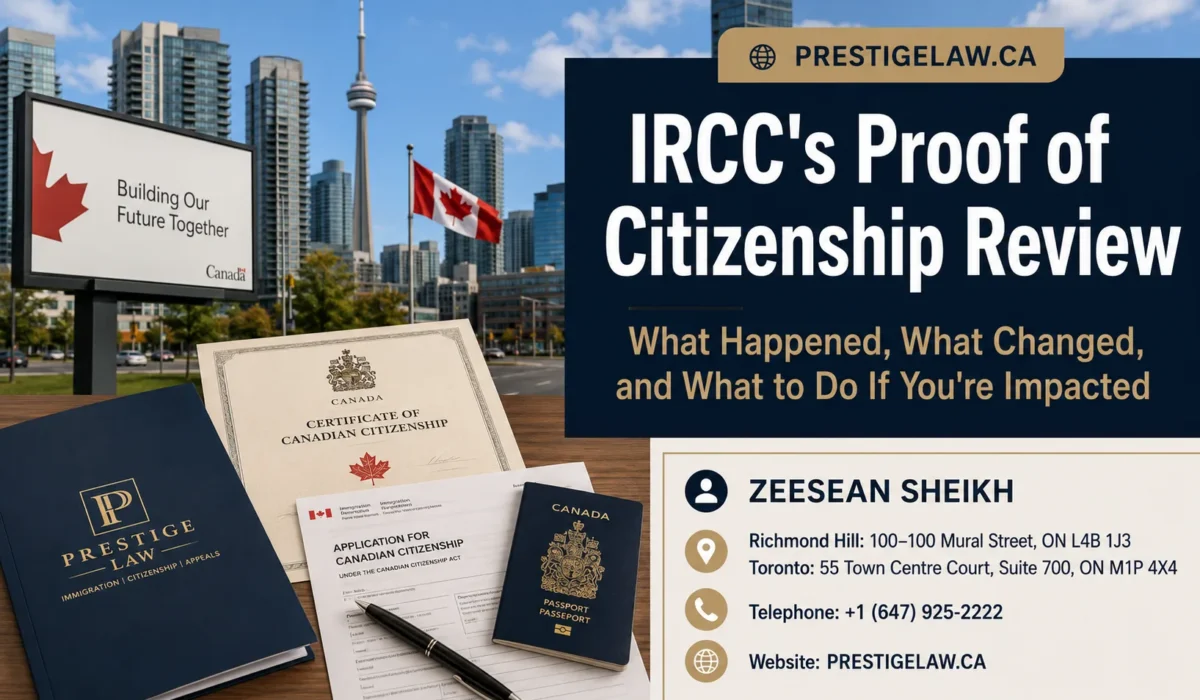
Thousands of people who believed their Canadian citizenship was finally confirmed on paper are now facing an unexpected letter from the federal government asking them to send their certificate back. In mid-June 2026, Immigration, Refugees and Citizenship Canada (IRCC) began contacting a group of recently approved citizenship-by-descent applicants, informing them that their files were under review and requesting the surrender of certificates that had already been issued. For families who spent months, sometimes years, tracing genealogical records across generations and borders to prove a claim to Canadian citizenship, the news has understandably caused alarm, confusion, and a flood of questions. This article breaks down exactly what happened, what has changed in IRCC’s documentation requirements since, what it means for anyone with a pending application or an existing certificate, and the concrete steps you should take if you’ve been contacted or believe you could be affected — along with where professional legal guidance can make the difference between a stalled claim and a confirmed one. IRCC Citizenship Certificate Review 2026
What Happened: IRCC’s Citizenship Certificate Review Explained
Over a weekend in mid-June 2026, IRCC’s Registrar of Canadian Citizenship sent emails to a group of individuals who had recently received citizenship-by-descent certificates under Bill C-3, the legislation that restored citizenship status to so-called “Lost Canadians.” The email informed recipients that the department had information suggesting they may not be entitled to hold a Canadian certificate of citizenship, directed them to surrender the certificate, and stated it would be returned if a review confirmed their entitlement.
It is important to understand what this review is not. This is an administrative review and certificate surrender, not a fraud case and not a formal revocation. The government’s stated concern is documentary in nature — that some applicants demonstrated their line of descent using compiled genealogy records rather than certified documents from original source authorities such as provincial vital-statistics offices. No wrongdoing has been alleged against any of the affected individuals, and IRCC has said certificates will be returned once entitlement is confirmed.
IRCC’s position, as reported by major outlets, is that some applications lacked proof of Canadian family lineage sourced from original authorities and that applicants had not adequately explained why those original documents were unavailable or what steps had been taken to obtain them. The pause followed surrender letters sent to what IRCC described as “a few dozen” people who had already received citizenship certificates, and in a public statement issued June 18, 2026, the department confirmed it was reviewing how this occurred and taking steps to ensure applications are assessed fairly and lawfully.
By early July, IRCC provided an update on the scope and outcome of that review. The department confirmed it had reviewed roughly 6,500 certificates already issued under Bill C-3 to check whether the supporting documentation held up, and that this review was completed on June 30. Of the certificates reviewed, 100 were flagged for potentially insufficient documentation, and 33 of those were reinstated once IRCC confirmed the underlying evidence supported the claim. The remaining 67 files — representing roughly one per cent of all certificates issued under the new law — were still being resolved at that time, with those applicants expected to be reinstated or contacted within days.
The Legal Backdrop: Why This Review Happened Now
To understand why this review occurred, it helps to understand the wave of applications that preceded it. On December 15, 2025, Canada removed the first-generation limit on citizenship by descent for individuals born before that date, opening eligibility to anyone who can trace an unbroken line back to a Canadian ancestor, regardless of how many generations have passed. This change affects millions of people, particularly Americans in parts of New England, where hundreds of thousands of French Canadians settled between 1840 and 1930.
The legislative change, known as Bill C-3, followed a 2023 Ontario Superior Court ruling that struck down the previous second-generation cut-off as unconstitutional. Once the new law took effect, application volumes surged dramatically, and with that surge came a wide range of supporting evidence quality — from certified vital records to informally compiled family-tree research submitted through genealogy platforms. IRCC’s review appears to have been triggered by concerns that some of the fastest-processed applications relied too heavily on the latter.
What Changed: The Updated CIT 0014 Document Checklist
Alongside the certificate review, IRCC formally tightened its documentation standards. The revised CIT 0014 checklist, updated June 17, 2026, introduced explicit new language stating that an application “cannot be supported solely by third-party records” — a standard the department had reportedly already been applying informally since mid-June, when it began ordering some recently approved certificates back for review.
Here is what the update means in practical terms:
Documents Must Come From the Original Source Authority
The updated checklist places renewed emphasis on the quality, reliability, and source of documents submitted with a proof of citizenship application, and applies to every generation included in the application. IRCC now makes clear that applications cannot be supported solely by third-party records — documents should be issued by the original authority that created or maintains the record, such as a civil registry, vital statistics office, or original government authority. This is particularly relevant for families relying on older records, foreign birth certificates, baptismal records, census documents, boat manifests, British subject records, or other historic immigration documents.
Acceptable Documents Under the New Standard
Under the updated checklist, IRCC continues to accept provincial or territorial birth certificates from official registries, foreign birth certificates showing parent-child links, Canadian citizenship or naturalisation certificates, Registration of Birth Abroad or retention certificates, historical British subject or landed immigrant records for older cases, and other official government-issued proof confirming citizenship lineage.
If an Original Document Isn’t Available
If an applicant cannot provide official documents issued by the original authority, IRCC now expects a written explanation along with evidence that the applicant attempted to obtain the records — such as emails, letters, or written confirmations from civil registries, vital statistics offices, archives, churches, hospitals, or government departments confirming the records are unavailable. Simply stating that a record cannot be found is insufficient; applicants should be prepared to show exactly what steps were taken, who was contacted, and what response was received. In practice, this may mean requesting a formal “letter of no record” from the issuing authority and submitting secondary documentation such as hospital records, baptismal certificates, or census data.
New Physical Presence Requirement for Recent Births
For applicants born outside Canada on or after December 15, 2025, where the Canadian parent was also born outside Canada to a Canadian parent, IRCC now requires proof that the Canadian citizen parent was physically present in Canada for at least 1,095 cumulative days before the applicant’s birth. This requirement is formalised through the CIT 0555 form, which must be submitted alongside supporting physical presence evidence for cases falling under this scenario.
Family Applications Are Linked
The updated checklist also reminds applicants that if one application within a family package is incomplete, all applications submitted together may be returned — a detail that makes careful, coordinated preparation essential for multi-generational filings.
Who Is Affected by This Review
Not everyone applying for proof of citizenship is caught up in this review. Based on the information IRCC has released, the people most directly affected fall into a few categories:
- Applicants who already received a surrender letter. Out of roughly 6,500 certificates reviewed, 100 were flagged, and as of the review’s completion, 67 remained unresolved. If you’re in this group, your file is under active reconsideration.
- Applicants with pending applications submitted before the June 2026 checklist update. Applications filed before the tightened standard may now face requests for supplementary documentation to meet the new evidentiary bar.
- Applicants relying primarily on genealogy-platform records. Family history sourced mainly from consumer genealogy websites, without corroborating certified records from an original government authority, is now more likely to draw scrutiny.
- Applicants born on or after December 15, 2025, to a Canadian parent who was themselves born abroad. This group must now also satisfy the new 1,095-day physical presence requirement.
If none of these applies to you, your application isn’t necessarily at risk — but the documentary bar has still risen for everyone filing under Bill C-3, and it’s worth reviewing your evidence against the current checklist before you submit.
What to Do If You Received a Surrender Letter
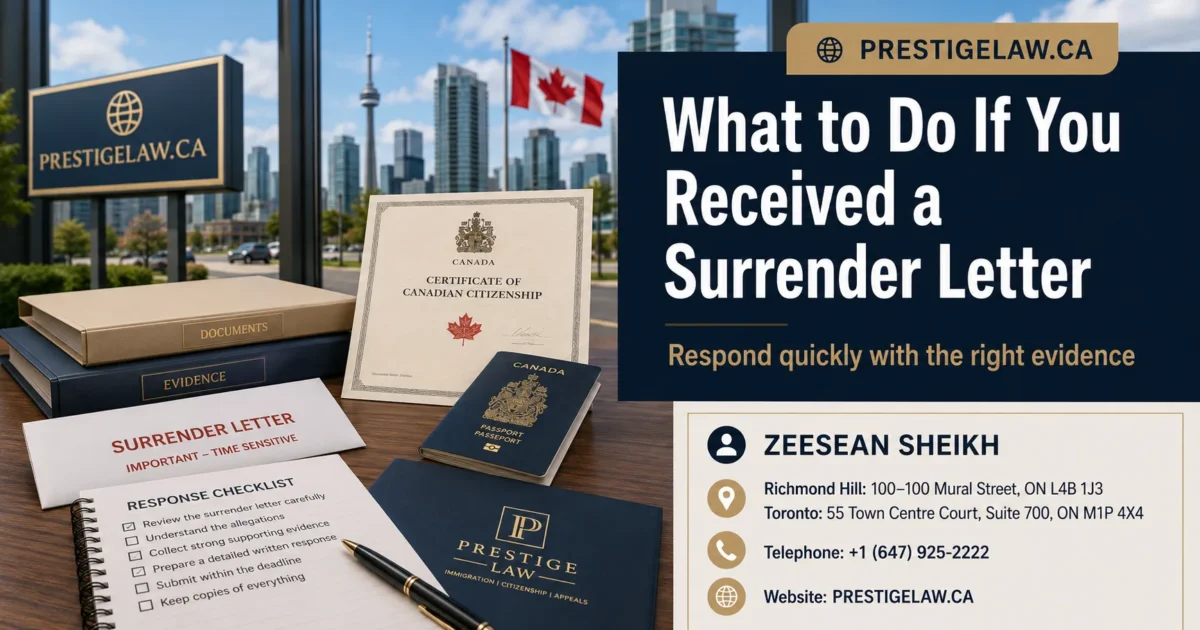
If you’ve received a letter from IRCC’s Registrar of Canadian Citizenship asking you to surrender your certificate, a few facts should guide your next steps.
You are still considered a Canadian citizen while your file is under review. Under Canadian citizenship law, applicants who have received a surrender letter remain Canadian citizens while their application is under review — the certificate is the document that proves that status and allows you to obtain a passport, but the underlying citizenship is not automatically lost simply because the certificate is being re-examined.
You cannot use a Canadian passport while the review is ongoing. IRCC has stated it is notifying affected individuals that they cannot use a Canadian passport while their citizenship claim is under review. If you hold a Canadian passport obtained on the strength of the now-surrendered certificate, treat its use as suspended until the matter is resolved.
You will have an opportunity to respond with more evidence. Anyone who receives a surrender letter is given a chance to submit additional documentary evidence, and if the review confirms Canadian lineage, the certificate will be returned. This is the most important window in the entire process — the strength and completeness of what you submit here often determines the outcome.
A rejection is not necessarily final. If IRCC ultimately determines an applicant is not entitled to Canadian citizenship, the certificate can be permanently cancelled — but immigration lawyers have pointed out that applicants who followed the instructions available at the time of their original application may have strong legal grounds to challenge a rejection, particularly given Federal Court precedents requiring IRCC to provide clear and consistent instructions to applicants. Legal commentators have also noted that lawyers expect court action in response to this review, pointing to potential Federal Court judicial review applications on grounds such as procedural fairness and legitimate expectations — since the people affected relied in good faith on certificates the government itself had issued to them.
Given the legal complexity and the time-sensitive nature of a response, do not respond to a surrender letter without first speaking to an immigration lawyer. What you submit, and how it’s framed, can materially affect whether your certificate is reinstated or your case becomes part of a longer dispute.
How to Strengthen a Pending or New Application
Whether you’re mid-process or just starting your research into a citizenship-by-descent claim, the current environment calls for a more rigorous approach to evidence than may have been the norm even a few months ago.
- Go to the source. Wherever possible, obtain vital records — birth, marriage, and death certificates — directly from the provincial, territorial, or foreign civil registry that originally issued them, rather than relying solely on compiled family-tree platforms.
- Document your search, not just your findings. If an original record genuinely cannot be located, keep a paper trail of every request you made: dates, contact names, response letters, and any formal confirmation of non-existence from the relevant authority.
- Anticipate the multi-generational chain. If your claim depends on a parent, grandparent, or earlier ancestor’s citizenship, be prepared to substantiate each link in that chain individually, not just your own connection to the most recent relative.
- Check whether the 1,095-day rule applies to you. If you were born on or after December 15, 2025, to a parent who was also born outside Canada, confirm early whether the physical presence requirement applies and begin gathering evidence — travel records, employment history, tax filings, school records — well before you file.
- File family applications as a coordinated package. Because an incomplete file from one family member can hold up the entire group’s applications, review every application in a shared submission together before sending.
- Expect a longer wait, and plan accordingly. Processing times for proof of citizenship applications have risen to roughly 19 months, with the application queue approaching 100,000 people as of July 2026, meaning someone applying today should realistically expect a decision around February 2028. Because IRCC’s processing estimate is based on the number of applications already ahead of yours, delaying your filing tends to push your eventual decision even further out rather than shortening the wait.
Processing Times and the Growing Application Queue
The scale of this issue has grown quickly. As of May 12, 2026, roughly 70,400 people were waiting for a decision on their proof of citizenship application; that number climbed to approximately 82,000 by June 2026 — an increase of 11,600 applicants in under a month. Processing times over that period jumped from roughly nine months to fifteen months since the December 2025 expansion of eligibility took effect.
By July 2026, the queue had grown further still, nearing 100,000 applicants, with processing times reaching approximately 19 months — up from just five months in May 2025. Some of this increase in wait times is directly tied to the certificate review process itself, which paused finalisation of new applications for several weeks while IRCC completed its assessment of previously issued certificates.
IRCC’s own statement described this as a period of “reviewing how this occurred,” with the department committing to steps that ensure applications are assessed fairly and lawfully going forward. For applicants, the practical takeaway is twofold: expect longer timelines than earlier in 2026, and expect closer document scrutiny throughout the process, not just at the initial filing stage.
Legal Grounds for Challenging a Rejection or Cancellation
If your certificate is ultimately cancelled or your new application is rejected, you are not without options. Canadian administrative and immigration law provides several potential avenues, and an experienced immigration lawyer can assess which, if any, apply to your specific situation:
- Procedural fairness. If IRCC issued instructions or checklists at the time of your original application that differed materially from the standard now being applied retroactively, this may support an argument that you were not given a fair opportunity to meet the requirements that actually governed your case.
- Legitimate expectations. Where the government itself issued a certificate based on an application that met the guidance in effect at the time, there is a reasonable argument that applicants relied on that guidance in good faith, and that this reliance should factor into how any subsequent review is conducted.
- Federal Court judicial review. Decisions by IRCC can, in certain circumstances, be challenged through an application for judicial review at the Federal Court of Canada, particularly where an applicant believes the decision-making process was procedurally unfair or unreasonable.
These are complex, fact-specific legal arguments, and success depends heavily on the details of the individual case, the timeline of the original application, and the specific communications received from IRCC. This is precisely the kind of situation where professional legal guidance — rather than a do-it-yourself response — makes a meaningful difference to the outcome.
How Prestige Law Can Help
Navigating a citizenship certificate review, responding to a surrender letter, or preparing a Bill C-3 application under the new CIT 0014 standard requires more than filling out a form correctly. It requires understanding how IRCC’s evidentiary expectations have shifted, how to build a documentary record that withstands scrutiny, and how to respond strategically if your file has already been flagged.
At Prestige Law, our team works directly with clients across Canada and internationally to prepare strong, defensible citizenship-by-descent applications, respond to IRCC reviews and surrender letters, and pursue further legal remedies where appropriate. If you’ve received a letter from IRCC regarding your citizenship certificate, or you’re preparing a new application and want to make sure your documentation holds up under the current standard, our office can help you build your case with the right evidence, submitted the right way, the first time.
Frequently Asked Questions
What is IRCC’s proof of citizenship review that happened in 2026? It was an administrative review in which IRCC examined roughly 6,500 previously issued citizenship-by-descent certificates to verify whether the underlying documentation met required standards, following concerns that some applications relied on compiled genealogy records rather than certified original-source documents.
Am I still a Canadian citizen if I received a surrender letter? Yes. Receiving a surrender letter does not remove your citizenship status. You remain a Canadian citizen while your file is under review; the certificate itself is simply the document that proves that status.
Can I still use my Canadian passport if my certificate is under review? No. IRCC has stated that individuals whose certificates are under review should not use a Canadian passport obtained based on that certificate until the review is resolved.
What documents does IRCC now require for a citizenship by descent application? Applicants must provide documents from source authorities, such as provincial or territorial vital statistics offices, foreign civil registries, or other official government bodies. Compiled third-party genealogy records alone are no longer sufficient.
What if I can’t find an original birth or marriage certificate? You should request a formal letter of no record from the relevant registry and gather evidence of your efforts to obtain the document, such as correspondence with the issuing authority. Secondary evidence like baptismal or census records may be considered alongside this documentation.
Does the new 1,095-day physical presence rule apply to me? It applies specifically to applicants born on or after December 15, 2025, where the Canadian parent was also born outside Canada to a Canadian parent. In that scenario, proof that the Canadian parent was physically present in Canada for at least 1,095 cumulative days before the applicant’s birth is required.
How long does it currently take to get proof of Canadian citizenship? As of July 2026, processing times have risen to approximately 19 months, with the application queue approaching 100,000 people, meaning a new application could realistically take until early 2028 for a decision.
Can I challenge IRCC’s decision if my citizenship certificate is cancelled? In many cases, yes. Depending on the circumstances of your original application and the instructions in effect at the time, you may have grounds to challenge a rejection or cancellation, including through a Federal Court judicial review application.
Should I respond to a surrender letter on my own? It’s strongly recommended that you consult an immigration lawyer before responding. The evidence you submit at this stage can significantly affect whether your certificate is reinstated, and the legal issues involved are highly fact-specific.
Who is eligible for Canadian citizenship by descent under the current rules? Anyone who can trace an unbroken line of descent back to a Canadian citizen ancestor born before December 15, 2025, may now be eligible, following the removal of the previous first-generation limit under Bill C-3.
Prestige Law, guided by immigration lawyer Zeesean Sheikh, helps clients across Canada and abroad navigate complex citizenship, immigration, and permanent residency matters with clarity and care.
📍 Richmond Hill: 100–100 Mural Street, ON
📍 Toronto: 55 Town Centre Court, Suite 700, ON
📞 +1 (647) 925-2222
🌐 prestigelaw.ca