



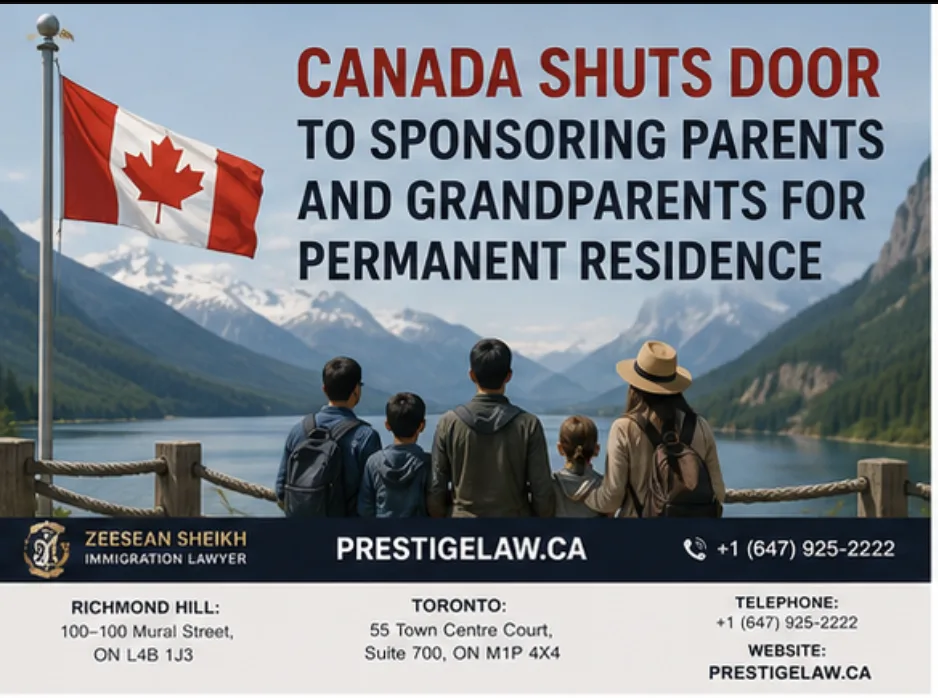
Canada Shuts Door to Sponsoring Parents and Grandparents for Permanent Residence

Canada has officially paused new intake under the Parents and Grandparents Program (PGP), the main permanent residence pathway that allows Canadian citizens and permanent residents to reunite with their parents and grandparents permanently, marking the third consecutive year that Immigration, Refugees and Citizenship Canada (IRCC) has declined to open a fresh intake round and leaving tens of thousands of hopeful families across the country without a clear timeline for when the door might reopen, even as the department continues processing a backlog of more than 60,000 applications already in its system and shifts its attention toward the Super Visa as the only actively available route for parents and grandparents who want to spend extended time with their Canadian families in the meantime. Canada Pauses Parent & Grandparent Sponsorship 2026
What IRCC Announced on July 15, 2026
On July 15, 2026, IRCC published a formal notice confirming that it is pausing the intake of new applications under the Parents and Grandparents Program. The department stated plainly that it will not receive new Interest to Sponsor forms, nor will it invite potential sponsors to apply, until further notice. This is not a temporary technical delay. It is a deliberate policy decision tied directly to Canada’s 2026–2028 Immigration Levels Plan, which has steadily reduced the number of permanent residency spots allocated to parents and grandparents in favour of economic immigration streams.
IRCC has confirmed that it will keep processing the applications already sitting in its inventory to approve up to 15,000 people for permanent residence through the PGP Program in 2026. The department frames this approach as a way to bring down wait times and create more predictability for the families who are already in the queue, rather than adding new applicants to an already strained system.
For many Canadian families, this announcement confirms what immigration professionals have been warning about for months: the PGP is no longer functioning as an annual, predictable program. It has become something closer to a slow, backlog-clearing exercise with no fixed reopening date.
A Program That Has Not Truly Reopened Since 2020
To understand how significant this pause really is, it helps to look at the program’s recent history. IRCC has not accepted a new round of Interest to Sponsor forms since October and November 2020, when the department collected more than 200,000 expressions of interest during a three-week window. Every intake since then, including in 2021, 2022, 2023, 2024, and 2025, has drawn invitations from that same original 2020 pool rather than opening a new submission window.
In 2025, IRCC issued invitations between late July and mid-August, aiming to receive 10,000 complete applications by an October deadline. As of January 1, 2026, the department confirmed it had paused new PGP applications until further instructions were issued, a pause that the July 15 announcement has now formalised and extended indefinitely.
In other words, families who submitted an Interest to Sponsor form back in 2020 have spent close to six years waiting simply to find out whether they will be randomly selected to apply. For everyone who did not submit a form during that original window, there has been no opportunity to enter the pool at all for six years running, and the July 2026 announcement confirms there is still no indication of when, or if, a new intake window will open.
Why the Targets Keep Shrinking
The PGP pause did not happen in isolation. It reflects a broader recalibration of Canada’s immigration priorities that has been building for several years. The PGP admission target has fallen sharply:
- 2024: 32,000 admissions targeted
- 2025: 24,500 admissions targeted
- 2026: 15,000 admissions targeted
- 2027 (planned): 15,000 admissions targeted
- 2028 (planned): 15,000 admissions targeted
That represents a drop of more than 50 per cent in just two years, and the federal government’s current planning documents show no increase through 2028. Total family class admissions overall have followed a similar downward trend, falling from roughly 114,000 in 2024 to approximately 84,000 in 2026, even though family reunification still accounts for around 21 to 22 per cent of all permanent resident admissions.
The processing inventory tells its own story. As of mid-2025, IRCC reported more than 55,000 people already sitting in the PGP processing pipeline, a number that has since grown to over 60,000. With admission targets shrinking and the existing backlog already exceeding what the department plans to approve in a given year, IRCC has effectively run out of room, and arguably out of appetite, to accept new applicants until that backlog is brought under control.
This shift is consistent with Canada’s wider immigration strategy over the past two years, which has prioritised economic-class immigration, tightened international student and temporary resident volumes, and slowed overall permanent resident admissions in response to housing affordability pressures and public concern about the pace of population growth. Family reunification programs, including the PGP, have absorbed a disproportionate share of that slowdown.
What This Means If You Already Have an Application in the System
If you submitted a complete PGP sponsorship application in a previous intake year and it is already being processed, this pause does not cancel or suspend your file. IRCC has confirmed it will continue working through existing applications, with a stated goal of approving up to 15,000 people in 2026. Processing times for applicants destined outside Quebec have generally run in the range of two to three years, while Quebec-destined files have historically taken longer, so continued patience and complete, well-organised documentation remain essential.
If you hold an Interest to Sponsor form from the 2020 pool but have not yet received an invitation to apply, your form remains valid, and you remain in the pool. However, there is currently no published timeline for when, or whether, further invitations will be drawn from that pool in 2026. Sponsors in this position should keep their contact information and income documentation current, since an invitation can arrive with a limited window to submit a complete application.
If you have never submitted an Interest to Sponsor form, there is currently no mechanism available to enter the pool. IRCC has stated it will not accept new forms or invite new sponsors until further notice, and no reopening date has been announced.
The Super Visa: The Only Active Pathway Right Now
With the PGP pathway closed to new entrants, IRCC has pointed directly to the Parent and Grandparent Super Visa as the tool that remains open today. The Super Visa is a long-term, multiple-entry temporary resident visa, not a permanent residence pathway, but it allows parents and grandparents of Canadian citizens and permanent residents to stay in Canada for up to five years at a time, with the possibility of a two-year extension from within Canada, and remains valid for entry over a period of up to ten years.
Importantly, IRCC has just made the Super Visa considerably easier to qualify for. Effective March 31, 2026, the department introduced two significant changes to how it calculates the income requirement for Super Visa hosts:
1. A two-year income assessment window. Previously, IRCC assessed only the host’s most recent tax year against the minimum income threshold. Under the new rule, hosts can rely on whichever of their two most recent tax years shows the higher income, which is a meaningful change for anyone whose earnings fluctuated due to parental leave, a career transition, seasonal or commission-based work, or a temporary income dip.
2. The ability to include the visiting parent or grandparent’s own income. Where a host and a co-signer, if applicable, already meet a minimum portion of the required income threshold, the visiting relative’s own recurring income, such as a foreign pension, rental income, or investment income, can now be used to help close the remaining gap. This is a notable shift for retired parents and grandparents who bring stable income of their own but were previously excluded from the calculation entirely.
These new rules apply retroactively to applications that were already in processing as of March 31, 2026, as well as to every application submitted from that date forward. Families who were previously just short of qualifying, whether because of a single weak income year or a parent with meaningful income sitting outside Canada, may want to revisit their eligibility under the updated criteria.
Other Super Visa requirements remain unchanged. Hosts must still provide a genuine letter of invitation, applicants must still undergo a medical examination, and applicants must still purchase a minimum of $100,000 in Canadian medical insurance coverage valid for at least one year from the date of entry.
2026 Super Visa Minimum Necessary Income Table
Meeting the income requirement is the single most common reason Super Visa applications get refused, so it is worth understanding exactly where the current thresholds sit. As of the most recent IRCC update effective July 29, 2026, the Minimum Necessary Income for a Super Visa host is calculated as the Low Income Cut-Off (LICO) for the relevant family size, plus an additional 30 per cent. Family size includes the host, their spouse or common-law partner, all dependent children, and the parent or grandparent applicant being invited.
Family Size (including applicant)Minimum Necessary Income (Gross, Annual)
1 person $30,526
2 people $38,002
3 people $46,720
4 people $56,724
5 people $64,336
6 people See IRCC’s published table for the exact figure
7 or more people $80,784, plus an incremental amount for each additional person
These figures represent gross income, meaning total earnings before taxes and deductions, as reported on Line 15000 of the Notice of Assessment. Under the March 31, 2026 rules, hosts can qualify using whichever of their two most recent tax years shows the stronger figure, and once a host meets a minimum share of the threshold independently, the visiting parent or grandparent’s own income, such as a foreign pension or investment income, can help close any remaining gap. Because IRCC adjusts these thresholds periodically for inflation, sponsors should always confirm the current table on the official IRCC website before submitting documentation.
Parents and Grandparents Program Intake History at a Glance
Understanding how the PGP intake process has evolved over the past several years helps explain why the July 2026 pause feels different from a routine annual pause.
YearIntake ActivityNotes
2020 New Interest to Sponsor window opened Over 200,000 forms submitted in three weeks
2021–2024 No new forms accepted Invitations drawn exclusively from the 2020 pool
2025 Invitations issued from 2020 pool Goal of 10,000 complete applications by the October deadline
Jan 1, 2026 Intake paused pending new instructions No new invitations issued
July 15, 2026 Formal pause confirmed indefinitely No new forms or invitations until further notice
Six consecutive years without a genuine new intake window marks a real shift from how the program operated in its earlier years, when new Interest to Sponsor windows opened more frequently and gave a wider pool of families a realistic chance to enter the process.
PGP vs. Super Visa: How the Two Pathways Compare
Because the terminology around these two programs is often confused, a side-by-side comparison can help families decide where to focus their efforts right now.
Feature Parents and Grandparents Program (PGP)Super Visa
Type of status Permanent residence Temporary, multiple-entry visitor visa
Current availability Paused indefinitely for new applicants Open and actively accepting applications
Length of stay Indefinite, as a permanent resident Up to 5 years per visit, extendable by 2 years, valid up to 10 years
Income test Minimum Necessary Income based on 3 years of Notices of Assessment LICO plus 30%, now assessable over 2 tax years
Health coverage Provincial healthcare once landed Minimum $100,000 private medical insurance required
Right to work or study Yes, once permanent residence is granted No
Typical processing time Historically 24 to 36+ months once invited to apply Often a matter of months
Path to citizenship Yes, after meeting residency requirements No
Step-by-Step: How to Apply for a Super Visa Under the New 2026 Income Rules
For families who want to act now rather than wait for the PGP to reopen, here is a general outline of the Super Visa application process.
- Confirm your relationship and eligibility. You must be a Canadian citizen or permanent resident inviting your parent or grandparent, or in some cases a step-parent, step-grandparent, or a grandparent’s spouse or partner, who is otherwise admissible to Canada.
- Calculate your family size and income requirement. Add together yourself, your spouse or common-law partner, your dependent children, and the parent or grandparent you are inviting, then match that total to the current LICO-plus-30-percent threshold.
- Gather your income documentation. Under the new rules, pull your last two years of Notices of Assessment so you can present whichever year shows the higher income. If you plan to include your parent or grandparent’s own income to help meet the threshold, gather supporting evidence of pension, rental, or investment income as well.
- Write a genuine letter of invitation. This letter should explain your relationship, confirm that you will provide financial support during the visit, and outline living arrangements while your parent or grandparent is in Canada.
- Purchase the required medical insurance. Applicants must show proof of a minimum of $100,000 in medical insurance coverage from a Canadian insurer, valid for at least one year from the date of entry.
- Complete a medical examination. A panel physician exam is mandatory and should be booked early, since results can take several weeks to process.
- Submit the complete application. Include the letter of invitation, proof of your status in Canada, income documentation, insurance proof, and medical exam confirmation together as one complete package.
- Monitor your application and plan for extensions. Once approved, your parent or grandparent can stay for up to five years at a time and may apply from within Canada to extend that stay by up to two additional years before it expires.
Practical Options for Families Right Now
For families who had been planning to pursue PGP sponsorship, the pause requires a shift in strategy rather than an abandonment of the goal. A few practical paths are worth considering.
Apply for or renew a Super Visa now. With income rules newly relaxed, this is the most realistic way to reunite with parents or grandparents for an extended period while the PGP remains paused. A Super Visa application can often be processed in a matter of months rather than years.
Keep your Interest to Sponsor form active if you already have one. No indication that existing 2020-pool forms have been cancelled. Ensure your contact details, income documentation, and family composition information are ready so you can respond quickly if an invitation is issued.
Reassess your Minimum Necessary Income position. Whether you are aiming for a future PGP application or a Super Visa application today, income documentation is central to both. Reviewing your last two Notices of Assessment now, rather than waiting until you need them, can save significant time later.
Watch for the next Immigration Levels Plan update. IRCC typically tables an updated Immigration Levels Plan each autumn. The next update could reveal whether PGP targets for 2029 and beyond will remain flat, increase, or fall further, and may signal whether a new intake window is being considered.
Speak with an immigration lawyer before assuming any pathway is closed to you. Family circumstances vary widely, and there are other family class and economic pathways, such as spousal or dependent child sponsorship, that remain unaffected by this pause and may be relevant depending on your situation.
Other Family Sponsorship Pathways That Remain Unaffected
It is worth emphasising that this pause applies specifically to the Parents and Grandparents Program. Other family class sponsorship categories continue to operate on their normal timelines and are not affected by the July 2026 announcement.
Spousal and common-law partner sponsorship remains open year-round with no annual cap or lottery system. Canadian citizens and permanent residents can sponsor a spouse, common-law partner, or conjugal partner at any time, and IRCC has generally prioritised fast processing for these applications given the direct family unit involved.
Dependent child sponsorship also remains open on an ongoing basis, allowing Canadian citizens and permanent residents to sponsor their dependent children for permanent residence without waiting for a specific intake window.
Adoption-based sponsorship for children adopted internationally similarly continues to operate outside the PGP framework and is unaffected by this pause.
If your family’s immigration goals involve any of these categories alongside a parent or grandparent, it is worth pursuing those applications on their normal timeline rather than assuming the entire family class system has slowed down. The PGP pause is a targeted policy decision affecting one specific stream, not a blanket freeze on family reunification as a whole.
Why This Matters Beyond the Headlines
The PGP pause is not just a procedural update buried in a government notice. For many Canadian families, particularly newer immigrants who came to Canada through economic or family pathways themselves, the ability to eventually bring ageing parents to Canada permanently is one of the emotional cornerstones of choosing to build a life here. A prolonged pause, layered on top of a program that has already gone six years without a genuine new intake, changes the calculus for how families plan multi-generational life in Canada.
At the same time, the government’s rationale, reducing an unmanageable backlog and creating more predictable processing for those already in the system, is not without merit. Wait times for existing applicants had climbed to three years or longer in some cases, and continuing to add new applicants to that queue without increasing overall admission targets would only have made those wait times worse for everyone. The tradeoff, however, falls heavily on families who have not yet had any opportunity to enter the system at all.
It is also worth noting that this pause does not exist in a vacuum. It follows several years of tightening across nearly every corner of Canada’s immigration system, including reduced international student permit caps, lower temporary foreign worker allocations in many sectors, and an overall reduction in total permanent resident admission targets under the current Immigration Levels Plan. Viewed together, the PGP pause reflects a government that is deliberately slowing the pace of population growth across almost all immigration categories, not singling out parents and grandparents specifically. That context does not make the pause easier for affected families, but it does help explain why a program that once opened annually has now gone six years without a genuine new intake.
For sponsors who remain in the 2020 Interest to Sponsor pool, the most productive use of this waiting period is preparation rather than passive hope. Reviewing your Minimum Necessary Income position across the past three tax years, confirming that your relationship documentation with your parent or grandparent is current, and staying informed about Immigration Levels Plan updates each autumn will put you in the strongest possible position if and when new invitations are drawn from the pool.
How Prestige Law Can Help
Navigating a shifting immigration landscape requires more than watching for headlines. It requires a clear understanding of where your specific file stands, what options remain open to you today, and how to position your application, whether that is a Super Visa application under the new income rules or preparation for a future PGP intake, so that it has the best possible chance of success.
Zeesean Sheikh and the team at Prestige Law regularly assist Canadian citizens and permanent residents with family sponsorship strategy, Super Visa applications, and Minimum Necessary Income documentation. If you are unsure what this pause means for your specific circumstances, a consultation can help clarify your options and put a realistic plan in place.
Frequently Asked Questions
Is the Parents and Grandparents Program permanently closed? No. IRCC has paused new intake, not cancelled the program. The department has stated it will continue processing existing applications and has not ruled out a future intake, but it has also not announced any reopening date.
Can I still submit an Interest to Sponsor form? No. As of the July 15, 2026 notice, IRCC is not accepting new Interest to Sponsor forms and is not inviting new sponsors to apply until further notice.
What happens to my application if I already applied? Existing applications continue to be processed. IRCC has stated it plans to approve up to 15,000 people for permanent residence through the PGP Program in 2026, drawing from its current inventory of applications.
Is the Super Visa a replacement for the PGP? Not exactly. The Super Visa is a temporary, multiple-entry visitor visa allowing stays of up to five years at a time, extendable, and valid for up to ten years. It does not lead directly to permanent residence, but it is currently the only actively available route for parents and grandparents to spend extended time in Canada.
Did the Super Visa income requirements change? Yes. As of March 31, 2026, hosts can qualify using whichever of their two most recent tax years shows higher income, and may also count a portion of the visiting parent or grandparent’s own income, such as a pension, once the host meets a minimum share of the required threshold.
How long is the current PGP backlog? IRCC’s processing inventory for the PGP Program stood at more than 60,000 applications as of mid-2026, which is part of why the department paused new intake rather than adding to that queue.
When will PGP reopen for new applications? IRCC has not announced a reopening date. Current federal planning documents show the PGP admission target remaining at 15,000 through 2027 and 2028, which suggests the pause could continue for some time, though this could change with future Immigration Levels Plan updates.
Should I still apply for a Super Visa if I plan to sponsor my parents for permanent residence later? Many families pursue both in parallel. A Super Visa allows your parents or grandparents to be physically present in Canada for extended periods now, while you continue to monitor for any future PGP intake opportunity.
Does the PGP pause affect spousal or dependent child sponsorship? No. This pause applies only to the Parents and Grandparents Program. Spousal, common-law partner, conjugal partner, and dependent child sponsorship applications continue to be accepted and processed on their usual timelines.
Can I sponsor my parents through an economic immigration program instead? Parents and grandparents are not eligible under Canada’s economic immigration streams, such as Express Entry or Provincial Nominee Programs, since those pathways are designed for principal applicants who can work and contribute economically on their own merits. Family reunification streams like the PGP and Super Visa remain the primary options for parents and grandparents.
Contact Prestige Law
Zeesean Sheikh
📍 Richmond Hill: 100–100 Mural Street, ON 📍 Toronto: 55 Town Centre Court, Suite 700, ON
📞 Telephone: +1 (647) 925-2222
🌐 Website: prestigelaw.ca