





Low-Wage LMIA Processing Restrictions Lifted for Eight Regions, Including Halifax, Winnipeg, and Regina
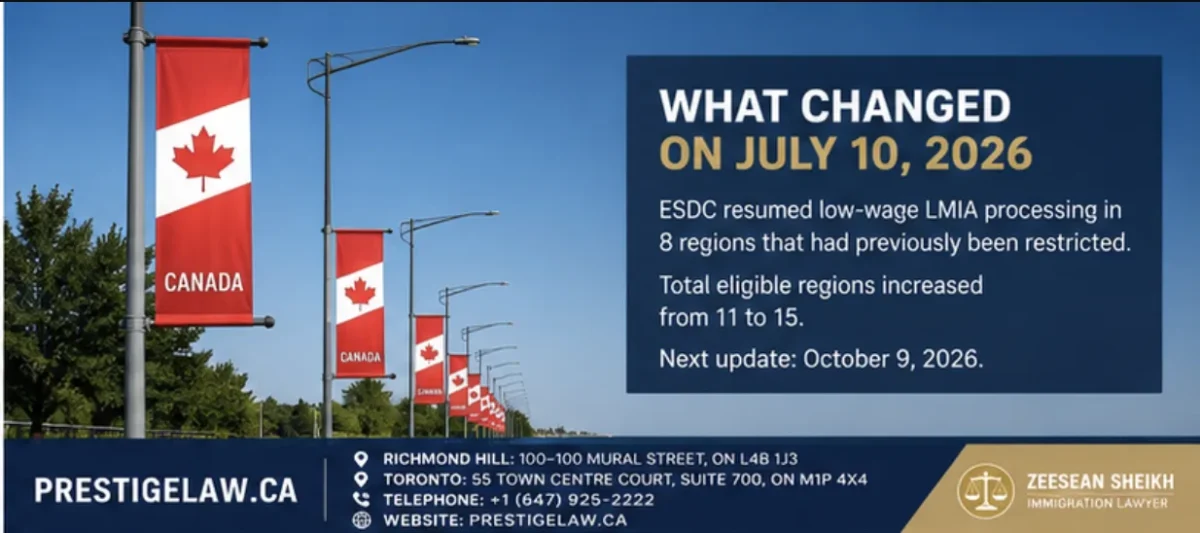
Beginning July 10, 2026, Employment and Social Development Canada (ESDC) resumed processing low-wage Labour Market Impact Assessment (LMIA) applications in eight Canadian regions that had previously been shut out under the federal government’s regional unemployment-rate restriction, including three cities that carry significant weight for employers and newcomers alike: Halifax, Nova Scotia; Winnipeg, Manitoba; and Regina, Saskatchewan. The change is part of ESDC’s routine quarterly review of labour market conditions across the country’s Census Metropolitan Areas (CMAs), and it brings the total number of regions eligible for low-wage LMIA processing to fifteen, up from eleven in the previous quarter. For Canadian employers who rely on the Temporary Foreign Worker Program (TFWP) to fill entry-level and low-wage roles, and for foreign nationals whose work permit applications depend on a positive or neutral LMIA, this update reopens a door that had been closed since the spring. But the update is not uniformly positive: four other regions, including Saskatoon and Kamloops, moved in the opposite direction and are now newly restricted. Understanding exactly where your CMA stands, and what the rules require even once a region becomes eligible, is essential before any low-wage LMIA application is filed. Low-Wage LMIA Restrictions Lifted in 8 Canadian
What Changed on July 10, 2026 Low-Wage LMIA Restrictions Lifted in 8 Canadian
Every three months, ESDC publishes an updated list of CMAs where low-wage LMIA applications will, and will not, be processed. The list is built directly from Statistics Canada’s Labour Force Survey data, and the rule is simple in concept: if a CMA’s unemployment rate sits at 6% or higher, ESDC will refuse to process new low-wage LMIA applications tied to job locations in that CMA. If the rate falls below 6%, the region becomes eligible again.
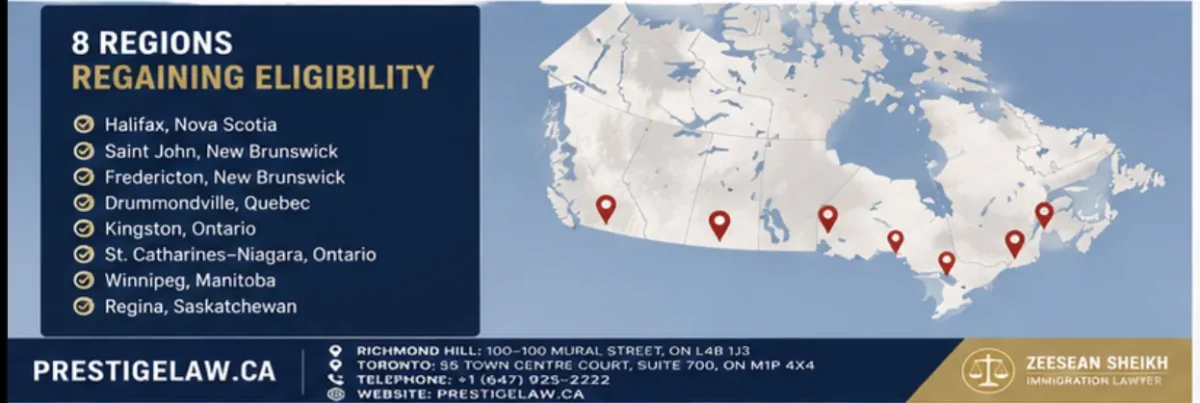
The July 10 update reflected a broadly positive shift for several parts of the country. Eight regions that had been ineligible in the prior quarter dropped back below the 6% threshold: Halifax, Saint John, Fredericton, Drummondville, Kingston, St. Catharines-Niagara, Winnipeg, and Regina. That brought the number of eligible CMAs nationally from eleven up to fifteen. At the same time, four regions that had been eligible in the previous quarter crossed above the threshold and lost eligibility: Saskatoon, Red Deer, Kamloops, and Chilliwack. The next scheduled update will take effect on October 9, 2026.
For employers and prospective foreign workers, this quarterly cycle means that eligibility is never permanent. A region that is open today may close again in three months, and a region that is closed today may reopen. Anyone planning around the low-wage stream needs to treat each quarter’s list as a fresh checkpoint, not a settled fact.
Understanding the Low-Wage LMIA Refusal-to-Process Rule
To understand why this update matters, it helps to understand the rule itself. In August 2024, the federal government introduced a measure restricting access to the low-wage stream of the TFWP in regions where local unemployment was already elevated. The stated goal was to better align temporary foreign worker hiring with regional labour market realities and to ensure that Canadian citizens and permanent residents already living in high-unemployment areas were given priority for available low-wage job opportunities. Since then, ESDC has published an updated list of restricted and eligible CMAs every quarter, and the list has shifted considerably as regional economic conditions have changed.
How the 6% Threshold Works
The mechanism itself is straightforward. ESDC pulls the most recent three-month average unemployment rate for each CMA from Statistics Canada. If that rate is 6% or higher, the region is placed on the restricted list, and low-wage LMIA applications tied to that CMA will not be processed for the duration of the quarter. If the rate is below 6%, the region is eligible, and employers can submit low-wage LMIA applications in the normal course.
It’s worth being precise about what “low-wage” means in this context, because the restriction does not apply uniformly. A position is generally considered low-wage if the offered wage falls below the provincial or territorial median hourly wage threshold, or below what the employer already pays other workers in the same role and location with similar experience, whichever is higher. Positions that meet or exceed that threshold fall into the high-wage stream instead, which is not subject to the CMA unemployment restriction at all. This distinction matters enormously for employers weighing their options, and we address it in more detail below.
It’s also critical to understand that the applicable rate is the one in effect on the date the LMIA application is actually submitted, not the date the job offer was made or the date recruitment advertising began. An employer who submitted a low-wage LMIA before July 10 will have that application assessed under the previous quarter’s rates, regardless of what the July 10 update says. Only new applications, submitted on or after July 10, are governed by the current list.
The Eight Regions Regaining Eligibility
The eight CMAs that moved back below the 6% threshold as of July 10, 2026 are:
Verifica quali sono i siti casino sicuri con licenza italiana.
- Halifax, Nova Scotia
- Saint John, New Brunswick
- Fredericton, New Brunswick
- Drummondville, Quebec
- Kingston, Ontario
- St. Catharines-Niagara, Ontario
- Winnipeg, Manitoba
- Regina, Saskatchewan
Three of these are Atlantic Canadian CMAs. Halifax, Saint John, and Fredericton had all lost eligibility earlier in the year, and their return below the threshold restores low-wage LMIA access across most of the region — though Moncton, New Brunswick remains restricted, with an unemployment rate still above 8%. St. Catharines-Niagara is a particularly notable addition for Ontario employers, since it had not appeared on the eligible list in recent quarters and now offers a new option in a province where eligible CMAs have otherwise been scarce. Winnipeg and Regina both moved back below the line as well, giving employers in Manitoba and Saskatchewan renewed access to the low-wage stream in their two largest metropolitan labour markets.
Full List of 15 Eligible CMAs (July 10 to October 8, 2026)
The complete list of CMAs currently eligible for low-wage LMIA processing, for the period running from July 10 to October 8, 2026, is as follows:
- Halifax, NS
- Saint John, NB
- Fredericton, NB
- Saguenay, QC
- Québec City, QC
- Sherbrooke, QC
- Trois-Rivières, QC
- Drummondville, QC
- Kingston, ON
- St. Catharines-Niagara, ON
- Thunder Bay, ON
- Winnipeg, MB
- Regina, SK
- Lethbridge, AB
- Victoria, BC
Quebec’s smaller and mid-sized cities continue to dominate this list. Saguenay, Québec City, Sherbrooke, and Trois-Rivières have remained consistently below the 6% threshold for well over a year, making the province’s regions outside Montreal the most reliable low-wage LMIA option in the country. It is worth noting, however, that most job opportunities in Quebec will require a working level of French, which is a separate consideration for both employers and prospective workers to plan around.
In Alberta, Lethbridge is currently the only eligible CMA. In British Columbia, Victoria remains the sole consistently eligible metropolitan area, having stayed below the threshold for more than a year while the province’s interior cities have moved in and out of restriction.
Regions Still Restricted: 26 CMAs Where Low-Wage LMIAs Won’t Be Processed
While the July 10 update brought good news to eight regions, it left twenty-six CMAs on the restricted list, meaning ESDC will continue to refuse processing of low-wage LMIA applications tied to those locations through at least October 8, 2026. The restricted CMAs include several of the country’s largest urban centres: Toronto, Vancouver, Calgary, Edmonton, Ottawa-Gatineau, Hamilton, and Montréal all remain above the 6% threshold, alongside St. John’s, Moncton, and a large cluster of Ontario cities including Kitchener-Cambridge-Waterloo, London, Windsor, Barrie, Oshawa, Peterborough, Belleville-Quinte West, Guelph, and Greater Sudbury. British Columbia’s Kelowna, Abbotsford-Mission, and Nanaimo also remain restricted, along with Brantford, Ontario.
For employers and foreign workers connected to any of these regions, low-wage LMIA applications submitted on or after July 10, 2026 will not move forward unless the position qualifies for an occupational exemption or the employer restructures the offer to meet the high-wage threshold instead.
Newly Restricted: Saskatoon, Red Deer, Kamloops, and Chilliwack
Four CMAs moved in the opposite direction this quarter, crossing above the 6% threshold after having been eligible in the prior period: Saskatoon, Red Deer, Kamloops, and Chilliwack. All four had regained eligibility earlier in 2026 after a period of restriction, but none held below the threshold for a second consecutive quarter.
Saskatoon’s shift is particularly notable because it had sat below 6% unemployment for multiple consecutive quarters before this update, making its return to the restricted list the first such move in the current cycle. Red Deer’s trajectory illustrates just how volatile these regional labour markets can be: the city’s unemployment rate was reported near 9% in January, dropped below 6% by April, and has now climbed back above 7% for the current quarter. A single quarter of improvement does not necessarily indicate a sustained trend, and employers planning multi-quarter hiring strategies should factor that volatility into their timelines.
Occupational Exemptions to the Refusal-to-Process Rule
The 6% unemployment restriction does not apply uniformly to every low-wage job in a restricted CMA. ESDC maintains a list of occupational categories that are exempt from the refusal-to-process measure regardless of the local unemployment rate. These exemptions generally include roles in construction, food manufacturing, hospitals, nursing and residential care facilities, and primary agriculture, along with certain short-duration positions of 120 calendar days or less that meet specific program criteria.
Employers hiring for exempt occupations in a restricted CMA should not assume their application will be blocked simply because the region appears on the restricted list. It is essential to review the specific occupational and job-duration criteria closely, since exemption eligibility depends on the precise nature of the role rather than the industry label alone. Given how detailed and fact-specific these exemption categories can be, employers are well advised to have their position and application reviewed before submission to confirm exemption status.
What This Means for Employers in Halifax, Winnipeg, and Regina
For employers based in Halifax, Winnipeg, or Regina, the July 10 update means that low-wage LMIA applications submitted from this date forward will not be blocked by the regional unemployment restriction, provided the CMA remains below the 6% threshold when the application is filed. This is a meaningful development for sectors that rely heavily on the TFWP’s low-wage stream, including hospitality, retail, food service, and other roles that frequently fall below the applicable wage threshold.
That said, a reopened CMA removes only one barrier among several. It does not create an automatic approval, and it does not exempt the employer from any of the program’s standard requirements.
Recruitment and Advertising Requirements Still Apply
Regardless of whether a CMA is currently eligible, employers must still demonstrate that they attempted, and failed, to recruit a Canadian citizen or permanent resident for the position before applying for an LMIA. This includes meeting the program’s minimum advertising requirements, which typically range from 14 days to eight weeks depending on the stream, and must generally be completed in the three months before LMIA submission. Employers must also continue to meet all other standard program obligations, including demonstrating business legitimacy, offering wages and working conditions consistent with prevailing standards, and establishing a genuine need for a foreign worker in the role.
In other words, the July 10 update opens the door for eligible applications to be processed at all — it does not shortcut any of the underlying legal and procedural requirements that determine whether an individual LMIA application will ultimately be approved.
What This Means for Foreign Workers and Existing Work Permit Holders
Foreign nationals already working in Canada under a valid work permit are not affected by this update in any way. The quarterly unemployment-rate review only determines whether ESDC will accept and process new low-wage LMIA applications going forward; it has no bearing on work permits that have already been issued, and it does not shorten or otherwise alter the authorised period of work under an existing permit.
For foreign nationals who have a job offer pending in one of the eight newly eligible regions, the practical effect is that their prospective employer can now proceed with submitting a low-wage LMIA application, where previously that application would have been refused outright. It remains the employer’s responsibility to initiate and manage the LMIA process; a positive or neutral LMIA, together with a valid job offer, is a prerequisite before a work permit application can be submitted to Immigration, Refugees and Citizenship Canada (IRCC) under the TFWP.
The High-Wage Stream Alternative
For employers and foreign workers connected to a CMA that remains on the restricted list, one available option is to reconsider the position’s wage structure. The low-wage restriction applies only to positions that fall below the applicable provincial or territorial wage threshold. If an employer is able to offer a wage that meets or exceeds that threshold, the position shifts into the high-wage stream of the TFWP, which is not subject to the CMA-based unemployment restriction at all.
This is not a workaround available to every employer or every role, since wage thresholds vary by province and are themselves periodically updated. But for positions where the wage gap is modest, restructuring the offer into the high-wage stream can be a faster and more reliable path forward than waiting for a future quarterly update to potentially reopen a restricted CMA.
Rural Exemption: 15% Cap Through March 2027
It is also worth noting that the CMA-based restriction applies only to Census Metropolitan Areas — cities with a core population of 100,000 or more. Employers located in smaller communities outside these defined CMAs are generally not subject to the low-wage refusal-to-process rule at all. As a temporary measure currently scheduled to run through March 2027, employers in rural areas outside CMAs are also permitted to hire low-wage temporary foreign workers for up to 15% of their total workforce, an increase from the standard 10% cap that otherwise applies. This provision offers meaningfully more flexibility for rural and smaller-market employers who might otherwise be constrained by both the unemployment restriction and the usual workforce percentage cap.
Looking Ahead: The October 9, 2026 Update
ESDC’s next quarterly review is scheduled to take effect on October 9, 2026. Given how much movement occurred between the previous quarter and this one, with eight regions gaining eligibility and four losing it, employers and foreign workers should not assume that current conditions will hold. Regions like Red Deer have already demonstrated how quickly a single quarter of improvement can reverse. Employers planning hiring timelines that extend into the fall should build in flexibility, monitor ESDC’s published unemployment data as the October update approaches, and avoid submitting time-sensitive applications right at the edge of a quarterly transition without professional guidance.
How Prestige Law Can Help
Navigating the TFWP’s low-wage and high-wage streams, tracking quarterly CMA eligibility changes, and correctly identifying whether a specific role qualifies for an occupational exemption requires close attention to a regulatory framework that changes every three months. At Prestige Law, our team works with employers and foreign workers across Canada to assess LMIA eligibility, prepare compliant applications, and plan hiring strategies that account for the realities of a shifting regulatory landscape — whether that means confirming exemption status for a role in a restricted CMA, evaluating whether a high-wage restructuring makes sense, or simply keeping a hiring plan on track through the next quarterly update.
Frequently Asked Questions
What is a low-wage LMIA, and how is it different from a high-wage LMIA? A Labour Market Impact Assessment (LMIA) confirms that a Canadian employer was unable to fill a position with a Canadian citizen or permanent resident and that hiring a foreign worker will not negatively affect the domestic labour market. A position is classified as low-wage if the offered wage falls below the applicable provincial or territorial median wage threshold; positions at or above that threshold fall under the high-wage stream, which is not subject to the CMA unemployment restriction.
Why was low-wage LMIA processing restricted in the first place? In August 2024, the federal government began refusing to process low-wage LMIA applications in CMAs with an unemployment rate of 6% or higher, in an effort to prioritise Canadian citizens and permanent residents for available job opportunities in higher-unemployment regions.
Is Halifax currently eligible for low-wage LMIA processing? Yes. As of the July 10, 2026 update, Halifax’s unemployment rate fell below the 6% threshold, making it eligible for low-wage LMIA processing through at least October 8, 2026.
Is Winnipeg currently eligible for low-wage LMIA processing? Yes. Winnipeg regained eligibility as of July 10, 2026, and remains on the current list of eligible CMAs.
Is Regina currently eligible for low-wage LMIA processing? Yes. Regina also regained eligibility as of July 10, 2026, alongside Halifax and Winnipeg.
How often does the government update the list of eligible and restricted regions? ESDC updates the list quarterly, based on the most recent Statistics Canada Labour Force Survey data. The current list applies from July 10 to October 8, 2026, and the next update is scheduled for October 9, 2026.
If my employer already submitted a low-wage LMIA before July 10, does the new update apply to it? No. Applications submitted before July 10, 2026, are assessed under the unemployment rates that were in effect at the time of submission. The update is not retroactive.
Does this update affect people who already hold a valid work permit? No. The quarterly review only determines whether new low-wage LMIA applications will be processed. It does not affect existing, valid work permits or the authorised period of work under them.
Are there jobs that are exempt from the low-wage LMIA restriction regardless of location? Yes. Certain occupations, including roles in construction, food manufacturing, hospitals, nursing and residential care facilities, and primary agriculture, along with short-duration positions of 120 days or less meeting specific criteria, are exempt from the refusal-to-process rule.
What can employers in restricted CMAs like Toronto or Vancouver do? Employers in restricted regions can consider whether the role qualifies for an occupational exemption, whether the position could be restructured to meet the high-wage threshold instead, or whether the location falls outside a defined CMA, in which case the restriction may not apply at all.
This article is provided for general informational purposes and does not constitute legal advice. Labour Market Impact Assessment rules and regional eligibility criteria are subject to change on a quarterly basis. For guidance specific to your situation, please contact our team directly.

Prestige Law Zeesean Sheikh
📍 Richmond Hill: 100–100 Mural Street, ON 📍 Toronto: 55 Town Centre Court, Suite 700, ON
📞 +1 (647) 925-2222
🌐 prestigelaw.ca