



IRCC Releases August 2026 Update on Immigration Application Processing
Immigration, Refugees and Citizenship Canada (IRCC) has released its latest monthly update on immigration application processing, providing new insight into the number of permanent residence, temporary residence, and citizenship applications currently in the system.
The latest figures were published on August 18, 2026, and reflect IRCC’s application inventory and processing activity as of June 30, 2026. The update shows that while IRCC processing update August 2026 continues to finalise a significant volume of applications, the department is still managing a substantial inventory across several immigration categories.
For individuals waiting for decisions on permanent residence, work permits, study permits, visitor visas, family sponsorship, humanitarian applications, or citizenship matters, these figures help illustrate the current scale of Canada’s immigration processing system.
At Prestige Law, we assist individuals and families with complex Canadian immigration matters, including application refusals, judicial reviews, reconsideration requests, humanitarian and compassionate applications, inadmissibility issues, work permit matters, permanent residence applications, and other immigration-related legal concerns.
IRCC Finalized More Than 2 Million Applications in the First Half of 2026
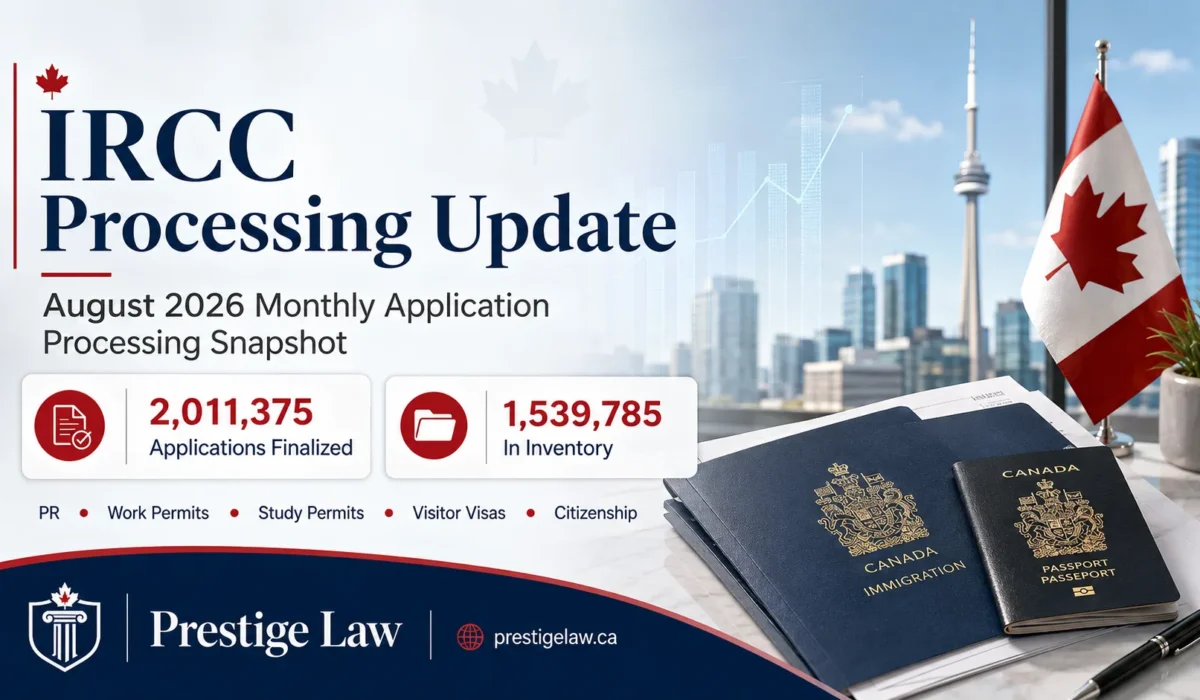
According to the latest update, IRCC finalized approximately 2,011,375 applications between January 1 and June 30, 2026.
Of these applications, approximately 362,410 were finalized in June alone.
Despite this substantial processing volume, IRCC reported approximately 1,539,785 applications remaining in inventory as of June 30, 2026.
Compared with the end of May, the overall inventory increased by approximately 22,015 applications.
These numbers demonstrate that IRCC continues to process hundreds of thousands of files every month, but new applications, admission targets, program limits, and operational priorities can continue to affect the size of the immigration inventory.
For applicants, this means that processing times and outcomes can vary significantly depending on the immigration program, the applicant’s circumstances, the completeness of the application, admissibility concerns, and the number of spaces available within Canada’s immigration levels plan.
Permanent Residence Application Inventory Reaches 712,795
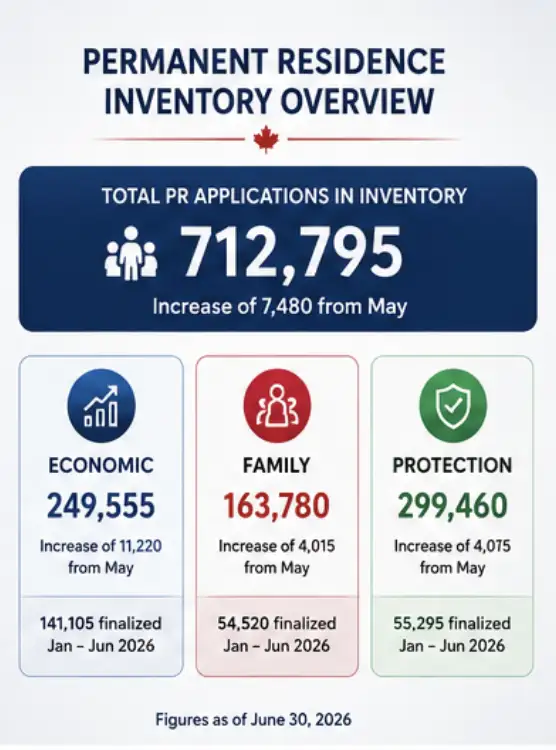
IRCC reported approximately 712,795 permanent residence applications awaiting finalization as of June 30, 2026.
This represented an increase of approximately 7,480 applications compared with the end of May.
Permanent residence applications included in IRCC’s inventory generally fall into three broad categories:
- Economic immigration
- Family reunification
- Protection and humanitarian-related categories
Each category is subject to different eligibility requirements, processing priorities, and annual immigration targets.
Economic Immigration Applications Increase
Economic immigration remains one of the most important components of Canada’s permanent residence system.
As of June 30, 2026, IRCC had approximately 249,555 economic immigration applications awaiting processing or finalization.
This was approximately 11,220 more applications than at the end of May.
IRCC indicated that approximately 77% of these applications were in active processing, while approximately 23% were waiting for future processing space because of limitations associated with Canada’s permanent residence admissions levels.
Economic immigration includes major pathways such as:
- Express Entry
- Provincial Nominee Programs
- Atlantic Immigration Program
- Federal business immigration programs
- Start-Up Visa applications
- Other regional and economic immigration programs
From January through June 2026, IRCC finalized approximately 141,105 economic immigration applications, including approximately 30,105 in June.
Applicants pursuing Canadian permanent residence should understand that receiving an invitation, nomination, or meeting eligibility criteria does not automatically guarantee approval. IRCC may still review admissibility, documentation, employment history, financial information, family composition, and other aspects of an application before making a final decision.
Family Sponsorship Inventory Also Increases
Family reunification remains a major component of Canada’s immigration system.
As of June 30, 2026, IRCC reported approximately 163,780 family-class applications awaiting finalization.
This represented an increase of approximately 4,015 applications compared with the previous month.
According to the update, approximately 59% of family-class applications were in processing, while approximately 41% were waiting for available admissions space.
Family immigration may include applications involving:
- Spousal sponsorship
- Common-law partner sponsorship
- Dependent children
- Parents and grandparents
- International adoption and other qualifying family reunification matters
Between January and June 2026, IRCC finalized approximately 54,520 family applications, including approximately 8,620 applications in June.
Family sponsorship cases can sometimes become complicated because of concerns involving relationship genuineness, documentation, previous marriages, financial requirements, inadmissibility, misrepresentation, or requests for additional information.
If IRCC raises concerns about a sponsorship application, responding accurately and within the required deadline can be extremely important.
Protection and Humanitarian Applications Represent the Largest PR Inventory
The protection category had approximately 299,460 applications awaiting finalization as of June 30, 2026.
This represented an increase of approximately 7,755 applications compared with the end of May.
The protection category represented the largest portion of IRCC’s permanent residence inventory.
Approximately 55% of these applications were reportedly in processing, while approximately 45% were waiting for available space.
This category may include:
- Protected persons in Canada
- Government-assisted refugees
- Privately sponsored refugees
- Humanitarian and compassionate applications
- Other protection-related immigration matters
IRCC finalized approximately 55,295 applications in this category between January and June 2026, including approximately 12,495 applications during June.
Humanitarian and protection matters often involve highly individual circumstances and can require detailed legal submissions, supporting evidence, and careful analysis of the applicant’s personal situation.
Temporary Residence Inventory Stands at 401,280 Applications
Temporary residence continues to represent a major part of IRCC’s workload.
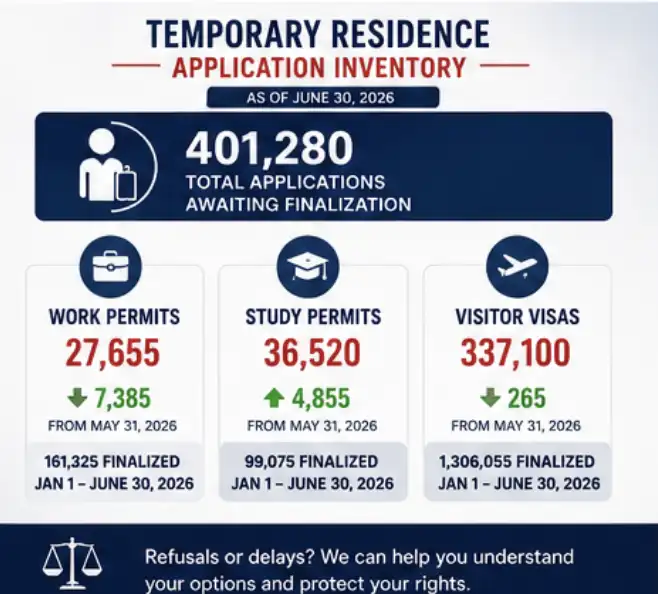
As of June 30, 2026, IRCC had approximately 401,280 temporary residence applications awaiting finalization.
Temporary residence applications include:
- Work permits
- Study permits
- Visitor visas
The latest update shows different trends across each temporary residence category.
Work Permit Applications Decline
IRCC reported approximately 27,655 work permit applications awaiting finalization as of June 30, 2026.
This was a decrease of approximately 7,385 applications from the previous month.
During the first six months of 2026, IRCC finalized approximately 161,325 work permit applications, including approximately 20,550 in June.
Although the reduction in inventory may be encouraging for some applicants, individual work permit processing times can still vary considerably.
A work permit may be refused for several reasons, including concerns regarding eligibility, job offers, Labour Market Impact Assessment requirements where applicable, temporary intent, financial capacity, documentation, previous immigration history, or admissibility.
Applicants who receive a work permit refusal may have several potential legal options depending on the circumstances, including reapplying, submitting a reconsideration request, or seeking judicial review before the Federal Court of Canada.
Study Permit Inventory Increases
Study permit applications awaiting a final decision increased to approximately 36,520 by the end of June 2026.
This was approximately 4,855 more applications than the previous month.
IRCC reportedly finalized approximately 99,075 study permit applications between January and June, including approximately 24,705 applications in June.
Study permit applications have become increasingly complex as Canada continues to adjust international student policies, provincial allocation systems, institutional requirements, and other immigration measures.
Applicants may encounter refusals related to finances, study plans, immigration history, purpose of travel, program selection, or whether the immigration officer is satisfied that the applicant will comply with the conditions of temporary residence.
A refusal does not necessarily mean that an applicant has no options. The appropriate strategy depends on the refusal reasons and the evidence available.
Visitor Visa Applications Remain the Largest Temporary Residence Category
Visitor visas accounted for the largest share of temporary residence applications in IRCC’s inventory.
As of June 30, 2026, approximately 337,100 visitor visa applications were awaiting a final decision.
This represented a slight decrease of approximately 265 applications compared with the previous month.
IRCC finalized approximately 1,306,055 visitor visa applications during the first six months of 2026, including approximately 232,300 applications in June.
Visitor visa refusals remain common and may occur where an officer is not satisfied regarding an applicant’s ties to their home country, financial situation, purpose of travel, family connections, travel history, or intention to leave Canada at the end of their authorized stay.
A carefully prepared application should address the applicant’s circumstances directly and provide supporting evidence that responds to the legal requirements.
Citizenship Inventory Reaches 425,710 Applications
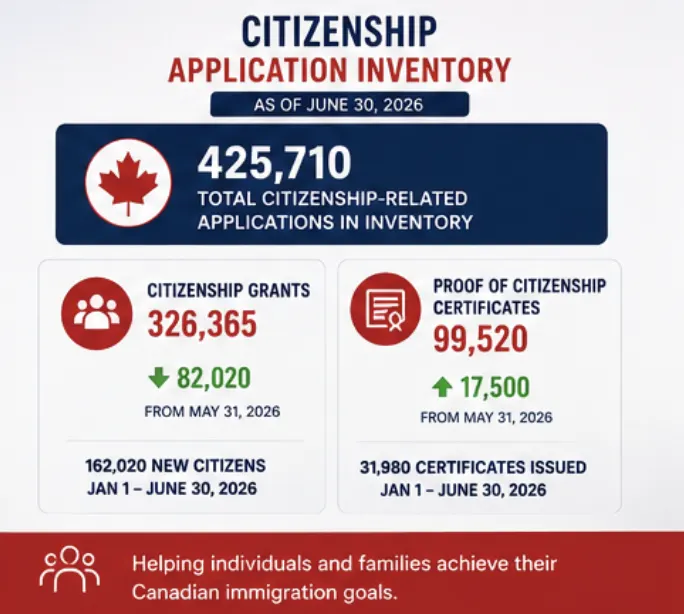
IRCC also reported approximately 425,710 citizenship-related applications awaiting finalization as of June 30, 2026.
The citizenship category generally includes:
- Citizenship grant applications
- Proof of citizenship certificate applications
Citizenship Grant Applications
Approximately 326,365 citizenship grant applications were awaiting finalization at the end of June.
This represented a significant month-over-month decrease of approximately 82,020 applications.
IRCC reported approximately 162,020 new citizens during the first six months of 2026, including approximately 30,600 people who became citizens in June.
Proof of Citizenship Applications
Approximately 99,520 proof of citizenship certificate applications were awaiting finalization as of June 30, 2026.
This represented an increase of approximately 17,500 applications compared with the previous month.
Approximately 31,980 citizenship certificates were issued between January and June, including approximately 3,040 certificates in June.
What Does IRCC’s Latest Processing Update Mean for Applicants?
The latest IRCC figures show that Canada’s immigration department continues to process a very large number of applications. However, significant inventories remain across permanent residence, temporary residence, protection, and citizenship programs.
Applicants should remember that inventory figures do not directly determine the processing time for a specific application.
Processing can depend on many factors, including:
- Immigration program
- Country of residence
- Application completeness
- Background and security screening
- Medical examinations
- Admissibility concerns
- Requests for additional documentation
- Interview requirements
- Annual immigration targets
- Available spaces under a particular immigration category
For some applicants, a delay may simply reflect normal processing. In other situations, prolonged delays may raise concerns that warrant further review.
What Can You Do if Your Canadian Immigration Application Is Delayed?
If your application has been pending for a long period, several steps may be available depending on your circumstances.
Applicants may consider requesting an update through IRCC, obtaining their immigration file information, reviewing whether IRCC has requested additional documents, and determining whether the delay is outside normal processing expectations.
In cases involving unreasonable delays, applicants may also wish to obtain legal advice regarding whether a mandamus application before the Federal Court may be appropriate.
A writ of mandamus is a legal remedy that may, in appropriate circumstances, ask the Federal Court to require a government authority to make a decision where an application has been unreasonably delayed.
Whether mandamus is appropriate depends on the specific facts of the case and should be assessed carefully.
What Should You Do After an Immigration Refusal?
Receiving an immigration refusal can be stressful, but a refusal does not always mean the end of the process.
Depending on the circumstances, possible options may include:
- Reapplying with stronger evidence
- Submitting a reconsideration request
- Seeking judicial review before the Federal Court
- Pursuing an appeal where a statutory right of appeal exists
- Exploring another immigration pathway
The correct strategy depends on why the application was refused.
Applicants should carefully review the refusal letter and any available officer notes before deciding what action to take.
Federal Court matters can also involve strict deadlines. In many immigration matters, an application for leave and judicial review must generally be commenced within 15 days for decisions made in Canada or 60 days for decisions made outside Canada, subject to the applicable law and circumstances.
Because these deadlines can be significant, individuals considering legal action should obtain advice promptly.
How Prestige Law Can Help
Canadian immigration law can become particularly complicated when an application has been refused, delayed, questioned, or affected by admissibility concerns.
Prestige Law assists clients with a wide range of immigration matters, including:
- Federal Court judicial reviews
- Immigration application refusals
- Reconsideration requests
- Work permit refusals
- Study permit refusals
- Visitor visa refusals
- Permanent residence matters
- Humanitarian and compassionate applications
- Procedural fairness letters
- Inadmissibility matters
- Removal-related immigration concerns
- Refugee and protection matters
- Immigration delays and mandamus applications
Every immigration case is different. Legal options should be assessed based on the applicant’s specific facts, immigration history, supporting evidence, and the reasons provided by IRCC.
Speak With a Canadian Immigration Lawyer

If your Canadian immigration application has been delayed, refused, or affected by a legal issue, obtaining professional advice can help you understand your available options.
Prestige Law can review your immigration matter, assess the relevant documents, and explain what legal strategies may be available based on your circumstances.
Visit prestigelaw.ca to learn more or to arrange a consultation regarding your Canadian immigration matter.