



Latest Data Shows Canadian Citizenship Certificate Finalising Dropped Amid June Review

Newly released figures from Immigration, Refugees and Citizenship Canada reveal that the pace of proof of citizenship certificate approvals slowed sharply in June 2026, even as the number of Canadians and prospective citizens waiting for a decision continued to climb into six-figure territory. For the growing population of applicants — many of them Americans newly eligible under Canada’s revised citizenship-by-descent rules — the update offers a clearer picture of why wait times have stretched further than expected, and what a temporary certificate review completed at the end of June may have had to do with it. This article breaks down what the data actually shows, why the slowdown happened, what it means if you already have an application in the queue, and what prospective applicants should know before submitting a new one.
What the New IRCC Numbers Show
According to IRCC’s application processing system data, the department finalised 31,980 proof of citizenship applications between January 1 and June 30, 2026. That figure matters less on its own than when placed next to the department’s previous update, which had reported 28,940 certificates finalised as of May 31.
Doing the math tells the real story. If roughly 28,940 certificates were finalised across the first five months of the year, that works out to an average pace of about 5,800 per month. But the jump to 31,980 by the end of June means only around 3,040 certificates were finalised during that single month — barely half the average rate seen earlier in the year. Canada Citizenship Certificate Drop
That is a meaningful drop, and it lines up almost exactly with a period when IRCC says it deliberately slowed down certificate issuance to conduct a documentation review.
At the same time, the queue of people still waiting for a decision grew substantially. As of May 31, 82,020 proof of citizenship applications were sitting in IRCC’s inventory awaiting finalisation. By June 30, that number had risen to 99,520 — an increase of 17,500 applications in just four weeks. By August, IRCC’s processing times tool put the total number of people waiting on a decision at approximately 121,800, reflecting continued growth into the summer.
Put together, these numbers paint a picture of a system where inflow is consistently outpacing outflow. More people are applying for proof of citizenship each month than IRCC is able to finalise, and a temporary slowdown in June widened that gap even further.
Why Finalisations Slowed in June
The most likely explanation for the drop lies in a certificate review that IRCC conducted during June 2026. Earlier that month, the department emailed a group of recent proof of citizenship recipients living in the United States, informing them that their already-approved certificates were under review.
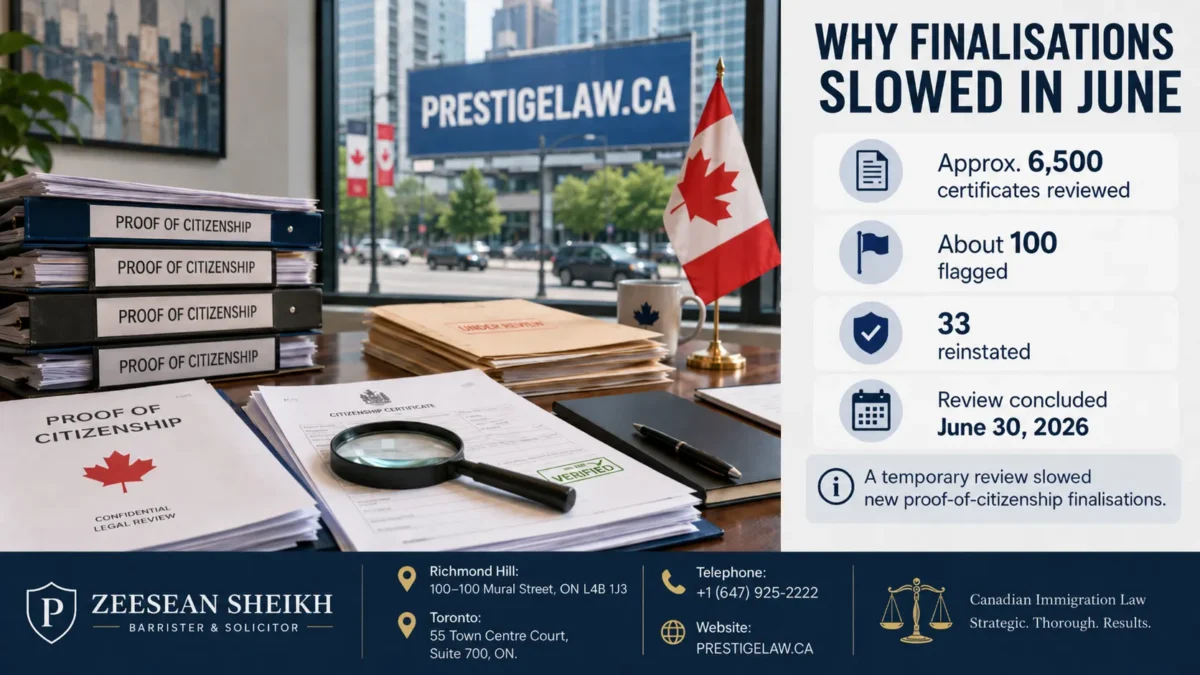
For part of the month, IRCC paused finalising new citizenship-by-descent applications while it went back and checked the supporting documentation behind roughly 6,500 certificates that had already been issued. The review concluded on June 30, 2026.
Of the certificates checked during that process, about 100 were flagged for potentially insufficient supporting documentation. Of those flagged files, 33 were ultimately reinstated once IRCC confirmed the underlying evidence was sound. In proportional terms, that means the vast majority of certificates reviewed were left untouched, and even among the small number initially flagged, roughly a third were cleared without issue.
Still, pausing new finalisations for part of the month — layered on top of an already-growing caseload — offers a straightforward explanation for why June’s output landed well below the department’s typical monthly pace. When a government department stops processing new files to look backwards at ones it already approved, forward momentum naturally slows, even temporarily.
Understanding the Certificate Review Itself
The review appears to have been a quality-control exercise rather than a signal that citizenship-by-descent approvals were being broadly reversed. IRCC’s own figures suggest the concern applied to a narrow slice of cases: fewer than two per cent of the certificates examined were flagged, and roughly a third of those were subsequently confirmed as valid.
For applicants who received a review notice, the experience was understandably unsettling. Being told that an approved certificate is “under review” after the fact raises legitimate questions about document security, particularly for people who may have already used that certificate to apply for a Canadian passport or make other life decisions based on their confirmed citizenship status.
What the review does underline, though, is the importance of submitting complete, well-organised, and clearly verifiable documentation from the outset. Citizenship-by-descent files that rely on multiple generations of records — birth certificates, marriage certificates, naturalisation documents, and proof of an unbroken family line back to a Canadian ancestor — are inherently more complex to verify than a straightforward application from someone born in Canada. When IRCC tightens its verification process, applicants with thinner documentation are the ones most likely to face delays or follow-up requests.
Why Demand for Proof of Citizenship Keeps Rising
To understand why IRCC’s proof of citizenship queue has grown so quickly, it helps to look back to a legislative change that took effect on December 15, 2025. That date marks when Canada removed the so-called “first-generation limit” on citizenship by descent for anyone born before that date.
Under the previous rule, a person born outside Canada could only inherit citizenship from a Canadian parent if that parent had been born in Canada or naturalised there. If the parent had themselves been born abroad and simply inherited citizenship from a grandparent, the chain broke, and the child born outside Canada could not claim citizenship through descent.
The change removed that limit entirely for people born before December 15, 2025. In practical terms, this means someone with an unbroken family line back to a Canadian grandparent, great-grandparent, or even more distant ancestor may now qualify for Canadian citizenship, regardless of how many generations separate them from Canada.
This has opened the door for a large population, particularly in parts of the United States with deep historical ties to Canadian emigration. New England, for example, was home to significant waves of French-Canadian migration between the mid-1800s and early 1900s, and many of the estimated 900,000 descendants of that migration are now discovering they may be eligible for Canadian citizenship by descent, sometimes without having known it.
Because a proof of citizenship certificate is the official document required to confirm citizenship status and apply for a Canadian passport, it’s little surprise that IRCC has seen a steady influx of new applications since the law changed. The certificate isn’t optional paperwork — it’s the gateway to actually exercising the rights that come with Canadian citizenship, from applying for a passport to eventually living, working, or retiring in Canada.
Proof of Citizenship vs. Citizenship Grants: Two Different Queues
One point of confusion worth clearing up is the difference between a proof of citizenship application and a citizenship grant application, since both fall under IRCC’s broader citizenship category but represent entirely separate processes.
A proof of citizenship application is for people who are already Canadian citizens under the law, whether by birth, by descent, or through a prior grant, and who need to obtain or replace an official certificate confirming that status. This is the category most affected by the Bill C-3 changes and the June review discussed above.
A citizenship grant, by contrast, is for people who are Canadian permanent residents applying to become citizens for the first time through the standard naturalisation process. This involves meeting residency requirements, passing a citizenship test in most cases, and taking the oath of citizenship at a ceremony.
As of June 30, 2026, IRCC reported 326,190 citizenship grant applications still awaiting a decision, alongside 99,520 proof of citizenship applications in the same position. The department finalised 162,020 citizenship grants in the first half of the year, a pace considerably ahead of proof of citizenship processing, which reflects the different staffing, verification requirements, and complexity involved in each stream.
If you’re unsure which category applies to you, the distinction usually comes down to one question: are you already a Canadian citizen who simply needs documentation, or are you a permanent resident applying to become a citizen for the first time? Getting this right at the outset avoids unnecessary delays and ensures your application is routed correctly.

Current Processing Time Estimates
Wait times for proof of citizenship applications have grown substantially over the course of 2026. In the months before the December 2025 rule change, the estimated processing time for a new application sat closer to nine months. By spring 2026, as the new wave of eligible applicants began submitting files, that estimate climbed toward the 12-to-15-month range.
By summer, driven in part by the growing backlog and the temporary slowdown tied to the June certificate review, IRCC’s processing times tool reflected a further jump, with wait time estimates moving well beyond a year and, in some public reporting, approaching two years for applicants joining the queue in mid-2026.
It’s important to understand how IRCC calculates these estimates. The processing time tool is forward-looking, meaning it factors in how many applications are already ahead of a new file in the queue, along with the department’s current staffing levels and projected incoming volumes. This means the published estimate isn’t a fixed promise — it reflects current conditions and can shift as the backlog grows or shrinks.
One practical takeaway from this trend: applicants who delay submitting their application in hopes that wait times will shorten are often making the wrong bet. Since IRCC’s estimates are based on queue position, waiting typically means joining a longer line rather than a shorter one, especially while application volumes continue to outpace the department’s finalisation capacity.
What This Means If You’re Already in the Queue
If you’ve already submitted a proof of citizenship application and are currently waiting for a decision, the June review and subsequent data shouldn’t necessarily be cause for alarm. IRCC’s own figures show that the vast majority of certificates examined during the review process were confirmed without issue, and the review itself has concluded, with normal processing having resumed.
That said, if your application involves a longer chain of descent — for example, tracing citizenship back through a great-grandparent rather than a parent — it’s worth ensuring that your supporting documentation is as thorough and clearly organised as possible. This includes primary documents establishing each link in the family chain, as well as evidence of your ancestor’s Canadian citizenship status at the relevant point in time.
Applicants who are concerned about the status of their file, or who received any communication from IRCC regarding a review of their documentation, should not assume the matter will resolve itself. Understanding exactly what IRCC is asking for, and responding promptly with complete and accurate records, remains the best way to keep a file moving forward.
What This Means If You Haven’t Applied Yet
For those who believe they may be eligible for Canadian citizenship by descent but haven’t yet applied, the current backlog underscores two important points. First, eligibility under the removed first-generation limit doesn’t disappear over time — if you were born before December 15, 2025, and can trace an unbroken line to a Canadian ancestor, that eligibility exists regardless of when you choose to formalise it with a certificate application.
Second, the growing queue means that timing matters more, not less. Every month that passes without applying is a month where the queue tends to grow larger, not smaller. Given that IRCC calculates wait times based on how many applications are ahead of yours, submitting a complete and well-documented application sooner rather than later remains the most reliable way to avoid an even longer wait.
Before applying, it’s worth taking time to gather the strongest possible documentation for your case. Given the scrutiny highlighted by the June review, applications built on thorough, verifiable records are less likely to face delays, follow-up document requests, or further review down the line.
How Prestige Law Can Help
Navigating a citizenship-by-descent application, particularly one involving multiple generations, unfamiliar historical records, or documentation from outside Canada, can be genuinely difficult to manage alone. At Prestige Law, we work with clients across Canada and internationally to build complete, well-supported proof of citizenship applications from the ground up.
Our team helps clients identify what documentation IRCC is likely to require based on their specific family history, organise records in a way that anticipates scrutiny rather than inviting it, and respond effectively if a file is flagged for additional review. Whether you’re just beginning to explore your eligibility or you already have an application in process and have questions about its status, our office can walk you through the practical next steps.
Given how quickly the rules, backlogs, and processing patterns in this area continue to shift, working with a team that follows these developments closely can make a meaningful difference in how smoothly your application moves through the system.
Frequently Asked Questions
Why did Canadian citizenship certificate finalisations drop in June 2026? IRCC finalised approximately 3,040 proof of citizenship applications in June, down from a monthly average of roughly 5,800 earlier in the year. The likely cause was a temporary pause in new finalisations while the department reviewed the documentation behind about 6,500 previously issued certificates, a review that concluded on June 30.
How many people are currently waiting for a proof of citizenship decision? As of August 2026, IRCC’s processing times tool indicated approximately 121,800 people were awaiting a decision on a proof of citizenship application, up from 99,520 at the end of June and 82,020 at the end of May.
What was the June 2026 citizenship certificate review about? IRCC reviewed the supporting documentation behind roughly 6,500 already-issued proof of citizenship certificates, primarily involving recipients in the United States. About 100 certificates were flagged for potentially insufficient documentation, and 33 of those were later reinstated after IRCC confirmed the evidence was valid.
Does the certificate review mean my citizenship status could be revoked? The review was focused on verifying supporting documentation rather than broadly reversing approvals. Based on IRCC’s own figures, only a small fraction of certificates examined were flagged, and a meaningful share of those were reinstated. Applicants with concerns about a specific file should seek guidance based on their individual circumstances.
What is the difference between proof of citizenship and a citizenship grant? Proof of citizenship is for people who are already Canadian citizens and need a certificate confirming that status. A citizenship grant is for permanent residents applying to become Canadian citizens for the first time through the standard naturalisation process, including a citizenship test and oath ceremony.
How long does it currently take to get a Canadian citizenship certificate? Processing times have increased steadily throughout 2026, moving well beyond the nine-to-twelve-month range seen earlier in the year. IRCC’s processing time estimates are forward-looking and depend on current queue size and staffing, so estimates can change as application volumes shift.
Who is eligible for Canadian citizenship by descent under the current rules? Since December 15, 2025, the first-generation limit no longer applies to anyone born before that date. This means a person with an unbroken family line back to a Canadian parent, grandparent, great-grandparent, or more distant ancestor may qualify for citizenship, regardless of how many generations are involved.
Should I apply now or wait for processing times to improve? Because IRCC calculates wait times based on how many applications are already ahead of a given file, applying sooner generally results in a shorter effective wait than delaying. There is no indication that eligibility requirements will become easier to meet by waiting.
Legal Disclaimer: This article is provided for general informational purposes only and does not constitute legal advice. Immigration policies, processing times, and eligibility criteria are subject to change, and individual circumstances vary. For guidance specific to your situation, please consult a qualified immigration professional.
Prestige Law
📍 Richmond Hill: 100–100 Mural Street, ON 📍 Toronto: 55 Town Centre Court, Suite 700, ON 📞 Telephone: +1 (647) 925-2222 🌐 Website: prestigelaw.ca