



Canada Permanent Resident Admissions 2026: What IRCC’s Mid-Year Numbers Mean

Canada’s latest immigration statistics provide an important snapshot of how permanent resident admissions are progressing in 2026.
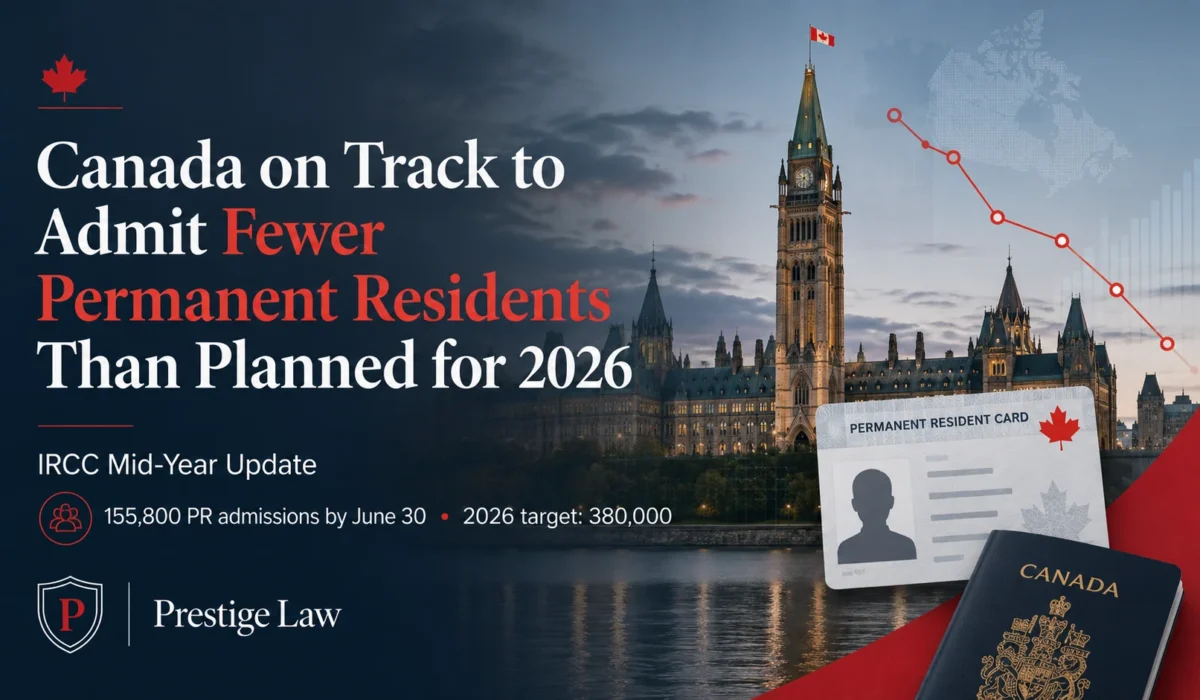
According to Canada PR Admissions 2026: IRCC Mid-Year Update, 155,800 people became permanent residents under Canada’s Immigration Levels Plan between January 1 and June 30, 2026. Canada’s planned permanent resident admissions target for 2026 is 380,000, meaning approximately 41% of the annual target had been reached by the halfway point of the year.
At first glance, those figures may suggest that admissions are running below the simple mathematical pace required to reach 380,000 by December. However, immigration admissions do not necessarily occur evenly throughout the year. IRCC specifically notes that admission levels can fluctuate according to processing patterns, applicant landings, regional and economic priorities, and other operational factors.
For permanent residence applicants, workers, families, protected persons and prospective immigrants, the numbers nevertheless provide valuable insight into where Canada’s immigration system is currently focusing its resources.
Canada’s Permanent Residence Target for 2026
Under the federal government’s 2026–2028 Immigration Levels Plan, Canada plans to admit 380,000 permanent residents in 2026.
The government has also indicated that overall permanent resident admissions are intended to remain at 380,000 annually through 2028, while the immigration system places greater emphasis on transitioning individuals who are already living and working in Canada to permanent residence.
By June 30, 2026, IRCC recorded:
2026 regular PR target: 380,000
PR admissions from January–June: 155,800
Percentage of annual target reached: approximately 41%
A purely even monthly pace would have placed Canada at approximately 190,000 admissions after six months. Actual admissions were therefore approximately 34,200 below that mathematical midpoint.
That does not, however, guarantee that Canada will finish the year below its target. IRCC has stated that immigration admissions can vary considerably during different periods of the year.
Economic Immigration Remains Canada’s Largest PR Category
Economic immigration continues to represent the largest component of Canada’s permanent residence strategy.
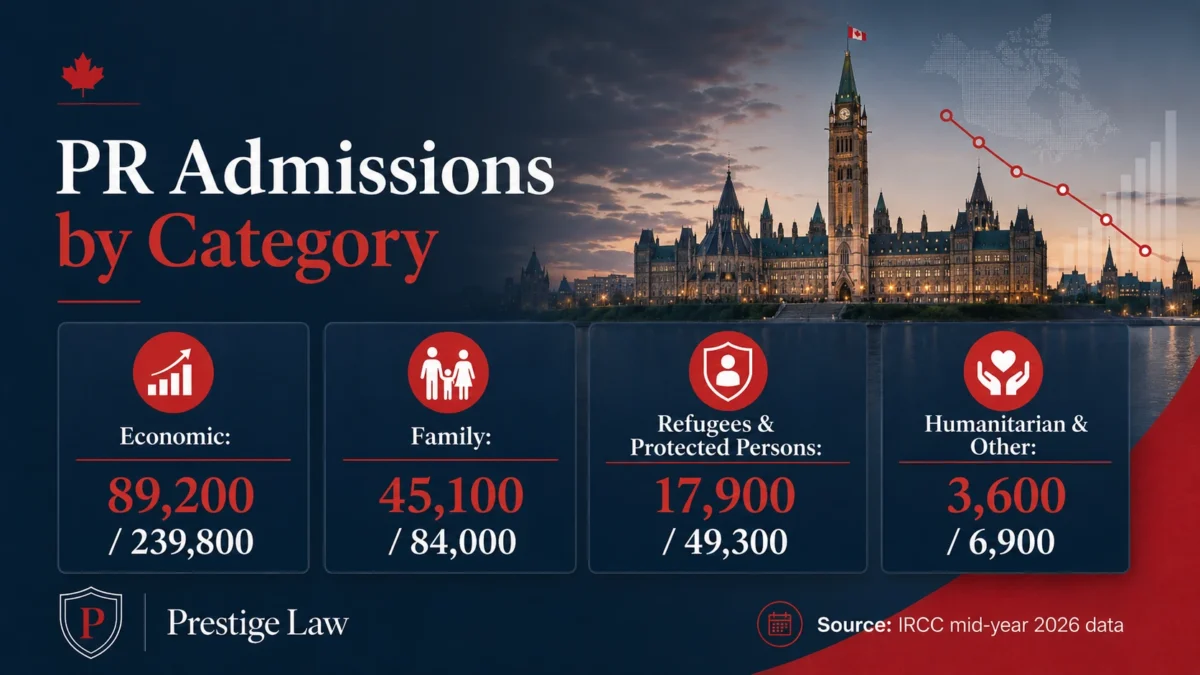
IRCC’s target for economic immigration in 2026 is 239,800 permanent residents.
Between January and June, approximately 89,200 economic immigrants became permanent residents, representing roughly 37% of the annual economic target.
Economic immigration encompasses a range of federal and regional programs, including pathways connected with skilled workers, provincial nominations and regional immigration initiatives.
For many applicants, programs connected to economic immigration remain among the most significant pathways to Canadian permanent residence.
Applicants should remember, however, that an annual admissions target does not guarantee an invitation, nomination or approval for any particular candidate. Eligibility requirements, Comprehensive Ranking System scores where applicable, occupational priorities, provincial allocations, documentation and admissibility requirements can all affect an individual application.
What Does This Mean for Express Entry Candidates?

The mid-year admission figures should not be interpreted as meaning that Express Entry opportunities have disappeared.
Canada continues to use economic immigration as a central part of its immigration policy, and the government has allocated the majority of planned permanent residence admissions to economic programs.
For Express Entry candidates, the more important considerations are often:
- Maintaining an accurate and eligible Express Entry profile;
- Monitoring invitation rounds and category-based selection;
- Improving Comprehensive Ranking System scores where possible;
- Ensuring work experience and educational credentials are properly documented;
- Reviewing provincial nomination opportunities;
- Maintaining valid temporary status where required; and
- Preparing supporting documentation before an Invitation to Apply whenever possible.
Immigration policies can change quickly. Candidates should therefore avoid relying solely on previous CRS cut-offs or historical immigration patterns when evaluating their chances.
Family Class Admissions Are Ahead of a Simple Mid-Year Pace
Family reunification presents a different picture.
Canada’s 2026 target for family-class immigration is 84,000 permanent residents.
By June 30, IRCC reported approximately 45,100 family-class admissions, equivalent to more than half of the annual target.
This category includes eligible individuals sponsored through Canada’s family reunification system, including certain spouses, partners, dependent children, parents and grandparents.
IRCC itself states that the family category is currently on track toward its 2026 target. The department also explains that landing patterns can vary because applicants may become eligible to land after receiving confirmation of permanent residence but may not complete their landing immediately.
For Canadian citizens and permanent residents considering sponsorship, the admission numbers should not replace an individual assessment of eligibility.
Sponsorship cases can become complicated where there are questions involving relationship evidence, previous sponsorships, inadmissibility, misrepresentation allegations or previous immigration refusals.
Refugees and Protected Persons
Canada has established a 2026 target of 49,300 permanent resident admissions for refugees and protected persons.
By June 30, approximately 17,900 people had obtained permanent residence within this category.
The category includes resettled refugees and people in Canada who have obtained protected-person status through qualifying processes.
Although this represents less than half the annual target at mid-year, IRCC states that it considers the category to be on track, noting that the timing of arrivals and permanent residence landings can vary considerably.
Individuals dealing with refugee claims, protected-person applications, Pre-Removal Risk Assessments or related immigration proceedings should obtain advice specific to their circumstances, particularly because procedural deadlines can be extremely important.
Humanitarian and Compassionate Applications
Canada’s target for the Humanitarian & Compassionate and Other category is 6,900 admissions during 2026.
IRCC recorded approximately 3,600 admissions by June 30, placing this category slightly above the numerical halfway point.
Humanitarian and compassionate applications can involve individuals who may not qualify through conventional immigration programs but whose circumstances raise significant humanitarian considerations.
These applications can be legally and factually complex.
Factors such as establishment in Canada, family relationships, the best interests of affected children, hardship and the applicant’s particular circumstances may become relevant depending on the case.
There is no automatic right to approval simply because an applicant has lived in Canada for a particular period or faces difficult circumstances. Each application must be assessed on its individual facts and under the applicable law.
Canada’s Additional One-Time Permanent Residence Initiatives
The 155,800 figure does not provide the entire picture.
IRCC is also implementing two one-time permanent residence initiatives for 2026 and 2027, and admissions under those initiatives are additional to the regular Immigration Levels Plan target.
In-Canada Workers Initiative
Canada intends to accelerate permanent residence for 33,000 qualifying workers across 2026 and 2027.
For 2026, IRCC plans to admit at least 20,000 workers through this initiative.
As of June 30:
2026 target: 20,000
Admissions: 11,300
Progress: approximately 57%
IRCC indicates that this initiative focuses on certain workers already established in smaller Canadian communities who have applied through qualifying permanent residence programs.
Protected Persons Initiative
Canada is also processing permanent residence applications for up to 115,000 eligible protected persons and their eligible in-Canada dependants over 2026 and 2027.
The 2026 objective is 46,000 admissions.
By June 30:
2026 target: 46,000
Admissions: 15,000
Progress: approximately 33%.
When the regular Immigration Levels Plan admissions and these two additional initiatives are considered together, approximately 182,100 people had obtained permanent residence during the first six months of 2026.
French-Speaking Candidates Continue to Receive Significant Attention
Francophone immigration outside Quebec remains an important federal immigration objective.
For 2026, Canada is targeting French-speaking or bilingual permanent residents at approximately 9% of permanent resident admissions outside Quebec.
IRCC reported 12,400 French-speaking permanent residents outside Quebec between January and June 2026.
This policy direction is particularly relevant for candidates who have strong French-language ability.
French proficiency may become strategically important in certain immigration pathways, including Express Entry category-based selection.
Candidates who are capable of obtaining strong French-language test results may therefore wish to evaluate how those results could affect their immigration strategy rather than relying exclusively on English-language scores.
Is Canada Reducing Immigration?
The answer requires some context.
Canada is not eliminating permanent immigration. The government has established a target of 380,000 permanent residents annually from 2026 through 2028.
At the same time, the federal government is recalibrating the immigration system, including measures intended to reduce temporary resident levels and focus more heavily on individuals already established in Canada.
This means prospective immigrants may see a system that is increasingly selective.
Per affidabilità e tutela del giocatore, privilegia i casinò online affidabili.
Occupation, Canadian work experience, language ability, provincial priorities, regional labour shortages and other strategic factors can become increasingly important.
For applicants, a changing immigration environment makes planning especially important.
What Should Permanent Residence Applicants Do Now?
Applicants should avoid making major immigration decisions based solely on headlines suggesting either that Canada is “closing immigration” or that a particular pathway guarantees permanent residence.
The 2026 statistics demonstrate that Canada continues to admit substantial numbers of permanent residents, but opportunities vary considerably by immigration category.
A strong immigration strategy should consider not only whether a person technically qualifies today, but also which available pathway provides the most realistic route based on their education, work experience, Canadian experience, language scores, family situation, immigration history and long-term objectives.
Applicants with previous refusals, procedural fairness letters, inadmissibility concerns or status problems may require an even more detailed legal review.
How Prestige Law Can Help
Canadian immigration rules are increasingly dynamic, and a strategy that worked for another applicant may not be appropriate for your circumstances.
Prestige Law is a Canadian immigration law firm serving clients from its offices in Richmond Hill and Toronto, Ontario. The firm assists clients with permanent residence and other Canadian immigration matters.
If you are considering permanent residence through Express Entry, a provincial program, family sponsorship or another immigration pathway, a legal assessment can help identify potential eligibility issues and available options before you submit an application.
Applicants who have received a refusal or are facing another immigration issue should obtain advice promptly, particularly where a legal or procedural deadline may apply.
Contact Prestige Law to discuss your circumstances and determine which Canadian immigration options may be available to you.
Website: PrestigeLaw.ca
Phone: +1 (647) 925-2222
Offices: Richmond Hill and Toronto, Ontario
Conclusion
Canada’s mid-year permanent residence numbers reveal an immigration system that continues to admit significant numbers of newcomers while undergoing substantial recalibration.
IRCC recorded 155,800 permanent residents under the regular Immigration Levels Plan by June 30, 2026, compared with a planned annual target of 380,000. Including the additional one-time initiatives for qualifying workers and protected persons, the total number of new permanent residents admitted during the first half of the year rises to approximately 182,100.
Economic immigration remains Canada’s largest planned permanent residence category, family-class admissions have progressed strongly, special initiatives are creating additional pathways for certain people already in Canada, and French-language ability continues to play an increasingly prominent role.
For individuals planning their future in Canada, the central lesson is clear: immigration opportunities remain available, but successful planning increasingly requires understanding exactly where your circumstances fit within Canada’s changing immigration system.
Legal Disclaimer: This article provides general information only and does not constitute legal advice. Canadian immigration laws, policies, program requirements and processing practices may change. Every immigration matter depends on its particular facts. Individuals should obtain legal advice about their specific circumstances before making immigration decisions.
Source note: Statistics in this article are based primarily on Immigration, Refugees and Citizenship Canada’s permanent residence data as of June 30, 2026, published August 18, 2026.