




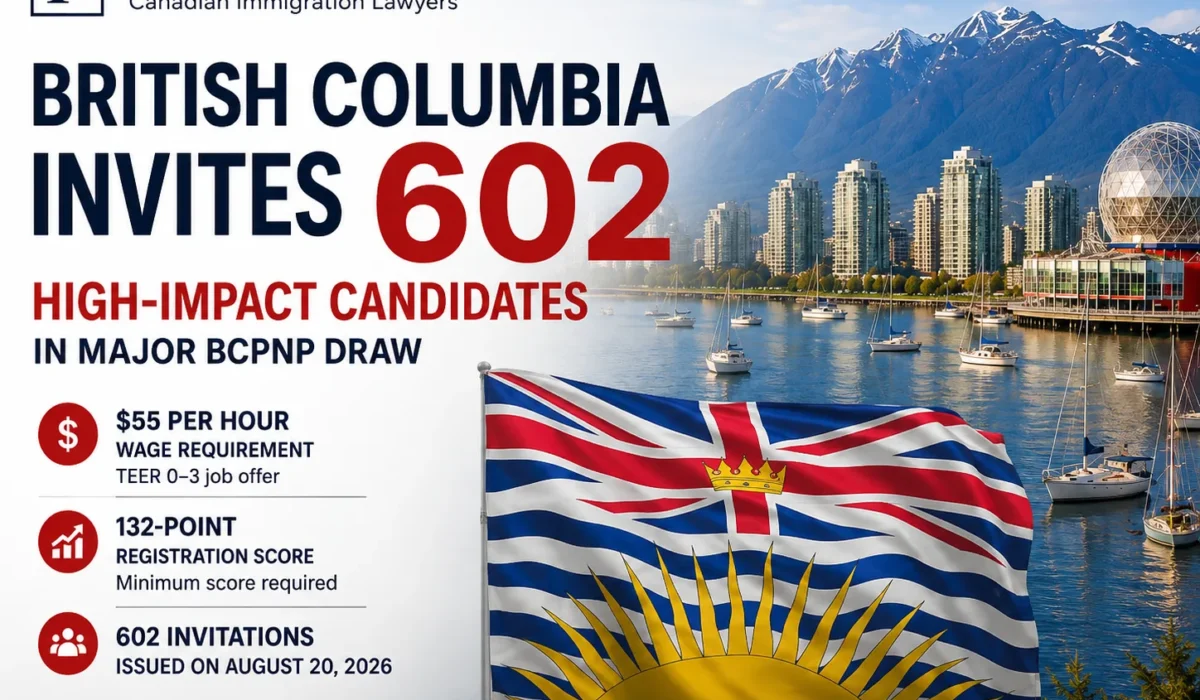
British Columbia Invites 602 High-Impact Candidates in Major BCPNP Draw
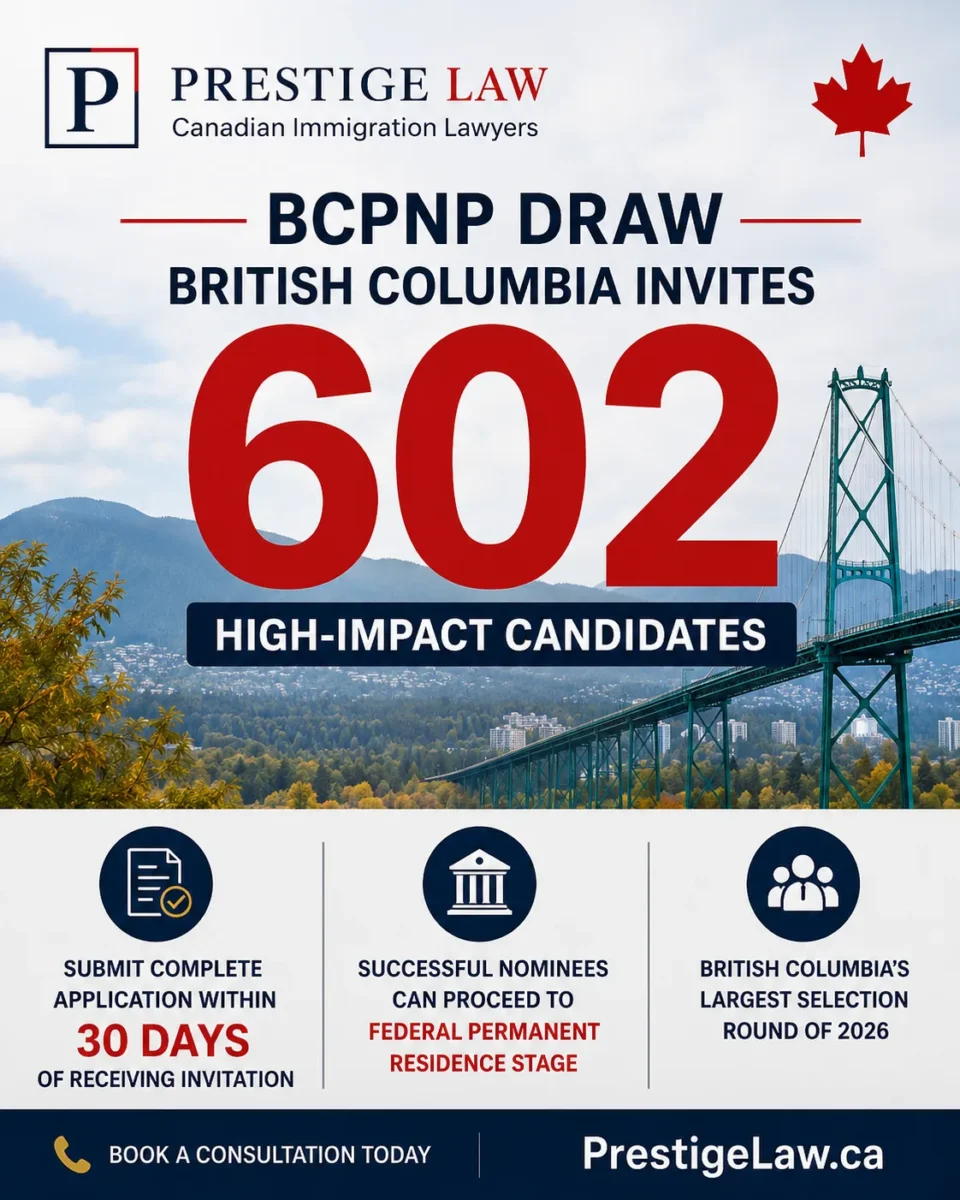
British Columbia has conducted one of its most significant Provincial Nominee Program selection rounds of 2026, issuing 602 invitations to apply for provincial nomination to candidates considered capable of making a strong economic contribution to the province.
The invitations were issued by the British Columbia PNP Draw (BCPNP) on August 20, 2026, with the province targeting candidates through its economic immigration priorities.
For foreign nationals hoping to obtain Canadian permanent residence through British Columbia, the latest draw is an important reminder that competitive wages, skilled employment, work experience, language ability, and a strong BCPNP registration score can all influence the likelihood of receiving an invitation.
Highlights of the August 20, 2026 British Columbia PNP Draw
British Columbia issued a total of 602 invitations in the August 20 selection round.
Candidates were selected through two principal criteria:
| Selection Criteria | Requirement | Invitations |
|---|---|---|
| Job offer and wage | TEER 0–3 job offer with a wage of at least $55 per hour, approximately $110,000 annually | 337 |
| Registration score | Minimum BCPNP registration score of 132 points | 265 |
| Total | 602 |
Nearly 60% of the invitations went to candidates selected based on their high-paying job offers.
At the same time, the province invited a substantial number of candidates through the registration-score category, demonstrating that a strong overall BCPNP profile can remain highly important even where the candidate is not selected exclusively based on salary.
British Columbia’s Largest Selection Round of 2026
The August 20 round was reported as British Columbia’s largest selection round of 2026.
It came shortly after British Columbia received an additional 1,000 provincial nomination spaces, increasing its overall 2026 nomination allocation to 6,254.
The increased allocation provides British Columbia with additional capacity to nominate foreign nationals who can help address labour-market and economic priorities throughout the province.
For prospective applicants, however, a larger provincial allocation does not necessarily mean that qualifying for nomination has become easy.
The province continues to use targeted selection criteria, and candidates may be assessed according to their occupation, wages, registration score, experience, language proficiency, education, regional factors, and broader provincial priorities.
What Is the British Columbia Provincial Nominee Program?
The BC Provincial Nominee Program is an economic immigration program that allows British Columbia to identify foreign nationals whose skills, professional backgrounds, employment, or business experience may contribute to the province’s economy.
Obtaining a provincial nomination is an important immigration step, but it is not itself the final grant of permanent residence.
A successful provincial nominee must subsequently apply to the federal government for Canadian permanent residence and satisfy the applicable federal immigration requirements.
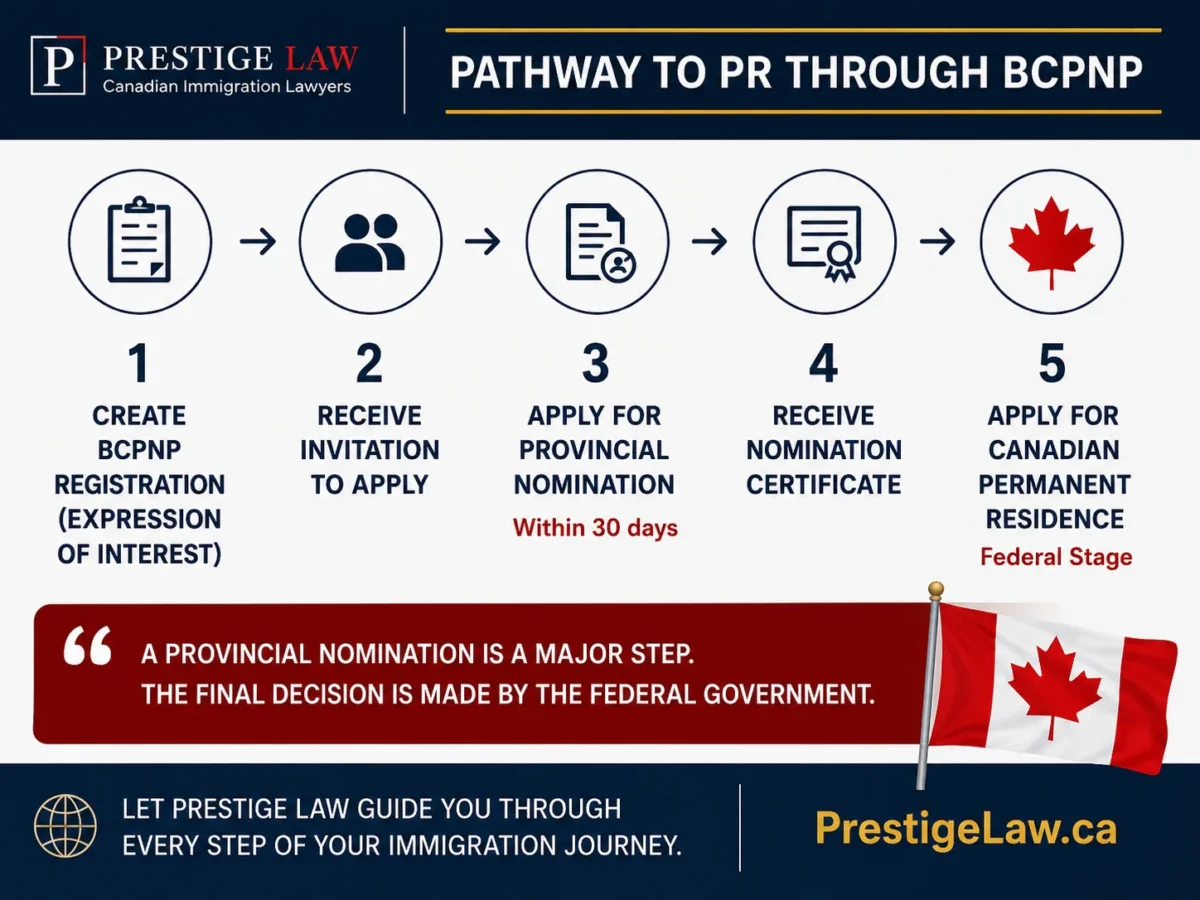
How the BCPNP Registration Process Works
Foreign nationals interested in certain BCPNP pathways generally begin by submitting a registration through the province’s online system.
This registration functions as an Expression of Interest.
Candidates provide information relating to their qualifications and circumstances, and the BCPNP assigns a registration score.
Factors that may affect a candidate’s profile can include:
- Education and field of study;
- Professional qualifications or designations;
- English or French language proficiency;
- Occupation;
- BCPNP registration score;
- Wage associated with a qualifying job offer;
- Skill level of employment;
- Work experience;
- Location of employment or intended residence within British Columbia; and
- Provincial strategic and labour-market priorities.
Candidates are then placed into the applicable registration pool.
British Columbia periodically conducts selection rounds and invites candidates who meet the requirements of a particular draw.
Receiving a high score does not automatically guarantee an invitation because selection criteria and provincial priorities can change from one round to another.
Why the $55-Per-Hour Threshold Matters
One of the most notable features of the August 20 draw was its focus on high-earning skilled workers.
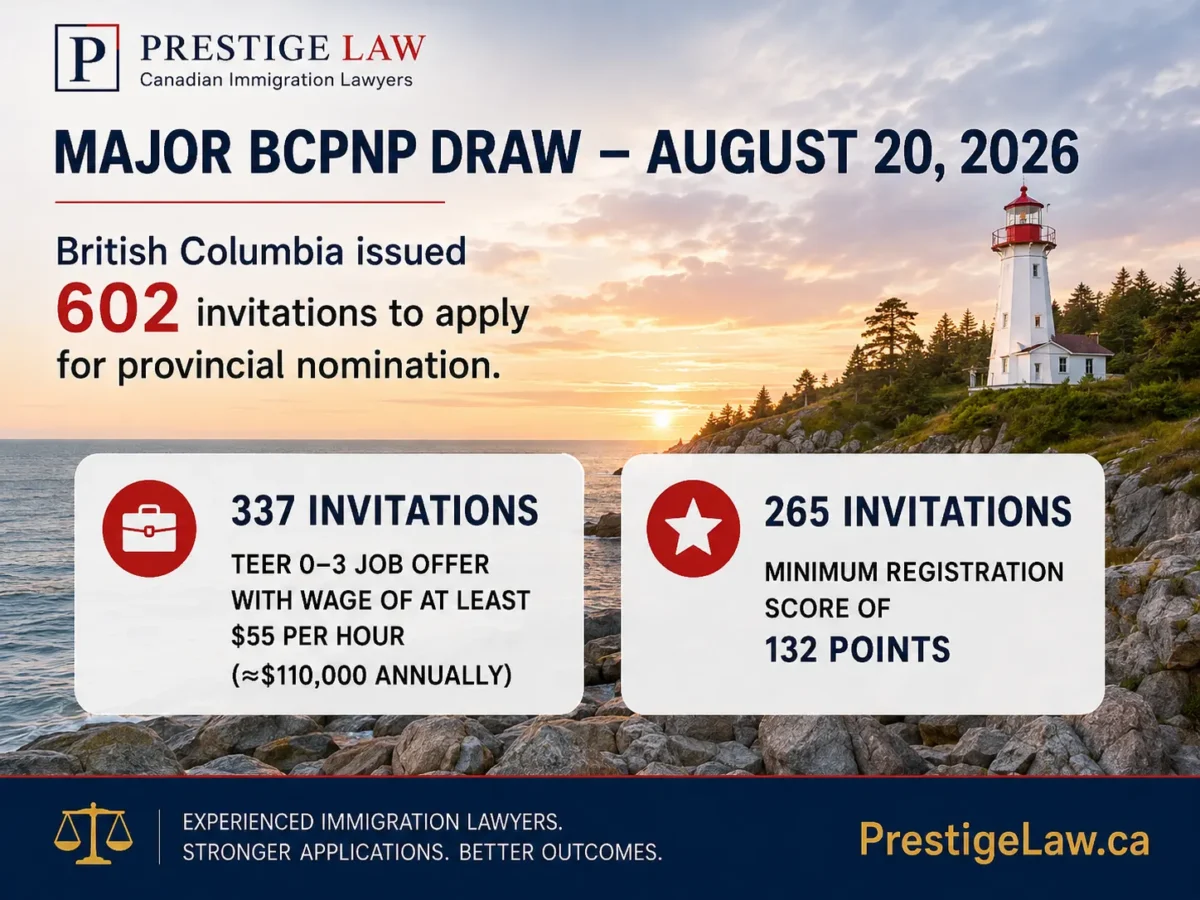
A total of 337 candidates were invited on the basis of having a TEER 0–3 job offer paying at least $55 per hour.
For a full-time worker, that wage represents approximately $110,000 annually.
This selection criterion demonstrates the province’s continued interest in attracting and retaining workers whose employment is considered to have a substantial economic impact.
However, salary should not be assessed in isolation.
A qualifying BCPNP application can involve numerous additional requirements concerning the employer, employment offer, occupation, immigration status, work experience, and other program-specific conditions.
Applicants should therefore avoid assuming that earning above a particular wage automatically makes them eligible for nomination.
Candidates With Scores of 132 or Higher Were Also Invited
Another 265 invitations went to candidates with a BCPNP registration score of at least 132 points.
This was a significant portion of the overall draw and demonstrates the importance of building a competitive registration profile.
Candidates considering the BCPNP should carefully review the information entered into their registration.
Errors concerning work history, wage, education, language results, or other eligibility factors can potentially affect a candidate’s score or create difficulties later when supporting documentation is reviewed.
BCPNP Registration Pool Remains Competitive
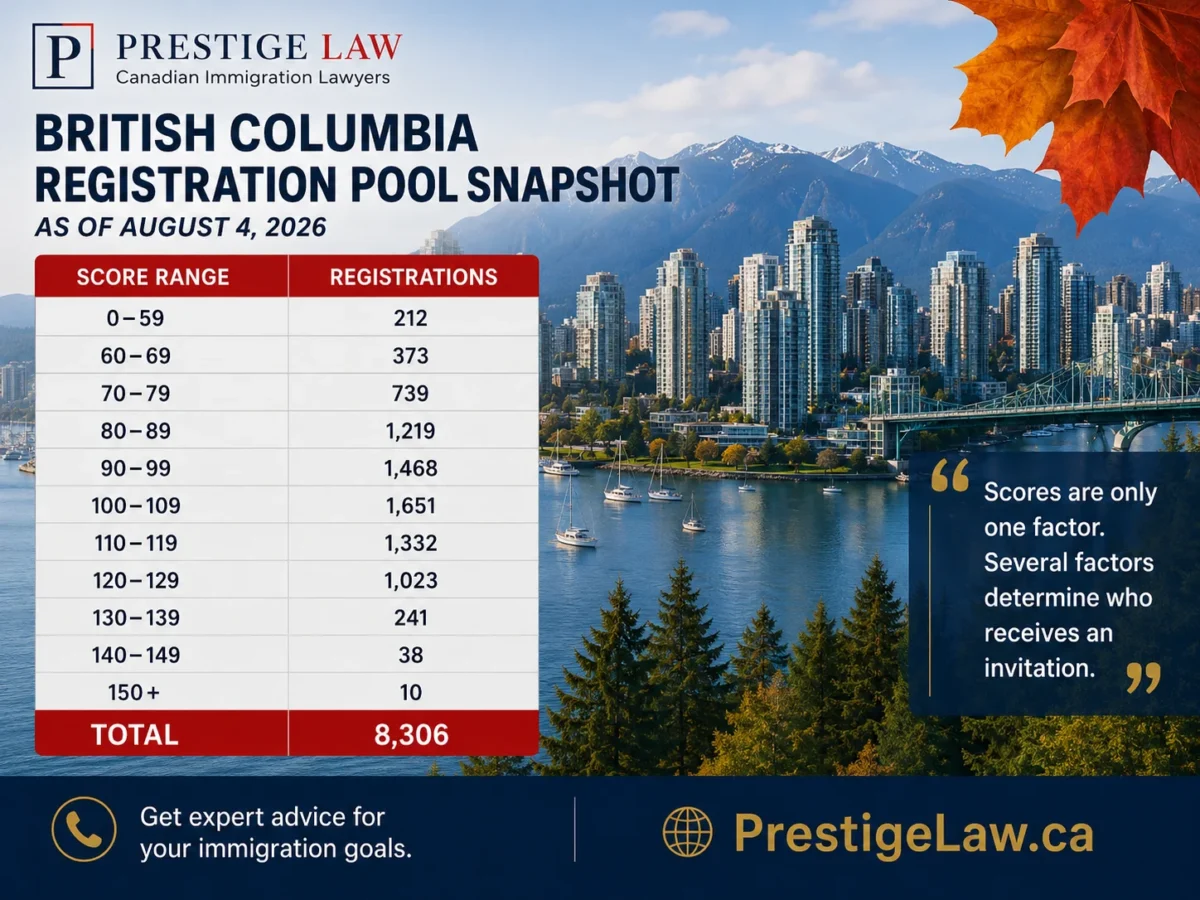
British Columbia reported 8,306 registrations in its pool as of August 4, 2026.
The distribution included:
| Score Range | Registrations |
|---|---|
| 0–59 | 212 |
| 60–69 | 373 |
| 70–79 | 739 |
| 80–89 | 1,219 |
| 90–99 | 1,468 |
| 100–109 | 1,651 |
| 110–119 | 1,332 |
| 120–129 | 1,023 |
| 130–139 | 241 |
| 140–149 | 38 |
| 150+ | 10 |
| Total | 8,306 |
The figures demonstrate why candidates should not evaluate their immigration prospects using a single historic cut-off.
Scores are only one part of the selection process, and British Columbia can conduct targeted rounds based on different economic priorities.
30-Day Deadline After Receiving an Invitation
Receiving an invitation from the BCPNP is an important milestone, but it also creates a significant deadline.
Candidates invited to apply for provincial nomination generally have 30 days to submit a complete application.
Applicants should use this period carefully.
Supporting documents may be required to establish matters such as:
- Employment and work experience;
- Educational credentials;
- Language results;
- Job offer details;
- Wage information;
- Employer information;
- Immigration status in Canada;
- Identity and civil-status documents; and
- Other program-specific eligibility requirements.
Waiting until the final days of the application period can create unnecessary risk, particularly if documents are missing or inconsistencies need to be addressed.
What Happens After a Provincial Nomination?
If British Columbia approves the application, the successful applicant receives a provincial nomination certificate.
The individual can then proceed with the applicable federal permanent residence process.
The federal stage remains important.
Immigration, Refugees and Citizenship Canada may still examine whether the foreign national satisfies Canada’s applicable immigration requirements, including admissibility and documentation requirements.
A provincial nomination should therefore not be treated as an automatic guarantee that permanent residence will ultimately be granted.
British Columbia Continues Targeted Immigration Selection
By August 20, British Columbia had issued at least 4,926 invitations to skilled workers and entrepreneurs during 2026.
The province has used several different approaches throughout the year, including general skills-based criteria, occupational targeting, wage and job-offer criteria, and specialized immigration initiatives.
This increasingly targeted approach means candidates should consider more than simply asking:
“What was the latest BCPNP cut-off?”
A more useful assessment may include:
Does my occupation align with current provincial priorities?
Is my wage competitive?
Is my BCPNP registration score strong enough?
Does my job offer satisfy the applicable requirements?
Can I document everything claimed in my registration?
Is there another provincial or federal immigration pathway that may be more appropriate?
These questions can materially affect immigration strategy.
Should You Create or Update a BCPNP Profile?
The latest selection round may be encouraging for workers with high registration scores or qualifying higher-wage employment in British Columbia.
However, immigration programs can contain detailed eligibility rules, and invitation thresholds may change.
Before submitting a registration or making significant changes to an existing immigration strategy, applicants should understand both the provincial requirements and the eventual federal permanent residence process.
An assessment can also be useful for individuals who have already created a BCPNP profile but have not yet received an invitation.
Changes in employment, wages, education, language scores, work experience, or family circumstances may affect a person’s immigration options.
How Prestige Law Can Help
Navigating a provincial nomination application can involve much more than calculating a points score.
At Prestige Law, we assist individuals and families with Canadian immigration matters and can review the circumstances surrounding a proposed or existing immigration application.
Our immigration legal services may include assistance with:
- Provincial nominee applications;
- Permanent residence applications;
- Work permits;
- Study permits;
- Family and spousal sponsorship;
- Immigration refusals;
- Procedural Fairness Letters;
- Judicial Review applications;
- Humanitarian and Compassionate applications;
- Immigration appeals;
- Inadmissibility matters; and
- Other complex Canadian immigration issues.
If you have received a BCPNP invitation, are considering registering under a British Columbia immigration pathway, or are uncertain about the best route toward Canadian permanent residence, obtaining advice based on your individual circumstances can help you make a more informed decision.
How Many Invitations Has British Columbia Issued in 2026?
As of the August 20 draw, British Columbia had issued 3,260 invitations based on the two selection criteria discussed in the source report.
More broadly, the province had issued at least 4,926 invitations to skilled workers and entrepreneurs during 2026 as of August 20.
The province had also conducted a variety of selection rounds throughout the year.
These included draws based on wages and job offers, registration points, occupation-specific criteria, and other targeted immigration initiatives.
This reflects an increasingly strategic approach to provincial immigration.
Rather than simply inviting candidates according to a universal points threshold, British Columbia can use nomination spaces to address specific provincial needs.
What Happens When You Receive a BCPNP Invitation?
Receiving an invitation to apply is an important achievement, but it is also the beginning of a critical application stage.
According to the program information reported in the source article, invited candidates must submit a complete provincial nomination application within 30 days.
Thirty days can pass quickly.
Candidates should therefore review their documentation as soon as possible.
Depending on the immigration pathway and individual circumstances, applicants may need documents relating to:
- Passport and identity;
- Immigration status;
- Employment;
- Job offer;
- Employer information;
- Salary;
- Work experience;
- Education;
- Language testing;
- Professional qualifications;
- Family circumstances; and
- Other relevant eligibility factors.
Any discrepancy between what was claimed during registration and what the supporting documents establish may require careful attention.
Why Accuracy Matters in a BCPNP Application
Immigration applications rely heavily on documentary evidence.
Candidates should ensure that the information submitted in their application is consistent with their supporting documents.
For example, an applicant may encounter difficulties if there are unexplained inconsistencies concerning:
- Employment start and end dates;
- Job duties;
- Salary;
- Hours of work;
- Occupational classification;
- Educational history;
- Language results;
- Immigration status;
- Previous applications; or
- Personal history.
Even seemingly minor discrepancies can lead to questions from immigration authorities.
Where an applicant is uncertain about information contained in a registration or application, it may be useful to obtain legal advice before submitting the final materials.
What Happens After British Columbia Approves the Application?
If British Columbia approves a provincial nomination application, the applicant receives a nomination certificate.
The successful nominee can then proceed to the appropriate federal permanent residence stage.
At the federal stage, the applicant must continue to comply with Canada’s immigration requirements.
Depending on the case, the federal government can examine matters involving:
- Medical admissibility;
- Criminal inadmissibility;
- Security concerns;
- Misrepresentation;
- Identity;
- Family composition;
- Immigration history; and
- Other statutory requirements.
This is why immigration applicants should think beyond the initial provincial invitation.
The ultimate objective is permanent residence, and every stage should be approached carefully.
What If Your BCPNP Score Is Below 132?
A score below 132 does not necessarily mean that permanent residence through British Columbia—or Canada more broadly—is impossible.
The 132-point threshold applied to this particular selection round.
Future draws may use different criteria.
Candidates who were not invited may consider whether legitimate improvements to their profile are possible.
Depending on individual circumstances, these could potentially involve changes relating to:
- Language proficiency;
- Employment;
- Wage;
- Work experience;
- Education;
- Professional credentials;
- Location of employment; or
- Other program factors.
Candidates should not make artificial or inaccurate changes simply to increase their score.
Any information submitted to immigration authorities should be truthful, accurate, and supported by documentation.
What If You Do Not Receive a BCPNP Invitation?
Candidates who remain in the registration pool should not necessarily assume their Canadian permanent residence plans have ended.
A BCPNP pathway is only one potential immigration strategy.
Depending on a person’s circumstances, other options may potentially include different provincial nominee programs, federal economic immigration programs, family sponsorship, work-related pathways, or other immigration categories.
The appropriate route depends on factors such as:
- Age;
- Education;
- Occupation;
- Work history;
- Canadian experience;
- Language ability;
- Job offer;
- Province of residence;
- Family relationships;
- Immigration status; and
- Long-term immigration objectives.
A personalized immigration assessment can therefore be more valuable than focusing exclusively on the latest draw score.
Should You Move to British Columbia Just to Qualify for the BCPNP?
Immigration candidates should be cautious about making major decisions solely for the purpose of trying to qualify for one immigration program.
Moving between provinces, changing employers, accepting a new job, or changing immigration status can have significant legal and practical consequences.
Provincial nominee programs are designed for applicants who genuinely intend to establish themselves in the nominating province.
Candidates considering major changes should understand how those changes may affect both their current immigration status and long-term permanent residence strategy.
What Should Employers Know?
The BCPNP can also be relevant to British Columbia employers trying to retain skilled foreign workers.
Employers may play an important role in supporting certain provincial nominee applications.
However, participation can involve specific requirements.
Employers should ensure that employment information provided in immigration documentation is accurate and consistent with actual workplace conditions.
This includes details such as:
- Job title;
- Duties;
- Salary;
- Working hours;
- Work location;
- Employment duration; and
- Nature of employment.
Incorrect or inconsistent employer information can create difficulties for both the employee and the immigration application.
Provincial Immigration Is Becoming More Targeted
A broader lesson from British Columbia’s 2026 selection activity is that Canadian provincial immigration is becoming increasingly targeted.
Provinces must balance available immigration allocations against local economic needs.
This can mean focusing nomination spaces on candidates who can help fill particular labour shortages or contribute to sectors identified as strategically important.
For applicants, this makes immigration planning more dynamic.
It may no longer be sufficient to ask:
“Do I qualify for the program?”
Candidates should also ask:
“How competitive is my profile under current provincial priorities?”
These are different questions.
A person may technically qualify for a program but still have a low probability of receiving an invitation if their profile is not competitive.
Questions to Ask Before Submitting a BCPNP Registration
Before creating or updating a provincial immigration profile, candidates may want to consider the following questions:
Is my occupation classified correctly?
The occupational code should accurately reflect the work actually performed.
Does my employment meet the program requirements?
Job title alone may not establish eligibility.
Is my wage accurately reported?
Salary and hourly wage calculations should be consistent with employment documentation.
Are my language results valid?
Applicants should verify both validity periods and the scores entered into their profile.
Is my work experience properly documented?
Employment letters and other records should be consistent with the work history claimed.
Can I prove everything I am claiming?
Immigration applications should be supported by reliable documentation.
Do I genuinely intend to reside in British Columbia?
Provincial nomination is connected to the applicant’s intention to settle in the nominating province.
Common Mistakes Candidates Should Avoid
Applicants should be careful to avoid preventable errors when dealing with provincial immigration applications.
Common concerns can include:
- Selecting an incorrect occupational classification;
- Miscalculating work experience;
- Reporting an incorrect wage;
- Submitting incomplete employment records;
- Failing to update changed circumstances;
- Waiting too long after receiving an invitation;
- Assuming an invitation guarantees approval;
- Ignoring federal permanent residence requirements;
- Providing inconsistent information across immigration applications; and
- Relying entirely on previous draw scores.
Immigration files can become significantly more complicated when incorrect information must later be explained or corrected.
Frequently Asked Questions About the Latest BCPNP Draw
How many invitations did British Columbia issue?
British Columbia issued 602 invitations in the August 20, 2026 BCPNP selection round.
What was the minimum BCPNP score?
Candidates selected through the registration-score criterion required at least 132 points.
What wage was required for the high-wage selection?
The draw included candidates with qualifying TEER 0–3 job offers paying at least $55 per hour, approximately $110,000 annually.
How many candidates were invited based on wages?
A total of 337 invitations were issued under the job-offer and wage criterion.
How many were invited based on registration score?
A total of 265 invitations were issued to candidates meeting the 132-point threshold.
Does receiving an invitation mean permanent residence is guaranteed?
No.
An invitation allows the candidate to apply for provincial nomination.
The candidate must still receive provincial approval and complete the applicable federal permanent residence process.
How long do invited candidates have to apply?
The source information states that invited candidates have 30 days to submit a complete provincial nomination application.
Can the next BCPNP score change?
Yes.
BCPNP selection criteria and thresholds may vary from one draw to another based on provincial priorities and the composition of the candidate pool.
Can someone below 132 points still immigrate to Canada?
Potentially, yes.
A score of 132 applied to this particular selection round.
Other BCPNP draws or different Canadian immigration programs may have different eligibility and selection requirements.
How Prestige Law Can Assist With Canadian Immigration Matters
Provincial immigration applications can involve detailed eligibility requirements, documentation, deadlines, and strategic considerations.
At Prestige Law, we assist individuals and families navigating Canadian immigration matters and can provide legal guidance based on the specific circumstances of a case.
Our immigration services may include assistance with:
- Provincial Nominee Program applications;
- Permanent residence applications;
- Express Entry matters;
- Work permits;
- Study permits;
- Spousal sponsorship;
- Family sponsorship;
- Immigration refusals;
- Procedural Fairness Letters;
- Judicial Review applications;
- Humanitarian and Compassionate applications;
- Immigration appeals;
- Inadmissibility matters;
- Removal-related immigration matters; and
- Other complex Canadian immigration cases.
An immigration strategy should be based on the individual applicant’s circumstances rather than assumptions drawn from a single immigration announcement or selection round.
Received a BCPNP Invitation? Pay Attention to Your Deadline
If you recently received an invitation to apply under the BCPNP, it is important to carefully review the deadline and documentation requirements associated with your invitation.
The reported application period is 30 days, making early preparation particularly important.
Applicants should avoid waiting until the deadline approaches before identifying missing documents, employment discrepancies, or other potential concerns.
Where a matter is complicated, receiving advice before submission may help identify issues while there is still time to address them.
Considering British Columbia Permanent Residence?
If you are working in British Columbia, have a qualifying job offer, have created a BCPNP registration, or are trying to understand whether provincial nomination may be available to you, a detailed review of your circumstances can help clarify your immigration options.
Immigration programs evolve frequently, and the best route can depend on much more than one score.
Factors involving employment, wages, occupation, language ability, education, work experience, immigration status, and long-term goals should all be considered together.
Speak With Prestige Law
If you have questions regarding the British Columbia Provincial Nominee Program, Canadian permanent residence, an immigration application, or a refusal, Prestige Law can review your circumstances and help you understand the legal options that may be available.
Visit PrestigeLaw.ca to schedule a consultation with our immigration team.
Every immigration case is different. Obtaining legal advice based on your particular facts can help you make informed decisions and avoid relying on generalized immigration information.