




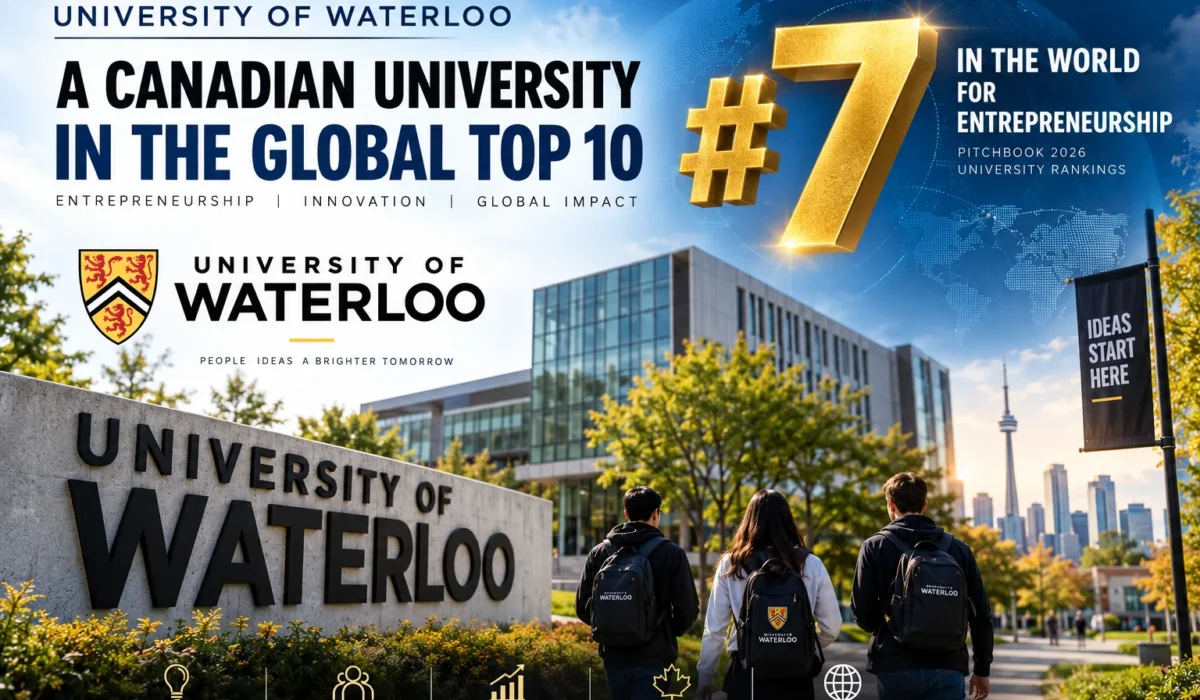
University of Waterloo Breaks Canada Into World’s Top 10 for Entrepreneurship

For the first time in its history, a Canadian university has cracked the global top 10 for producing successful entrepreneurs. The University of Waterloo has climbed to seventh place in PitchBook’s 2026 University Rankings, a widely respected venture-capital research benchmark that tracks which schools produce the founders who go on to build investor-backed companies. The achievement places Waterloo ahead of Ivy League powerhouses such as Harvard, Cornell, and the University of Pennsylvania, and makes it the highest-ranked university outside the United States. For prospective students, international applicants, tech founders, and immigration-minded professionals across Canada, the milestone is more than a bragging right — it is a signal about where Canada’s innovation economy, talent pipeline, and immigration pathways are heading in 2026 and beyond.
Key Takeaways
- The University of Waterloo ranked seventh globally in PitchBook’s 2026 University Rankings for undergraduate founders — the first time any Canadian school has reached the global top 10.
- Waterloo climbed 11 spots year-over-year, moving up from 18th place in the 2025 rankings.
- Waterloo is now the highest-ranked university outside the United States and one of only two non-U.S. schools in the global top 10.
- Eight Canadian universities appear in PitchBook’s global top 100, led by Waterloo, the University of Toronto, and McGill University.
- The result carries practical implications for international students, skilled workers, founders, and anyone evaluating Canada’s Post-Graduation Work Permit, Express Entry, and provincial entrepreneur immigration pathways.
What the PitchBook 2026 University Rankings Actually Measure
PitchBook is an independent research firm that tracks global venture capital activity, and its annual “Top 100 Universities Ranked for Entrepreneurs” report is now in its thirteenth edition. Unlike rankings built around tuition costs, research output, or reputation surveys, PitchBook’s methodology is entirely outcome-based. The firm analysed data on more than 222,000 venture-backed founders worldwide who raised capital between January 2015 and August 2026, then traced each founder back to the university where they earned their undergraduate or graduate degree. Waterloo Breaks Top 10 for Entrepreneurship
The funding types counted in the study span the full venture lifecycle: seed rounds, early-stage venture capital, later-stage venture capital, angel investment, and several restart-stage categories. In other words, a university only scores well if its graduates go on to actually start companies that convince professional investors to write checks. That makes the ranking a meaningful proxy for a school’s real-world entrepreneurial output, rather than its classroom reputation alone.
Waterloo’s climb to seventh place in the undergraduate category represents an 11-spot jump from 18th place in the 2025 edition — one of the largest single-year moves of any school in the report. The university’s founders have collectively started more than 1,000 venture-backed companies, raising tens of billions of dollars in capital along the way.
Why Waterloo’s Rise Matters for Canada
Until this year, no Canadian institution had ever appeared in PitchBook’s global top 10. Canadian universities have long been recognised for strong engineering, computer science, and mathematics programs, and Waterloo in particular has built an international reputation around its cooperative education (co-op) model, which places students directly into industry roles throughout their degree. What had been missing, at least by this specific measure, was proof that Canadian graduates were converting that technical training into venture-scale companies at a rate comparable to the top American schools.
That gap has now visibly narrowed. Waterloo is the only publicly funded university in the global top 10 besides the University of California, Berkeley, and it is one of only two non-U.S. schools to make the list at all. For a country that has spent the past decade trying to close its “innovation gap” with the United States — through federal superclusters, provincial tech funds, and expanded skilled-worker immigration streams — an independent, data-driven ranking like this carries real weight with policymakers, investors, and prospective students evaluating where to study and build a career.
University leadership has framed the result as validation of a university-wide push toward commercialisation and startup support rather than a one-off statistical fluke. Velocity, Waterloo’s flagship startup incubator, has been central to that push, and its leadership has pointed to the ranking as recognition that the university’s founders are turning ambitious ideas into companies that attract real investment and create lasting economic impact.
The Global Top 10: Where Waterloo Stands
PitchBook’s 2026 rankings for undergraduate-degree founders placed the following institutions at the top of the world:
Rank University Country Founder Count
1 University of California, Berkeley USA 2,380
2 Stanford University USA 1,997
3 Harvard University USA 1,697
4 Cornell University USA 1,541
5 Massachusetts Institute of Technology USA 1,525
6 University of Pennsylvania USA 1,466
7 University of Waterloo Canada 1,303
8 University of Michigan, Ann Arbour USA 1,085
9 Tel Aviv University Israel 1,084
10 University of Texas at Austin USA 1,036
Every other school in the top 10 is American, with the sole exception of Tel Aviv University. Waterloo’s presence on this list — ahead of Cornell alumni networks and MIT’s famed entrepreneurship ecosystem in the undergraduate category — is a notable shift in how global venture capital views Canadian-trained talent.
In the separate ranking for founders holding graduate degrees, Waterloo placed 54th worldwide, tying the University of British Columbia for the second-best result among Canadian schools. Waterloo was also recognised as the fastest-rising school globally in the female-founder category, climbing to 11th place worldwide for undergraduate alumnae who went on to raise venture funding — a trend worth watching as Canada continues to push for more diverse representation in its startup and tech sectors.
Canada’s Long Wait for a Top-10 Ranking
Canadian universities have appeared in PitchBook’s global top 100 for years, but none had previously broken into the top 10 — a threshold widely treated as the dividing line between “strong regional program” and “globally elite entrepreneurial pipeline” in venture capital circles. Waterloo itself had spent recent editions hovering in the high teens and low twenties, respected for producing capable technical graduates but not yet recognised as a peer to Stanford or MIT in terms of founder output.
The 11-spot jump in a single year is unusual for a ranking built on multi-year venture funding data, where movement tends to be gradual because the underlying founder cohorts change slowly. A jump of this size typically reflects either a strong new wave of well-funded companies reaching notable funding rounds within the report’s measurement window, or a broader re-weighting as more of a university’s alumni founders reach the venture stage rounds PitchBook tracks. Either way, the scale of the shift is part of why the result has drawn attention well beyond Waterloo’s own campus and into national business and immigration-focused media coverage.
For context, it also helps to understand who was previously occupying that seventh-place position and the ground Waterloo had to make up. Cracking a list dominated almost entirely by long-established American research universities — several of which have multi-decade head starts in venture-backed alumni networks and dedicated entrepreneurship faculties — represents a meaningful competitive achievement for a Canadian public university operating with a fraction of the endowment resources of its Ivy League counterparts.
How Other Canadian Universities Compare
Waterloo was not the only Canadian school to make PitchBook’s broader global top 100. Eight Canadian universities appeared on the list this year, led by a cluster of Ontario institutions alongside schools from Quebec, British Columbia, and Alberta:
National RankUniversityFounder CountGlobal RankYoY Change
1 University of Waterloo 1,303 7 +11
2 University of Toronto 808 17 —
3 McGill University 721 23 -1
4 Western University 548 36 +4
5 University of British Columbia 472 43 +1
6 Queen’s University 319 78 —
7 University of Calgary 249 96 +4
8 York University 248 98 +2
This spread shows the strength isn’t confined to a single Ontario campus. Five of the eight Canadian schools in the global top 100 are based in Ontario, reinforcing the province’s position as the country’s most active hub for venture-backed founders, while McGill, UBC, and the University of Calgary demonstrate that Quebec, British Columbia, and Alberta each have credible entrepreneurial pipelines of their own. Taken together, the results suggest Canada’s startup talent base is broader than a single flagship school, even as Waterloo stands out as the clear national leader.

Notable Companies Founded by Waterloo Alumni
Part of what makes Waterloo’s ranking credible is the calibre of companies its graduates have actually built. Waterloo alumni have gone on to found or co-found several globally recognised, venture-backed businesses, including:
- Instacart — the grocery delivery platform that became a household name across North America
- Databricks — one of the most highly valued private data and AI companies in the world
- Faire — a wholesale marketplace connecting independent retailers with brands
- Netskope — a major cybersecurity and cloud-security company
- Arctic Wolf — a cybersecurity operations company headquartered in Waterloo, Ontario
- ContextLogic Holdings — the parent company behind e-commerce platform Wish
According to the university’s most recent economic and alumni impact report, Waterloo alumni have collectively founded more than 67,900 companies worldwide, generating an estimated $397 billion in annual economic activity across sectors including artificial intelligence, fintech, health technology, software, advanced manufacturing, and sustainability. In Ontario alone, Waterloo-linked entrepreneurs are credited with generating hundreds of millions of dollars in GDP, underscoring how directly the university’s output feeds the province’s broader economy.
Velocity: The Engine Behind Waterloo’s Entrepreneurial Culture
Much of Waterloo’s entrepreneurial output is tied to Velocity, the university’s flagship startup incubator and one of the most active university-affiliated incubators in the world. Velocity offers residence-style startup housing, dedicated workspace, mentorship, and funding competitions designed to help student and alumni founders move from early-stage ideas to fundable companies. Since its founding, Velocity has supported the launch of more than 500 companies, which have gone on to generate tens of billions of dollars in combined enterprise value.
Velocity’s model — pairing Waterloo’s co-op education pipeline, which sends students into industry placements throughout their degree, with dedicated incubation infrastructure on campus — is frequently cited as a key differentiator versus other Canadian universities. Students graduate having already worked multiple industry co-op terms, often at fast-growing technology companies, giving them both the technical skills and professional networks that make founding or joining an early-stage startup a realistic next step rather than a leap into the unknown.
What This Means for International Students Considering Canada
For prospective international students weighing where to study, a top-10 global entrepreneurship ranking is a meaningful signal about long-term career outcomes — and it intersects directly with how Canada’s immigration system evaluates skilled applicants.
International graduates of a Designated Learning Institution such as the University of Waterloo are generally eligible to apply for a Post-Graduation Work Permit (PGWP), which allows them to gain Canadian work experience after completing their studies. That Canadian work experience, in turn, can strengthen a candidate’s profile under the Express Entry system, Canada’s primary pathway for skilled economic immigration, and can support additional points under many Provincial Nominee Program (PNP) streams that specifically target graduates working in innovation, technology, or entrepreneurship-adjacent roles.
It’s worth being precise about what a university ranking does and does not do within Canada’s immigration framework. Attending a highly ranked entrepreneurial school does not, by itself, add points to a candidate’s Comprehensive Ranking System (CRS) score under Express Entry. The CRS rewards factors such as education level, age, language proficiency, and Canadian work experience — not institutional prestige or ranking position. What a strong program like Waterloo’s does provide is a stronger foundation for building those underlying factors: higher likelihood of securing a skilled job offer, stronger co-op and post-graduation work experience, and in some cases direct access to entrepreneur-focused immigration streams offered by provinces eager to retain graduate talent.
Ontario, British Columbia, and several other provinces operate PNP streams specifically designed for entrepreneurs and tech workers, some of which give preference to applicants who have already demonstrated traction — funding raised, a registered business, or a functioning team — while studying or working in Canada. Graduates coming out of an ecosystem like Waterloo’s, where campus incubators actively help students formalise startup ideas before graduation, are often better positioned to meet these program-specific criteria than graduates of institutions without comparable infrastructure.
Canada’s Startup Visa Program and the Ranking Connection
One immigration pathway worth understanding alongside this ranking is Canada’s Start-Up Visa Program, a federal permanent residence stream designed specifically for foreign entrepreneurs who can secure support from a designated Canadian venture capital fund, angel investor group, or business incubator. Unlike Express Entry, the Start-Up Visa Program does not rely on a points-based comprehensive ranking system; instead, eligibility hinges on securing a qualifying commitment from a designated organisation, along with meeting language and settlement fund requirements.
Waterloo’s rise in the PitchBook rankings is relevant here for a practical reason: designated incubators and venture funds connected to Waterloo’s ecosystem, including those affiliated with Velocity and the broader Toronto-Waterloo corridor, are among the organisations that can issue the commitments required under the Start-Up Visa Program. As Waterloo’s founder network continues to expand and attract international attention, the university’s ecosystem is likely to remain a meaningful entry point for foreign entrepreneurs specifically targeting Canada’s Start-Up Visa pathway, in addition to the study-to-PGWP-to-Express-Entry route more commonly used by international students.
Founders exploring either pathway should note that Start-Up Visa applications require careful preparation, including a qualifying letter of support, evidence of a genuine and innovative business, and compliance with detailed program requirements — an area where coordinated legal guidance often makes a material difference to outcomes.
Choosing a Program With Immigration Goals in Mind
Prospective international students often ask which Waterloo programs are most closely tied to the university’s entrepreneurial track record. While founders have emerged from across the university, Waterloo’s engineering, computer science, mathematics, and systems design programs are consistently cited as the strongest feeders into its startup ecosystem, largely because of their integration with the co-op system and their overlap with the software, AI, and hardware sectors where venture capital has been most active in recent years. Students planning a Canadian education with long-term immigration and career goals in mind may want to weigh not just program rankings in isolation, but how directly a program connects to co-op placements, campus incubators, and the kinds of employers who later support Post-Graduation Work Permit holders through to permanent residence.
What This Means for Founders, Employers, and Investors
Beyond the immigration lens, the ranking has practical implications for anyone operating in Canada’s startup and technology sectors.
For founders and early-stage entrepreneurs, Waterloo’s result reinforces Ontario’s Toronto-Waterloo innovation corridor as one of the most credible startup ecosystems outside Silicon Valley — a factor that increasingly shapes decisions about where to incorporate, hire, and raise capital.
For employers and scaling companies, the ranking is a useful recruiting signal. A verified, VC-validated track record of graduates founding successful companies suggests a talent pool with both technical depth and a bias toward building — qualities that matter whether a company is hiring its first engineers or its first executive team.
For investors, PitchBook’s dataset offers a data-backed argument for paying closer attention to Canadian-trained founders, whose companies are increasingly attracting serious venture capital rather than being treated as a secondary market relative to the United States.
For legal and immigration advisors working with founders, the ranking is a reminder that university pedigree, work permit eligibility, and provincial entrepreneur streams are increasingly interconnected. Founders building a company in Canada — whether they trained locally or are relocating a startup here — often need coordinated guidance across corporate structuring, employment law, and immigration status simultaneously.
For legal and immigration advisors working with founders, it’s also worth noting that PitchBook’s underlying dataset — tracking seed through later-stage venture rounds — reflects companies at very different stages of maturity. A founder whose company just closed a seed round faces a different set of legal, tax, and immigration considerations than one preparing for a later-stage raise or an eventual exit, which is why founder-focused legal support tends to be most effective when it evolves alongside the company rather than being treated as a single point-in-time engagement.
The Toronto-Waterloo Corridor and Canada’s Innovation Economy
Waterloo’s result also reinforces the broader strength of the Toronto-Waterloo innovation corridor, widely regarded as Canada’s largest and most active technology cluster. The corridor benefits from a dense concentration of universities, incubators, established technology employers, and venture capital firms operating within roughly a 90-minute radius, allowing talent, capital, and mentorship to circulate more efficiently than in more geographically dispersed ecosystems.
This concentration matters for national competitiveness. Canada has spent years trying to reduce the number of homegrown technology graduates who move to the United States for better-funded opportunities — a trend often referred to as brain drain. A ranking like PitchBook’s, which shows Waterloo alumni raising billions in venture capital while building companies headquartered in Canada, the United States, and elsewhere, offers evidence that Canadian-trained founders are increasingly capable of building globally competitive companies without necessarily needing to relocate entirely, even as many still do.
How Prestige Law Supports Entrepreneurs and Skilled Professionals in Canada
News like Waterloo’s top-10 ranking underscores a broader reality: Canada’s innovation economy is growing, and with it, the legal and immigration questions facing founders, skilled workers, and international graduates are becoming more complex, not less. Whether the issue is structuring a new company, navigating a Post-Graduation Work Permit, assessing eligibility for Express Entry or a provincial entrepreneur stream, or supporting a founder relocating a startup to Ontario, these matters typically require coordinated legal guidance rather than a single generic form.
Prestige Law works with entrepreneurs, skilled professionals, and international graduates across a range of business and immigration matters connected to building a career or a company in Canada. The firm’s approach focuses on practical, outcome-oriented guidance tailored to each client’s specific situation, rather than one-size-fits-all templates.
Frequently Asked Questions
What ranking did the University of Waterloo achieve in 2026? The University of Waterloo placed seventh globally in PitchBook’s 2026 University Rankings for undergraduate alumni founders, making it the first Canadian university ever to reach the global top 10 for entrepreneurship.
What is PitchBook, and why does its ranking matter? PitchBook is an independent venture capital research firm. Its annual university ranking is based on actual venture funding data tied to alumni founders, rather than reputation surveys, making it one of the more outcome-driven entrepreneurship rankings available.
Which companies were founded by University of Waterloo alumni? Notable companies founded by Waterloo alumni include Instacart, Databricks, Faire, Netskope, Arctic Wolf, and ContextLogic Holdings, spanning sectors from grocery delivery and cybersecurity to data infrastructure and e-commerce.
Does a university’s entrepreneurship ranking affect Express Entry CRS scores? No. Canada’s Comprehensive Ranking System does not award points based on a university’s ranking or reputation. It awards points for factors such as education level, age, language ability, and Canadian work experience, which a strong academic and co-op program can help a candidate build over time.
How many Canadian universities made PitchBook’s global top 100? Eight Canadian universities appeared in the 2026 global top 100, led by the University of Waterloo, followed by the University of Toronto, McGill University, Western University, the University of British Columbia, Queen’s University, the University of Calgary, and York University.
What is Velocity, and how does it relate to Waterloo’s ranking? Velocity is the University of Waterloo’s flagship startup incubator. It has supported the launch of more than 500 companies and is widely credited as a major driver of the university’s strong entrepreneurial output.
Can international students who study at a top-ranked entrepreneurial university stay in Canada after graduating? Graduates of eligible Designated Learning Institutions, including the University of Waterloo, can generally apply for a Post-Graduation Work Permit, which allows them to gain Canadian work experience that can support future permanent residence applications.
Are there Canadian immigration streams specifically for entrepreneurs? Yes. Several provinces, including Ontario and British Columbia, operate Provincial Nominee Program streams designed for entrepreneurs and tech-sector workers, often with criteria tied to business ownership, funding raised, or job creation in Canada. Canada also runs a federal Start-Up Visa Program for foreign entrepreneurs who secure support from a designated venture fund, angel group, or incubator.
What was Waterloo’s global ranking before 2026? Waterloo ranked 18th in the world in PitchBook’s 2025 undergraduate rankings before jumping 11 spots to seventh place in the 2026 edition.
Which Canadian region benefits most from Waterloo’s entrepreneurial output? The Toronto-Waterloo innovation corridor is widely regarded as Canada’s largest technology cluster and is the primary regional beneficiary of Waterloo’s startup activity, though Waterloo alumni have founded companies headquartered across Canada, the United States, and internationally.
Does Waterloo’s ranking apply to graduate-degree founders as well? Waterloo placed 54th globally in the graduate-degree founder rankings, tying the University of British Columbia for the second-best result among Canadian universities in that category, behind its stronger seventh-place undergraduate result.

Contact Prestige Law
Richmond Hill Office: 100–100 Mural Street, Richmond Hill, ON
Toronto Office 55 Town Centre Court, Suite 700, Toronto, ON
Phone: +1 (647) 925-2222 Website: prestigelaw.ca
Prestige Law, led by lawyer Zeesean Sheikh, advises entrepreneurs, skilled professionals, and international graduates on business and immigration matters across Ontario. Contact our team to discuss how these developments may affect your business, work permit, or immigration plans.
The University of Waterloo’s climb to seventh place in PitchBook’s global entrepreneurship rankings is a milestone years in the making, built on a combination of technical education, industry-integrated co-op learning, and dedicated startup infrastructure through programs like Velocity. For Canada, it offers rare, independently verified proof that the country’s top technical universities are producing founders capable of competing directly with graduates of Stanford, MIT, and the Ivy League for venture capital and global market share.
For students, founders, employers, and immigration-minded professionals watching Canada’s innovation economy, the ranking is worth paying attention to — not as an isolated headline, but as a data point in a longer trend of Canadian universities, and the entrepreneurs they produce, becoming genuinely globally competitive.