



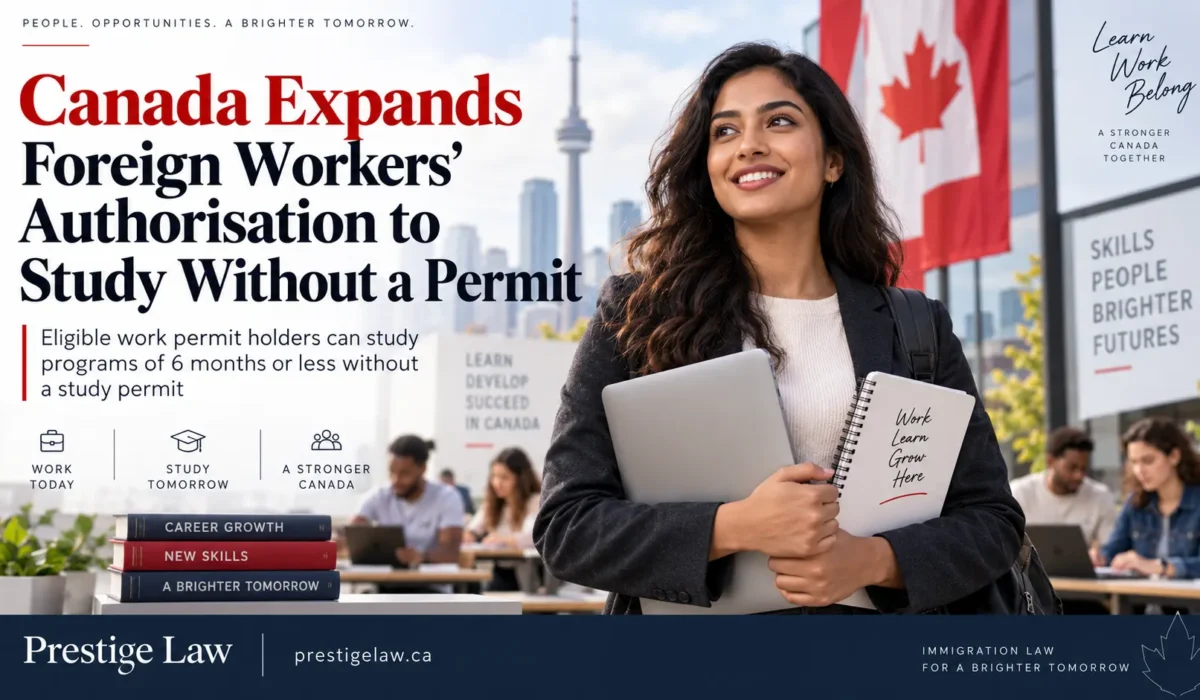
Canada Expands Foreign Workers’ Authorisation to Study Without a Permit

Canada has once again widened the door for temporary foreign workers who want to upgrade their skills while they work. Under a new temporary public policy that took effect on September 4, 2026, eligible work permit holders can now study a short-term program of six months or less without applying for a separate study permit — even if that program runs past the period of stay they were originally authorised when they first entered Canada. For thousands of workers already living and working across Ontario and the rest of the country, this is a meaningful, practical change that removes a paperwork barrier standing between them and better-paying, higher-skilled employment. At Prestige Law, we are closely tracking this policy because it intersects with several areas we regularly advise on, including work permit extensions, permanent residence planning, and Express Entry strategy, and because it is the kind of quiet regulatory update that can easily be misunderstood or missed by workers who would benefit most from it.
What Exactly Changed on September 4, 2026 Foreign Workers Can Now Study in Canada
On September 9, 2026, Immigration, Refugees and Citizenship Canada (IRCC) publicly announced a new version of its “Temporary public policy to allow foreign nationals with valid work permits to study without a study permit.” The policy itself had already come into force five days earlier, on September 4, 2026, and IRCC has been notifying eligible work permit holders individually by email, informing them that they may study at an institution of their choice for six months or less without needing to apply for a study permit.
This new measure was signed on August 5, 2026, and is designed to succeed an earlier version of the same policy that had been in place since 2023 and expired on June 27, 2026. In other words, this is not an entirely new concept for Canadian immigration policy — it is a refreshed and, in some respects, more flexible version of a tool IRCC has used before to help temporary workers gain additional skills without leaving the workforce or applying for a second immigration document.
The policy will remain in effect until December 31, 2027, unless it is revoked earlier or replaced by a further update. Given that the prior version of this policy ran for roughly three years before being renewed, workers and employers alike should treat this as a meaningful window of opportunity rather than a fleeting administrative footnote.
The Rule That Existed Before This Policy Foreign Workers Can Now Study in Canada
To understand why this update matters, it helps to understand the general rule it is modifying. Under paragraph 188(1)(c) of the Immigration and Refugee Protection Regulations (IRPR), a foreign national who is otherwise authorised to be in Canada can already study a course or program of six months or less without obtaining a study permit — but only if that course can be completed before the end of the period of stay that was originally authorised when the person entered the country.
That last condition is where many temporary workers ran into trouble. A worker who entered Canada on a work permit valid for, say, one year, and who later extended that work permit for an additional two years, would often find that the “period of stay” tied to their original entry had already technically ended, even though their work authorisation was still active. Strictly applying the regulation, that worker would not be permitted to take even a short training course without first obtaining a study permit, despite having every right to continue working in Canada.
This created a strange gap: someone with a fully valid, extended work permit — someone IRCC has already vetted and approved to remain and work in Canada — could still be blocked from taking a six-week professional development course or a short licensing program simply because of how their original entry authorisation was dated. For workers trying to requalify for a regulated occupation, obtain a professional credential, or simply build new skills, this technicality could mean choosing between an expensive, time-consuming study permit application or giving up the opportunity altogether.
What the New Policy Fixes
The new temporary public policy, issued under section 25.2 of the Immigration and Refugee Protection Act (IRPA), directly targets this gap. It exempts eligible work permit holders from the requirement in IRPR 188(1)(c) that a short-term program be completed within the originally authorised period of stay. In plain terms, that means a worker can now study a program of six months or less without a study permit, even if that program falls outside the window tied to their original entry into Canada, as long as they hold a valid work permit and meet the other conditions of the policy.
To qualify, a worker generally needs to satisfy two core conditions:
- They must hold a valid work permit at the time they begin — and throughout the duration of — their studies.
- Their program of study must be six months or less in length.
The authorisation to study without a permit lasts until whichever comes first: the six-month mark, the expiry of the underlying work permit, or the expiry or revocation of the public policy itself. If a worker’s work permit has less than six months of validity remaining, their study authorisation under this policy is effectively capped at whatever time is left on that permit — they cannot use the policy to study beyond the life of their work authorisation.
Importantly, IRCC has confirmed that this expanded authorisation also applies to workers in Quebec, provided they meet the same eligibility requirements. Quebec has its own distinct immigration framework in several respects, so this explicit confirmation matters for workers and employers operating there.
A Practical Example
Consider a worker who entered Canada three years ago on a one-year, employer-specific work permit tied to a job in the skilled trades. That worker’s employer has since applied for, and received, an extension, and the worker now holds a valid work permit that runs for another eighteen months. Under the strict wording of the old rule, that worker’s “period of stay” was arguably tied to the window created at their original entry — long since expired — meaning a short trade-certification course could technically require a study permit.
Under the new policy, that same worker can now enrol directly in a four-month certification program without applying for a study permit at all, provided their work permit remains valid throughout the program. They do not need to file a separate application with IRCC to access this exemption; the eligibility exists by operation of the public policy itself, based on the conditions being met.
This kind of scenario is common. Workers in construction, healthcare support roles, hospitality management, early childhood education, and various regulated and semi-regulated trades frequently need short courses, certificate programs, or licensing exams to move into better roles or to formally recognise skills they already use on the job. The new policy removes an administrative obstacle that had nothing to do with whether the worker was actually qualified to study — it was purely a function of when their original entry authorisation happened to expire.
Why IRCC Introduced This Change
IRCC has framed this policy as part of a broader effort to support temporary foreign workers already contributing to the Canadian economy. The department has indicated that the goal is to give these workers more flexibility to upgrade their skills, obtain professional credentials or licensing, and move into higher-skilled and higher-paying roles — including in sectors facing labour shortages, such as healthcare.
This aligns with a pattern in recent Canadian immigration policy: rather than creating entirely new visa categories, IRCC has increasingly used narrow, targeted public policies under section 25.2 of IRPA to smooth out specific frictions faced by people who are already lawfully in Canada. The study-without-a-permit exemption for work permit holders is a good example — it does not open a new pathway into Canada, but it does make life meaningfully easier for people who are already here and already working.
Do You Need to Apply, or Prove Anything, to Use This Policy?
One of the more practical questions workers ask is whether they need to submit any kind of application to IRCC to take advantage of this exemption. The answer is no — there is no separate application process. Eligibility exists automatically for workers who meet the conditions of the policy.
That said, the educational institution you plan to study with may ask you to demonstrate that you are eligible to study without a study permit. If asked, you should be prepared to show your valid work permit. Workers should not assume that simply telling a school or training provider that they qualify will be sufficient — institutions are entitled to request supporting documentation, and it is worth having your permit and any relevant documentation on hand when registering for a program.
Workers should also keep in mind that this policy exempts them from needing a study permit under Canadian immigration law. It does not exempt them from any requirements the province, professional regulatory body, or the educational institution itself may impose for enrollment, such as prerequisite coursework, language proficiency, or professional standing.

What This Policy Does Not Do
This update expands access to short-term study, but it is not a general-purpose study authorisation, and workers should be careful not to overstate what it allows. A few limitations are worth highlighting clearly.
It does not grant student work rights. Studying under this exemption does not come with the same work authorisation that a study permit combined with a co-op work permit might provide. If your program includes a work placement or co-op component involving a different employer or a different type of work than what your existing work permit authorises, you may need additional or separate work authorisation for that placement. Simply being enrolled in a program under this policy does not automatically extend or broaden your existing work permissions.
It is capped at six months. If the program you want to pursue runs longer than six months, this exemption will not cover it, and you would need to apply for a study permit in the ordinary way.
It depends entirely on your work permit remaining valid. If your work permit expires, is revoked, or is refused (in the case of a pending renewal), your authorisation to study under this policy ends at the same time. Workers considering a multi-month program should think carefully about the remaining validity of their work permit before committing, since losing status partway through a program can create complications.
It may not count toward Canadian work experience for certain immigration programs. This is one of the most important nuances for workers who are also planning a path to permanent residence. Where a worker moves from working to studying full-time under this exemption, any period spent primarily studying, rather than working, generally will not count as qualifying Canadian work experience for purposes such as the Canadian Experience Class (CEC) under Express Entry, even though the worker technically still holds a valid work permit during that time. Workers who are relying on continuous, qualifying work experience to build their Express Entry profile or meet a provincial nomination requirement should think carefully about how a period of full-time study might affect that calculation, and should get tailored advice before making a decision.
Who Stands to Benefit Most
While the policy is broad in the sense that it applies to any eligible work permit holder, certain groups are especially well positioned to benefit from it:
- Workers pursuing professional licensing or certification. Many regulated occupations in Canada — from healthcare aides to certain trades — require a Canadian credential, exam, or short bridging course before a worker can practise at full scope or move into a more senior role. This policy makes it easier to complete that step without pausing employment to apply for a study permit.
- Workers whose original entry authorisation has already lapsed. Anyone whose work permit has been extended or renewed since they first entered Canada, such that their originally authorised period of stay has technically expired, is precisely the group this policy was designed to help.
- Post-Graduation Work Permit (PGWP) holders. A PGWP is a type of work permit, so PGWP holders who meet the other conditions may also be eligible to study a short program under this policy, which can be useful for graduates looking to add a targeted credential while working.
- Employers in sectors facing skills shortages. Employers in healthcare, skilled trades, and other in-demand sectors may find that this policy makes it easier for existing foreign worker employees to complete short, targeted training without disrupting their work schedule or requiring a separate, lengthy application process.
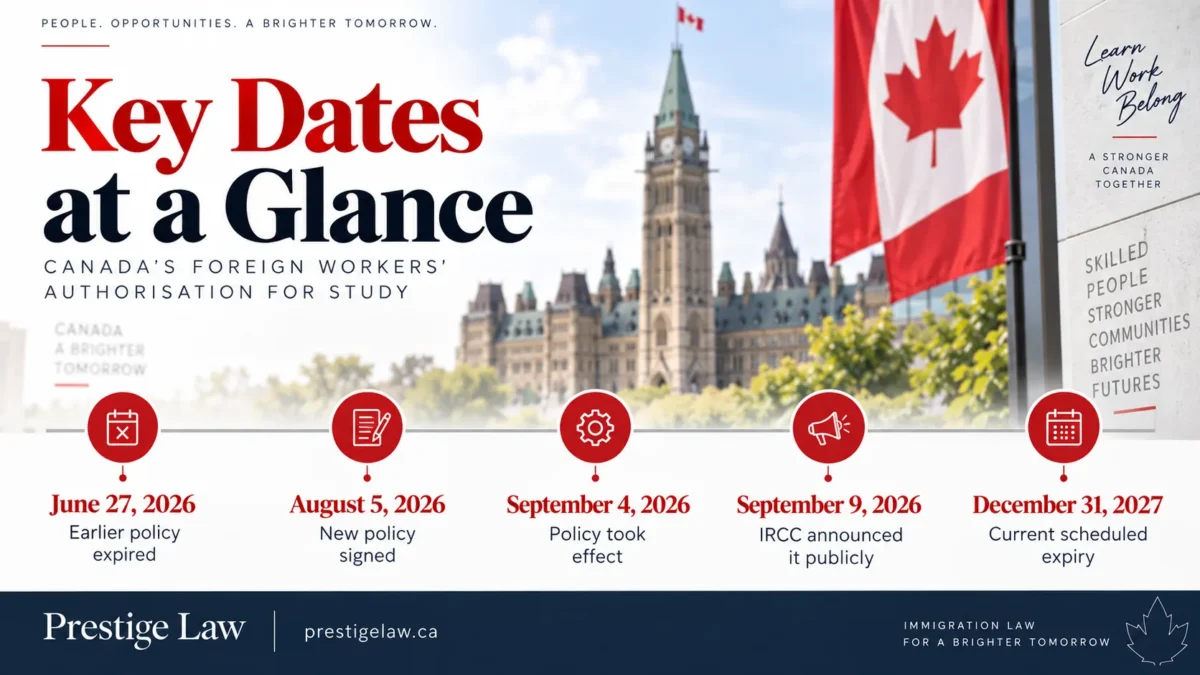
Timeline at a Glance
- June 27, 2023: The original version of this temporary public policy came into effect.
- June 27, 2026: The original policy expired.
- August 5, 2026: The renewed, expanded version of the policy was signed.
- September 4, 2026: The new policy came into effect.
- September 9, 2026: IRCC publicly announced the policy and began notifying eligible work permit holders by email.
- December 31, 2027: The current scheduled expiry date of the policy, unless it is revoked or replaced earlier.
Why This Matters for Ontario Employers and Workers
Ontario’s economy continues to rely heavily on temporary foreign workers across healthcare, construction, hospitality, logistics, and skilled trades. For employers, a workforce that can more easily access short-term upskilling without navigating a separate immigration application is a workforce that can adapt more quickly to changing certification requirements, seasonal demands, and internal promotion opportunities. For workers, the ability to pursue a licensing exam, a safety certification, or a short professional program without the cost, delay, and uncertainty of a study permit application is a genuine improvement in day-to-day flexibility.
At the same time, immigration policy in this area remains detailed and fact-specific. Whether a particular worker qualifies, how a period of study may interact with their broader immigration goals, and how to correctly document eligibility for an educational institution are all questions where the specific facts of a person’s immigration history matter a great deal. A policy that is genuinely helpful on paper can still create complications if it is applied incorrectly, particularly for anyone who is also working toward permanent residence.
How Prestige Law Can Help
Our team advises both workers and employers across a wide range of Canadian immigration matters, including work permit extensions and renewals, study permit applications, and long-term permanent residence strategy. If you are a work permit holder considering a short-term program under this new exemption, or an employer trying to understand how this policy affects your workforce, we can help you assess your eligibility, confirm how a period of study may interact with your broader immigration plans, and put together the documentation you may need to show an educational institution. Given how closely this policy intersects with work permit validity, provincial nomination requirements, and Express Entry eligibility, getting tailored advice before enrolling in a program is often the difference between a smooth process and an avoidable setback.
Frequently Asked Questions
Do I need to apply for anything to study without a study permit under this new policy? No. There is no separate application to IRCC. If you meet the conditions — a valid work permit and a program of six months or less — the exemption applies automatically. However, your school may ask you to show your work permit as proof of eligibility.
How long does this policy last? The current version of the policy took effect on September 4, 2026, and is scheduled to remain in effect until December 31, 2027, unless it is revoked or replaced sooner.
Can I study for longer than six months under this policy? No. The exemption only applies to programs of six months or less. If your program is longer, you will need to apply for a study permit in the usual way.
Does this policy give me the right to work as part of a co-op or work placement included in my program? Not automatically. If your program includes a work placement with a different employer or in work outside what your existing work permit authorises, you may need separate work authorisation for that placement.
Will time spent studying under this policy count toward my Canadian work experience for Express Entry? Not necessarily. Periods spent primarily studying full-time, rather than working, generally will not count as qualifying work experience for programs like the Canadian Experience Class, even if your work permit remains valid during that time. This can matter significantly for anyone building an Express Entry profile, so it is worth getting advice before enrolling.
Does this apply to workers in Quebec? Yes. IRCC has confirmed that eligible workers in Quebec can also study without a study permit under this policy, provided they meet the same conditions.
What happens if my work permit expires while I am studying? Your authorisation to study under this policy ends when your work permit expires, is refused, or the policy itself ends or is revoked — whichever happens first. If you lose valid work permit status partway through a program, your study authorisation under this exemption ends as well.
Are Post-Graduation Work Permit (PGWP) holders eligible? Potentially, yes. Since a PGWP is a type of work permit, a PGWP holder who meets the other conditions of the policy — namely, a program of six months or less — may be eligible to use this exemption.
What proof should I bring when registering for a program? Bring your valid work permit. Institutions may ask you to demonstrate your eligibility, and simply stating that you qualify may not be enough on its own.
Should I speak with an immigration lawyer before enrolling in a program under this policy? If you are also pursuing permanent residence, hold a work permit close to expiry, or are unsure how a period of study might affect your immigration status or eligibility for other programs, it is worth getting advice before you commit to a program. The policy is helpful, but the details of how it interacts with your individual immigration history can meaningfully affect the outcome.
Legal Disclaimer
This article is provided for general informational purposes only and does not constitute legal advice. Immigration policies, including temporary public policies issued by Immigration, Refugees and Citizenship Canada, can change or be revoked without notice, and individual eligibility depends on the specific facts of each case. Nothing in this article should be relied upon as a substitute for personalised legal advice from a qualified immigration professional. For advice specific to your situation, please contact our office to arrange a consultation.
Contact Prestige Law
For guidance on work permits, study permits, or how this new policy may affect your immigration plans, our team at Prestige Law is here to help.
Zeesean Sheikh, Prestige Law
📍 Richmond Hill: 100–100 Mural Street, ON 📍 Toronto: 55 Town Centre Court, Suite 700, ON
📞 Telephone: +1 (647) 925-2222 🌐 Website: prestigelaw.ca