



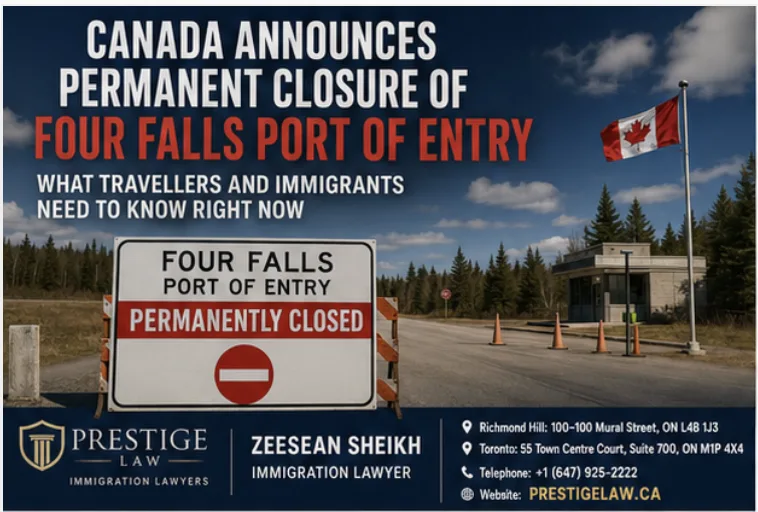
Canada Announces Permanent Closure of Four Falls Port of Entry
What Travellers and Immigrants Need to Know Right Now

In a significant development that will reshape cross-border travel patterns in Atlantic Canada, the Canada Border Services Agency (CBSA) has officially confirmed the permanent closure of the Four Falls, New Brunswick, port of entry. The announcement, made on May 11, 2026, marks the end of a crossing that had already been suspended since May 2020 — initially as a temporary COVID-19 pandemic measure — and signals a broader shift in how Canada manages its land border infrastructure. For travellers, tourists, commuters, and most importantly, for immigrants navigating Canada’s already complex entry system, this closure carries real and immediate consequences that require careful attention and, in many cases, professional legal guidance. Canada Closes Four Falls Port of Entry Permanently
This article breaks down everything you need to know about the Four Falls port of entry closure: why it happened, what it means for border crossings in New Brunswick and Atlantic Canada, how it fits into Canada’s national border strategy, and crucially, what steps you should take to protect your immigration status and travel plans. If you have questions specific to your situation, Prestige Law — led by experienced immigration lawyer Zeesean Sheikh — is available to help you navigate every step of the process from offices in Richmond Hill and Toronto, Ontario. Canada Closes Four Falls Port of Entry Permanently Canada Closes Four Falls Port of Entry Permanently
What Was the Four Falls Port of Entry? Canada Closes Four Falls Port of Entry Permanently
Understanding the History and Role of the Four Falls Border Crossing
The Four Falls port of entry was a seasonal land border crossing located in Four Falls, New Brunswick, situated along the Canada–United States border in the northwestern part of the province. Unlike the majority of Canada’s border crossings, which operate year-round on a full-time basis, Four Falls functioned exclusively as a seasonal crossing — open from mid-April through mid-October each year. During those months, it provided a direct passage point for travellers moving between northern Maine in the United States and western New Brunswick in Canada.
The crossing served a relatively modest but steady stream of travellers each season, primarily cottage-goers, tourists exploring the Saint John River Valley, and residents of border communities who relied on the route for cross-border errands and visits. Historically, the crossing averaged approximately 8,000 travellers per season — a figure that, while meaningful to local communities, represents a fraction of what Canada’s high-volume crossings process on a daily basis.
Four Falls was never designed to handle commercial freight traffic at a significant scale, and its facilities reflected its primarily recreational and light-travel purpose. The crossing operated without a corresponding U.S. Customs and Border Protection (CBP) post directly across from it — an operational asymmetry that would later become a central justification for its permanent closure.
The CBSA Announcement: What Was Said and When
Breaking Down the Official Government Statement on the Four Falls Closure
On May 11, 2026, the Canada Border Services Agency issued an official news release from Perth-Andover, New Brunswick, confirming that the seasonal Four Falls port of entry, which had been out of service since 2020, would now be permanently closed. The announcement was unambiguous in its language and its finality.
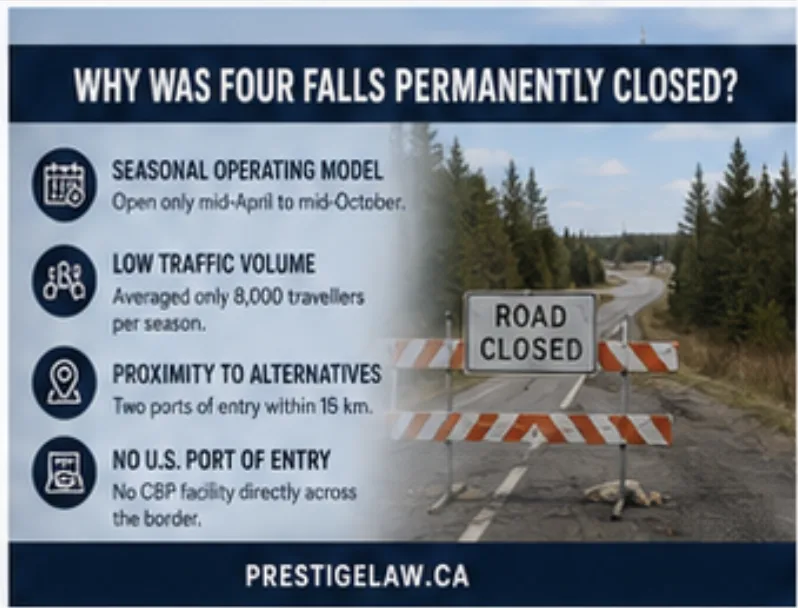
The CBSA identified four core operational factors behind the decision:
1. Seasonal Operating Model The Four Falls crossing only operated between mid-April and mid-October each year, meaning it was inactive for approximately six months of every calendar year, even before the pandemic closure. This seasonal model created recurring staffing, logistics, and administrative challenges without generating the travel volumes that would justify those recurring costs.
2. Low Traffic Volume The crossing averaged just 8,000 travellers per season — a figure the CBSA described as insufficient to justify continued operation when weighed against the resources required to staff and maintain a designated port of entry.
3. Proximity of Alternative Ports of Entry Two operational ports of entry are located within 15 kilometres of the now-closed Four Falls crossing:
- Andover — Located at 6 Route 190, Carlingford, NB — open 24 hours a day, 7 days a week.
- Gillespie Portage — Located at 600 Route 375, California Settlement, NB — open daily from 7:00 a.m. to 7:00 p.m.
The CBSA noted that these two crossings provide travellers with accessible alternatives that, while requiring a 15- to 30-minute detour, are operationally superior — particularly the Andover crossing, which offers round-the-clock availability.
4. No Adjacent U.S. Port of Entry Perhaps the most operationally decisive factor was the absence of a corresponding U.S. Customs and Border Protection facility on the American side of the Four Falls crossing. Without a U.S. partner facility actively processing outbound travellers, the Canadian crossing was effectively an orphaned infrastructure point — unable to function as a true bilateral crossing and misaligned with how modern border operations are designed to work.
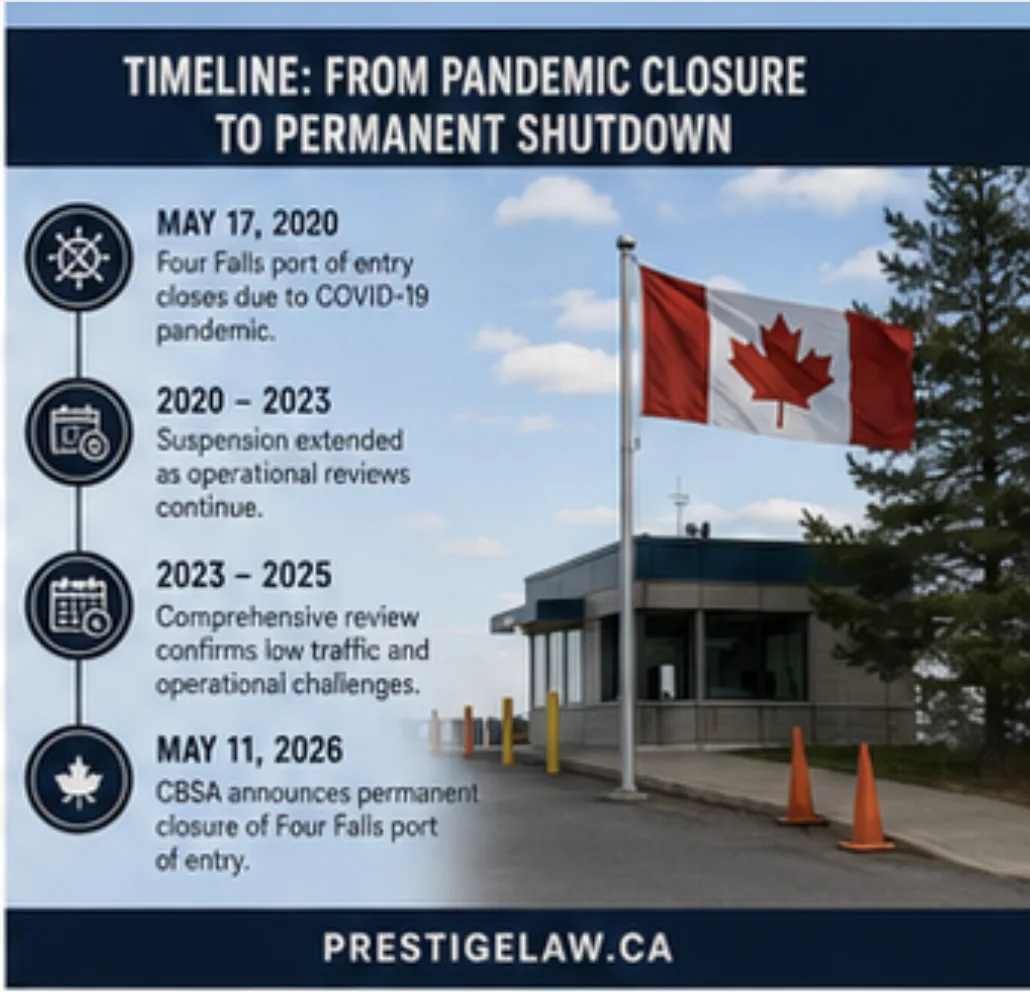
Timeline: From Pandemic Closure to Permanent Shutdown
Six Years of Suspension That Led to Canada’s Final Decision
To fully understand the significance of the May 2026 announcement, it is essential to trace the trajectory of the Four Falls closure from its origins during the early days of the COVID-19 pandemic.
May 17, 2020: The Four Falls port of entry closes temporarily in response to the COVID-19 pandemic. Canada and the United States jointly restrict cross-border movement to essential travel only, and dozens of smaller, lower-volume ports of entry across the country are suspended during this period.
2020–2023: As pandemic restrictions gradually ease and most Canadian border crossings resume operations, Four Falls remains closed. The CBSA extends the suspension repeatedly, citing ongoing operational reviews.
2023–2025: The CBSA conducts a comprehensive analysis of operational pressures and service demands across Atlantic Canada. The review examines traffic volumes, alternative crossing availability, staffing requirements, and alignment with U.S. border operations. Four Falls consistently falls short of the thresholds that would justify reopening.
May 11, 2026: The CBSA makes it official. The temporary suspension of service becomes a permanent closure. The announcement is published on Canada.ca and distributed via news release from the Government of Canada.
This six-year arc from emergency pandemic closure to permanent shutdown reflects both the immediate disruptions of COVID-19 and the longer-term rationalisation of Canada’s border infrastructure — a process that the CBSA suggests may continue at other low-volume seasonal crossings across Quebec and Saskatchewan.
What This Means for Travellers Crossing in Atlantic Canada
Practical Impacts on Cross-Border Travel Between New Brunswick and Maine
For most international tourists and casual travellers, the closure of Four Falls will require a route adjustment rather than a fundamental change in plans. The Andover crossing — open 24 hours a day, 7 days a week — is the primary alternative and is well-equipped to handle the overflow that previously flowed through Four Falls. The Gillespie Portage crossing provides additional capacity during daytime hours.
However, the impact is not trivial for everyone. Residents of border communities who relied on Four Falls as their most convenient entry point will now face a permanent detour of 15 to 30 minutes each way. For those making frequent cross-border trips — whether for work, shopping, healthcare, or family visits — this adds up over time. Tourism operators and hospitality businesses in the immediate Four Falls area may also feel the downstream effects of reduced cross-border traffic that previously passed through their communities.
NEXUS Cardholders and Trusted Traveller Programs
For NEXUS cardholders — travellers who have pre-cleared as low-risk through the joint Canada-U.S. trusted traveller program — the CBSA has confirmed that no changes to the program itself are anticipated as a result of the Four Falls closure. NEXUS cardholders can continue to use dedicated lanes at the Andover crossing without interruption.
Commercial Carriers and Freight Commercial carriers routing freight through the region should update their customs documentation, electronic logging device records, and transit plans to reflect the closure of Four Falls. Failing to report to the CBSA at a designated port of entry is a serious offence under both the Immigration and Refugee Protection Act (IRPA) and the Customs Act, carrying consequences that include financial penalties, seizure actions, and loss of trusted traveller program membership.
Immigration Implications: Why This Matters Beyond Simple Travel
How the Four Falls Closure Affects People Seeking Entry to Canada
While the immediate headline focuses on the closure of a border crossing, the immigration implications of this announcement extend well beyond route planning. For anyone seeking to enter Canada — whether as a visitor, a temporary foreign worker, a student, a permanent resident returning from abroad, or a refugee claimant — the port of entry through which you enter Canada is not a trivial detail. It can affect the processing of your documents, the officers available to assess your case, and, in some circumstances, the legal record of your entry.
Irregular Border Crossing Risks
One of the most serious concerns that immigration lawyers like Zeesean Sheikh at Prestige Law consistently raise with clients is the danger of irregular border crossing. The closure of the Four Falls port of entry means that the area between Four Falls and the nearest official crossings at Andover and Gillespie Portage is no longer served by a designated CBSA entry point. This does not mean the border is unmonitored — the RCMP maintains responsibility for border enforcement between designated ports of entry, and surveillance and patrol activity continues in these areas.
Travellers who attempt to cross the border outside of a designated port of entry — whether intentionally or out of confusion about the closure — face severe legal consequences. These include detention, deportation, criminal charges, and permanent inadmissibility findings that can bar future entry to Canada. The CBSA and the RCMP have made clear that border integrity remains a priority, and that resources freed by the closure of Four Falls will be redirected to higher-volume crossings and enhanced surveillance between ports.
Refugee Claimants and the Safe Third Country Agreement
Under the Canada-U.S. Safe Third Country Agreement (STCA), refugee claimants who arrive at an official land port of entry on the Canada-U.S. border are generally required to make their refugee claim in the first safe country they arrived in — meaning claimants arriving from the U.S. at a designated port of entry must usually make their claim in the U.S. rather than Canada. However, claimants who enter Canada between designated ports of entry have historically been able to make inland refugee claims.
The closure of Four Falls and the continued vigilance of RCMP patrols in the area reinforce the importance of understanding these legal distinctions before making any border crossing decision. This is a complex and rapidly evolving area of law, and the stakes for getting it wrong are extremely high.
Canada’s Border Plan: The Bigger Picture
Understanding the $1.3 Billion Investment Driving Canada’s Border Strategy
The permanent closure of Four Falls is not an isolated administrative decision. It is part of a much larger national border strategy articulated in Canada’s Border Plan — described by the federal government as the largest single investment in the border in Canadian history. The $1.3 billion Border Plan directs substantial resources toward modernising Canada’s border infrastructure, concentrating staffing and technology at high-volume crossings, and enhancing enforcement capacity between ports of entry.
Of the total $1.3 billion investment, over $355 million is allocated specifically to bolstering CBSA frontline operations and equipping officers with the latest tools and technology to stop the flow of illegal drugs and firearms across the border. The closure of low-volume seasonal crossings like Four Falls is part of this rationalisation — freeing staffing and administrative resources that can be redirected to higher-priority operations.
For the public, the message from CBSA is clear: the agency is not reducing border security. It is concentrating on it. The resources that were committed to maintaining Four Falls as an intermittently staffed, low-volume, seasonal crossing will now be redirected to crossings and patrol corridors where they have a greater impact on border security outcomes.
This strategic context is important for immigration practitioners and their clients to understand. When CBSA resources are concentrated, processing times and enforcement scrutiny at the remaining crossings may intensify. Travellers and immigrants who might previously have had access to a range of crossing options — including smaller, quieter ports — should be prepared for potentially higher volumes and more rigorous processing at the crossings that remain.
What Happens to Border Integrity in the Four Falls Area?
The Role of the RCMP Between Ports of Entry
A question that many residents and observers have raised following the closure announcement is straightforward: if the CBSA is no longer operating at Four Falls, who is watching that stretch of the border?
The answer lies in the division of border responsibilities under Canadian law. The CBSA is responsible for enforcing the law at designated ports of entry — the official crossing points where travellers are required to present themselves to border officers. Between those designated ports, border security and the enforcement of Canadian legislation fall under the mandate of the Royal Canadian Mounted Police (RCMP).
The RCMP’s responsibility for the stretch of border near Four Falls was always in place during the months when the crossing was closed seasonally, and it continues now that the closure is permanent. This means that the border between Four Falls and the Andover and Gillespie Portage crossings is not ungoverned — it is simply governed by the RCMP rather than the CBSA, consistent with how the vast majority of the Canada-U.S. land border has always been managed.
Anyone with information about suspicious cross-border activity in this or any other area of the border is encouraged to contact the CBSA’s toll-free Border Watch Line.
How Prestige Law Can Help You Navigate Canada’s Changing Border Landscape
Expert Immigration Legal Advice from Zeesean Sheikh
At Prestige Law, immigration lawyer Zeesean Sheikh and his team understand that news like the permanent closure of Four Falls is more than a logistical inconvenience for many people. For individuals in the middle of an immigration application, for families planning a cross-border reunion, for temporary foreign workers whose employers depend on predictable travel routes, and for refugee claimants whose legal options hinge on how and where they enter Canada, changes to border infrastructure can have profound consequences.
Zeesean Sheikh has built Prestige Law’s reputation on providing clear, accurate, and compassionate immigration legal advice to clients across Ontario and beyond. His practice covers the full spectrum of Canadian immigration law, from visitor visas and study permits to permanent residence applications, spousal sponsorships, refugee claims, and immigration appeals. When border policies shift — and they are shifting — having an experienced immigration lawyer in your corner is not a luxury. It is a necessity.
Prestige Law offers professional guidance on:
Visitor Visas and Entry to Canada. If you are planning to travel to Canada and need to understand how border crossing changes affect your entry requirements, Prestige Law can advise you on the correct port of entry to use, the documentation you need to carry, and how to present yourself to border officers in a way that gives your application the best possible chance of success.
Refugee Claims and Irregular Entry The closure of Four Falls and the RCMP’s continued patrol of the border area make it more important than ever for potential refugee claimants to understand their legal options before attempting to enter Canada. Zeesean Sheikh can provide a comprehensive assessment of your refugee claim, explain the implications of the Safe Third Country Agreement, and guide you toward the approach that best protects your legal rights.
Permanent Residence and Sponsorship Whether you are applying for permanent residence through Express Entry, the Provincial Nominee Program, or spousal sponsorship, Prestige Law has the expertise to guide your application from start to finish — ensuring that your documentation is complete, your eligibility is clearly established, and your application is positioned for approval.
Immigration Appeals and Judicial Review. If you have received a negative decision on an immigration application, Zeesean Sheikh can assess whether grounds exist for an appeal to the Immigration Appeal Division (IAD) or for a judicial review application to the Federal Court of Canada.
Work Permits and Temporary Foreign Workers. If you are an employer relying on temporary foreign workers whose travel routes or entry documentation may be affected by border changes, or if you are a worker needing to understand your rights and obligations at the border, Prestige Law can help.
About Zeesean Sheikh — Immigration Lawyer at Prestige Law
Zeesean Sheikh is an experienced Canadian immigration lawyer who leads the team at Prestige Law. He is committed to delivering professional, results-driven immigration legal services to clients navigating Canada’s complex and constantly evolving immigration system. His approach combines deep legal knowledge with a genuine commitment to understanding each client’s unique circumstances and goals.
Whether you are dealing with an urgent border issue in the wake of the Four Falls closure, working through a long-term permanent residence application, or seeking guidance on any other aspect of Canadian immigration law, Zeesean Sheikh brings the expertise and dedication that Prestige Law’s clients have come to rely on.
Frequently Asked Questions (FAQs)
Most Searched Questions About the Four Falls Port of Entry Closure
Q1: Is the Four Falls port of entry closure permanent?
Yes. The Canada Border Services Agency (CBSA) confirmed on May 11, 2026, that the Four Falls, New Brunswick, port of entry is now permanently closed. The crossing had been temporarily suspended since May 17, 2020, in response to the COVID-19 pandemic, and after an extensive operational review of Atlantic Canada border services, the CBSA determined that a permanent closure was the appropriate outcome.
Q2: What are the alternative border crossings near Four Falls, New Brunswick?
The CBSA has identified two ports of entry located within 15 kilometres of Four Falls:
- Andover at 6 Route 190, Carlingford, NB — open 24 hours a day, 7 days a week.
- Gillespie Portage at 600 Route 375, California Settlement, NB — open daily from 7:00 a.m. to 7:00 p.m.
Travellers who previously used Four Falls are directed to use either of these crossings. The Andover crossing is the most accessible option for those requiring a 24/7 crossing point.
Q3: Why did Canada permanently close the Four Falls port of entry?
The CBSA cited four key reasons: the crossing’s seasonal operating model (open only from mid-April to mid-October), low average traffic volumes of approximately 8,000 travellers per season, the proximity of two alternative ports of entry within 15 kilometres, and the absence of a corresponding U.S. Customs and Border Protection facility directly across the border from Four Falls. Closing the crossing also aligns with Canada’s Border Plan, which concentrates border resources at higher-volume crossings.
Q4: Can I still cross the border in the Four Falls area after the closure?
You cannot cross the border at the Four Falls crossing point. You must use a designated port of entry — the nearest being Andover or Gillespie Portage. Crossing the border outside of a designated port of entry is illegal under Canadian law and can result in serious consequences, including detention, deportation, financial penalties, and findings of inadmissibility that can affect future immigration applications to Canada.
Q5: Does the Four Falls closure affect NEXUS cardholders?
No. The CBSA has confirmed that no changes to the NEXUS trusted traveller program are anticipated as a result of the Four Falls closure. NEXUS cardholders can continue to use dedicated lanes at the Andover crossing.
Q6: How does the Four Falls closure affect refugee claimants?
This is an area of considerable legal complexity, and refugee claimants should seek legal advice before attempting to enter Canada in the wake of this closure. Under the Canada-U.S. Safe Third Country Agreement, claimants arriving at a designated port of entry on the Canadian-U.S. land border are generally required to make their claim in the United States. Claimants who enter between ports of entry have different legal options. The closure of Four Falls, combined with ongoing RCMP patrol activity in the area, makes it essential to understand these distinctions before making any border crossing decision. Contact Prestige Law for a comprehensive legal assessment of your situation.
Q7: Will the Four Falls closure lead to closures of other Canadian border crossings?
The CBSA has indicated that its broader post-pandemic infrastructure rationalisation may include additional reviews of low-volume seasonal ports of entry in other provinces, including Quebec and Saskatchewan. Industry groups and border community advocates are closely monitoring these developments. Prestige Law will continue to provide timely updates on border policy changes that may affect travellers and immigrants.
Q8: What is Canada’s Border Plan, and how does it relate to the Four Falls closure?
Canada’s Border Plan is the federal government’s $1.3 billion investment in border security and infrastructure — described as the largest single border investment in Canadian history. Of that total, over $355 million is directed at frontline CBSA operations and technology upgrades to intercept illegal drugs and firearms. The closure of low-volume crossings like Four Falls is part of this plan’s rationalisation strategy: concentrating border resources at high-impact locations rather than spreading them thinly across dozens of low-volume seasonal crossings.
Q9: Is failing to report to the CBSA at a port of entry a criminal offence?
Failing to report to the CBSA upon entering Canada is a serious offence. Depending on the circumstances, it may result in financial penalties, seizure of goods, loss of trusted traveller program membership such as NEXUS, and, in the most serious cases, prosecution under the Immigration and Refugee Protection Act or the Customs Act. Anyone uncertain about their obligations at the border should seek legal advice before attempting to cross.
Q10: How do I contact Prestige Law for immigration advice related to the Four Falls closure or any other border issue?
You can reach Prestige Law at either of its Ontario offices or by telephone:
- 📍 Richmond Hill: 100–100 Mural Street, ON
- 📍 Toronto: 55 Town Centre Court, Suite 700, ON
- 📞 Telephone: +1 (647) 925-2222
- 🌐 Website: prestigelaw.ca
Conclusion: A Border Is Closing — Your Immigration Strategy Should Not Be Left to Chance
The permanent closure of the Four Falls port of entry is a clear signal that Canada’s approach to border management is evolving. Whether you are a frequent cross-border traveller, an immigrant in the middle of a complex application, a refugee claimant weighing your legal options, or a business owner whose operations depend on predictable and compliant cross-border movement, the changes happening at Canada’s borders in 2026 demand attention and, in many cases, professional legal guidance.
At Prestige Law, Zeesean Sheikh and his team are committed to keeping you informed, legally protected, and positioned for success in Canada’s immigration system. From the permanence of the Four Falls closure to the broader shifts in Canada’s Border Plan, the legal landscape is changing — and having the right lawyer in your corner makes all the difference.
Do not leave your immigration future to chance. Contact Prestige Law today.
Contact Prestige Law
Your Trusted Canadian Immigration Lawyers in Ontario
📍 Richmond Hill: 100–100 Mural Street, ON 📍 Toronto: 55 Town Centre Court, Suite 700, ON 📞 Telephone: +1 (647) 925-2222 🌐 Website: prestigelaw.ca
Disclaimer: The information contained in this article is provided for general informational purposes only and does not constitute legal advice. Immigration law is complex and fact-specific. For advice tailored to your individual circumstances, please consult a qualified immigration lawyer. Prestige Law is pleased to offer consultations to prospective clients at either of its Ontario offices.
© 2026 Prestige Law | prestigelaw.ca | All Rights Reserved