




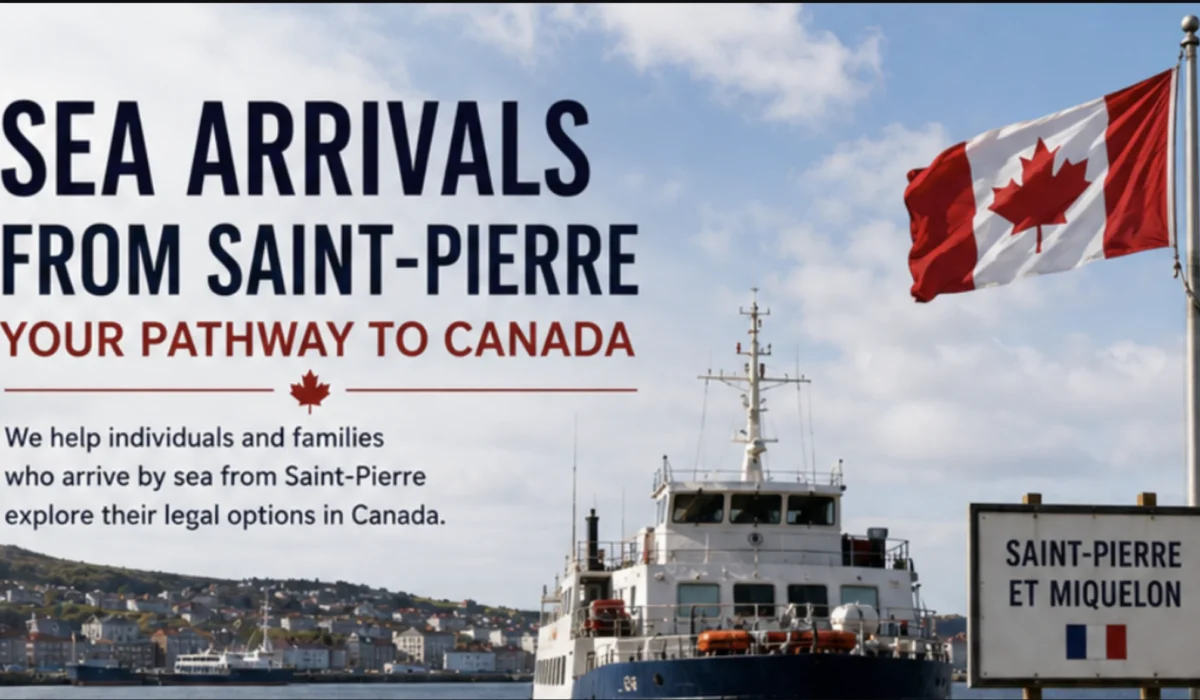
Canada Tightens Entry Requirements for Sea Arrival from Saint-Pierre-et-Miquelon
By Zeesean Sheikh, Immigration Lawyer | Published: June 11, 2026 | Prestige Law — prestigelaw.ca
Effective 1:00 a.m. Eastern Time on June 5, 2026, the Government of Canada has introduced a significant new border security measure: most visa-exempt foreign nationals who travel to Canada by sea from the French overseas collectivity of Saint-Pierre-et-Miquelon are now required to hold a valid Electronic Travel Authorisation (eTA) before boarding their vessel. This policy change affects travellers arriving by ferry, private boat, and commercial vessel — and it has immediate implications for thousands of people who cross this route every year. If you are a traveller, a resident of Saint-Pierre-et-Miquelon, or an individual planning a visit to Atlantic Canada by sea, this article explains exactly what. Sea Arrivals from Saint-Pierre
What Is Saint-Pierre-et-Miquelon, and Why Does It Matter for Canadian Immigration?
Saint-Pierre-et-Miquelon is a small but strategically significant French overseas collectivity situated approximately 25 kilometres off the southwestern coast of Newfoundland and Labrador. As a French territory, the islands are subject to European Union regulations and French governance, yet they sit geographically within Canadian waters — creating a uniquely complex cross-border relationship that has long been characterised by close tourism, fishing, cultural, and economic ties with Atlantic Canada.
The primary sea crossing between Saint-Pierre-et-Miquelon and Canada takes place between the town of Saint-Pierre and the community of Fortune, Newfoundland and Labrador. Approximately 6,000 visa-exempt foreign nationals make use of the passenger ferry route every year, making it a well-travelled corridor for both leisure tourism and trade. The ferry service, operated by SPM Ferries, has historically served as one of the most convenient entry points into Canada for European nationals and others who hold visa-exempt status.
Because the route was classified as a marine entry rather than an air entry, it previously fell outside the scope of Canada’s eTA requirement, which had traditionally applied to air travellers from visa-exempt countries. This distinction created a gap in Canada’s pre-arrival screening framework — a gap that, according to Immigration, Refugees and Citizenship Canada (IRCC), was increasingly being exploited by individuals seeking to avoid proper immigration screening.
The New eTA Requirement: What Has Changed Effective June 5, 2026?
⚠️ Important Policy Change: As of 1:00 a.m. Eastern Time on June 5, 2026, most visa-exempt foreign nationals travelling to Canada by boat from Saint-Pierre-et-Miquelon must hold a valid Electronic Travel Authorisation (eTA). This is a legal requirement — non-compliance can result in denied boarding or refusal of entry at the Canadian border.
Before June 5, 2026, the eTA was only mandatory for visa-exempt foreign nationals arriving in Canada by air, or transiting through a Canadian airport. Land and sea crossings carried different rules, with the sea crossing from Saint-Pierre-et-Miquelon notably excluded from the eTA obligation. That exemption no longer exists for most travellers using this route.
The new measure, announced on June 4, 2026, by Immigration, Refugees and Citizenship Canada (IRCC) under Minister Hon. Lena Metlege Diab, extends the eTA requirement to cover the following categories of sea travellers departing from Saint-Pierre-et-Miquelon:
- Passengers travelling by passenger ferry (including the SPM Ferries service between Saint-Pierre and Fortune, NL)
- Individuals arriving by private boat or personal watercraft
- Passengers aboard commercial vessels, excluding those who qualify under the seafarer exemption
The government has been explicit that this policy was introduced in direct response to intelligence gathered through ongoing monitoring of migration patterns. Canadian border authorities identified a pattern of foreign nationals deliberately choosing the sea route from Saint-Pierre-et-Miquelon to Fortune, Newfoundland and Labrador, as a means of circumventing the mandatory pre-arrival screening that would otherwise apply to them had they arrived by air.
“Through ongoing monitoring of migration patterns, Canada identified that some people were attempting to bypass Canada’s pre-arrival screening requirements by travelling by boat between Saint-Pierre-et-Miquelon and Fortune, Newfoundland and Labrador.” — Government of Canada, June 2026
This policy change is part of a coordinated, whole-of-government initiative involving IRCC, the Canada Border Services Agency (CBSA), Public Safety Canada, and other federal partners. It reflects Canada’s broader commitment to strengthening border security without disrupting the legitimate tourism and economic relationships that define the Canada-Saint-Pierre-et-Miquelon corridor.
Who Needs an eTA? A Clear Breakdown for Travellers
Understanding exactly who is subject to the new rule is critical. Failure to obtain an eTA before travel can result in being denied boarding by the ferry operator, or being refused entry by a Canada Border Services Agency officer upon arrival. Below is a clear summary of which travellers are now required to hold an eTA:
Visa-exempt foreign nationals (e.g., EU citizens, Australian citizens) travelling by ferry eTA Required: YES — Must apply online before departure.
Visa-exempt foreign nationals travelling by private boat eTA Required: YES — Must obtain eTA before sea departure.
Visa-exempt foreign nationals on commercial vessels (non-seafarer passengers) eTA Required: YES — Applies to the passenger role, not active crew.
French citizens who are residents of Saint-Pierre-et-Miquelon eTA Required: NO — Must travel directly to Canada from Saint-Pierre-et-Miquelon.
US citizens eTA Required: NO — US nationals do not require an eTA.
US lawful permanent residents (green card holders) eTA Required: NO — Must present a valid US permanent resident card.
Cruise ship passengers (visa-exempt) eTA Required: NO — Cruise ships are excluded from the new rule.
Seafarers actively working on commercial vessels (e.g., fishing boats) eTA Required: NO — Must be actively employed as crew on the vessel.
Nationals of visa-required countries eTA: NOT APPLICABLE — Entry requirements for visa-required countries have not changed.
Canadian citizens and permanent residents eTA: NOT APPLICABLE — ETAs do not apply to Canadian citizens or permanent residents.
Who Is Exempt from the New eTA Requirement?
The Government of Canada has been careful to define clear exemptions that protect the rights of those with legitimate, long-standing ties to the Canada-Saint-Pierre-et-Miquelon corridor. The following groups are explicitly exempt from the new eTA requirement when travelling by sea from Saint-Pierre-et-Miquelon:
French citizens residing in Saint-Pierre-et-Miquelon — These individuals, many of whom travel regularly to Atlantic Canada for business, shopping, healthcare, and family visits, are not required to obtain an eTA. However, they must be able to demonstrate their French citizenship and residency in Saint-Pierre-et-Miquelon. A national identification card is acceptable documentation for this purpose.
United States nationals — Citizens of the United States do not require an eTA regardless of the mode of travel to Canada. This remains unchanged.
United States lawful permanent residents — Holders of valid US green cards (Form I-551) are also exempt and may enter Canada by land or water without an eTA, as long as they are arriving directly from the US or Saint-Pierre-et-Miquelon.
Cruise ship passengers — Passengers arriving aboard cruise ships are not subject to the new eTA requirement. This exemption recognises the distinct and organised nature of cruise travel, which is subject to separate regulatory oversight.
Seafarers and commercial vessel crew — Individuals who are actively employed as crew members or seafarers on commercial vessels — including fishing boats — are exempt. This is an important carve-out for the fishing industry, which forms a core part of the economic relationship between Canada and Saint-Pierre-et-Miquelon.

What Is an eTA and How Do You Apply for One?
An Electronic Travel Authorisation (eTA) is a digital entry requirement that allows Canadian immigration officials to pre-screen visa-exempt travellers before they arrive in Canada. It is not a visa — it is a lighter form of travel clearance that is linked electronically to a traveller’s passport and does not require a physical stamp or sticker.
Key eTA Facts:
- An approved eTA is electronically linked to your passport — there is no physical document
- An eTA is valid for five years, or until your passport expires — whichever comes first
- Most eTA applications are processed within a few minutes online
- The application must be completed before boarding — you cannot apply at the border
- The current government fee for an eTA is CAD $7
- Applications are made through the official IRCC website: canada.ca/eta
- You will need a valid passport, a credit or debit card, and an email address
While most eTA applications are processed automatically within minutes, some applications are flagged for additional review. This can occur if a traveller has a prior immigration history, a criminal record, previous refusals, or other complexity in their personal background. In such cases, additional documents may be required, and the processing time could extend from days to several weeks. If your eTA application has been delayed, refused, or if you are unsure of your eligibility, consulting with a qualified Canadian immigration lawyer before you travel is strongly advised.
Documents Typically Required for an eTA Application
When applying for an eTA, most travellers will need to provide the following:
- A valid passport from a visa-exempt country (the eTA will be linked to this passport)
- A valid email address to receive your eTA approval confirmation
- A credit or debit card to pay the CAD $7 application fee
- Information about your travel history, criminal history, and any previous visa or immigration applications
Travellers should note that the eTA is passport-specific. If you renew your passport after obtaining your eTA, you will need to apply for a new eTA linked to your new passport — even if your previous eTA has not expired.
Why Did Canada Introduce This Rule Now? Understanding the Policy Context
Canada’s decision to extend the eTA requirement to sea arrivals from Saint-Pierre-et-Miquelon is not arbitrary. It reflects a broader and ongoing effort by the federal government to close loopholes in Canada’s immigration screening framework — loopholes that, left unaddressed, can undermine the integrity of the entire system.
The eTA was originally introduced in Canada in 2016 as a mechanism to pre-screen air travellers from countries whose nationals do not require a visa to enter Canada. Over time, however, immigration officials observed that the sea route from Saint-Pierre-et-Miquelon to Fortune, Newfoundland was being used by some foreign nationals specifically because it fell outside the eTA framework. Rather than fly into a Canadian airport — where the eTA requirement and security screening would apply — these individuals travelled first to Saint-Pierre-et-Miquelon (a French territory accessible from Europe without a Canadian visa) and then crossed by ferry to Canada, thereby bypassing the pre-screening process entirely.
The new rule addresses this gap directly. By extending the eTA requirement to marine arrivals from this specific route, the Canadian government ensures that all visa-exempt travellers — regardless of whether they arrive by air, sea, or this hybrid route — are subject to consistent pre-arrival screening standards.
It is important to emphasise that this policy is targeted and proportionate. The government has preserved exemptions that protect the daily lives and economic activities of Saint-Pierre-et-Miquelon residents, fishing crews, cruise passengers, and Americans — groups for whom the marine crossing is a routine and essential part of life and commerce. The rule primarily affects third-country nationals from visa-exempt countries who may have been using the route to circumvent standard immigration controls.
Impact on Tourism, the Fishing Industry, and Atlantic Canadian Communities
Canada and Saint-Pierre-et-Miquelon share deep and long-standing ties that extend far beyond immigration policy. The communities of Fortune, Burin, Marystown, and other towns along Newfoundland’s Burin Peninsula have historically maintained close cultural, commercial, and social relationships with the residents of Saint-Pierre-et-Miquelon. These ties include ferry-based tourism, cross-border shopping, fishing industry cooperation, and family connections that have developed over generations.
By exempting French citizens who are residents of Saint-Pierre-et-Miquelon from the new eTA requirement, the Canadian government has made a deliberate effort to protect these community ties. The measure is targeted at third-country nationals attempting to exploit the route — not at the local population whose daily lives depend on convenient access to Atlantic Canada.
The fishing industry is similarly protected. Seafarers actively working on commercial fishing vessels — a major economic sector connecting Saint-Pierre-et-Miquelon and Newfoundland — are explicitly exempt from the new requirement. This ensures that the operational continuity of fishing fleets is not disrupted by the administrative burden of eTA compliance.
For the estimated 6,000 visa-exempt foreign nationals who use the ferry route each year — primarily European tourists and visitors — the practical impact of the new rule is modest. An eTA application typically takes only a few minutes to complete online, costs CAD $7, and once approved, remains valid for five years. Most travellers who apply well in advance of their trip will experience no disruption whatsoever.
How This Change Is Part of Canada’s Broader Border Security Strategy
This policy change does not exist in isolation. It is one component of a coordinated, whole-of-government border security strategy that has been evolving in Canada over recent years. The initiative involves cooperation between Immigration, Refugees and Citizenship Canada (IRCC), the Canada Border Services Agency (CBSA), Public Safety Canada, and other federal departments and agencies.
Canada’s border security strategy is built around three key principles: pre-arrival screening, risk-based assessment, and partnership. Pre-arrival screening tools like the eTA allow the government to identify potential concerns before a traveller sets foot on Canadian soil, enabling faster and more efficient border processing for the vast majority of travellers who pose no security concerns, while flagging those who may require additional scrutiny.
The extension of eTA requirements to the Saint-Pierre-et-Miquelon sea route is consistent with this framework. It closes a specific vulnerability without imposing a significant burden on legitimate travellers, and it does so in a way that preserves Canada’s welcoming posture toward the international community.
Canada remains one of the most open and welcoming countries in the world to immigrants, visitors, and international students. However, the government has made clear that openness must be paired with rigour — and that the integrity of Canada’s immigration system is a precondition for public confidence in immigration programs generally.
What Happens If You Arrive Without an eTA?
If you are a visa-exempt foreign national who now requires an eTA under the new rules and you attempt to board a ferry or vessel from Saint-Pierre-et-Miquelon without one, you may face the following consequences:
Denied boarding — Ferry operators and commercial vessel carriers are required to verify eTA status before allowing passengers to board. Individuals without a valid eTA may be refused embarkation.
Refused entry at the border — Even if you reach a Canadian port of entry, a CBSA officer has the authority to refuse entry to any traveller who does not meet Canada’s entry requirements, including the eTA requirement.
Administrative detention — In more serious cases — particularly where there is reason to believe immigration rules were deliberately circumvented — a traveller may be subject to a more detailed secondary examination, or in extreme cases, detention pending a removal order.
Future inadmissibility — Attempting to enter Canada without proper documentation can create a record that may complicate future travel to Canada, including future visa or eTA applications.
If you have already travelled to Canada by sea from Saint-Pierre-et-Miquelon without an eTA — particularly in the days immediately following the June 5, 2026 announcement — you may wish to consult an immigration lawyer to understand your current status and any steps you should take.
How Prestige Law Can Help You Navigate Canada’s New Entry Rules
Canada’s immigration rules can be complex, and changes of this nature — introduced quickly and with immediate effect — can create significant uncertainty for travellers, families, and businesses. At Prestige Law, our team of experienced Canadian immigration lawyers is here to help you understand exactly how the new eTA requirement affects you and what steps you need to take to protect your status and your plans.
Led by immigration lawyer Zeesean Sheikh, Prestige Law has helped hundreds of clients navigate the complexities of Canadian immigration law — from visitor visa applications and eTA matters to permanent residency, family sponsorship, and refugee claims. We bring a client-first approach to every matter, providing clear, honest, and strategic legal advice tailored to your specific circumstances.
Whether you are a European tourist planning a visit to Newfoundland via Saint-Pierre-et-Miquelon, a business owner with ties to the fishing industry, a student planning to study in Canada, or a family member seeking to reunite with loved ones in Atlantic Canada — Prestige Law has the expertise and the dedication to guide you through every step of the process.
Our Services Include:
- eTA application assistance and eligibility assessment
- Visitor visa applications for travellers from visa-required countries
- Inadmissibility assessment and legal advice for refused entry situations
- Representation before the Immigration and Refugee Board (IRB)
- Permanent residence applications (Express Entry, Provincial Nominee Programs)
- Family sponsorship and spousal/partner sponsorship
- Study permits and work permits
- Citizenship applications and appeals
- Refugee and asylum claims
📍 Richmond Hill: 100–100 Mural Street, Richmond Hill, ON 📍 Toronto: 55 Town Centre Court, Suite 700, Toronto, ON 📞 Telephone: +1 (647) 925-2222 🌐 Website: prestigelaw.ca
Frequently Asked Questions (FAQ)
1. When did the new eTA rule for Saint-Pierre-et-Miquelon sea arrivals take effect?
The new eTA requirement came into effect at 1:00 a.m. Eastern Time on June 5, 2026. Any sea journey from Saint-Pierre-et-Miquelon to Canada that commenced after this time and date requires a valid eTA for eligible travellers who are not otherwise exempt.
2. Do French citizens living in Saint-Pierre-et-Miquelon need an eTA to enter Canada?
No. French citizens who are residents of Saint-Pierre-et-Miquelon are explicitly exempt from the new eTA requirement when they are travelling directly to Canada from Saint-Pierre-et-Miquelon. They must be able to prove both their French citizenship and their residency in Saint-Pierre-et-Miquelon. A national identification card is an acceptable document for this purpose.
3. Does the new eTA rule apply to passengers on cruise ships?
No. Cruise ship passengers are exempt from the new eTA requirement introduced on June 5, 2026. The rule applies specifically to ferry passengers, private boat travellers, and passengers on commercial vessels. A separate regulatory framework governs cruise ship travel and is not affected by this change.
4. I am an American citizen planning to cross from Saint-Pierre-et-Miquelon to Newfoundland by ferry. Do I need an eTA?
No. United States nationals and lawful permanent residents of the United States do not require an eTA to enter Canada by any means of travel. This has not changed with the new policy. US citizens should, however, carry a valid US passport or passport card when crossing international borders.
5. How long does an eTA last, and how much does it cost?
Once approved, an eTA is valid for five years or until your passport expires — whichever occurs first. The government fee for an eTA application is CAD $7. The application is made entirely online through the IRCC website. Most applications are processed in a matter of minutes, though some may take longer if additional review is required.
6. Can my eTA application be refused? What happens if it is?
Yes. An eTA application can be refused in certain circumstances, including if a traveller has a criminal record, a history of immigration violations, a prior deportation order, or certain health-related inadmissibility grounds. If your eTA is refused, you may still be able to apply for a temporary resident visa (TRV) — but this requires a more detailed application process. It is strongly recommended to consult an immigration lawyer if your eTA has been refused.
7. I work on a fishing boat between Saint-Pierre-et-Miquelon and Newfoundland. Do I need an eTA?
No. Seafarers who are actively working as crew members on commercial vessels — including fishing boats — are exempt from the new eTA requirement. This exemption is designed to protect the fishing industry and the economic relationship between Canada and Saint-Pierre-et-Miquelon. If you are travelling as a passenger and not as active crew, the exemption does not apply, and you will need an eTA if you are from a visa-exempt country.
8. What happens if I arrive at Fortune, Newfoundland by ferry without an eTA?
If you are required to hold an eTA and you do not have one, you may be denied boarding by the ferry operator before you even reach Canada. If you do reach the port of entry, a CBSA officer may refuse your entry into Canada. In more serious situations, you could face secondary examination, detention, or a removal order. The consequences can also include future complications with visa and immigration applications to Canada. We strongly recommend ensuring your eTA is approved before you travel.
9. Does Canada’s new eTA rule affect travellers from visa-required countries?
No. The new policy specifically targets visa-exempt foreign nationals. The entry requirements for nationals of visa-required countries — those who need a Canadian visa to visit Canada — have not changed. If you are from a country whose nationals require a visa to enter Canada, you must continue to obtain a valid visa before travelling.
10. Why should I hire an immigration lawyer when an eTA application seems straightforward?
For many travellers, an eTA application is indeed straightforward. However, complications arise more often than people expect — particularly for individuals with prior immigration refusals, criminal records, health concerns, or complex travel histories. An immigration lawyer can assess your admissibility before you apply, identify any potential red flags, help you prepare supporting documentation, and represent you if your application is refused. The cost of a consultation is far less than the cost of being stranded, refused entry, or facing inadmissibility proceedings.
11. Is this eTA rule permanent, or could it change?
The eTA requirement introduced on June 5, 2026, is a regulatory policy change by the federal government and is effective immediately. Like all immigration regulations, it could be amended or updated by the government at any time. However, there is no indication at this stage that this is a temporary measure — it reflects a long-term commitment to consistent pre-arrival screening across all modes of travel. We recommend checking the official IRCC website or consulting with an immigration lawyer for the most current information before you travel.
12. Can Prestige Law help me if my eTA has been refused or my entry to Canada has been denied?
Absolutely. Prestige Law, led by immigration lawyer Zeesean Sheikh, is experienced in handling cases involving eTA refusals, visa refusals, denied entry, inadmissibility, and complex immigration situations. We can review your circumstances, advise you on your options — including applying for a temporary resident permit (TRP) or a temporary resident visa — and represent you through the process. Contact us at +1 (647) 925-2222 or visit prestigelaw.ca to book a consultation.

What You Need to Do Before Your Next Crossing
Canada’s new eTA requirement for sea arrivals from Saint-Pierre-et-Miquelon is a significant, immediate policy change affecting thousands of travellers every year. If you are a visa-exempt foreign national who is not a US citizen, not a resident of Saint-Pierre-et-Miquelon with French citizenship, not a seafarer actively working on a vessel, and not a cruise ship passenger — you now need a valid eTA before boarding any ferry, private boat, or commercial vessel to Canada from Saint-Pierre-et-Miquelon.
The application is available online through Immigration, Refugees and Citizenship Canada and, for most travellers, takes only a few minutes to complete. The fee is CAD $7, and approval is typically granted within minutes. Once approved, your eTA is linked to your passport and is valid for five years or until your passport expires.
However, not every eTA application is simple. If you have a prior immigration history, a criminal record, a previous refusal, or any other complexity in your background, obtaining proper legal advice before you apply could make the difference between a smooth journey and a serious legal problem. At Prestige Law, immigration lawyer Zeesean Sheikh and his dedicated team are here to ensure that you understand your rights, meet all requirements, and travel to Canada with confidence.
Do not leave your travel plans to chance. Contact Prestige Law today and let us provide the expert immigration guidance you deserve.
📍 Richmond Hill: 100–100 Mural Street, Richmond Hill, ON 📍 Toronto: 55 Town Centre Court, Suite 700, Toronto, ON 📞 Telephone: +1 (647) 925-2222 🌐 Website: prestigelaw.ca
© 2026 Prestige Law | prestigelaw.ca | All Rights Reserved. Linked to your passport and is valid for five years or until your passport expires.