





Canada announces plans for up to 622,000 new permanent residents in 2027

Canada has announced plans for up to 622,000 new permanent residents in 2027, and the figure has quickly become one of the most discussed immigration headlines of the year. On November 5, 2026, the federal government tabled Budget 2026 and released the 2027–2029 Immigration Levels Plan on the same day. Together, the two documents hold Canada’s core permanent resident target at 380,000 admissions a year, set an upper admissions ceiling of 422,000 for 2027, and add a one-time measure that could move up to 200,000 temporary residents who already live in Canada onto permanent status by the end of 2027.
Add the 422,000 ceiling to the 200,000 transition spaces, and you arrive at the 622,000 headline. For skilled workers, international students, families, and employers, the announcement raises practical questions. Who will qualify for the new measure? How will Express Entry and the provincial nominee programs change? What should people with expiring permits do now? This guide from Prestige Law explains what Canada announced, how the numbers actually work, and how to prepare for the opportunities that 2027 may bring. Canada Immigration Plan 2027
Prepared by Prestige Law | Lawyer: Zeesean Sheikh | Published: November 6, 2026
Key takeaways from Canada’s 2027–2029 immigration announcement
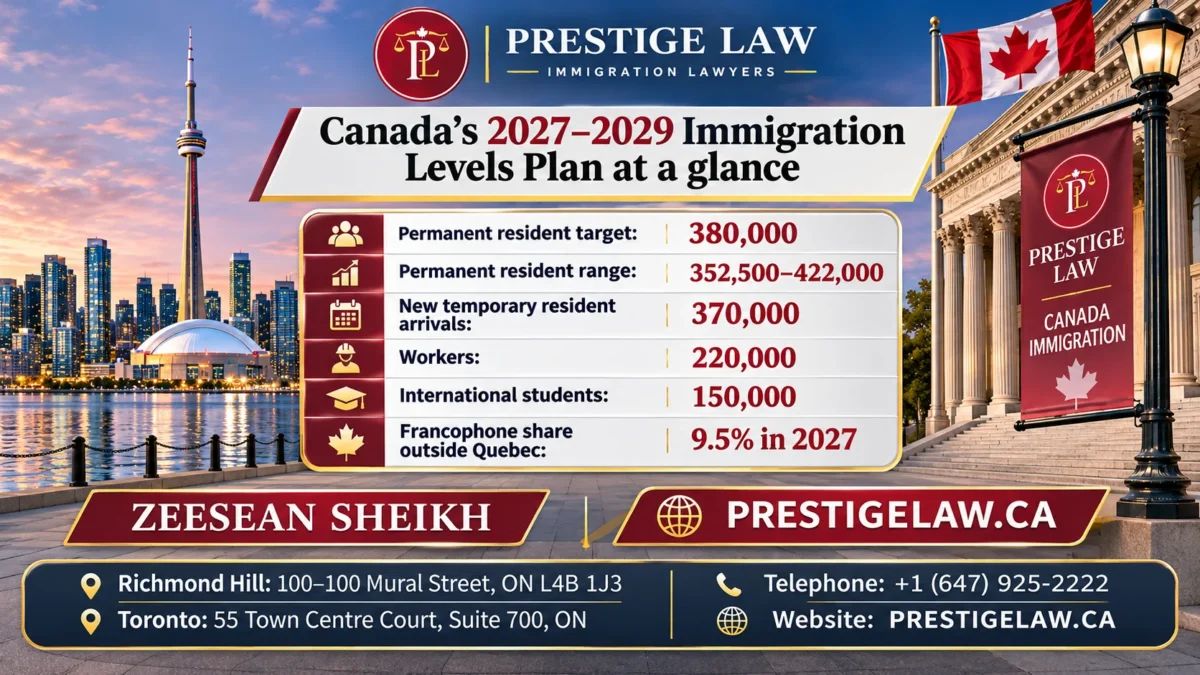
- Canada’s permanent resident target stays at 380,000 admissions a year for 2027, 2028, and 2029, within a range of 352,500 to 422,000.
- Budget 2026 adds a one-time measure to transition up to 200,000 temporary residents to permanent residence by the end of 2027.
- The 622,000 figure equals the 422,000 top of the 2027 range plus the 200,000 transition spaces. It is a ceiling, not a guaranteed total.
- Half of the transition spaces, or 100,000, are earmarked for skilled workers through Express Entry and the Provincial Nominee Program.
- New temporary resident arrivals are capped at 370,000 a year, made up of 220,000 workers and 150,000 students.
- Francophone admissions outside Quebec are targeted at 9.5 per cent of permanent resident admissions in 2027.
- Admissions left over from the 2026–2027 one-time initiatives for protected persons and in-Canada workers will add to the 2027 total.
What Canada announced on November 5, 2026
Finance Minister François-Philippe Champagne tabled Budget 2026 on November 5, 2026. On the same day, Immigration, Refugees and Citizenship Canada (IRCC) published the 2027–2029 Immigration Levels Plan. Every year, the government must set out how many people it intends to admit as permanent residents and how many temporary residents it expects to arrive. This year’s plan covers three years instead of one, which gives employers, universities, provinces, and newcomers a longer planning horizon.
Three messages stand out. First, the overall permanent resident target did not change. The government confirmed 380,000 admissions for 2027 and 2028, the same figures it announced a year earlier, and extended the same number to 2029. Second, the government kept new temporary arrivals at 370,000 a year, which continues its effort to bring the temporary population into better balance with housing, health care, and labour market capacity. Third, Budget 2026 introduced a time-limited measure that turns a large group of temporary residents into permanent residents during 2027.
The budget document and the levels plan are both available on the government’s official websites, including Budget 2026 and the 2027–2029 Immigration Levels Plan. Reading the primary sources matters, because many headlines compress a layered announcement into a single number.
How the 622,000 figure is calculated
The 622,000 number is the result of simple addition, and understanding it helps you avoid unrealistic expectations. The levels plan sets a target of 380,000 permanent resident admissions for 2027, with a range running from 352,500 to 422,000. The top of that range is 422,000. Budget 2026 then announces transition measures for up to 200,000 temporary residents already in Canada. Add the two together, 422,000 plus 200,000, and you get 622,000.
That arithmetic tells you three important things:
- The headline is an upper limit. The government’s planning midpoint for ordinary admissions is 380,000, not 422,000. Actual admissions can land anywhere inside the published range.
- The 200,000 figure is also “up to.” The government has said it can transition up to that many people. It has not guaranteed that every space will be used.
- Other admissions sit on top. The plan also anticipates that a further group of people will become permanent residents in 2027 under the two one-time initiatives announced last year, which together promised permanent residence to up to 115,000 protected persons and 33,000 workers already in Canada.
Those earlier initiatives were launched for 2026 and 2027, and they total 148,000 admissions. According to government data available at the time of writing, 46,330 people were admitted under them between January and August 2026. That suggests roughly 100,000 admissions remain to be completed before the end of 2027. The plan does not publish an exact remaining count, so treat that estimate as an approximation rather than an official forecast.
In short, the 622,000 headline is a useful signal of direction, but the more reliable planning figure for most applicants is the 380,000 target together with the specific pathways that feed it.
Canada’s 2027–2029 Immigration Levels Plan at a glance
The table below summarises the main targets for each year of the plan.
Target
2027
2028
2029
Permanent resident admissions (target) 380,000 380,000 380,000
Permanent resident range 352,500–422,000 352,500–422,000 352,500–422,000
New temporary resident arrivals 370,000 370,000 370,000
Of which workers 220,000 220,000 220,000
Of which international students 150,000 150,000 150,000
Francophone share outside Quebec 9.5% 10.5% 12%
Two features of this table deserve attention. The numbers are flat from year to year, which signals stability rather than expansion in the regular program. The real growth in 2027 comes from the one-time measures layered on top of those flat targets. For anyone planning a permanent residence strategy, that distinction is the key to reading the announcement correctly.
Permanent resident targets by immigration category
The 380,000 target for each year is divided into four broad streams. Using the midpoint figures in the plan, the split looks like this:
- Economic immigration: 244,700. This stream covers Express Entry programs, the Provincial Nominee Program, the Atlantic Immigration Program, rural and Francophone pilots, caregivers, and business programs.
- Family reunification: 81,000. This includes spouses, partners, children, and parents and grandparents.
- Refugees and protected persons: 49,300. This covers resettled refugees and people granted protection in Canada.
- Humanitarian and compassionate and other: 5,000. This covers cases decided on humanitarian grounds and a small number of other admissions.
Economic immigration accounts for about 64.4 per cent of admissions in each year of the plan. That share confirms what immigration lawyers have seen in practice for several years: Canada continues to build its permanent resident intake around labour market needs, while still reserving meaningful space for family and humanitarian cases.
Why the economic share matters to applicants
Because economic immigration holds nearly two-thirds of the spaces, competition inside that stream shapes the experience of most applicants. Express Entry draws, provincial nominations, and employer-supported pathways all depend on how many spaces the government assigns to each program. When Ottawa increases spaces for provincial nominations, as the budget signals it will, candidates with a provincial connection gain more room to succeed, even if their Comprehensive Ranking System score is modest.
The one-time measure for up to 200,000 temporary residents
The most significant new element in Budget 2026 is the plan to transition up to 200,000 temporary residents to permanent residence by the end of 2027. The measure targets people who already live in Canada, work in Canadian communities, study at Canadian institutions, and in many cases already have applications in the system.
According to the budget, 100,000 of those spaces are earmarked for skilled workers through Express Entry and the Provincial Nominee Program. Ottawa has said it will work closely with the provinces and territories on delivery. Public reporting on the announcement indicates that the remaining spaces are aimed at other people already in Canada, including some long-term temporary residents with pending applications and some family and humanitarian cases. Full eligibility rules, intake dates, and application steps had not been confirmed when this article was published, so every detail should be verified against IRCC announcements as they appear.
Why Canada is choosing this approach
Canada’s temporary resident population grew rapidly after the pandemic. Many of those workers and graduates have since built careers, paid taxes, and settled into their communities, yet their permits have an expiry date. Moving some of them to permanent status serves several goals at once. It keeps experienced workers in sectors that struggle to hire, it reduces the number of people who would otherwise fall out of status, and it lowers the need to bring in new temporary workers from abroad. For the government, it is also a way to reduce the temporary population without losing the skills and local ties that those residents have developed.
Who may benefit most?
While final criteria are still to come, the groups most likely to benefit include:
- Skilled workers with Canadian work experience in occupations that are in demand.
- International graduates who have completed a program in Canada and are working in their field.
- Workers holding employer-specific or open work permits who are close to the end of their permitted stay.
- Candidates with a provincial nomination or a strong connection to a province seeking workers.
- Family members and humanitarian applicants with pending applications, if confirmed in the final design.
What happens to the 2026–2027 one-time initiatives
Last year, the government announced two one-time initiatives. One offered permanent residence to up to 115,000 protected persons already in Canada, and the other offered permanent residence to up to 33,000 workers. Together they account for 148,000 admissions across 2026 and 2027.
The 2027–2029 plan confirms that the government will complete what remains of these initiatives during 2027. These admissions build on the 380,000 target and the 200,000 transition measure, which is why some analysts say Canada could add more than 600,000 permanent residents in 2027. The honest answer is that no one can give a precise final figure yet. The total will depend on processing capacity, application volumes, and decisions that IRCC makes during the year.
Temporary resident targets for 2027
While permanent residence draws most of the attention, the temporary targets are just as important for planning, because most future permanent residents begin as workers or students.
The plan sets new temporary resident arrivals at 370,000 for 2027. They divide as follows:
- 220,000 workers. Of these, 50,000 are for the Temporary Foreign Worker Program, which requires a Labour Market Impact Assessment, and 170,000 are for the International Mobility Program, which does not.
- 150,000 international students. This is a firm cap on new student arrivals.
The same figures apply to 2028 and 2029. Employers who depend on the Temporary Foreign Worker Program should note that the 50,000 allocation is modest compared with the number of positions many industries wish to fill. Employers who rely on LMIA-exempt hiring have more room, but they still face competition and shifting program rules. International students and the colleges that recruit them should plan around the 150,000 limit, because it affects study permit approvals and the pipeline of future graduates who might apply for permanent residence.
Francophone immigration targets keep rising.
The plan raises the share of French-speaking permanent residents admitted outside Quebec to 9.5 per cent in 2027, 10.5 per cent in 2028, and 12 per cent in 2029. That is a steady climb, and it shows that Francophone immigration remains a priority in Canada’s population strategy.
For applicants, this has direct consequences. Strong French language results can add significant points in Express Entry, and Francophone candidates often receive dedicated invitations in category-based draws. Someone who is considering French classes should treat the targets as a strong reason to start now. Improving language scores can be one of the most effective ways to raise a ranking, and it often takes less time than gaining additional years of work experience.
Provincial nominations and regional immigration
The budget also signals that Ottawa will increase the number of spaces available through the Provincial Nominee Program, which will give provinces and territories more room to nominate people who match local labour needs. The government also plans to make the Rural Community Immigration Pilot a permanent program, which provides a lasting route for smaller communities that want to attract and keep skilled newcomers.
For candidates, the lesson is clear. Provincial and regional pathways are growing in importance, and they can offer opportunities that a federal points system cannot. A nomination adds a large number of points to an Express Entry profile, and some provincial streams allow candidates to apply directly for nomination without an Express Entry invitation. Candidates in Ontario, in particular, should watch for the Ontario Immigrant Nominee Program and for regional pilots that serve northern and rural communities.
What the 2027 plan means for different applicants
The impact of the announcement depends on who you are. The sections below explain how the numbers may affect common client groups.
Skilled workers and Express Entry candidates
With 100,000 transition spaces earmarked for skilled workers, candidates who already work in Canada should expect more opportunities in 2027. Candidates should keep their profiles current, update language test results before they expire, and review whether their work experience qualifies for category-based selection. The right moment to prepare is before the invitations begin, because documents such as police certificates, educational credential assessments, and reference letters can take weeks to obtain.
International students and recent graduates
Students who graduate in 2027 need a plan that connects a post-graduation work permit to a permanent residence strategy. The 150,000 cap on new students means that those who are already in Canada hold an advantage, because the government wants to retain graduates who have Canadian education and experience. Students should check their permit expiry dates, track the hours they work, and speak with a lawyer early if their status is uncertain.
Workers on employer-specific permits
Workers whose permits are tied to one employer face the greatest risk when a permit approaches its end date. If you are in this group, begin to collect proof of your work history, pay records, and employer letters now. Consider whether a provincial nomination, an Express Entry profile, or another pathway offers the strongest route. Also remember that maintained status, sometimes called implied status, depends on filing a proper application before your permit expires.
Families and sponsors
The family stream continues at 81,000 spaces a year, which is steady rather than expanding. Sponsors should expect that processing will continue to depend on the category. Spousal and partner applications generally move faster than parent and grandparent applications, which are limited by annual intake caps. A complete and accurate application remains the best way to avoid delays.
Refugees and protected persons
The plan holds the refugee and protected person stream at 49,300 admissions, and the earlier one-time initiative for people already protected in Canada will continue to produce admissions during 2027. People with pending claims or approved protection decisions should keep their contact information current with IRCC and respond quickly to any request for documents.
Employers and businesses
Employers should plan for a labour market in which temporary hiring is limited and permanent pathways are expanding for workers already in the country. Supporting a valuable employee through a provincial nomination or an Express Entry profile can protect your investment in training and reduce turnover. Employers should also review their obligations under the Temporary Foreign Worker Program so that compliance problems do not undermine a worker’s later application.
How to prepare for 2027 permanent residence opportunities
Waiting for every detail before acting can cost valuable time. The following steps are practical, low-risk, and useful no matter how the final rules look.
- Check your status and expiry dates. Know exactly when your work permit, study permit, or visitor record expires, and plan applications well before that date.
- Update your language results. Language tests are valid for two years. Retaking a test to improve your scores is one of the most cost-effective ways to strengthen a profile.
- Gather your documents. Passports, education records, credential assessments, employment letters, pay stubs, police certificates, and tax records should be ready before an invitation arrives.
- Create or refresh your Express Entry profile. A profile that is accurate and complete is ready when the government begins issuing invitations.
- Research provincial streams. Review the provinces where your occupation is in demand and where you have a genuine connection, such as work experience, study, or family.
- Keep records of your Canadian work. Pay records and reference letters that show hours, duties, and wages are essential in most economic applications.
- Get professional advice early. A lawyer can identify strategies that you may not see, check your eligibility, and prepare a case that avoids mistakes.
Common mistakes to avoid
Every time the government announces a major measure, scams and misinformation follow. Keep these points in mind:
- Do not treat 622,000 as a promise. It is a ceiling that combines the top of the range with the maximum transition measure.
- Do not pay anyone who promises guaranteed selection. No one can guarantee an invitation, a nomination, or a visa decision.
- Do not rely on social media summaries. Check IRCC and provincial websites for the official rules.
- Do not let a permit expire while waiting. A new measure does not extend your legal status, so you must maintain it yourself.
- Do not submit incomplete forms. Errors and missing documents are among the most common causes of refusals and delays.
How Prestige Law can help
Prestige Law helps individuals, families, and employers across Canada understand their options and build strong applications. From the Richmond Hill and Toronto offices, our team advises on Express Entry, provincial nominations, work permits, study permits, family sponsorship, and applications that seek to keep status in Canada. Lawyer Zeesean Sheikh and the firm’s team review each case in detail, explain the risks in plain language, and prepare clear submissions so clients can move forward with confidence.
If Canada’s 2027–2029 plan raises questions about your own situation, speak with a professional before you decide on a strategy. Early guidance can protect your status, improve your chances, and save months of delay.
Contact Prestige Law
📍 Richmond Hill: 100–100 Mural Street, ON.
📍 Toronto: 55 Town Centre Court, Suite 700, ON.
📞 Telephone: +1 (647) 925-2222
🌐 Website: prestigelaw.ca
Frequently asked questions about Canada’s 2027 immigration plan.
How many new permanent residents will Canada welcome in 2027?
The official target is 380,000 permanent residents in 2027, within a range of 352,500 to 422,000. When the 422,000 upper limit is combined with the one-time measure for up to 200,000 temporary residents, the maximum reaches 622,000. Additional admissions under the 2026–2027 one-time initiatives may also occur.
Is Canada really admitting 622,000 permanent residents?
Not necessarily. The 622,000 figure is a combined ceiling and not a fixed quota. The regular plan targets 380,000 admissions, and the transition measure covers up to 200,000 additional people. Actual results will depend on applications, processing capacity, and government decisions during 2027.
What is the 200,000 temporary-to-permanent residence measure?
It is a time-limited measure announced in Budget 2026 that aims to move up to 200,000 temporary residents already in Canada to permanent residence by the end of 2027. The budget earmarks 100,000 of those spaces for skilled workers through Express Entry and the Provincial Nominee Program. Detailed eligibility rules are still to come.
Who is eligible for the new transition measure?
Full criteria had not been confirmed when this article was published. Skilled workers with Canadian experience, graduates, and people with pending applications appear most likely to benefit. Monitor IRCC announcements and speak with a lawyer to assess your eligibility as soon as details are released.
Has Canada reduced or increased its immigration levels?
The regular permanent resident target is unchanged at 380,000 a year. New temporary arrivals are also unchanged at 370,000 a year. The main increase comes from the one-time transition measure and the remaining admissions from last year’s initiatives.
How many temporary workers and students will Canada admit?
The plan targets 220,000 new workers and 150,000 new international students each year from 2027 to 2029. Of the workers, 50,000 fall under the Temporary Foreign Worker Program and 170,000 under the International Mobility Program.
Will Express Entry change because of the new plan?
The budget earmarks transition spaces for skilled workers through Express Entry and provincial nominations, which suggests that Express Entry invitations will remain central in 2027. The exact draw sizes, categories, and score levels have not been announced, so candidates should keep their profiles current.
Will provincial nominee programs get more spaces?
Yes, the budget signals that Ottawa will increase the number of spaces available under the Provincial Nominee Program. This should give provinces more room to nominate workers for local needs. Each province will publish its own allocation and rules.
What are the Francophone immigration targets?
The plan sets Francophone admissions outside Quebec at 9.5 per cent of permanent resident admissions in 2027, 10.5 per cent in 2028, and 12 per cent in 2029.
Should I apply now or wait for more details?
If you are eligible for an existing program, there is usually no advantage in waiting. Prepare your documents, maintain your status, and submit a strong application when you qualify. A lawyer can help you decide whether to act now or prepare for the transition measure.
Most searched topics about Canada’s 2027 immigration levels.
People who follow Canadian immigration news often search for the following topics. Each one is worth reading closely as the government publishes more details:
- Canada immigration levels plan 2027–2029: the full set of permanent and temporary targets for the next three years.
- Canada permanent residence 2027: pathways, eligibility, and timelines for people seeking status next year.
- Canada temporary to permanent residence pathway 2027: how the 200,000 transition measure may work.
- Express Entry draws 2027: invitation rounds, category-based selection, and score trends.
- Provincial Nominee Program 2027: new allocations, streams, and nomination criteria.
- Canada work permit changes 2027: limits on temporary workers and employer obligations.
- Canada study permit cap 2027: the 150,000 student arrival target and what it means for applicants.
- How many immigrants will Canada accept in 2027? The shortest answer is 380,000, with a range up to 422,000, plus transition spaces.

Conclusion: what Canada’s 2027 plan means for you
Canada’s announcement of plans for up to 622,000 new permanent residents in 2027 combines stability in the regular program with a bold one-time move for people who already live and work in the country. The core targets are steady at 380,000 permanent residents and 370,000 temporary arrivals a year. The real change is the opportunity for up to 200,000 temporary residents to gain permanent status, with half of those spaces earmarked for skilled workers.
The smartest response is to prepare now. Know your status, strengthen your profile, gather your documents, and follow official announcements. If you want a clear, personal assessment of your options, Prestige Law is ready to help. Contact the firm in Richmond Hill or Toronto, speak with lawyer Zeesean Sheikh and the team, and take the first step toward your future in Canada.
Disclaimer: This article offers general information about Canadian immigration news and is not legal advice. Immigration rules change often, and the details of the 2027 transition measure had not been finalised when this article was published. Consult a qualified lawyer about your own circumstances.