



Canada Expands Access to Work Permits for Spouses of Quebec Healthcare Workers
What Families Need to Know in 2026
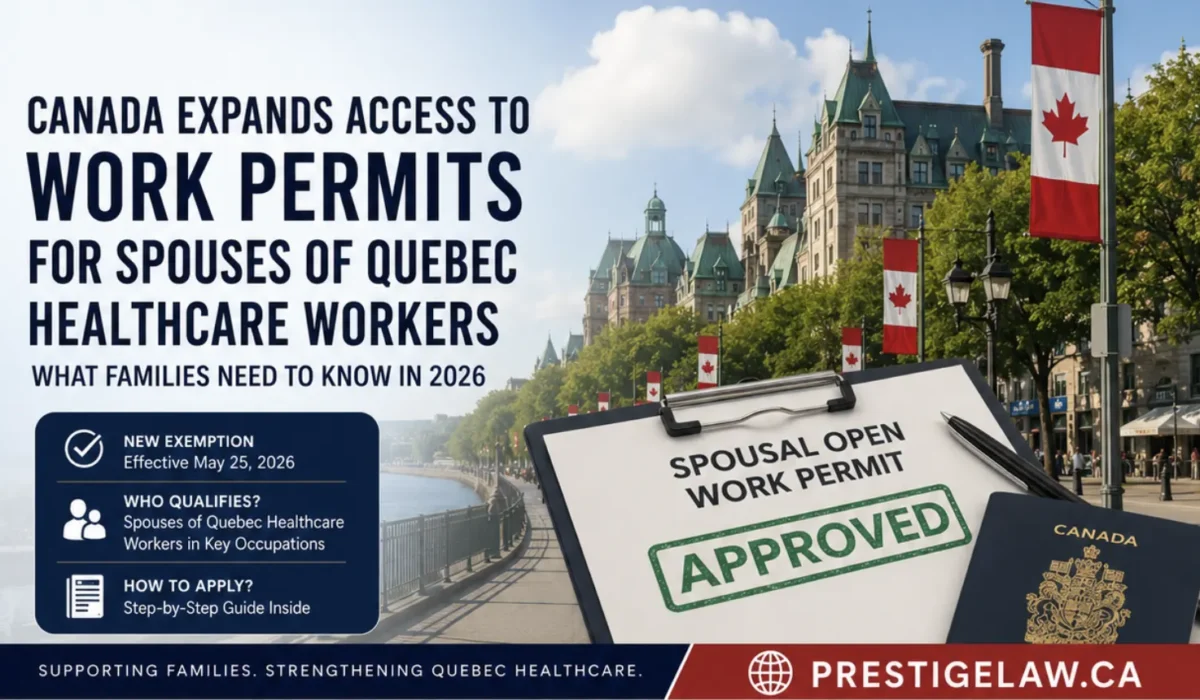
Effective May 25, 2026, Immigration, Refugees and Citizenship Canada (IRCC) has introduced a landmark exemption that expands spousal open work permit (SOWP) access for the spouses and common-law partners of certain foreign-trained healthcare professionals working in Quebec — waiving the 16-month validity requirement that has blocked thousands of families since January 2025 and creating a dedicated pathway for families supporting Quebec’s critical healthcare workforce. Spouses of Quebec Healthcare Workers
Overview of the New Policy
Canada’s immigration landscape shifted meaningfully on May 25, 2026, when IRCC updated its program delivery instructions to give spouses and common-law partners of qualifying foreign-trained healthcare workers in Quebec a special carve-out from one of the most restrictive spousal work permit rules introduced in recent years.
Under the updated instructions, eligible spouses no longer need the principal worker’s work permit to be valid for at least 16 months — a recent stipulation Canada’s immigration department added to spousal open work permit (SOWP) eligibility at the start of 2025.
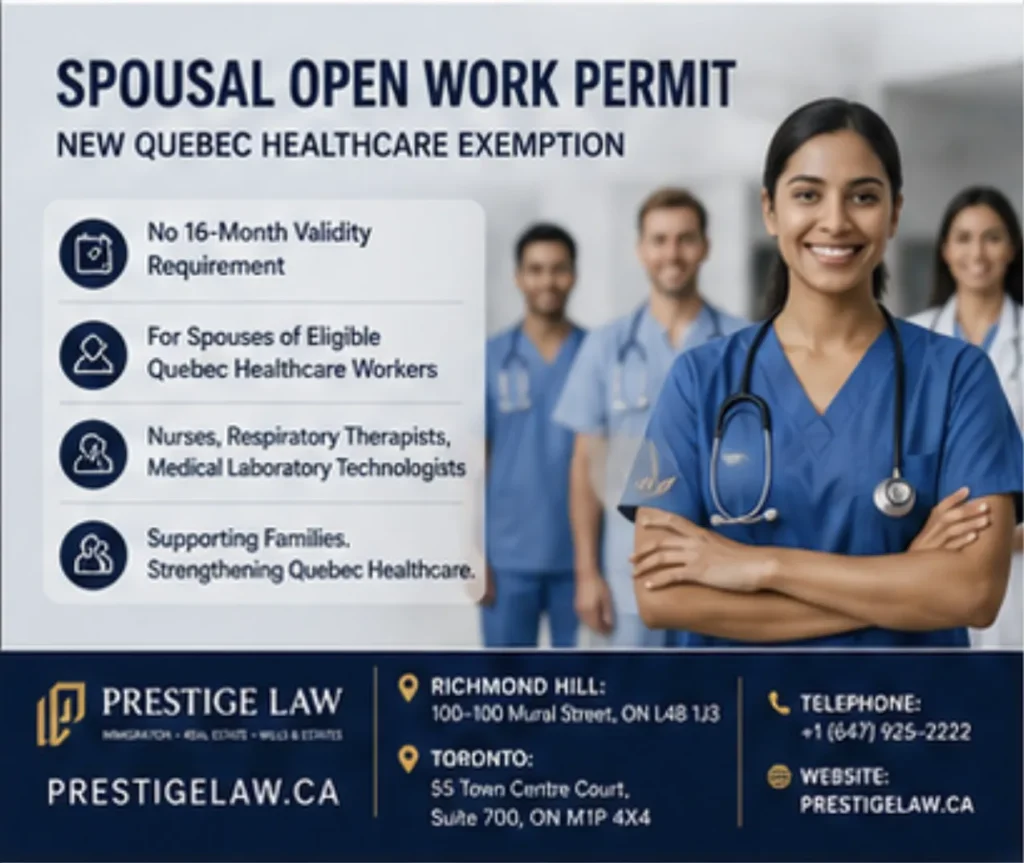
This is a targeted and meaningful change. It does not open the door to every foreign worker or every province. The exemption applies only to spouses of foreign-trained healthcare professionals in Quebec who work in one of three occupations and who were admitted into a specific Quebec recognition or recruitment project.
For families who have been separated or whose ability to work in Canada has been curtailed by the 16-month rule, this update offers a genuine and practical pathway forward.
Why This Change Was Needed
To understand why this exemption matters, it is important to look at the timeline of Canada’s evolving spousal work permit policy.
The January 2025 changes introduced the 16-month rule and narrowed the list of eligible occupations to TEER 0 and 1, plus a select list of TEER 2 and 3 occupations. These changes reduced the number of foreign workers whose spouses could access open work permits in Canada.
The goal of that tightening was to reduce the overall volume of temporary residents in Canada. In March 2024, IRCC announced that the government aims to reduce the share of temporary residents to 5% of Canada’s population by the end of 2026. As part of that effort, changes were made to the eligibility requirements for open work permits issued to spouses of temporary workers and international students.
While those restrictions had a broader policy rationale, they created an unintended consequence in Quebec’s healthcare sector. Foreign-trained nurses, respiratory therapists, and medical laboratory technologists working in Quebec often face recognition timelines that result in their initial work permits being issued for periods shorter than 16 months. That made their spouses ineligible for an SOWP — a significant hardship for families trying to establish themselves in Quebec while contributing to a province in desperate need of healthcare staffing.
The May 2026 exemption directly addresses that gap. The Quebec healthcare exemption does not reverse that broader shift. It creates a limited carve-out for a specific group of workers in a province facing acute healthcare staffing needs.
Who Qualifies for the Exemption?
Eligibility for this exemption rests on two distinct pillars: the occupation of the principal foreign worker and their participation in one of three Quebec government-recognised healthcare projects. Canada
Eligible Occupations (NOC Codes)
To qualify, the principal foreign national must work in one of the following occupations as described by Canada’s National Occupation Classification (NOC) system:
- Registered nurses and registered psychiatric nurses (NOC 31301);
- Respiratory therapists, clinical perfusionists, and cardiopulmonary technologists (NOC 32103); or
- Medical laboratory technologists (NOC 32120).
These are not arbitrary selections. They reflect the three most acute staffing shortages within Quebec’s public healthcare network and align directly with the three Quebec government projects designed to recruit and integrate foreign-trained professionals into the provincial system.
If the principal worker’s occupation does not appear on this list, the exemption does not apply — even if the worker is otherwise employed in healthcare in Quebec. Standard spousal open work permit rules, including the 16-month validity requirement, would continue to govern their spouse’s eligibility.
The Principal Worker Must Still Be Authorised to Work
Per standard spousal open work permit rules for foreign workers, the principal foreign worker must still be authorised to work at the time that their spouse or partner applies for their open work permit.
This is a fundamental rule that the exemption does not remove. The principal worker cannot have an expired or cancelled work permit at the time of the spouse’s SOWP application, regardless of their participation in a Quebec healthcare project.
Eligible Quebec Projects
The second qualifying condition is that the principal foreign worker must have been admitted into one of three specific Quebec projects jointly administered by the Quebec Ministry of Immigration, Francisation and Integration (MIFI), the Ministry of Health and Social Services (MSSS), and the Ministry of Higher Education (MES).
The three eligible projects are:
- Projet de reconnaissance des compétences d’infirmières et d’infirmiers recrutés à l’international;
- Projet de reconnaissance des compétences d’inhalothérapeutes formés à l’étranger; or
- Projet de recrutement et reconnaissance des compétences de technologistes médicaux formés à l’étranger.
Each of these projects targets a specific healthcare occupation and provides a provincial framework for validating and integrating the credentials of internationally trained professionals. Admission into one of these projects is not automatic — it requires the principal worker to have gone through a formal Quebec recognition process, which itself demonstrates a commitment to contributing to Quebec’s healthcare system.
The requirement for project admission is a safeguard that ensures this exemption remains targeted. It prevents broader misuse while ensuring that the families of workers who have formally committed to Quebec’s healthcare system can access the support they need.
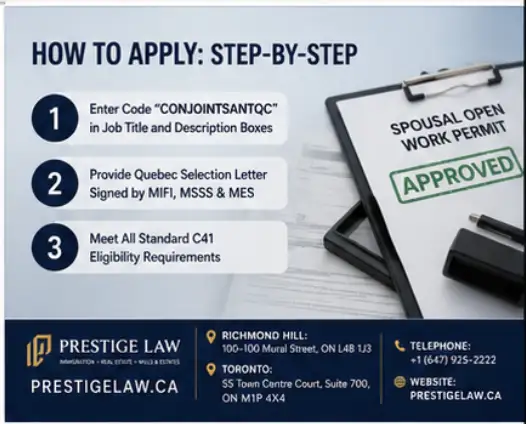
How to Apply: Step-by-Step Guide
For eligible spouses and common-law partners, the application process does not require a new or special form. Eligible spouses apply through the standard C41 spousal open work permit application. No separate or special application is required.
However, there are two critical additional steps that must be taken to trigger the exemption and avoid being processed under standard rules.
Step 1: Enter the Correct Code on Your Application
Applicants must enter the code “CONJOINTSANTQC” in both the job title box and the brief description of duties box on their application form. Without this code, IRCC may process the application under the standard rules, which include the 16-month requirement.
This is not a minor detail — it is the mechanism by which IRCC identifies applications that should be reviewed under the exemption rather than the standard framework. Failing to include this code in both fields could result in a refusal that would otherwise have been approved.
Step 2: Provide the Principal Worker’s Quebec Selection Letter
Applicants must provide the principal worker’s Quebec selection letter. This letter must be signed by all three Quebec ministries — MIFI, MSSS, and MES — and must confirm the principal worker’s admission into one of the three eligible projects.
This letter is the documentary proof of project admission. It must reflect signatures from all three ministries. A letter signed by fewer than three ministries would likely be considered insufficient.
Step 3: Meet All Standard C41 Eligibility Requirements
Even with the exemption in place, the application must still satisfy all other standard C41 requirements. This includes identity documents, relationship evidence, and proof that the principal worker is currently authorised to work in Canada.
Working with a qualified immigration lawyer who can review your application before submission significantly reduces the risk of processing errors or refusals.
What the Application Code “CONJOINTSANTQC” Means
The code “CONJOINTSANTQC” is a processing flag embedded directly into the C41 application to signal to IRCC officers that this application falls under the new Quebec healthcare exemption. Breaking it down linguistically: “conjoint” is French for “spouse” or “partner,” “santé” translates to “health,” and “QC” is the standard abbreviation for Quebec.
This code serves a functional bureaucratic purpose — it routes the application to the appropriate processing framework. Because IRCC handles millions of applications, these internal codes are how officers identify exemptions quickly and accurately. Omitting it, even accidentally, could mean your application is assessed against the 16-month rule and refused.
If you are unsure how to complete the C41 form with this code, or if you want to verify that your application has been assembled correctly, speaking with an immigration lawyer before submitting is the most reliable way to protect your family’s interests.
Standard Spousal Open Work Permit Rules (Still in Force)
It is important to emphasise that the new exemption is narrow and targeted. The broader spousal open work permit rules introduced in January 2025 remain fully in force for everyone outside this specific exemption.
The 16-month requirement still applies to all other spouses and partners of foreign workers applying for an SOWP.
Current standard rules also require that SOWPs are limited to spouses of foreign nationals who work in high-skilled occupations at TEER 0 or 1, or in select occupations at TEER 2 or 3, under IRCC’s International Mobility Program (IMP).
This means that if your spouse works in Quebec healthcare but does not hold one of the three qualifying NOC codes, or has not been admitted into one of the three Quebec projects, the exemption does not apply to your situation. You would need to meet the standard eligibility criteria, including the 16-month validity requirement.
Understanding whether you fall within or outside the exemption requires a careful review of your specific circumstances. An experienced immigration lawyer can assess your situation and advise on the most appropriate pathway.
Quebec’s Healthcare Staffing Crisis: The Bigger Picture
This policy change does not exist in a vacuum. It is a direct response to one of the most urgent workforce challenges facing Canada’s most populous francophone province.
Quebec’s public healthcare system has been under significant strain for years, driven by an ageing population, increased demand for services, and persistent shortages of trained professionals in critical roles. Registered nurses, respiratory therapists, and medical laboratory technologists are among the most acutely needed workers, and Quebec’s domestic supply has not kept pace with demand.
To address this, Quebec has turned to international recruitment as a core strategy, building formal programs to attract, recognise, and retain foreign-trained healthcare professionals. The three projects listed in the new exemption — covering nurses, respiratory therapists, and medical laboratory technologists — are the cornerstone of that international recruitment effort.
However, attracting international healthcare workers is not only about salaries and credential recognition. It is also about family settlement. A healthcare professional who cannot bring a working spouse to Canada faces significant barriers to long-term settlement. A working spouse means financial stability, reduced isolation, and a greater likelihood that the healthcare worker will remain in Quebec long-term rather than departing once their initial permit expires.
By extending spousal open work permit access to the families of workers in these three occupations, Canada is taking a practical step to improve retention alongside recruitment. This is smart immigration policy — connecting workforce needs to family settlement outcomes in a way that serves both the province and the workers it is trying to keep.
Other Federal Measures Supporting Quebec Healthcare Workers
The May 2026 exemption is part of a broader pattern of federal-provincial collaboration on Quebec healthcare staffing.
The May 25 exemption is the latest in a series of federal measures that support Quebec’s efforts to retain foreign-trained healthcare workers.
These measures reflect an understanding that Quebec’s healthcare workforce challenges are severe enough to warrant specific, tailored policy responses — rather than expecting all provinces to be served equally by national rules designed for the general population of temporary workers.
For foreign-trained healthcare professionals in Quebec who are navigating this evolving landscape, staying current with IRCC program delivery instructions is essential. Policy updates like this one often take effect quickly and with limited public announcement, meaning that workers and their families can miss opportunities if they are not actively monitoring the immigration landscape.
This is one reason why working with an immigration lawyer who focuses on Canadian immigration policy is so valuable. A knowledgeable legal team will identify changes like this one, assess your eligibility, and help your family move forward without delay.
How Prestige Law Can Help
Navigating Canada’s immigration system is complex at the best of times. When policies are changing rapidly — as they have been throughout 2025 and into 2026 — the stakes of a misstep are high. A refused application, a missed code, or a document submitted without the required ministry signatures can cost your family months of delay and significant financial hardship.
At Prestige Law, our team is led by Zeesean Sheikh, an experienced Canadian immigration lawyer who understands the nuances of spousal open work permits, Quebec-specific immigration programs, and the evolving IRCC policy landscape. We are committed to helping families in Quebec and across Canada access the immigration pathways they are entitled to — clearly, confidently, and without unnecessary delays.
Whether you are a foreign-trained nurse, respiratory therapist, or medical laboratory technologist working in Quebec, or the spouse of a qualifying healthcare professional hoping to work in Canada, Prestige Law provides personalised legal guidance tailored to your exact circumstances.
Our services include:
- Assessment of your eligibility for the new Quebec healthcare SOWP exemption
- Preparation and review of your C41 spousal open work permit application
- Verification that the “CONJOINTSANTQC” code is correctly entered and supporting documents are complete
- Representation in the event of IRCC requests for additional information or refusals
- Broader immigration planning for permanent residence pathways in Quebec and across Canada
We serve clients from our offices in Richmond Hill and Toronto, and we assist clients across Canada and internationally.
📍 Richmond Hill: 100–100 Mural Street, ON 📍 Toronto: 55 Town Centre Court, Suite 700, ON 📞 Telephone: +1 (647) 925-2222 🌐 Website: prestigelaw.ca

Frequently Asked Questions (FAQs)
1. What is a spousal open work permit (SOWP)?
A spousal open work permit (SOWP) is a type of Canadian work permit that allows the spouse or common-law partner of a temporary foreign worker or international student to work for any employer in Canada. Unlike a closed work permit, it is not tied to a specific employer, giving the holder broad flexibility in the Canadian labour market.
2. Who is eligible for the new Quebec healthcare SOWP exemption?
The exemption applies to spouses and common-law partners of foreign-trained healthcare professionals in Quebec who hold one of three NOC codes — NOC 31301 (registered nurses), NOC 32103 (respiratory therapists and related professionals), or NOC 32120 (medical laboratory technologists) — and who have been admitted into one of three Quebec government-recognised healthcare recruitment and recognition projects.
3. Do I still need to meet all other SOWP requirements?
Yes. The exemption only removes the 16-month validity requirement for qualifying applicants. All other standard C41 eligibility requirements remain in force, including proof of identity, relationship evidence, and confirmation that the principal worker is currently authorised to work in Canada.
4. What happens if I forget to include “CONJOINTSANTQC” in my application?
If the code is not entered in both the job title box and the brief description of duties box on the C41 form, IRCC may process your application under the standard rules, which include the 16-month requirement. This could result in a refusal even if you are otherwise eligible for the exemption. Always have a qualified immigration lawyer review your application before submission.
5. Does the exemption apply to healthcare workers outside Quebec?
No. The exemption is specific to foreign-trained healthcare professionals in Quebec who are participating in one of the three named Quebec provincial projects. Healthcare workers in other provinces are not covered by this exemption and must meet standard SOWP eligibility requirements.
6. What if the principal healthcare worker’s work permit is almost expired?
The principal foreign worker must still be authorised to work in Canada at the time the spouse submits the SOWP application. If the principal worker’s permit is expired or near expiry, the application may be refused. It is advisable to apply well before expiry and to discuss a permit renewal strategy with an immigration lawyer.
7. Can common-law partners also apply under the exemption?
Yes. The exemption covers both legal spouses and common-law partners of qualifying Quebec healthcare workers, consistent with IRCC’s standard recognition of common-law relationships for immigration purposes.
8. Is this exemption permanent?
As of the publication of this article, IRCC has not confirmed whether this exemption has a defined end date. Immigration policies can change, and it is advisable to apply promptly if you believe you qualify. Consulting with an immigration lawyer will help you stay current with any updates.
9. How long does it take to process a spousal open work permit?
Processing times for SOWPs vary depending on the volume of applications and individual circumstances. Applicants can check current processing times on the IRCC website. Some applicants may be eligible to apply for a visitor visa with authorisation to work upon arrival while their SOWP is being processed, depending on their situation.
10. Can Prestige Law help me if I am already in Quebec?
Yes. Prestige Law serves clients across Canada, including those who are already in Quebec and need assistance with their immigration status, work permit renewals, spousal permit applications, or longer-term permanent residence planning.

The expansion of spousal open work permit access for spouses of Quebec healthcare workers is a targeted, practical, and family-centred update to Canada’s immigration policy. It reflects an understanding that attracting and retaining skilled healthcare professionals in Quebec requires more than credential recognition — it requires enabling those professionals to build stable family lives in Canada.
If you are a foreign-trained nurse, respiratory therapist, or medical laboratory technologist working in Quebec under one of the three recognised provincial projects, or if you are the spouse of such a professional, you may now have access to a spousal open work permit that was previously out of reach.
Acting on this opportunity promptly and correctly — particularly with respect to the “CONJOINTSANTQC” code and the required ministry-signed selection letter — is essential to success. The team at Prestige Law, under the leadership of Zeesean Sheikh, is ready to help your family take this next step with confidence.
📍 Richmond Hill: 100–100 Mural Street, ON
📍 Toronto: 55 Town Centre Court, Suite 700, ON
📞 Telephone: +1 (647) 925-2222
🌐 Website: prestigelaw.ca
Published by Prestige Law | prestigelaw.ca