



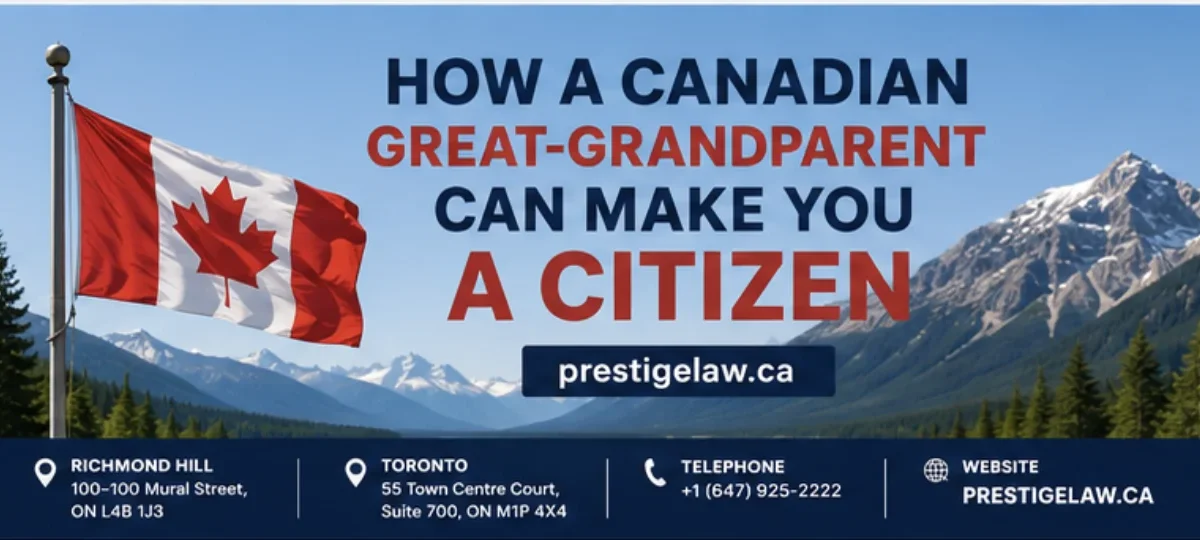
How a Canadian Great-Grandparent Can Make You a Citizen
A single ancestor born in Canada generations ago could be the reason you’re entitled to a Canadian passport today — here’s how the law changed, who qualifies, and what you need to prove it. Canadian Citizenship Through a Great-Grandparent
For decades, thousands of families around the world carried a piece of Canadian history without knowing what it was worth. A grandmother who crossed the border in the 1940s. A great-grandfather who was born in a small Ontario township before moving south. For a long time, Canadian law drew a hard line after just one generation born abroad, and that line quietly cut off the citizenship rights of countless children, grandchildren, and great-grandchildren. That line is gone now. Following a landmark court ruling and the passage of Bill C-3, Canada has reopened the door to citizenship by descent, and in many cases, that door reaches all the way back to a great-grandparent.
If you’ve ever heard a family story about Canadian roots, this is the moment to take it seriously. This guide walks through exactly how the “chain of descent” works, who is likely eligible, what evidence you’ll need, and why so many families are moving quickly to secure proof of a status they may already legally hold.
Understanding Canadian Citizenship by Descent Canadian Citizenship Through a Great-Grandparent
Canadian citizenship by descent refers to citizenship acquired not through birth on Canadian soil or through immigration and naturalisation, but through a parent, grandparent, or in many newly recognised cases, a great-grandparent who held Canadian citizenship. It is fundamentally different from applying for permanent residence or naturalising as a new Canadian. Citizenship by descent is a confirmation of a status the law says you already hold — the paperwork simply proves it.
For years, this pathway was severely limited by something called the first-generation limit (FGL). Introduced in 2009, the FGL meant that a Canadian citizen who was born outside Canada could pass citizenship down to their own child born abroad, but that child — now a second-generation descendant — could not pass it any further. In practical terms, a family with deep Canadian roots could lose that legal connection within two generations simply because successive children happened to be born outside the country.
That rule created what became widely known as the “Lost Canadians” problem: people who, by any reasonable reading of their family history, should have been Canadian, but were excluded on a technicality tied purely to where their parents or grandparents happened to give birth.
What Changed: The End of the First-Generation Limit
In December 2023, the Ontario Superior Court of Justice ruled that the first-generation limit violated the Canadian Charter of Rights and Freedoms, finding that it created an unfair second-class of citizenship based on national origin. The federal government chose not to appeal that decision, effectively agreeing that the old rule needed to go.
After a lengthy legislative process — including an earlier proposal known as Bill C-71 that did not survive a change in government — Parliament passed Bill C-3, An Act to Amend the Citizenship Act, which received Royal Assent on November 20, 2025, and came into force on December 15, 2025.
Bill C-3 does two important things:
- It retroactively restores citizenship to people born before December 15, 2025, who would have been Canadian citizens if the first-generation limit had never existed.
- It creates a new forward-looking test for anyone born on or after December 15, 2025. Going forward, a Canadian parent who was themselves born or adopted outside Canada can pass citizenship to their child only if that parent can demonstrate at least 1,095 cumulative days (three years) of physical presence in Canada before the child’s birth or adoption. This is often called the “substantial connection” test.
For families tracing their roots back through a great-grandparent, the retroactive piece of Bill C-3 is the one that matters most, because it does not impose an arbitrary cutoff on how far back the original Canadian ancestor can be found.
Can You Really Claim Citizenship Through a Great-Grandparent?
Yes — and this is the detail that surprises most people. Canadian citizenship still does not pass directly from a great-grandparent to a great-grandchild in one legal step. Instead, the law works by restoring the entire chain, one generation at a time.
Here is how that chain typically looks for a family born before December 15, 2025:
- Generation 1 — The Anchor Ancestor: Your great-grandparent was born in Canada, or was naturalised as a Canadian citizen before your grandparent was born.
- Generation 2 — Your Grandparent: Born abroad to that Canadian great-grandparent. Under the old first-generation limit, your grandparent would have been Canadian by descent, but unable to pass citizenship any further.
- Generation 3 — Your Parent: Born abroad to your grandparent. Previously excluded entirely by the first-generation limit.
- Generation 4 — You: Born abroad to your parent, and also previously excluded.
Under Bill C-3, the law now works backwards through this chain and repairs it link by link. Your grandparent is retroactively confirmed as a Canadian citizen. Because your grandparent is confirmed, your parent is retroactively confirmed as having been born to a Canadian citizen. Because your parent is confirmed, you are recognised as having been a Canadian citizen from the moment of your birth — not from the date you apply, and not from the date Bill C-3 became law, but from birth itself.
This is a critical legal distinction. You are not applying for a new grant of citizenship with conditions attached. You are applying for proof of a citizenship status the law says you have held all along, in the form of a Citizenship Certificate.
There is one important limitation to keep in mind: this retroactive chain generally applies to people born before December 15, 2025. If a family member in that chain was born on or after that date, the new 1,095-day substantial connection rule may apply to them, and the analysis becomes more layered. This is exactly the kind of nuance where a qualified immigration lawyer can save a family significant time and prevent a rejected application.
Who Is Likely Eligible
Because eligibility depends heavily on dates of birth, family structure, and documentary evidence, no two cases look identical. That said, you are a strong candidate for review if any of the following describe your family:
- Your great-grandparent (or grandparent) was born in Canada, particularly in provinces with strong historical emigration patterns to the United States, the United Kingdom, or elsewhere.
- A family member emigrated from Canada in the early-to-mid twentieth century and later had children abroad.
- You, your parent, or your grandparent were previously told you did not qualify for Canadian citizenship because of the “second generation” or “first-generation limit” rule.
- Your family has copies, even partial or damaged, of old Canadian birth certificates, baptismal records, naturalisation papers, or immigration documents.
- You were born outside Canada before December 15, 2025, and at least one ancestor in your direct line was Canadian.
- Your parent already held a Canadian citizenship certificate or passport at some point, even if it expired or was never renewed.
- You are a U.S. citizen with a Canadian-born grandparent or great-grandparent and have always wondered whether dual citizenship might be within reach.
If several of these apply to you, it is worth pursuing a formal eligibility review rather than assuming the door is closed. Many people who were rejected under the old rules, or who never bothered to apply because they were told it was pointless, are now eligible.
The Documents You Will Need
Because Bill C-3 restores citizenship retroactively based on historical facts rather than a simple checklist, the strength of your application depends almost entirely on the quality of your documentary evidence. Immigration, Refugees and Citizenship Canada (IRCC) expects primary source documents wherever they exist. Typically, a complete application will include:
- Birth certificates for every person in the chain of descent, from the original Canadian ancestor down to the applicant.
- Marriage certificates, where relevant, to establish family connections and legal name changes across generations.
- Proof of the anchor ancestor’s Canadian citizenship, such as a Canadian birth certificate, a certificate of naturalisation, or historical citizenship registration records.
- Adoption records, if any generation in the chain involves an adopted child.
- Supporting identity documents such as passports, school records, military service records, or census entries, especially for older generations where official vital records may be incomplete.
- A clear, consistent family tree narrative connecting names, dates, and locations across every jurisdiction involved, since records often come from multiple provinces, states, or even countries.
Genealogy websites and online family-tree platforms can be enormously helpful for locating leads, but they are not accepted as standalone proof. IRCC generally requires certified copies of official vital records. Where an official birth record was never created or has been lost, secondary evidence — such as church baptismal records, hospital records, or historical boat manifests — may be used to meet the legal standard of a balance of probabilities, but this kind of alternative evidence needs to be assembled and presented carefully.
How the Application Process Works
Once you’ve gathered your family’s documentary record, the application itself generally follows these stages:
1. Confirm the anchor ancestor. Every case starts by identifying the earliest person in your direct line who was either born in Canada or lawfully naturalised before the next generation was born. This person is your legal “anchor,” and everything else in the application is built around proving their status and your relationship to them.
2. Build the generational chain. Each link in the chain — great-grandparent to grandparent, grandparent to parent, parent to applicant — needs to be documented with consistent names, dates, and locations. Inconsistencies, name changes, or gaps between records are the most common reason applications stall.
3. Determine whether the 1,095-day rule applies. If everyone in your chain was born before December 15, 2025, the substantial connection test generally does not apply to you. If a parent or grandparent in your chain was born on or after that date, additional evidence of physical presence in Canada may be required for that specific generation.
4. Submit the application for a Citizenship Certificate. This is typically filed using IRCC’s proof of citizenship application (Form CIT 0001), along with certified copies of all supporting documents.
5. Respond to any requests for additional evidence. IRCC may request further documentation, particularly for older or more complex family histories. Because Bill C-3 significantly increased the number of applications being filed, processing times have lengthened, and IRCC has been paying close attention to the completeness and consistency of documentation.
6. Receive your Citizenship Certificate. Once approved, this certificate is your legal proof of Canadian citizenship, which you can then use to apply for a Canadian passport or other benefits of citizenship.
Because IRCC has recently increased scrutiny on citizenship-by-descent files — including contacting some self-represented applicants to review previously issued certificates — it is more important than ever that an application is complete, well-documented, and legally sound the first time.
Common Challenges Families Run Into
Several recurring issues tend to slow down or derail applications:
- Missing or unregistered historical birth records. Especially for ancestors born in the early 1900s, official registration was inconsistent, and families often need to rely on alternative evidence.
- Name discrepancies across countries. Spelling variations, anglicised names, or clerical inconsistencies between Canadian, American, and other national records can create doubt about whether two documents refer to the same person.
- Confusing “grandparent citizenship” with a direct grant. Citizenship does not skip a generation. Even under Bill C-3, the law works by confirming each generation in sequence — which means if your parent’s status hasn’t been confirmed yet, your own application generally needs to establish (or be filed alongside) theirs.
- Assuming the process is automatic. While the law recognises your citizenship as having existed since birth, you still need to formally apply for a Citizenship Certificate to have that status documented and usable — for travel, sponsorship, or any other purpose.
- Overlooking the December 15, 2025 cutoff. Anyone born on or after that date needs to satisfy the new substantial connection test, which requires proof of at least three years of physical presence in Canada by the Canadian parent.
The Benefits of Confirming Canadian Citizenship
Beyond the emotional value of reconnecting with family history, there are real, practical advantages to formally confirming Canadian citizenship:
- Global mobility. A Canadian passport provides visa-free or visa-on-arrival access to a large share of the world, including the European Union and the United Kingdom.
- Healthcare and residency rights. Canadian citizens have full access to provincial healthcare systems once residency requirements are met, along with the unrestricted right to live and work anywhere in Canada without a work permit.
- Education advantages. Citizens are generally eligible for domestic (rather than international) tuition rates at Canadian colleges and universities, which can represent enormous savings for families planning for their children.
- Sponsorship opportunities. Once your own citizenship is confirmed, you gain the ability to sponsor a spouse, common-law partner, or eligible family member for Canadian permanent residence.
- Dual citizenship is fully permitted. Canada allows dual and even multiple citizenship. For example, U.S. citizens who become Canadian citizens through descent are not automatically subject to Canadian income tax simply for holding the status, since Canada’s tax system is based primarily on residency rather than citizenship. Whether your other country of citizenship permits dual status depends entirely on its own laws.
- A stable legacy for future generations. Once confirmed, your own children born after you may be entitled to citizenship as well, depending on where and when they are born.
Why Work With an Experienced Immigration Lawyer
Bill C-3 has genuinely reopened citizenship to a much wider group of applicants, but the law’s benefit is only as strong as the evidence behind your application. Because eligibility now depends on historical facts — sometimes spanning three, four, or more generations and multiple countries — small documentation gaps can create real uncertainty, even for families who clearly qualify in principle.
An experienced immigration lawyer can:
- Assess your family history and identify the correct “anchor ancestor” in your chain of descent.
- Advise on which documents are essential and which alternative evidence may be accepted where official records are missing.
- Coordinate multi-generational applications where more than one family member’s status needs to be confirmed in sequence.
- Respond effectively if IRCC requests additional evidence or raises questions about a file.
- Help families understand how citizenship by descent interacts with related matters, such as spousal sponsorship, once status is confirmed.
Given the recent increase in IRCC scrutiny of citizenship-by-descent files, professional guidance is no longer just a convenience — for many families, it is the difference between a smooth approval and a prolonged, stressful review.
Frequently Asked Questions
Can I really become a Canadian citizen because of a great-grandparent? Yes, in many cases. Bill C-3 removed the old first-generation limit and allows the law to retroactively recognise each generation in your family line, provided you were born before December 15, 2025, and can document the chain connecting you back to your Canadian ancestor.
Does citizenship skip directly from my great-grandparent to me? No. Canadian law confirms citizenship sequentially through each generation. Your great-grandparent’s status confirms your grandparent, your grandparent’s status confirms your parent, and your parent’s status confirms you.
What is the first-generation limit, and does it still exist? The first-generation limit was a rule, introduced in 2009, that prevented Canadians born abroad from passing citizenship to their own children if those children were also born outside Canada. It was ruled unconstitutional in 2023 and formally repealed by Bill C-3 in December 2025, though a new rule now applies to people born on or after that date.
What is the 1,095-day rule? It’s the new “substantial connection” test that applies only to children born or adopted outside Canada on or after December 15, 2025. Their Canadian parent must show at least 1,095 cumulative days (three years) of physical presence in Canada before the child’s birth or adoption for citizenship to pass down.
I was told years ago that I didn’t qualify for Canadian citizenship. Should I check again? Yes. Many people who were previously denied, or who never applied because they were told the first-generation limit made it pointless, may now be eligible under Bill C-3’s retroactive provisions.
What documents do I need to start? At minimum, birth certificates for every generation in your chain of descent, along with any available proof of your original Canadian ancestor’s citizenship, such as a Canadian birth certificate or naturalisation record. Marriage certificates and adoption records may also be needed depending on your family history.
How long does the application process take? Processing times have varied as IRCC works through a significant increase in citizenship-by-descent applications following Bill C-3. Complex, multi-generational cases with older or incomplete records generally take longer, which is another reason a well-prepared, complete application matters.
Will becoming a Canadian citizen affect my citizenship in my current country? Canada permits dual and multiple citizenship. Whether your current country of citizenship allows you to hold Canadian citizenship as well depends on that country’s own laws, so this is worth confirming independently.
Do I need to live in Canada to keep my citizenship by descent? No. Citizenship confirmed under Bill C-3 for people born before December 15, 2025, is not conditional on future residency in Canada. The three-year physical presence requirement applies to the Canadian parent, not to the applicant, and only for births on or after December 15, 2025.
What if my family’s records are in another country, or very old? This is common, especially for ancestors born in the late 1800s or early 1900s. Provincial and state vital records offices are usually the first place to look, and where formal records don’t exist, alternative evidence such as church, census, or immigration records may be used to support your case.
Take the Next Step Toward Confirming Your Canadian Citizenship
Citizenship by descent through a great-grandparent is no longer a legal dead end — for many families, it is a real and achievable path to a Canadian passport, and everything that comes with it. The key is building a complete, well-documented application that reflects exactly how the law now treats your family’s history.
At Prestige Law, immigration lawyer Zeesean Sheikh works closely with families across Canada and abroad to trace eligible lines of descent, gather the right documentation, and prepare strong applications for proof of Canadian citizenship under the new rules introduced by Bill C-3.
Prestige Law
📍 Richmond Hill: 100–100 Mural Street, ON
📍 Toronto: 55 Town Centre Court, Suite 700, ON
📞 Telephone: +1 (647) 925-2222
🌐 Website: prestigelaw.ca
If your family has Canadian roots that go back a generation or two further than you thought mattered, now is the time to find out for certain.
Formatting note for publishing: set the main headline (“How a Canadian Great-Grandparent Can Make You a Citizen”) in black, medium font weight when placing this on the website.