





Manitoba invites 1,304 workers to apply for provincial nomination.
Published October 30, 2026 | Prestige Law | Canadian Immigration News and Analysis
Manitoba provincial nomination just opened its doors to far more skilled workers than usual. On October 22, 2026, the Manitoba Provincial Nominee Program (MPNP) issued 1,304 Letters of Advice to Apply in Expression of Interest Draw #282, almost four times the size of the draw held only two weeks earlier. The invitations went to Manitoba graduates and their spouses, to top-scoring skilled workers already living in the province, and to a smaller group of candidates selected through strategic recruitment initiatives. If you received a letter, the clock is already running. If you did not, this draw still teaches you exactly how the province is choosing people right now. This guide explains the results, the cutoff scores, the next steps, and the mistakes that can cost a promising application.
In this article
- Draw #282 at a glance
- How the Manitoba Provincial Nominee Program works
- The three selections explained
- What the cutoff scores tell you
- Why this draw was so large
- Who should pay attention
- What to do after receiving a letter
- Document checklist
- If you were not invited
- Common mistakes
- How nomination connects to permanent residence
- How Prestige Law can help
- Frequently asked questions
Manitoba Provincial Nomination: Draw #282 at a Glance
Before going into detail, here are the headline facts from the October 22 round. Every figure below comes from the results the province published for Expression of Interest Draw #282.
Selection
Letters of Advice to Apply
Lowest score invited
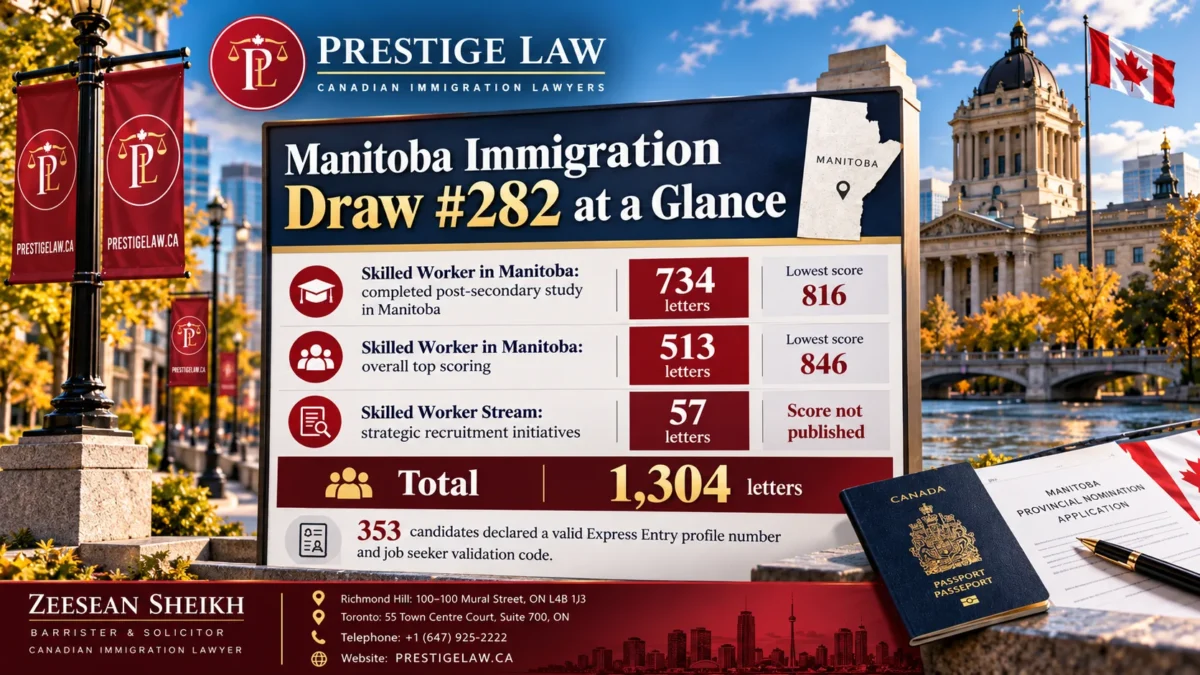
Skilled Worker in Manitoba: completed post-secondary study in Manitoba 734 816
Skilled Worker in Manitoba: overall top scoring 513 846
Skilled Worker Stream: strategic recruitment initiatives 57 Not published
Total 1,304
Of the 1,304 letters, 353 went to candidates who declared a valid Express Entry profile number and job seeker validation code. That detail matters because it shows how many people are pursuing both a provincial pathway and the federal system at the same time.
The round also followed the October 8 draw, which issued 340 letters, including 211 to workers in education and childcare occupations and 46 to healthcare workers. Put the two draws side by side and a pattern appears. Manitoba is mixing targeted rounds for labour shortages with broader rounds that reward points and local ties.
How the Manitoba Provincial Nominee Program Works
Canada’s provinces and territories can nominate people who want to settle in their region and who meet local labour market needs. Manitoba runs one of the most established of these programs. The MPNP lets the province select skilled workers, international students, business people, and other candidates, then recommend them to the federal government for permanent residence.
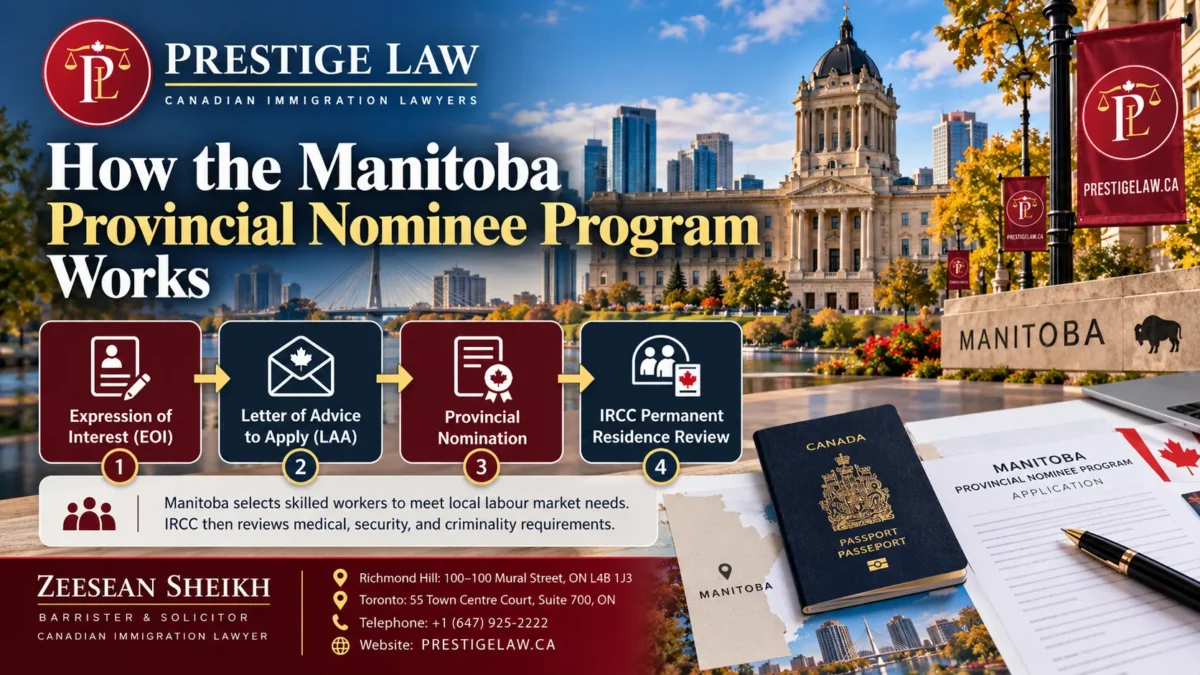
The process has two stages, and many applicants confuse them. First, the province decides whether to nominate you. Second, Immigration, Refugees and Citizenship Canada (IRCC) decides whether to approve your permanent residence application, including medical, security, and criminality checks. A nomination is a strong endorsement, but it is not a visa.
For the Skilled Worker streams, the first step is an Expression of Interest (EOI) profile. You enter details about your age, language ability, education, work experience, and connection to Manitoba. The system scores the profile. At regular intervals, the MPNP holds a draw, selects profiles according to published criteria, and sends a Letter of Advice to Apply (LAA) to chosen candidates.
An LAA does not guarantee nomination. It is an invitation to submit a full application with documents. The province then reviews your proof and decides whether to issue a nomination. This is why accuracy in the EOI stage is so important. Everything you claimed must be backed by evidence later.
Inside the October 22 Draw: Three Selections Explained
Draw #282 contained three separate selections. Understanding which one applies to you helps you read your own results and plan your next move.
Selection one: Manitoba post-secondary graduates and their spouses (734 letters)
The largest group went to Skilled Worker in Manitoba candidates who, or whose spouses, completed a post-secondary program in Manitoba. The lowest score invited was 816. These candidates have already invested years in the province, often through study followed by a post-graduation work permit.
This selection rewards a genuine local footprint. A person who studied in Winnipeg, Brandon, or another Manitoba community, then found work in the province, fits the profile the program wants to retain. If you were selected here, you must be able to prove the Manitoba education claim. A diploma and an official transcript are the obvious documents. If you cannot prove it, the province has signalled that you may wish to decline the letter rather than risk a refusal.
Selection two: top-scoring Skilled Worker in Manitoba candidates (513 letters)
The second group was the overall top-scoring selection. It considered eligible Skilled Worker in Manitoba profiles with no occupation or education filter. The lowest score invited was 846. This is a pure points contest, and the cutoff shows how competitive it can be when the pool is wide open.
Candidates in this group were already living in Manitoba, and many held strong combinations of language results, work experience, and local ties. If you work in a regulated occupation, you should know that the MPNP expects full licensing steps to be complete when you claim to be licensed. The province has warned that it may refuse applications from people who are not actually working in that occupation or who cannot show that every licensing step was finished.
Selection three: strategic recruitment initiatives (57 letters)
The smallest group went to candidates in the Skilled Worker in Manitoba or Skilled Worker Overseas pathways who declared a direct invitation from the MPNP under a strategic recruitment initiative. These are targeted channels, and they work differently from the points-based rounds. The 57 letters broke down as follows:
Strategic recruitment initiative
Letters
Employer Services 21
Francophone Community 16
Regional Communities 15
Temporary Public Policy for work permits for prospective nominee candidates 3
Ethnocultural Communities 2
These channels matter for people outside the province too. They show that candidates abroad are not shut out entirely, although in this draw they could only be selected if the MPNP had directly invited them. A general overseas profile without a direct invitation was not part of the pool.
What the Manitoba Provincial Nomination Cutoff Scores Tell You
Cutoff scores are the most searched part of any draw result, and they are also the most misunderstood. A cutoff is simply the lowest score that received an invitation in that selection on that day. It is not a minimum requirement, and it is not a promise about the next round.
In Draw #282, the post-secondary selection closed at 816, while the overall top-scoring selection closed at 846. The higher number in the open selection makes sense. It was a wider contest with no education filter, so only the strongest profiles cleared the line. The graduate selection narrowed the field to people with a Manitoba education, so a lower score was enough.
Compare this with earlier rounds. In the draw held on September 10, the post-secondary selection closed at 825. That means the October cutoff for graduates was nine points lower. A small drop like this can reflect a different mix of profiles in the pool, a larger number of invitations, or both. Be careful, though, about comparing the 846 figure with the 760 figure from an earlier September draw. That earlier round was limited to one occupational category, so the two numbers measure different groups of people.
The practical lesson is simple. Do not chase a single number. Instead, improve the factors you control. Higher language scores, additional Canadian work experience, a stronger Manitoba connection, and a clean, accurate profile all raise your standing in every type of draw.
Why This Draw Was Almost Four Times Larger
The October 8 draw issued 340 letters. The October 22 draw issued 1,304. That jump is difficult to ignore, and it raises a fair question about why the province invited so many people at once.
The province has not given a public explanation for the size of any single draw, so any answer is an interpretation. Still, several reasonable factors can be considered. Provincial programs work within annual nomination allocations set with the federal government. Provinces often spread invitations across the year, but they can also issue larger rounds when they want to move candidates through the pipeline before the end of the year. A large draw may also reflect the number of strong profiles waiting in the pool, especially among local graduates.
Another point deserves attention. A very large graduate selection suggests the province values retaining people who already study and work in Manitoba. That is consistent with the program’s long-standing focus on candidates who are likely to stay. For international students currently in Manitoba, the message is encouraging. A local education is a real asset in the points system.
For everyone else, the large size of the draw is not a reason to assume the next round will match it. Draw sizes vary, and the province can change its approach at any time. The safest plan is to keep your profile accurate and competitive rather than wait for a pattern to repeat.
Who Should Pay Attention to Manitoba Provincial Nomination
Several groups of people should read this draw closely, even if they were not invited this time.
International graduates of Manitoba institutions. The 734 letters in the graduate selection show that this group is a clear priority. If you finished a program in the province, or your spouse did, make sure your EOI states that correctly and that you hold the documents to prove it.
Skilled workers already employed in Manitoba. The top-scoring selection rewards strong overall profiles. Workers with good language results, solid work history, and local ties are best positioned.
Express Entry candidates. Because 353 of the 1,304 invited candidates declared an Express Entry profile number and job seeker validation code, this group is clearly active in the system. A nomination tied to an Express Entry profile can carry major weight in the federal ranking, which we explain later in this article.
Francophone candidates and people in smaller communities. The strategic recruitment numbers show that French-speaking applicants and those tied to regional communities receive direct attention. If you fit one of these categories, ask whether a targeted channel applies to you.
Employers. Employer Services produced 21 of the 57 strategic letters. Businesses that rely on foreign talent should understand how employer-linked channels interact with the nomination process.
What to Do After Receiving a Letter of Advice to Apply
Receiving a letter is a major milestone, but the real work begins right away. Follow these steps in order.
Step 1: Read the letter carefully and note the deadline. Your letter states how long you have to submit a complete application. Recent rounds have typically allowed 60 days, but your own letter is the only reliable source. Mark the date and work backwards.
Step 2: Compare every claim in your EOI with your evidence. Go line by line. If you claimed a language score, find the test report. If you claimed Manitoba education, find the transcript. If you claimed work experience, find reference letters, pay records, and tax documents that match. The province will test your profile against your documents.
Step 3: Decide whether you should proceed. The MPNP has said that if you cannot prove the criterion that earned your invitation, you may wish to decline the letter. This is an honest, practical warning. Submitting an application you cannot support can lead to refusal and, in serious cases, a misrepresentation finding.
Step 4: Gather and organise your documents. Build a clean folder with every required item, clearly named and in the format the portal expects. Translate any document that is not in English or French, and include the translator’s declaration where needed.
Step 5: Submit the complete application through MPNP Online. Do not wait until the final days. Portals can be slow, uploads can fail, and a missing page can delay everything. Submit early and keep proof of submission.
Step 6: Respond quickly to any request for more information. Officers may ask for clarification. A prompt, accurate answer keeps the file moving.
Step 7: Prepare for the federal stage. Once nominated, you will need to apply to IRCC for permanent residence. Start gathering police certificates and medical exam details early, because they take time.
Document Checklist for Manitoba Provincial Nomination Applicants
Every file is different, and your letter will list what the province expects. Still, most skilled worker applicants should prepare the following.
- Valid passport and any current immigration documents, such as a work permit or study permit.
- Language test results that are still valid and that match the test number in your EOI.
- Education credentials, including diplomas, transcripts, and an educational credential assessment where relevant.
- Proof of Manitoba post-secondary study for yourself or your spouse, if you were invited in the graduate selection.
- Employment letters, pay stubs, and tax records that prove your work history and current job.
- Licensing or registration documents for regulated occupations.
- Proof of your connection to Manitoba, such as a lease, utility bills, or a letter from a supporter.
- Marriage certificate and your spouse’s documents, if you list a partner.
A useful habit is to label each document with the exact claim it supports. This protects you from submitting evidence that is related but not matching.
If You Were Not Invited: Common Reasons and Fixes
Most candidates in any pool do not receive a letter in a given draw, and that is normal. Still, some profiles miss out for reasons that are entirely fixable.
A missing or invalid language test number. If you claimed a language result but entered no valid test number, or your test has expired, the system may not count your claim. Check the expiry date of your test and update your profile.
A missing invitation number. If you claimed a strategic recruitment invitation without a valid invitation number, your profile will not be considered for that channel.
A score below the cutoff. If your profile is accurate but the score was simply too low, focus on raising it. Retaking a language test, gaining more work experience, or strengthening your Manitoba connection can change your standing.
A mismatch between your profile and the selection criteria. Some draws focus on certain occupations or groups. Your profile may be strong yet not match the target of a particular round.
The good news is that you can update an EOI. After you correct errors or improve your factors, your profile can be considered in the next draw. Review your profile every time you receive new test results, change jobs, or reach a new milestone.
Common Mistakes That Can Sink a Manitoba Application
Experienced practitioners see the same errors again and again. Avoid these, and you protect your chances.
Overstating work experience. Claiming duties or years you cannot prove is the fastest way to lose credibility. Officers compare reference letters against job descriptions and against your tax history.
Using an expired language test. Language results have a limited validity period. An expired result can invalidate an otherwise strong claim.
Ignoring licensing rules. If you state that you are fully licensed in a regulated occupation, you must be able to show that every step was completed and that you actually work in that field.
Submitting late or incomplete files. A missed deadline can end an application that took years to build.
Using unauthorised representatives. Only lawyers, licensed paralegals, and regulated consultants can give immigration advice for a fee in Canada. Anyone else offering to “guarantee” a nomination is a warning sign.
Misrepresentation. Providing false information or fake documents can lead to a five-year ban from applying to Canada, along with other consequences. No shortcut is worth that risk.
How Manitoba Provincial Nomination Connects to Express Entry and Permanent Residence
A nomination is a step, not the finish line. What happens next depends on how you applied.
If you have an active Express Entry profile and the province nominates you through an Express Entry-linked pathway, the nomination adds 600 points to your Comprehensive Ranking System score. That boost virtually guarantees an invitation to apply in a subsequent Express Entry draw. This is why so many candidates build both a provincial EOI and a federal profile at the same time. In Draw #282, 353 candidates declared Express Entry details for exactly this reason.
If you are applying through a paper-based or non-Express Entry route, you will submit your permanent residence application directly to IRCC after the province nominates you. Processing then follows the federal timeline for provincial nominees.
In both cases, remember that the federal stage includes its own checks. IRCC will review your admissibility, including health, security, and criminality. Keep your documents current, and report any change in your circumstances.
After nomination, many people can also request a work permit support letter from the province if they need to extend their right to work while their permanent residence file is processed. Ask early, because timing can affect your ability to keep working.
How Prestige Law Can Help With Manitoba Provincial Nomination
A provincial nomination file is a high-stakes project. The documents must match, the deadlines are firm, and a single inconsistency can cost years of effort. At Prestige Law, our work is to reduce that risk and give you a clear path.
Lawyer Zeesean Sheikh and the team assess your profile, review your Expression of Interest for accuracy, and build a document plan before you face a deadline. If you receive a Letter of Advice to Apply, we help you decide whether to proceed, prepare the application, and plan the federal stage. If you are still waiting, we help you improve your score and choose the right pathway.
We serve clients from our offices in Richmond Hill and Toronto, and we work with applicants across Canada and abroad. Every case begins with an honest assessment, because the right advice sometimes means choosing a different route.
Contact Prestige Law
📍 Richmond Hill: 100–100 Mural Street, ON.
📍 Toronto: 55 Town Centre Court, Suite 700, ON.
📞 Telephone: +1 (647) 925-2222
🌐 Website: prestigelaw.ca
Frequently Asked Questions About Manitoba Provincial Nomination
How many invitations did Manitoba issue on October 22, 2026?
The MPNP issued 1,304 Letters of Advice to Apply in Expression of Interest Draw #282. That included 734 to Manitoba graduates and their spouses, 513 to top-scoring candidates living in Manitoba, and 57 to candidates directly invited under strategic recruitment initiatives.
What were the cutoff scores in Draw #282?
The post-secondary study selection closed at 816, and the overall top-scoring selection closed at 846. The province did not state a score for the strategic recruitment selection.
Is a Letter of Advice to Apply the same as a provincial nomination?
No. The letter is an invitation to submit a full application. The province still has to review your documents and decide whether to nominate you. After that, IRCC decides on your permanent residence application.
How long do I have to submit my application after receiving a letter?
Your letter states the exact deadline. Recent rounds have generally allowed 60 days, but you should always rely on the date in your own letter and submit well before it.
Can I apply if I live outside Canada?
In this draw, overseas candidates were selected only if the MPNP had directly invited them under a strategic recruitment initiative or a related policy. A general overseas profile was not part of the pool. Check the current eligibility rules on the official program website before you plan.
Does a Manitoba nomination add points to Express Entry?
Yes, if the nomination is tied to your Express Entry profile. It adds 600 points to your Comprehensive Ranking System score, which typically places you far ahead of other candidates in a federal draw.
Why was I not invited even though my score looks high?
Common causes include a missing or expired language test number, a missing invitation number for a strategic channel, or a profile that did not match the selection criteria. Review your profile, correct any errors, and wait for the next draw.
What happens if I cannot prove a claim in my profile?
You may be refused, and serious inaccuracies can lead to a misrepresentation finding. If you cannot support a claim, speak with a lawyer before deciding whether to submit or decline the invitation.
Should I hire an immigration lawyer for a Manitoba application?
You are not required to, but a lawyer can catch errors early, protect your deadlines, and plan the federal stage. This is especially valuable if your file has complications, such as gaps in work history or regulated occupation rules.

Manitoba Provincial Nomination
Draw #282 shows that Manitoba provincial nomination rewards candidates who build real roots in the province and who document every claim with care. The 1,304 invitations offer a clear signal to graduates, local workers, Francophone candidates, and employers. They also remind everyone that a letter is only the beginning of a demanding process.
If you were invited, act quickly, verify every detail, and submit a complete file well ahead of the deadline. If you were not, treat this draw as a roadmap. Strengthen your profile, correct any errors, and prepare for the next round.
The team at Prestige Law is ready to guide you through each stage. Reach out today, and take the next step toward your future in Canada.
This article provides general information about Canadian immigration programs and is not legal advice. Program rules, draw criteria, and cutoff scores can change without notice. For guidance on your own situation, consult a qualified immigration lawyer. Source for draw figures: Manitoba Provincial Nominee Program, Expression of Interest Draw #282.