



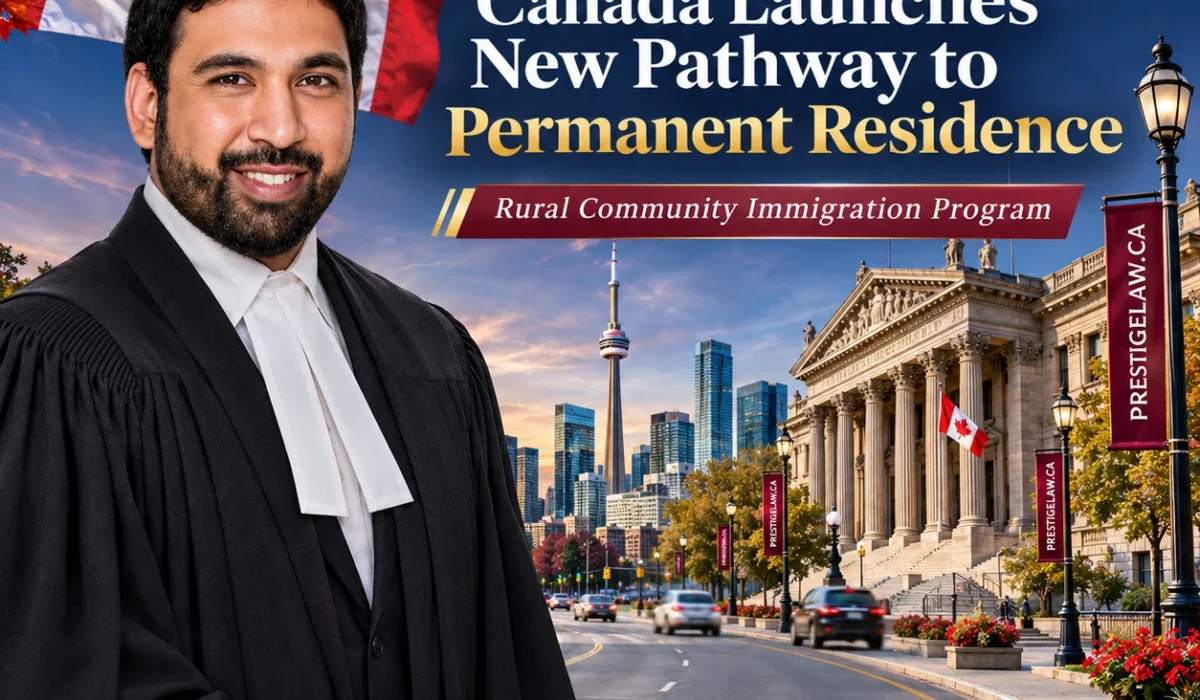
Canada launches new pathway to permanent residence.
Canada has announced a new pathway to permanent residence for skilled workers and international graduates who want to build a future in smaller communities. On November 9, 2026, Immigration Minister Lena Metlege Diab confirmed that the Rural Community Immigration Pilot will become a permanent program on January 1, 2027, giving workers with a qualifying job offer in 14 participating communities a lasting route to permanent residence.
The change replaces a temporary pilot with a stable, community-driven program, backed by yearly admission targets that are set to grow through 2029. For foreign workers already in Canada, graduates of Canadian institutions, and employers who struggle to fill vacancies outside the largest cities, this announcement matters. In this guide, Prestige Law explains what the new pathway to permanent residence means, who may qualify, which dates are critical, and how to prepare a strong application.
Last reviewed: November 14, 2026. This article is general information, not legal advice.
Key takeaways: Canada’s new pathway to permanent residence
Before we go deeper, here is a quick summary of what the federal government has announced and why it matters.
- The Rural Community Immigration Pilot (RCIP) becomes the permanent Rural Community Immigration Program on January 1, 2027.
- The program offers a pathway to permanent residence for eligible workers who hold a job offer from a designated employer and a recommendation from a participating community.
- Fourteen communities across Nova Scotia, Ontario, Manitoba, Saskatchewan, Alberta, and British Columbia currently take part.
- Canada has set a target of 5,500 permanent resident admissions through the program in 2027, with notional targets of 6,000 in 2028 and 6,500 in 2029.
- People who already hold a community recommendation dated December 31, 2026, or earlier must apply before it expires, using the existing application forms.
- Recommendations dated January 1, 2027, or later will require a different set of forms.
- The government plans to add more communities in the future, although none have been named yet.
What did Canada announce on November 9, 2026?
During a press conference in Stellarton, Nova Scotia, Minister Diab announced that the federal government will turn the Rural Community Immigration Pilot into a permanent immigration program. The announcement came just four days after the release of the 2027–2029 Immigration Levels Plan, which outlined how many newcomers Canada intends to welcome in each of the next three years.
The pilot launched in 2025 as a way to share the benefits of immigration with communities that often find it hard to attract and keep skilled workers. Because pilots are temporary by design, many employers and candidates were left wondering what would happen once the trial period ended. The decision to make the program permanent answers that question. It tells communities, employers, and workers that this pathway to permanent residence is not going away.
The pilot will officially close in its existing format on January 1, 2027. From that date, the permanent program takes over. According to the federal backgrounder released the same day, the permanent program will continue to operate under the model used during the pilot phase. In other words, employers and participating communities will keep working together in the same way, and candidates should expect the core structure to remain familiar.
You can read the government’s own summary in the official news release from Immigration, Refugees and Citizenship Canada and the federal overview of the Rural Community Immigration Program.
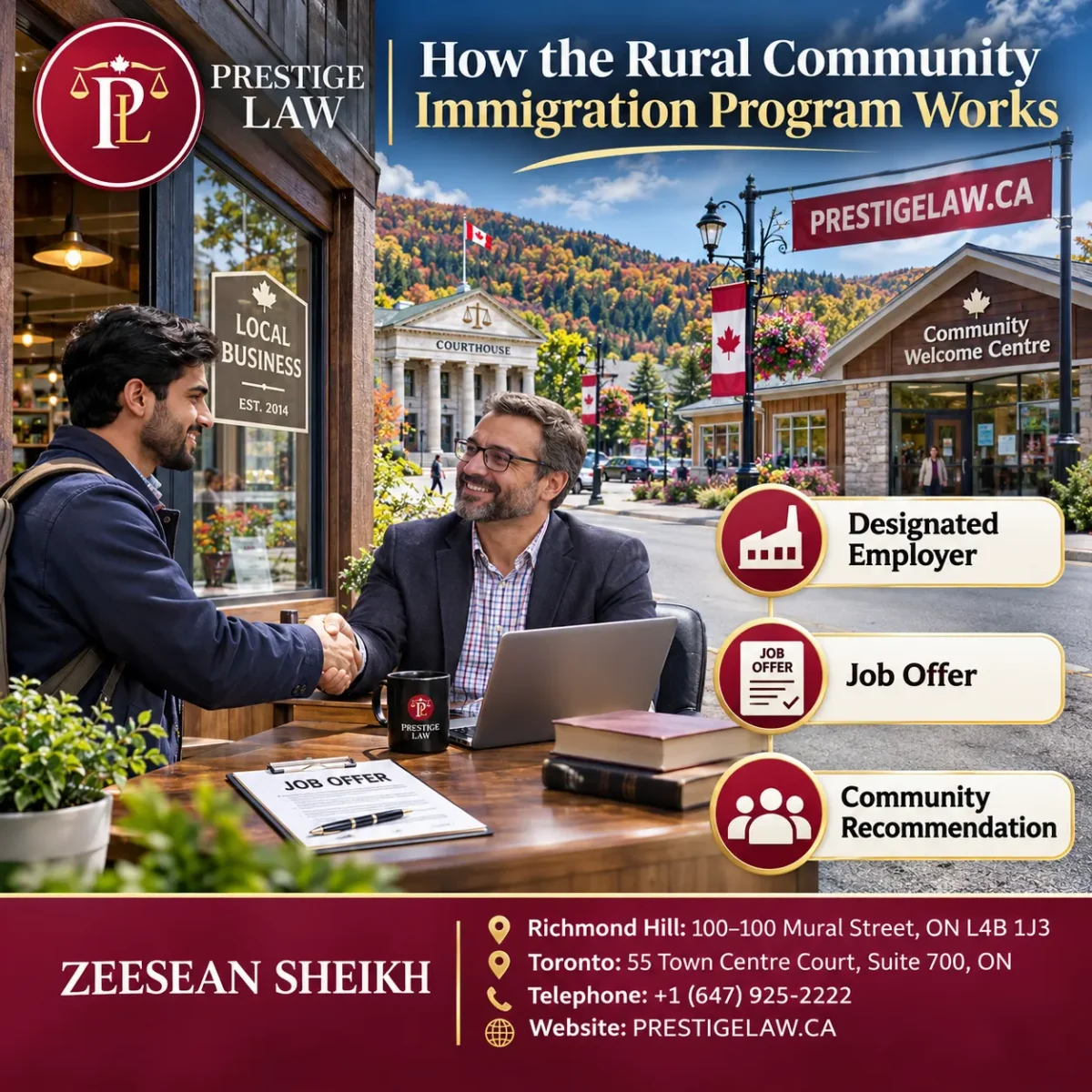
How the Rural Community Immigration Program works
The program is built around a simple idea: local communities know their own labour needs better than anyone else. Instead of relying only on a national points system, this pathway to permanent residence gives communities a direct role in choosing who can immigrate to work for local employers.
The three building blocks
Every application rests on three pieces that fit together.
- A designated employer. A local economic development organisation in a participating community designates employers that are allowed to recruit foreign workers under the program. An employer cannot simply decide to take part on its own.
- A qualifying job offer. The worker must receive an offer from one of those designated employers for a role that meets the program’s requirements.
- A community recommendation. After reviewing the candidate and the job offer, the participating community issues a recommendation. This recommendation is the key that allows the candidate to move forward with a permanent residence application.
Only after these steps are complete can a candidate apply to the federal government for permanent residence. The candidate must also meet the federal requirements related to work experience, education, language ability, and settlement funds.
Why a community-driven model matters
Community-driven programs tend to produce stronger long-term results because the people making the recommendation have a real interest in the outcome. A community that recommends a worker usually wants that worker to stay, find housing, enrol children in school, and become part of local life. Employers benefit too, since they can recruit with greater confidence that the candidate understands the community and its realities.
For candidates, this model also brings something valuable: a clear connection between the job, the place, and the pathway to permanent residence. You are not applying into the unknown. You are applying with an employer and a community that have already said yes.
The 14 participating communities
The federal government confirmed that the new pathway applies to workers with job offers in the following 14 communities.
Atlantic Canada
- Pictou County, Nova Scotia
Ontario
- North Bay
- Sudbury
- Timmins
- Sault Ste. Marie
- Thunder Bay
Manitoba
- Steinbach
- Altona/Rhineland
- Brandon
Saskatchewan
- Moose Jaw
Alberta
- Claresholm
British Columbia
- West Kootenay
- North Okanagan-Shuswap
- Peace Liard
These communities differ widely. Some are northern Ontario centres with strong mining, health care, and service sectors. Others are Prairie communities with agriculture, manufacturing, and trades. The British Columbia regions combine tourism, forestry, and growing health needs. Each community sets its own priorities, which means the job opportunities, recommendation processes, and local requirements are not identical from one place to the next.
If you are considering this pathway to permanent residence, research each community carefully. A strong match between your skills and a community’s needs can make your application far more competitive.
Will more communities join?
Yes, the government says it plans to expand the program to additional communities in the future. However, it has not shared which communities are being considered or when they might be added. Anyone planning around a specific location should watch for official updates rather than relying on rumours or unofficial lists.
Admission targets for 2027, 2028, and 2029
One of the strongest signals of Canada’s commitment is the numbers. The 2027–2029 Immigration Levels Plan, released on November 5, 2026, sets the following targets for the program:
Year
Permanent resident admissions through the program
2027 5,500
2028 6,000
2029 6,500
The figures for 2028 and 2029 are notional targets, so they may change in future levels plans. Even so, the direction is clear: the government expects the program to grow each year.
To put these numbers in context, the pilot was one of several economic immigration pilots that shared a combined federal admissions target of 8,175 permanent residents for 2026. A dedicated 2027 target of 5,500 for this program alone shows that rural and community-based immigration remains a priority within Canada’s wider economic plan.
For applicants, higher targets do not guarantee approval. Every application is still assessed on its own merits. Still, a larger and more predictable target gives communities, employers, and candidates more confidence to plan.
Early results from the pilot
The federal government pointed to early results as part of its reason for making the program permanent. According to the minister, more than 1,500 newcomers, along with their family members, have already been admitted through the pilot since it launched in 2025.
Between January 2025 and August 2026, more than 1,950 employers were designated, and more than 4,700 job offers and community recommendations were issued. The government says newcomers have helped fill persistent labour shortages in key sectors, including health care, education, and sales and services.
There is also a longer history behind the idea. The earlier Rural and Northern Immigration Pilot welcomed more than 12,000 newcomers and their family members between 2019 and 2024. Together, these programs show that community-based immigration has been part of Canada’s approach for several years, and the permanent program builds on that experience.
Who may qualify for this pathway to permanent residence?
The program is aimed at skilled foreign workers and international graduates. To qualify, applicants need a qualifying job offer and a community recommendation, and they must also meet requirements in several other areas.
Job offer and community recommendation
The job offer must come from an employer designated by the local economic development organisation. The offer must also fit the standards set by the program and the community. After the offer is accepted, the community reviews the case and decides whether to issue a recommendation.
Work experience or education
Applicants must show that they meet the program’s work experience or education standards. Under the pilot, many candidates qualified through recent full-time work experience, while some qualified as graduates of eligible institutions in the participating community. Because the permanent program is expected to follow the pilot’s model, these categories are likely to remain central. However, you should always confirm the exact criteria in the official program guidance before you apply.
Language proficiency
Language ability is a core requirement. Applicants must prove their skills in English or French through an approved test. Under the pilot, the required language level depended on the skill level of the job, with higher-skilled roles requiring stronger language scores. If your results are close to the minimum, improving your test score before you apply can make a real difference.
Settlement funds
Applicants must also show that they have enough money to support themselves and their family members when they arrive or settle in the community, unless an exemption applies. The amount depends on family size. Keep your bank records clear and well organised, because poorly documented funds are a common cause of delays.
Intention to live in the community
This program is built to keep newcomers in the community that recommended them. Applicants should be genuine about their plan to live and work there. A recommendation is not just a stepping stone to a larger city, and officers may look closely at whether your plans are realistic.

Work permits and family members
Permanent residence applications can take time. The program therefore allows eligible candidates to start working sooner. A foreign national who obtains a qualifying job offer and community recommendation may be eligible for a two-year, employer-specific work permit. This allows the candidate to begin working for the designated employer while the permanent residence application is processed.
Family members are not left out. A spouse or common-law partner may qualify for an open work permit, although the employment is restricted to the participating community. That restriction matters, because it ties the whole family to the same local labour market during the period covered by the permit.
If you are planning a move with your spouse and children, it is wise to think about schooling, housing, childcare, and healthcare access early. Smaller communities offer many advantages, such as lower housing costs and strong community ties, but services and rental availability can vary, so planning is essential.
Critical dates and forms: December 31, 2026 versus January 1, 2027
The most urgent part of this announcement for existing candidates is the change in forms. The government has set a clear dividing line.
- If your community recommendation is dated December 31, 2026, or earlier, you must apply for permanent residence before the recommendation expires. You will use the existing application forms that are available online.
- If your community recommendation is dated January 1, 2027, or later, you will be expected to use a different set of forms designed for the permanent program.
Applications that were already submitted under the pilot will continue to be processed. You do not need to start again.
Using the wrong form can lead to a rejected or returned application, which wastes time and money. Always check the date on your recommendation and match it to the right set of forms. If you are unsure which category you fall into, speak with a licensed professional before you submit anything.
What this means for employers
Employers in participating communities gain more than a new program name. A permanent framework gives them something that a pilot could not: long-term certainty.
- Stable planning. Employers can build recruitment strategies that look years ahead instead of month to month.
- A trusted route to hire abroad and at home. Designated employers can recruit foreign workers already in Canada as well as workers overseas, within the program’s rules.
- Stronger retention. A worker with a clear pathway to permanent residence has a strong reason to stay. Lower turnover saves time and training costs.
- Closer cooperation with local organisations. The designation process connects employers with the community’s economic development body, which can offer guidance and support.
Employers should contact their local economic development organisation to ask about designation. Businesses outside the 14 participating communities cannot use this program for now, although they may be able to use other federal or provincial options.
What this means for international graduates
International graduates often face a difficult choice. They have studied in Canada, built local connections, and want to stay, but the pathways open to them can be competitive. This program adds another option, especially for graduates who studied in or near one of the participating communities and have a job offer from a designated employer.
Graduates should pay attention to how their work permit status connects to the application timeline. A post-graduation work permit has an expiry date, and your plan for permanent residence should be mapped out well before that date arrives. If you are close to the end of your permit, ask for a professional review early so you can identify backup options.
Common mistakes to avoid
A strong application is usually a well-prepared one. Here are some of the most common problems we see in community-based immigration cases.
- Missing the recommendation deadline. A recommendation does not last forever. Applicants who wait too long may lose their chance and have to start the process again.
- Using outdated forms. With the new date-based rule, form errors are a real risk. Double-check the date on your recommendation.
- Weak proof of work experience. Reference letters should clearly describe your duties, hours, dates, and pay. Vague letters invite questions.
- Overlooking language test validity. Language results expire. Make sure your test is valid when you apply.
- Incomplete settlement funds documents. Provide clear bank statements and explain any large deposits.
- Ignoring inadmissibility issues. Past criminal, medical, or immigration problems can affect any application. Disclose them honestly and get advice early.
- Relying on social media advice. Rules change often. Rely on official government sources and qualified professionals instead.
A step-by-step approach to the new pathway to permanent residence
While each case is different, most candidates can follow a clear path.
- Research the 14 communities. Learn about the local economy, housing, schools, and industries.
- Match your skills to local demand. Look at sectors such as health care, education, and sales and services, where the pilot has already shown results.
- Find a designated employer. Contact the community’s economic development organisation or search for employers that are actively recruiting.
- Secure a qualifying job offer. Confirm that the job meets the program’s standards before you accept.
- Request a community recommendation. Prepare your documents and be ready to explain why you want to settle in that community.
- Prepare your permanent residence application. Gather language results, proof of work experience, education records, and settlement funds documents.
- Apply using the correct forms. Check the date of your recommendation and use the matching forms.
- Plan your arrival and settlement. Think about housing, schooling, and local support services.
How Prestige Law can help
A new program creates new questions. Should you apply now under the pilot rules, or wait for the permanent program? Does your job offer meet the standard? Is your recommendation still valid? Making the wrong choice at the wrong time can be costly.
At Prestige Law, we help individuals, families, and employers move through Canada’s immigration system with clarity and care. Zeesean Sheikh and the firm’s team can review your situation, explain your options in plain language, check your documents, and help you avoid errors that cause delays. Whether you are a worker with a job offer, a graduate planning your next step, or an employer exploring how to recruit, we are ready to guide you.
Contact Prestige Law
📍 Richmond Hill: 100–100 Mural Street, ON.
📍 Toronto: 55 Town Centre Court, Suite 700, ON.
📞 Telephone: +1 (647) 925-2222
🌐 Website: prestigelaw.ca
Frequently asked questions about Canada’s new pathway to permanent residence.
What is the new pathway to permanent residence that Canada launched?
Canada announced that the Rural Community Immigration Pilot will become a permanent program called the Rural Community Immigration Program. It provides a pathway to permanent residence for eligible skilled workers and international graduates who have a job offer from a designated employer and a recommendation from a participating community.
When does the permanent program start?
The permanent program begins on January 1, 2027. On that date, the pilot closes in its existing format, and the permanent program takes over.
Which communities are included?
Fourteen communities currently take part: Pictou County in Nova Scotia; North Bay, Sudbury, Timmins, Sault Ste. Marie, and Thunder Bay in Ontario; Steinbach, Altona/Rhineland, and Brandon in Manitoba; Moose Jaw in Saskatchewan; Claresholm in Alberta; and West Kootenay, North Okanagan-Shuswap, and Peace Liard in British Columbia.
Do I need a job offer to apply?
Yes. You need a job offer from an employer designated by the local economic development organisation, and you also need a community recommendation. Without both, you cannot move forward with a permanent residence application under this program.
I already have a community recommendation. What should I do?
Check the date on your recommendation. If it is dated December 31, 2026, or earlier, you must apply for permanent residence before it expires and use the existing forms. If it is dated January 1, 2027, or later, you will use the new set of forms.
Will my application be affected if I already applied under the pilot?
No. The government has confirmed that applications already submitted under the pilot will continue to be processed.
Can I work while I wait for permanent residence?
Possibly. Candidates with a qualifying job offer and community recommendation may be eligible for a two-year, employer-specific work permit. Spouses or common-law partners may be eligible for open work permits, with employment restricted to the participating community.
How many people will Canada admit through this program?
The 2027–2029 Immigration Levels Plan sets a target of 5,500 permanent resident admissions in 2027. Notional targets are 6,000 for 2028 and 6,500 for 2029.
Can international graduates use this pathway?
Yes. The program is open to eligible skilled workers and international graduates who meet the requirements, including a qualifying job offer and a community recommendation.
Will more communities be added?
The government says it plans to expand the program to additional communities in the future. No list of future communities has been released.
Is the language requirement the same for every job?
Under the pilot, the language level depended on the skill level of the occupation. Confirm the current benchmarks in the official program guidance before you book a language test.
Do I need a lawyer to apply?
You are not required to hire a lawyer, but professional advice can help you avoid mistakes, choose the right forms, and meet deadlines. Complex cases, such as those involving refusals or inadmissibility concerns, benefit most from legal guidance.
Most searched topics related to this announcement.
People researching this change are also looking for answers to the following questions. Each one is worth exploring as you plan your next step.
- Rural Community Immigration Program eligibility requirements 2027
- How to get a community recommendation in Canada
- List of designated employers for rural immigration
- Rural Community Immigration Program language requirements
- Rural immigration pathway versus Express Entry
- How long does permanent residence take through a community program?
- Can my spouse work while I apply for permanent residence?
- Best rural communities in Canada for newcomers
- Work permit options for rural community candidates
- Canada immigration levels plan 2027–2029 explained.

A lasting route for workers and communities
The decision to make the Rural Community Immigration Program permanent is more than a policy update. It gives workers a dependable pathway to permanent residence, gives employers a stable recruitment tool, and gives smaller communities a long-term way to grow. With a 2027 target of 5,500 admissions, planned increases in the following two years, and the promise of future expansion, the program looks set to play a meaningful role in Canada’s immigration system.
If you hold a recommendation dated on or before December 31, 2026, act before it expires. If you are still exploring options, now is the right time to research the 14 communities, build your documents, and seek advice. A well-prepared application is the best way to turn this new pathway to permanent residence into a real future in Canada.
To discuss your options with Prestige Law, visit prestigelaw.ca or contact our Richmond Hill or Toronto office using the details above.
Disclaimer: This article provides general information only and is not legal advice. Immigration rules and program details can change. Please confirm current requirements with Immigration, Refugees and Citizenship Canada or a licensed professional before you act.