





Ontario Is Replacing Nearly All Its Permanent Residence Pathways
Here’s What We Know So Far
Published by Prestige Law | Immigration Law Firm | prestigelaw.ca Last Updated: June 2026
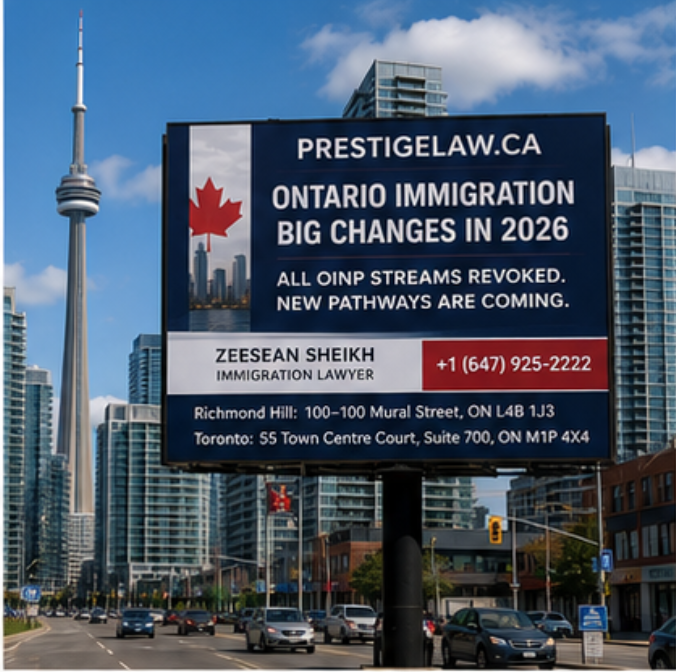
Something significant and largely unprecedented happened in Ontario immigration on May 30, 2026. Every single stream through which foreign nationals could qualify for a provincial nomination under the Ontario Immigrant Nominee Program (OINP) was revoked from provincial regulations — all nine of them, simultaneously, without replacement pathways yet in place. Ontario Replacing Its Permanent Residence Pathways
For the thousands of skilled workers, international students, healthcare professionals, entrepreneurs, and newcomers who had been counting on Ontario as their route to Canadian permanent residence, that date marked a sharp turning point. Whether you have an active application, were preparing to apply, or are simply trying to understand what the province’s immigration landscape looks like going forward, this article is your complete guide to everything that is known — and, equally importantly, everything that is still uncertain.
At Prestige Law, our immigration team has been closely monitoring these developments. Immigration lawyer Zeesean Sheikh and our team in Richmond Hill and Toronto are ready to guide clients through this transition with clarity and confidence.
What Happened on May 30, 2026?
On May 30, 2026, scheduled legislative changes to Ontario’s provincial regulations took effect, effectively invalidating every immigration stream that had previously operated under the OINP. The revocation covers:
- The Foreign Worker Stream
- The International Student Stream
- The In-Demand Skills Stream
- The Master’s Graduate Stream
- The PhD Graduate Stream
- The Human Capital Priorities Stream
- The French-Speaking Skilled Worker Stream
- The Skilled Trades Stream
- The Entrepreneur Stream
This is the largest single change to the Ontario Immigrant Nominee Program since the program began operating. All nine nomination categories have been repealed from provincial regulations. As of the writing of this article, Ontario has not yet published the specific details, launch dates, or final eligibility criteria for whatever pathways will come next.
That said, the province is far from silent on what is being planned. A detailed stakeholder consultation published in December 2025 lays out Ontario’s vision for what replaces the current structure — and it is a significant redesign.
Why Did Ontario Do This?
To understand where Ontario immigration is heading, it helps to understand what prompted such a sweeping change.
Fraud and Compliance Concerns
One of the key triggers was the suspension of the OINP Express Entry: Skilled Trades Stream in November 2025. On November 14, 2025, Ontario halted intake to this stream and began returning all pending applications after a program review identified what the government described as “systemic compliance and enforcement concerns” and “systemic misrepresentation and/or fraud relating to Skilled Trades Stream eligibility criteria.” All applications were returned, with fees refunded.
That suspension created both political and operational pressure to rethink how the OINP was structured.
Expanded Provincial Powers
Ontario’s ability to act as decisively as it did was partly enabled by Bill 30 — the Working for Workers Seven Act, 2025 — which received Royal Assent on November 27, 2025. This legislation granted the Ontario government new authority to introduce, update, or close OINP streams more quickly based on labour-market needs and shifting provincial priorities. The May 30, 2026 revocation was effectively the first exercise of that expanded authority.
Labour Market Alignment
Ontario has also signalled a desire to move away from broad-based streams toward more targeted, labour-market-responsive pathways. The proposed new framework reflects a philosophy of prioritising sectors where Ontario has the most acute workforce needs — particularly healthcare, technology, and the skilled trades — rather than maintaining a wide array of general-purpose immigration routes.
The Four Proposed Replacement Streams
While Ontario has not published final regulations or opened any new streams, the December 2025 stakeholder consultation outlined four new pathways the province intends to introduce in two phases. The consultation period closed on January 1, 2026. Here is what each proposed stream looks like:
1. Employer Job Offer Stream
This proposed stream would consolidate Ontario’s three former employer-driven streams — the Foreign Worker Stream, the International Student Stream, and the In-Demand Skills Stream — into a single, unified program. The new stream would feature two separate tracks:
Track One: TEER 0–3 Occupations (Skilled Workers)
This track would target candidates in higher-skilled occupations under the National Occupational Classification (NOC) Training, Education, Experience and Responsibility (TEER) categories 0, 1, 2, and 3. Eligibility would hinge on meeting minimum thresholds in three areas:
- Wage: The job offer must meet or exceed the median wage for that occupation in Ontario.
- Work Experience: Candidates must demonstrate relevant professional experience in their field.
- Education: Advanced qualifications are prioritised, though recent Ontario graduates — those who completed an eligible program within the past two years — may qualify with a lower-wage job offer.
The proposal also signals a preference for candidates who are already in Canada, particularly those already working in Ontario.
Track Two: TEER 4–5 Occupations (Lower-Skilled Workers)
This track would create a pathway for workers in TEER 4 and 5 occupations, which traditionally have had more limited access to permanent residence through the OINP. Details on eligibility criteria for this track are less developed in the proposal, but its inclusion signals Ontario’s recognition that lower-wage workers in critical sectors deserve a viable path to permanent residence.
Additional Flexibility: Construction and Regional Pathways
Within the Employer Job Offer Stream, the proposal also contemplates a construction-specific pathway that would allow trades workers to qualify with the support of their union, even without a permanent full-time job offer. There is also a proposal to use regional and sector-specific targeting within this stream — inviting candidates by region, occupation, or other criteria to address urgent employer needs in specific parts of Ontario.
2. Priority Healthcare Stream
Ontario’s healthcare system is under enormous strain. The province faces a well-documented shortage of nurses, physicians, pharmacists, and other regulated health professionals. The proposed Priority Healthcare Stream would create a dedicated pathway for healthcare workers, with a focus on those who are already licensed in regulated healthcare professions in Ontario.
While the full eligibility criteria have not been published, the broad intent is to accelerate provincial nominations for candidates who are actively contributing to Ontario’s healthcare system and who face barriers to permanent residence under the current framework.
This stream would replace elements of what previously fell under the Human Capital Priorities Stream and other OINP pathways that healthcare workers may have used.
3. Entrepreneur Stream
The proposed Entrepreneur Stream would resurrect — and redesign — the previously closed OINP Entrepreneur category, which had been suspended for years. The new stream would target candidates who can contribute to Ontario’s economy by:
- Launching a new business in Ontario
- Purchasing and operating an existing Ontario business — what the proposal describes as “business succession”
The business succession option is particularly notable. It addresses a real economic challenge: many small and medium-sized Ontario business owners are approaching retirement age with no family succession plan, and the pool of qualified domestic buyers is limited. A pathway that connects immigrant entrepreneurs with established Ontario businesses could benefit both the newcomer and the broader provincial economy.
Specific eligibility thresholds — minimum investment amounts, job creation requirements, business performance milestones — have not been published in final form.
4. Exceptional Talent Stream
Perhaps the most distinctive of the four proposals, the Exceptional Talent Stream would create a pathway for individuals whose contributions to their field are extraordinary. This stream would target candidates in:
- Academia and research
- Innovation and technology
- Science
- The creative industries
- Other fields where exceptional achievement can be demonstrated
Immigration Minister David Piccini specifically referenced culinary arts, research, and entrepreneurship when announcing this direction in November 2025. The stream is designed to recognise excellence in a way that the previous OINP structure did not — providing a route to provincial nomination for people who may not fit neatly into employer-driven or credential-based categories.
This stream bears some conceptual resemblance to federal programs like the Global Talent Stream, though Ontario has not confirmed how it would interact with federal immigration pathways.
Two-Phase Implementation
Ontario has proposed introducing these four streams in two phases:
Phase One would consolidate the three employer-driven streams (Foreign Worker, International Student, In-Demand Skills) into the new unified Employer Job Offer Stream.
Phase Two would eliminate all remaining OINP streams and introduce the Priority Healthcare Stream, the Entrepreneur Stream, and the Exceptional Talent Stream.
As of June 2026, Ontario has not confirmed the timeline for either phase, nor has it published final eligibility regulations or opening dates.
What Happens to Applications Already Submitted?
This is one of the most pressing questions for anyone currently in the OINP pipeline.
Ontario has stated that applications already submitted under the old streams will be assessed according to the eligibility requirements that were in place at the time those applications were filed. However, the province has not published detailed guidance on what will happen to candidates currently in Expression of Interest (EOI) pools under the existing OINP programs, or how pending applications will be processed in practice.
If you have a pending OINP application or are actively in an EOI pool, we strongly recommend consulting with an experienced immigration lawyer who can assess your specific file and advise you on the most prudent course of action.
Who Is Most Affected by These Changes?
The revocation of all nine OINP streams affects a wide range of people. The groups most immediately impacted include:
International Students in Ontario: Students who graduated from Ontario colleges and universities and were counting on the International Student Stream or the Master’s or PhD Graduate Streams no longer have an active pathway to a provincial nomination through the OINP. They must wait for replacement streams to open and assess their eligibility under the new criteria.
Skilled Foreign Workers Employed in Ontario: Workers currently employed in Ontario who were planning to apply through the Foreign Worker Stream or In-Demand Skills Stream are in a holding pattern. The proposed Employer Job Offer Stream is designed to serve this population, but its opening date remains unannounced.
Healthcare Professionals: Nurses, doctors, pharmacists, and other regulated health professionals who were pursuing OINP pathways must now wait for the Priority Healthcare Stream to open. Given the severity of Ontario’s healthcare labour shortage, this stream is expected to be a priority for the province — but timing remains uncertain.
Entrepreneurs and Business Investors: Those who were planning to use the OINP’s Entrepreneur category have been waiting since that stream’s previous suspension. The proposed redesigned Entrepreneur Stream offers a path forward, but no opening date has been confirmed.
French-Speaking Skilled Workers: The French-Speaking Skilled Worker Stream has also been revoked. Candidates in this category may have federal options through Express Entry, particularly through programs designed to support French-speaking communities outside Quebec, but they should consult with an immigration professional to explore all available options.
Construction and Trades Workers: Construction workers who may have qualified under the Skilled Trades Stream (now suspended and now fully revoked) face particular uncertainty. The proposed construction pathway within the Employer Job Offer Stream is promising but remains in proposal form.

What Does This Mean for Express Entry Candidates in Ontario?
One important dimension of these changes is how they affect the interaction between the OINP and the federal Express Entry system.
A provincial nomination through a PNP stream that is aligned with Express Entry adds 600 points to a candidate’s Comprehensive Ranking System (CRS) score — essentially guaranteeing an Invitation to Apply (ITA) for Canadian permanent residence. The revocation of OINP’s Express Entry-aligned streams means that this powerful tool is currently unavailable to candidates seeking Ontario’s provincial backing.
Ontario’s proposed new streams have not yet specified which, if any, will be Express Entry-aligned. Given that alignment with Express Entry is one of the most valued features of any PNP stream, there is strong expectation that at least some of the new pathways will carry this designation — but candidates should not assume that until the regulations are published.
What Should You Do Right Now?
If you are affected by the revocation of Ontario’s OINP streams, here are the most important steps to take:
1. Do not panic, but do not wait indefinitely either. Ontario has signalled a clear direction, and the four proposed streams suggest that new pathways are coming. However, the absence of launch dates means you should be exploring all your options — federal and provincial — rather than waiting exclusively for Ontario.
2. Explore federal immigration pathways. Programs like Express Entry (Federal Skilled Worker, Canadian Experience Class, Federal Skilled Trades), Atlantic Immigration Program, Rural and Northern Immigration Pilot, and other federal streams may be available depending on your profile.
3. Consider other provinces. Provincial Nominee Programs in Alberta, British Columbia, Manitoba, Saskatchewan, Nova Scotia, Prince Edward Island, and other provinces remain active and may offer viable routes to permanent residence depending on your qualifications and occupation.
4. Protect your existing application. If you submitted an application under an OINP stream before May 30, 2026, maintain all documentation and do not make any assumptions about its status without checking your IRCC online account or consulting your immigration lawyer.
5. Get professional legal advice. These are complex, fast-moving developments. An experienced immigration lawyer can assess your specific profile, identify the best available pathways, and help you avoid costly mistakes during this uncertain period.
Prestige Law: Your Trusted Ontario Immigration Lawyers
At Prestige Law, we understand that immigration is not just a process — it is your future, your family’s future, and in many cases, years of hard work and sacrifice. When the rules change as dramatically as they have with Ontario’s OINP, having skilled legal counsel is not optional; it is essential.
Immigration Lawyer Zeesean Sheikh leads Prestige Law’s immigration practice. With a deep understanding of both provincial and federal immigration law, Zeesean and his team are actively advising clients affected by the OINP changes — assessing alternative pathways, protecting pending applications, and building personalised strategies for permanent residence.
Prestige Law serves clients across Ontario and internationally, with offices in Richmond Hill and Toronto.
📍 Richmond Hill: 100–100 Mural Street, Richmond Hill, ON 📍 Toronto: 55 Town Centre Court, Suite 700, Toronto, ON 📞 Telephone: +1 (647) 925-2222 🌐 Website: prestigelaw.ca
Whether you are a skilled worker, international student, healthcare professional, entrepreneur, or family member trying to navigate Canada’s immigration system, Prestige Law is here to help you move forward with confidence.
Frequently Asked Questions (FAQ)
Q: Are all OINP streams really closed?
Yes. As of May 30, 2026, all nine streams of the Ontario Immigrant Nominee Program have been revoked from provincial regulations. There are currently no active OINP streams through which new applicants can seek a provincial nomination.
Q: Will Ontario open new immigration streams in 2026?
Ontario has proposed four new streams in a December 2025 stakeholder consultation: an Employer Job Offer Stream, a Priority Healthcare Stream, an Entrepreneur Stream, and an Exceptional Talent Stream. However, no launch dates have been confirmed, and final eligibility criteria have not been published as of June 2026.
Q: My application was already submitted under an OINP stream. What happens to it?
Ontario has stated that applications submitted before May 30, 2026, will be assessed under the eligibility rules that were in place when those applications were filed. If you have a pending application, check your IRCC online account and consult an immigration lawyer for personalised advice.
Q: Can I still immigrate to Canada through Ontario?
Yes, but not through the OINP for the time being. Federal Express Entry programs, family sponsorship, and other pathways remain open. Other provincial nominee programs across Canada are also still active. We recommend consulting an immigration professional to assess all available options.
Q: What is the NOC TEER system mentioned in the proposed streams?
TEER stands for Training, Education, Experience and Responsibility. It is the classification system Canada uses to categorise occupations. TEER 0 includes managerial roles, TEER 1–3 covers skilled and technical occupations requiring post-secondary education, and TEER 4–5 covers occupations requiring on-the-job training. The new proposed Employer Job Offer Stream would have separate tracks for TEER 0–3 and TEER 4–5 workers.
Q: Who qualifies for the proposed Exceptional Talent Stream?
The Exceptional Talent Stream is intended for individuals who have demonstrated extraordinary achievement in academia, innovation, science, technology, and the creative industries. Final eligibility criteria have not been published. Ontario Minister Piccini specifically cited research, culinary arts, and entrepreneurship as target fields.
Q: What is the difference between the OINP and Express Entry?
The OINP is Ontario’s provincial program. It nominates candidates for permanent residence, but a provincial nomination alone does not grant permanent residence — you must also apply to the federal government through Immigration, Refugees and Citizenship Canada (IRCC). Express Entry is the federal points-based system. Many OINP streams were “aligned” with Express Entry, meaning a successful nomination added 600 points to an applicant’s CRS score, essentially guaranteeing a federal invitation to apply.
Q: Does Prestige Law help with immigration applications?
Yes. Prestige Law provides comprehensive immigration legal services in Ontario, including Express Entry applications, provincial nominee programs, work permits, study permits, family sponsorships, refugee claims, and immigration appeals. Contact our office to book a consultation.
Q: How do I stay updated on new OINP stream launches?
Monitor the official Ontario immigration website (ontario.ca/immigration), subscribe to trusted immigration news sources, and work with a licensed immigration lawyer who can alert you when new streams open and help you apply quickly.
Q: What if I am an international student who missed the deadline?
If you are an Ontario international graduate who was planning to apply through the now-revoked International Student Stream or Master’s/PhD Graduate Streams, your options include federal Express Entry (particularly the Canadian Experience Class if you have Canadian work experience), other provincial nominee programs, and the proposed new OINP Employer Job Offer Stream once it opens. Consulting an immigration lawyer promptly is strongly recommended to avoid unnecessary delays.

Key Takeaways
Ontario’s decision to revoke all nine OINP streams on May 30, 2026, is a watershed moment in Canadian provincial immigration. It is disruptive in the short term — particularly for those who were mid-process or planning to apply imminently — but it reflects a broader ambition to build a more targeted, fraud-resistant, and labour-market-aligned provincial immigration system.
The four proposed replacement streams — Employer Job Offer, Priority Healthcare, Entrepreneur, and Exceptional Talent — suggest a thoughtful redesign that could ultimately serve both Ontario’s economic needs and the aspirations of skilled newcomers more effectively than the previous structure.
What is clear is that the gap between the old system closing and the new system opening creates a period of genuine uncertainty. During that period, your best asset is current, accurate legal advice from someone who understands both the changing provincial landscape and the full range of federal options.
Prestige Law is committed to providing exactly that.
Disclaimer: This article is for general informational purposes only and does not constitute legal advice. Immigration law is subject to frequent change. For advice specific to your circumstances, please consult a licensed immigration lawyer.
Prestige Law | Immigration Law Firm Lawyer: Zeesean Sheikh 📍 Richmond Hill: 100–100 Mural Street, ON 📍 Toronto: 55 Town Centre Court, Suite 700, ON 📞 +1 (647) 925-2222 🌐 prestigelaw.ca