





Saskatchewan Nominations: Capped Sectors Nearly Full, Others Still Open
Prestige Law | Updated November 5, 2026
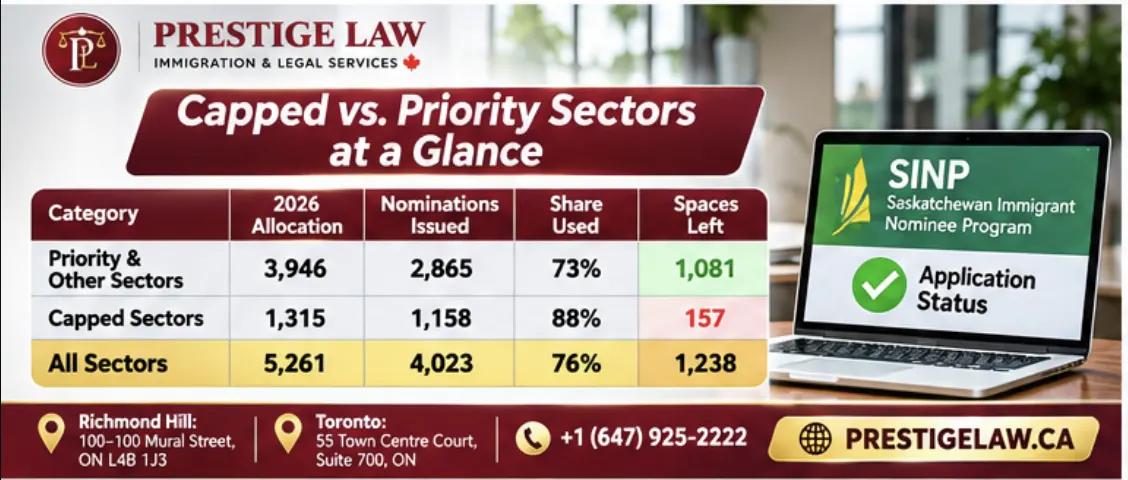
Saskatchewan nominations are racing toward the end of the 2026 calendar year, and the latest quarterly update from the Saskatchewan Immigrant Nominee Program (SINP) shows a clear split between sectors: the three capped sectors have used 88% of their annual space, while priority and other sectors still hold more than 1,000 nominations. For employers, foreign workers, international graduates, and families planning a move to the province, this gap changes how you should time your application, prepare your documents, and choose your pathway. This in-depth guide from Prestige Law explains what the numbers mean, how the sector rules work, how long processing is taking, and which practical steps matter most before the year closes.
Every year, thousands of skilled workers look to Saskatchewan as a realistic route to permanent residence in Canada. The province offers a stable economy, a growing demand for labour, and communities that welcome newcomers. However, the SINP does not have unlimited room. Each year, the federal government grants Saskatchewan a fixed number of nominations, and the province must decide how to share them across industries.
In 2026, that sharing became more structured than ever. Understanding how Saskatchewan nominations are distributed is now a basic part of planning, not an optional extra. This article walks through the October 2026 figures in plain language and shows what they could mean for your own plans.
Key Takeaways
- Saskatchewan had issued 4,023 nominations by the end of September 2026, which is 76% of its annual allocation of 5,261.
- Capped sectors have used 1,158 of 1,315 spaces (88%), leaving only 157.
- Priority and other sectors have used 2,865 of 3,946 spaces (73%), leaving 1,081.
- The annual allocation was raised by 500 during the third quarter, up from 4,761.
- The final capped-sector intake windows of 2026 opened on September 14 and 15, and a planned November window was cancelled.
- Most application categories were finalised in about two weeks between July and September 2026.
What the Latest Saskatchewan Nominations Update Shows
The province publishes nomination data every quarter on its official SINP processing statistics page. The update released in October 2026 covers nominations issued from January through September. According to that data, 1,238 nomination spaces remained across all sectors at the time of the update. That equals 24% of the full-year allocation.
The table below summarises the position.
Category
2026 allocation
Nominations issued
Share used
Spaces left
Priority and other sectors 3,946 2,865 73% 1,081
Capped sectors 1,315 1,158 88% 157
All sectors 5,261 4,023 76% 1,238
Three points stand out. First, capped sectors are the tightest part of the system by a wide margin. Second, the remaining room is concentrated in priority and other sectors. Third, the province itself warns that these figures do not include applications that are still in process. In other words, the real number of open spaces may be lower than the table suggests.
For anyone following Saskatchewan nominations closely, that last warning deserves attention. A published figure is a snapshot, not a promise. Applications already under review will use up part of the remaining room, so a candidate who waits for a perfect moment could find less space than expected.
How the 2026 Allocation Grew During the Year
At the start of 2026, Immigration, Refugees and Citizenship Canada (IRCC) granted Saskatchewan 4,761 nomination spaces. At the end of June, the province had issued 2,628 of them, which was about 55% of that earlier figure. During the third quarter, the annual allocation rose to 5,261, an increase of 500 spaces.
This matters for two reasons. The first is that the increase gave the province more room to work with in the final months. The second is that it shows the allocation is not completely fixed. Mid-year changes can and do happen, although applicants should never plan around an increase that has not been announced.
The quarterly pace has also been steady. The province issued 1,223 nominations in the first quarter, 1,405 in the second quarter, and 1,395 in the third quarter. Capped sectors accounted for 440 of the third-quarter nominations, which is nearly one-third of that quarter’s total.
How Saskatchewan Nominations Are Divided: Priority, Capped, and Other Sectors
To read the October figures correctly, you first need to understand the three-part structure that the SINP uses in 2026. Every nomination space falls into one of three groups.
Priority sectors
The province has reserved at least 50% of its total annual allocation for seven priority sectors:
- Agriculture
- Energy
- Health care
- Manufacturing
- Mining
- Skilled trades
- Technology
These industries match the province’s long-term labour needs. The SINP has also stated that priority sectors may receive more than half of all spaces if demand justifies it. If that happens, the share left for other groups becomes smaller.
Capped sectors
Three sectors carry strict yearly limits because they used to absorb a very large share of nominations:
- Accommodation and food services, limited to 15% of the annual allocation
- Trucking, limited to 5%
- Retail trade and other services, limited to 5%
Together, these three sectors cannot exceed 25% of the yearly allocation. With an allocation of 5,261, that works out to 1,315 spaces, which matches the capped figure in the October table.
Other sectors
Any industry that is neither a priority sector nor a capped sector falls into the “other” group. These occupations still have access to nominations, but they do not receive the dedicated reservation that priority sectors enjoy.
Why Capped Sectors Are Nearly Full
It is no surprise that capped sectors filled first. Demand from employers in accommodation, food services, trucking, and retail has historically been very high, and the SINP introduced caps in 2026 precisely because these industries had taken a disproportionate share of nominations in earlier years.
Several features of the system explain the speed.
Intake windows replace open submission. Employers in capped sectors can submit an Employer Position Assessment only during scheduled intake windows. Employers in other sectors can submit throughout the year. Because the number of positions in each window is limited, a window can fill within hours.
Demand is concentrated. When many employers compete for a small number of positions, the earliest and best-prepared files win. Windows in 2026 opened in January, March, May, July, and September, and the province reported that several of them reached their limits almost immediately.
Capped sectors have used more than their natural share. From January through September, capped sectors received 1,158 of the 4,023 nominations issued, which is roughly 29% of the total. That is higher than the 25% ceiling that applies to the full-year allocation, and it explains why the remaining capped room is so small.
For workers in these industries, the message is direct: the room that remains in 2026 is very limited, and planning for the next year is just as important as acting now.
What the Remaining 157 Capped Spaces Really Mean
Seeing 157 spaces left may sound encouraging, but the number needs careful reading.
The SINP’s final intake windows of 2026 opened on September 14 and 15. According to the latest data, the windows for accommodation and food services and for trucking have already reached their position limits. In the retail trade window, 26 of 175 positions had not been used when the update was published.
The province had planned a further intake window for November 2. It cancelled that window and moved those positions into the September intake instead. As a result, there is no later window this year for employers in capped sectors to submit new assessments.
In practical terms, this means three things:
- Employers in accommodation, food services, and trucking should not expect to submit a new Employer Position Assessment for 2026.
- Employers in retail trade should check the official SINP page for the current status of the remaining positions, because those spaces may already be claimed by the time anyone reads this article.
- Candidates whose employers already hold approved positions should focus on submitting complete, accurate nomination applications without delay.
Because in-process applications are not counted in the published totals, the remaining capped room could be smaller than 157 in reality. This is one more reason to rely on current official information rather than assumptions.
Where Saskatchewan Nominations Are Still Open
The encouraging news in the October update sits on the other side of the table. Priority and other sectors have 1,081 spaces left, and those spaces are tracking close to the pace of the calendar year.
This is where most new opportunities lie for the rest of 2026. Workers and employers in the following areas have the most room to move:
- Health care: Hospitals, long-term care homes, and clinics continue to need skilled staff across the province.
- Agriculture: Farms, processing plants, and agri-business employers remain central to the provincial economy.
- Skilled trades: Electricians, welders, plumbers, and similar trades are in steady demand.
- Technology: Software, data, and engineering roles support a growing innovation sector.
- Energy, mining, and manufacturing: These resource and industrial employers continue to hire experienced workers.
Unlike capped sectors, employers in priority and other sectors are not tied to fixed windows for Employer Position Assessments. That gives them more flexibility to submit when their file is ready. However, flexibility is not the same as unlimited time. With 1,238 spaces left overall and roughly three months to go, the calendar still matters.
Will the Remaining Saskatchewan Nominations Run Out Before December?
The numbers allow for a simple calculation. The province issued about 447 nominations per month from January through September. To use its whole allocation by the end of the year, it would need to issue about 413 per month for the remaining three months.
Because 413 is below 447, the province could use its full allocation slightly before the end of December if the recent pace continues. This is arithmetic, not a forecast, and several factors could change the result. Application quality, refusals, withdrawals, and the number of files already in process can all shift the outcome. Still, the comparison is a useful reminder that late applications may face a tight finish.
Candidates and employers who are close to submitting should therefore avoid unnecessary delay. A complete and correct application filed now is far better than a perfect application filed after spaces are gone.

SINP Processing Times in the Third Quarter of 2026
Processing speed is a major part of any provincial nomination plan. The October update also reported how long the SINP took to finalise applications between July and September 2026. The reported averages cover 80% of finalised applications, excluding the fastest 10% and the slowest 10%. They are measured from the day a complete application is received to the day it is finalised.
Category
Application type
Q3 (Jul–Sep)
Q2 (Apr–Jun)
Q1 (Jan–Mar)
International Skilled Worker Employment offer 2 weeks 2 weeks 3 weeks
International Skilled Worker Innovation and Tech Talent Pathway 2 weeks 2 weeks 2 weeks
International Skilled Worker Agriculture Talent Pathway 2 weeks 2 weeks 3 weeks
International Skilled Worker Health Talent Pathway 2 weeks 2 weeks 2 weeks
Saskatchewan Experience Existing work permit 2 weeks 2 weeks 3 weeks
Saskatchewan Experience International students 2 weeks 2 weeks 2 weeks
Second reviews Applicants with job offers 1 week 1 week 2 weeks
Job approval process Employer Position Assessments 4 weeks 3 weeks 4 weeks
These results are strong. The SINP states a service standard of 16 weeks for International Skilled Worker and Saskatchewan Experience applications, and six weeks for Employer Position Assessments. Actual performance in recent quarters has been well inside those targets.
Two cautions apply. First, these are averages, and an individual file can take longer if documents are missing or if officers need clarification. Second, a fast provincial decision is only one step. After a nomination, the candidate must still apply to IRCC for permanent residence, and federal processing runs on a separate timeline.
How the Main Saskatchewan Nominations Pathways Work
The SINP organises its work through several categories. The processing table above shows the most active ones, and a basic understanding helps you choose the right route.
International Skilled Worker. This category includes the Employment Offer route, along with talent pathways for innovation and technology, agriculture, and health. Candidates who qualify usually need a job offer from a Saskatchewan employer, and the employer generally needs an approved Employer Position Assessment.
Saskatchewan Experience. This category serves people who already live and work in the province. The processing data separates candidates who hold an existing work permit from international students who studied in Saskatchewan. These applicants have already shown that they can settle in the province, which often strengthens their case.
Employer Position Assessment. Saskatchewan employers must obtain this approval before they can hire a foreign national through the SINP. For capped sectors, the request can only be made during an intake window. For other sectors, it can be submitted throughout the year.
Eligibility rules, language requirements, and documentary standards can change, so always check the official SINP guidelines before you apply. A pathway that suits a friend or a colleague may not suit your situation.
What Employers Should Do Now
Employers are the first link in the chain for many Saskatchewan nominations. If you hire or plan to hire foreign workers, the October update suggests several clear actions.
1. Identify your sector category. Confirm whether your business sits in a priority, capped, or other sector. The answer decides whether you can submit now or must wait for a future window.
2. Prepare your Employer Position Assessment carefully. A weak or incomplete file can cause delays or refusal. Gather job descriptions, wage information, recruitment evidence, and company records before you submit.
3. Act quickly if you are in a priority or other sector. With limited time before year-end, early action gives your candidate the best chance of using the remaining room.
4. Plan for 2027 if you are in a capped sector. Since no further 2026 windows remain, begin preparing now. When the next window is announced, the files that are already complete will have the advantage.
5. Keep records organised. Reliable payroll data, tax filings, and proof of genuine job openings help at every stage of the process.
6. Communicate with your employee. A foreign worker who knows the timeline and the risks can prepare documents faster and avoid costly mistakes.
What Candidates Should Do Now
Workers and international graduates also have real choices to make. These steps are a practical starting point.
Check your occupation and sector. Your job title may not match the sector you expect. Review your actual duties and the employer’s main business activity, because both affect classification.
Gather your documents early. Typical files include identity documents, language test results, education records, proof of work experience, and a valid job offer where one is required. Missing documents are one of the most common causes of delay.
Confirm your status in Canada. If you hold a work permit or study permit, note the expiry date and think about how a nomination timeline fits with it. A gap in status can create serious problems.
Review your options if you are in a capped sector. If your employer cannot submit in 2026, consider whether another pathway, another sector, or a plan for the 2027 windows fits your goals better.
Do not rely on rumours. Social media posts and group chats often repeat outdated information. Use the official SINP statistics page and speak with a qualified professional when your future is involved.
Common Mistakes That Cost Applicants Their Place
Many refusals and delays are avoidable. Based on the way the SINP system works, these are the errors that deserve the most attention.
- Waiting too long. Spaces are limited, and in-process files already reduce the room that remains.
- Choosing the wrong sector. An incorrect classification can lead to a refused or delayed file.
- Submitting incomplete documents. The processing clock starts only when a complete application is received.
- Ignoring deadlines. Applicants who receive an ineligibility letter have only 30 days to request a second review, and a late request cannot be corrected.
- Assuming a nomination ends the process. A nomination is a strong step, but the federal permanent residence application still follows, and it must also be accurate and complete.
- Using unverified advice. A single wrong assumption about eligibility can cost months.
What If Your Application Is Refused?
The SINP allows a second review of applications that were found ineligible, as long as the applicant submits a justified request within 30 days of receiving the ineligibility letter. In the third quarter of 2026, second reviews for applicants with job offers took about one week on average.
A second review is not an automatic reversal. It works best when the request addresses the exact reasons given in the letter and includes clear supporting evidence. A vague complaint rarely helps. If you receive a refusal, read the reasons carefully and seek advice immediately, because the 30-day window leaves little time to prepare.
Looking Ahead: What 2027 Could Bring
The 2026 figures show where the SINP is heading. The province is placing a larger share of nominations into sectors that support long-term economic growth, while it limits the three sectors that once took the most spaces. The use of fixed intake windows, the quarterly publication of statistics, and the mid-year increase in allocation all point to a system that is more managed and more transparent than before.
Nothing in the October update confirms the 2027 allocation or the 2027 intake dates. Employers and candidates should therefore watch for official announcements and avoid treating any single year’s rules as permanent. Those who prepare early, keep their documents current, and understand the sector structure will be in the strongest position when new windows open.
How Prestige Law Can Help With Saskatchewan Nominations
Provincial nomination planning rewards accuracy and timing. A well-prepared file, filed at the right moment, can make the difference between a successful nomination and a missed opportunity. At Prestige Law, our immigration team helps workers, employers, and families understand their options and prepare applications that meet the required standards.
Lawyer Zeesean Sheikh and the Prestige Law team can help you with:
- Reviewing your eligibility for the SINP and other provincial and federal pathways
- Preparing and checking Employer Position Assessment materials
- Organising supporting documents so that your file is complete
- Planning the steps that follow a nomination, including the federal permanent residence application
- Responding to refusals and preparing second review requests within the 30 days
We believe that clear information leads to better decisions. If you are unsure which pathway suits you, or if the sector rules feel confusing, a short consultation can save you time, money, and stress.
Contact Prestige Law
📍 Richmond Hill: 100–100 Mural Street, ON.
📍 Toronto: 55 Town Centre Court, Suite 700, ON.
📞 Telephone: +1 (647) 925-2222
🌐 Website: prestigelaw.ca
Frequently Asked Questions About Saskatchewan Nominations
How many Saskatchewan nominations are left in 2026?
According to the October 2026 update, 1,238 spaces remained out of 5,261. Of those, 1,081 were in priority and other sectors, and 157 were in capped sectors. The province notes that applications currently in process are not included, so the true number of open spaces may be lower.
Which sectors are capped under the SINP?
Three sectors are capped in 2026: accommodation and food services, trucking, and retail trade and other services. Their combined limit is 25% of the annual allocation, with individual limits of 15%, 5%, and 5% respectively.
Which sectors are priority sectors in 2026?
The seven priority sectors are agriculture, energy, health care, manufacturing, mining, skilled trades, and technology. The province reserves at least half of its total allocation for them.
Can employers in capped sectors still apply this year?
Employers in capped sectors can submit Employer Position Assessments only during scheduled intake windows. The final windows of 2026 opened on September 14 and 15, and a planned November window was cancelled. The accommodation, food services, and trucking windows have reached their limits, and the retail trade window had only a small number of unused positions at the time of the update. Always check the official SINP page for the latest status.
How long does the SINP take to process an application?
Between July and September 2026, most International Skilled Worker and Saskatchewan Experience categories were finalised in about two weeks on average. Employer Position Assessments averaged four weeks. The official service standards are 16 weeks for most applications and six weeks for employer assessments.
Does a provincial nomination guarantee permanent residence?
No. A nomination is an important step, but the candidate must still submit a permanent residence application to IRCC. That application is reviewed separately, and approval depends on meeting federal requirements, including admissibility.
What can I do if my SINP application is refused?
You may request a second review if you submit a justified request within 30 days of receiving the ineligibility letter. The request should respond directly to the reasons for refusal and include supporting evidence.
Did Saskatchewan increase its 2026 nomination allocation?
Yes. The allocation started at 4,761 and was raised to 5,261 during the third quarter of 2026. Future increases cannot be assumed.
Do I need a job offer to be nominated?
It depends on the category. Employment Offer applicants need a job offer, and the employer generally needs an approved Employer Position Assessment. Saskatchewan Experience categories serve people who already work or study in the province. Check the official guidelines for the exact requirements.
When will the next capped-sector intake window open?
No 2027 dates were included in the October update. Watch for announcements on the official SINP website, and prepare your documents in advance so that you can act quickly.

Conclusion
The October 2026 data tells a clear story. Capped sectors are almost full, with only 157 spaces left and no further intake windows planned this year. Priority and other sectors still hold 1,081 spaces, and the province has been processing most applications quickly. At the same time, the published figures exclude files already in process, and the pace of nominations suggests that the remaining room may not last through the final weeks of December.
For employers, the best response is to confirm sector classification, prepare strong files, and act without delay if you work in a priority or other sector. For workers and graduates, the best response is to gather documents, check your status, and choose a pathway that matches your real situation. For everyone, reliable information is worth more than speed alone.
Saskatchewan nominations will continue to evolve as the province refines its sector-based system. Staying informed and prepared is the surest way to protect your plans. If you would like guidance tailored to your case, contact Prestige Law and speak with a team that treats every application as if it were its own.
Disclaimer: This article is for general information only and is not legal advice. Immigration rules, allocations, and processing statistics change often. Please confirm current details on the official Government of Saskatchewan SINP pages or speak with a qualified immigration professional before you act. Figures in this article reflect the quarterly update published by the province in October 2026.