




Alberta Invites Workers in Healthcare, Manufacturing, and Agriculture to Apply for Provincial Nomination
Alberta has opened a fresh wave of opportunity for foreign workers, formally inviting candidates employed in healthcare, manufacturing, and agriculture to apply for provincial nomination through the Alberta Advantage Immigration Program (AAIP). This move reflects the province’s 2026 economic strategy, which places these three sectors among its highest immigration priorities alongside technology, construction, and aviation. For skilled workers currently living and working in Alberta, or those with a qualifying job offer from an Alberta employer, this development represents one of the clearest and most direct pathways to permanent residency in Canada available today. Below, we break down exactly what this invitation means, who qualifies, which AAIP streams are involved, and how you can position yourself for a successful nomination.
Table of Contents
- What Is the Alberta Advantage Immigration Program (AAIP)?
- Why Alberta Is Prioritising Healthcare, Manufacturing, and Agriculture
- AAIP Streams Open to These Sectors
- Who Is Eligible to Apply
- Step-by-Step: How the Provincial Nomination Process Works
- Documents You Will Need
- Processing Times You Can Expect
- Common Reasons Applications Get Refused
- How Prestige Law Can Help You Apply
- Frequently Asked Questions
- Get in Touch With Prestige Law
What Is the Alberta Advantage Immigration Program (AAIP)?
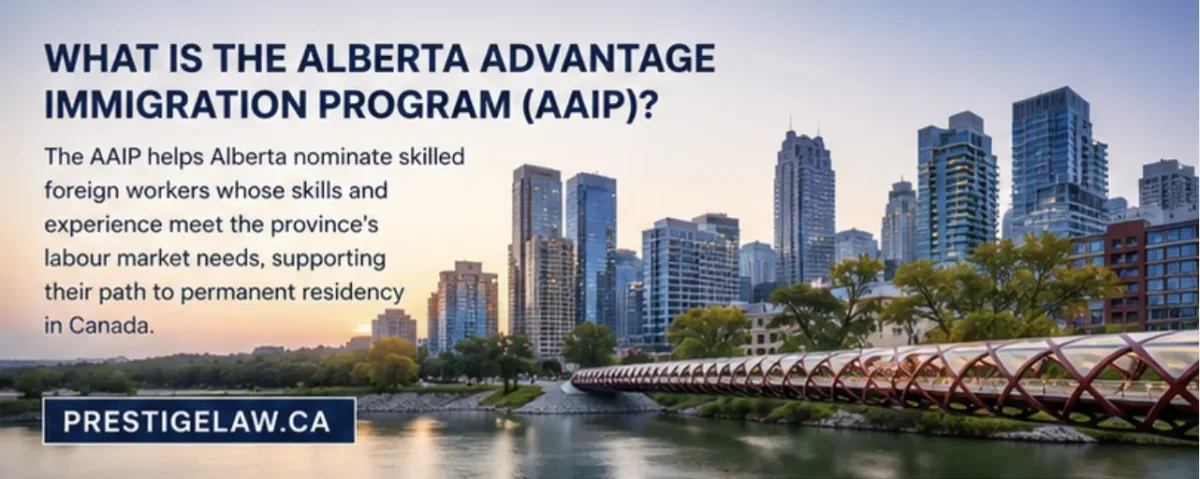
The Alberta Advantage Immigration Program is the province’s official Provincial Nominee Program (PNP), operated in partnership with Immigration, Refugees and Citizenship Canada (IRCC). Through this program, Alberta identifies foreign nationals whose skills and work experience align with local labour market needs and nominates them for Canadian permanent residency. A provincial nomination adds significant weight to a candidate’s application, and in many streams it comes with additional Comprehensive Ranking System (CRS) points if the candidate is also enrolled in the federal Express Entry system. Alberta Invites Healthcare & Manufacturing Workers
Unlike a purely federal points-based system, the AAIP allows Alberta to respond directly to its own labour shortages. Each year, the province receives a nomination allocation from the federal government, and it distributes that allocation across a series of streams and pathways designed for different categories of applicants — including skilled workers already employed in Alberta, international graduates, entrepreneurs, and candidates selected through the federal Express Entry pool. For 2026, Alberta was granted a nomination allocation of 6,403 spaces, a substantial increase compared to prior years, reflecting the province’s growing reliance on immigration to fill persistent gaps in its workforce.
What makes the AAIP particularly attractive is its flexibility. The program does not rely on a single fixed formula. Instead, it conducts periodic selection rounds, commonly referred to as “draws,” in which candidates from its Expression of Interest (EOI) pool are invited to apply based on factors such as their occupation, connection to Alberta, language ability, and work experience. This structure allows the province to respond quickly to emerging economic priorities — which is exactly what is happening now with healthcare, manufacturing, and agriculture.
Why Alberta Is Prioritising Healthcare, Manufacturing, and Agriculture
Alberta’s labour market has been undergoing a significant transformation. While the province has traditionally been associated with the energy sector, its economy has diversified considerably, and with that diversification have come new and pressing workforce needs.
Healthcare
Alberta’s healthcare system continues to face staffing shortages across nearly every level of care, from registered nurses and nurse aides to specialist physicians and allied health professionals. Rural and remote communities are particularly affected, often struggling to retain qualified staff. In response, the province has made healthcare its single most consistent immigration priority, using multiple dedicated pathways to recruit both general healthcare workers and practice-ready physicians.
Manufacturing
Manufacturing is one of the newer additions to Alberta’s list of priority sectors, reflecting a broader push toward industrial diversification. As the province works to expand its manufacturing base — including food processing, industrial equipment, and value-added production — employers are reporting increasing difficulty filling skilled and semi-skilled positions domestically. Immigration has become a key lever to close this gap, with the AAIP now actively selecting candidates whose occupations fall within manufacturing and industrial production roles.
Agriculture
Agriculture remains foundational to Alberta’s economy and export base. From large-scale farming operations to food processing facilities, the sector depends heavily on a stable, skilled workforce. Seasonal labour shortages, an ageing domestic workforce, and rising demand for food production have all contributed to agriculture’s inclusion as a top immigration priority. The AAIP supports this sector not only through its worker streams but also through dedicated business immigration pathways for those looking to establish or manage a farm operation in the province.
Together, these three sectors form a core part of Alberta’s broader 2026 immigration strategy, which also names technology, construction, aviation, and rural community development among its priorities. For candidates working in any of these fields, the message from the province is clear: Alberta wants you, and it is actively building pathways to make that possible.
Alberta’s Broader Economic and Population Strategy
This push toward targeted immigration does not exist in isolation. Alberta has positioned itself as one of the fastest-growing provinces in Canada, with a population strategy built around attracting skilled workers who can fill immediate labour gaps while also contributing to long-term economic diversification. The province’s nomination allocation for 2026 reflects a substantial increase over previous years, signalling that Alberta intends to rely more heavily on immigration — not less — as a tool for economic growth.
This matters for prospective applicants because it means the AAIP is not a shrinking or increasingly restrictive program. On the contrary, the province has continued to run frequent selection rounds throughout the year, issuing invitations across a wide range of streams and pathways. For candidates in healthcare, manufacturing, and agriculture in particular, this translates into more frequent opportunities to be selected from the Expression of Interest pool compared to sectors that are not currently designated as priorities.
At the same time, competition remains real. Alberta’s worker EOI pool includes tens of thousands of active candidates, many of whom are competing for a limited number of nomination spaces. This is precisely why occupation classification, documentation quality, and a clear demonstration of genuine ties to Alberta matter so much — they are often the deciding factors between candidates with otherwise similar profiles.
AAIP Streams Open to Healthcare, Manufacturing, and Agriculture Workers
The AAIP is not a single application — it is a collection of streams, each with its own eligibility rules. Below are the pathways most relevant to candidates working in these three priority sectors.
1. Alberta Opportunity Stream
This is typically the highest-volume stream within the AAIP and is designed for foreign workers who are already employed in Alberta on a valid work permit and have a full-time, non-seasonal job offer from an Alberta employer. Many healthcare, manufacturing, and agriculture workers who are already living in the province qualify through this route, provided they meet minimum work experience, language, and education requirements.
2. Alberta Express Entry Stream – Priority Sectors Pathway
This pathway is reserved for candidates who already have an active profile in the federal Express Entry pool and whose occupation falls within one of Alberta’s designated priority sectors — including healthcare, manufacturing, and agriculture. Candidates do not always need a job offer to be considered under this pathway, although having strong Alberta connections, relevant work experience, and a competitive EOI score significantly improves the likelihood of receiving an invitation.
3. Dedicated Health Care Pathway
Recognising the severity of its healthcare staffing needs, Alberta operates a pathway specifically for healthcare occupations, available both through Express Entry and outside of it. This pathway covers a wide range of roles, from physicians and registered nurses to continuing care aides and other frontline healthcare workers, and is one of the most active pathways in the province’s 2026 selection activity.
4. Rural Renewal Stream
Many agriculture and food-processing positions are based in Alberta’s rural and smaller communities. The Rural Renewal Stream is designed for candidates who have a qualifying job offer from an employer located in one of Alberta’s designated rural communities, helping address labour shortages outside the province’s two largest cities.
5. Alberta Farm Business Pathway
For individuals looking to establish, purchase, or manage a farming operation rather than work as an employee, the Farm Business Pathway offers a dedicated entrepreneurial route into the province, supporting Alberta’s long-term agricultural development goals.
Each of these streams has distinct eligibility thresholds, and candidates are strongly encouraged to determine which pathway best matches their occupation, work history, and current immigration status before submitting an Expression of Interest.
AAIP vs. Federal Express Entry: What’s the Difference?
Many candidates researching their options come across both the AAIP and the federal Express Entry system and are unsure how the two relate to one another. Understanding this distinction is important.
Express Entry is a federal system used to manage applications for several Canadian permanent residence programs, including the Federal Skilled Worker Program, the Canadian Experience Class, and the Federal Skilled Trades Program. Candidates create a profile, receive a Comprehensive Ranking System (CRS) score, and are entered into a pool where they compete against other candidates across the country for an invitation to apply.
The AAIP, by contrast, is a provincial program. Alberta can either select candidates directly from its own Worker Expression of Interest pool (a non-Express Entry route), or it can identify and nominate candidates who already have an active federal Express Entry profile. When a candidate receives a provincial nomination linked to their Express Entry profile, they are awarded a substantial number of additional CRS points — enough, in almost every case, to guarantee an invitation to apply in the next federal draw.
This means candidates generally have two possible paths into Alberta: applying directly through a non-Express Entry AAIP stream (such as the Alberta Opportunity Stream), or building a strong Express Entry profile and being selected through the Alberta Express Entry Stream. For many healthcare, manufacturing, and agriculture workers, pursuing both avenues simultaneously — where eligible — can improve the overall odds of success.
Who Is Eligible to Apply
While specific requirements vary by stream, most AAIP pathways for healthcare, manufacturing, and agriculture workers share several common eligibility criteria:
- A qualifying job or job offer: Most streams require either a current job in Alberta or a valid, full-time job offer from an eligible Alberta employer in an approved occupation.
- Relevant work experience: Candidates typically need a minimum period of recent, related work experience in their occupation, either in Canada or internationally, depending on the stream.
- Language proficiency: Applicants must generally demonstrate a minimum level of English or French proficiency through an approved test, with requirements varying based on the skill level of the occupation.
- Education credentials: Depending on the role, candidates may need to provide proof of relevant education or, where applicable, a Canadian equivalency assessment for credentials earned outside Canada.
- Licensing and certification: For regulated professions — which includes most healthcare occupations — applicants must typically hold or be eligible for the appropriate provincial licence, registration, or certification required to legally practise in Alberta.
- Genuine intention to reside in Alberta: Candidates must be able to demonstrate a genuine intention to live and work in Alberta on a long-term basis.
- Sufficient settlement funds: Some streams require proof of funds to support the applicant and any accompanying family members during the initial settlement period.
Because eligibility criteria differ meaningfully between streams — and because occupation lists and minimum score thresholds are updated periodically — it is important to confirm current requirements before submitting an Expression of Interest.
Step-by-Step: How the Provincial Nomination Process Works
Understanding the mechanics of the AAIP process can help candidates avoid unnecessary delays. Broadly, the process unfolds in the following stages:
Step 1: Confirm Eligibility and Choose the Right Stream. Before doing anything else, candidates should carefully review the eligibility criteria for each relevant stream and determine which pathway best fits their occupation, job offer status, and immigration history.
Step 2: Submit an Expression of Interest (EOI). Most AAIP streams require candidates to first submit an EOI profile, which is scored based on factors such as occupation, education, work experience, language ability, and connection to Alberta. Candidates are placed into a pool and remain eligible for selection in future draws.
Step 3: Wait for an Invitation to Apply (ITA). Alberta periodically conducts draws from its EOI pool, inviting the highest-ranking or most relevant candidates to submit a full application for provincial nomination. Draws are not held on a fixed calendar; they occur as needed based on labour market demand and available nomination spaces.
Step 4: Submit a Complete Nomination Application. Once invited, candidates typically have a limited window — often 30 to 90 days depending on the stream — to submit a complete application with all required supporting documents. Incomplete or inaccurate applications are a leading cause of refusals at this stage.
Step 5: Await a Nomination Decision. Alberta’s immigration officers review the application to confirm the candidate meets all stream requirements. If approved, the candidate receives a provincial nomination certificate.
Step 6: Apply for Permanent Residence. With a provincial nomination in hand, candidates then apply to IRCC for permanent residence — either through Express Entry (if the nomination was linked to an Express Entry profile) or through the paper-based provincial nominee stream. A provincial nomination typically adds a substantial number of points to an Express Entry profile, greatly increasing the chances of receiving a federal invitation to apply.
Step 7: Final Federal Review and Landing: IRCC conducts its own background, security, and admissibility checks before issuing a Confirmation of Permanent Residence, at which point the candidate — and any eligible family members — can complete the process of becoming a permanent resident of Canada.
Documents You Will Need
While document requirements vary by stream and individual circumstances, most AAIP applications for healthcare, manufacturing, and agriculture workers should be prepared to provide:
- A valid passport and, where applicable, current work permit
- A detailed employment reference letter confirming job title, duties, hours, and dates of employment
- A copy of the current job offer or employment contract, where required
- Language test results from an approved testing body
- Educational credential documents, and an Educational Credential Assessment (ECA) if the education was completed outside Canada
- Proof of any required professional licence, registration, or certification
- Proof of settlement funds, where applicable
- Police clearance certificates and, in some cases, medical examination results
- Any additional stream-specific forms requested by the AAIP
Errors, inconsistencies, or missing documents are among the most common reasons applications are delayed or refused, which is why careful preparation before submission is essential.

Processing Times You Can Expect
Processing times through the AAIP can vary depending on the stream, application volume, and completeness of the submitted file. As a general guide, provincial nomination decisions have recently taken several months to process from the point of a complete application submission, with additional time required afterwards for the federal permanent residence stage. Candidates applying through Express Entry–linked streams often experience faster federal processing once nominated, compared to non-Express Entry pathways. Because timelines can shift based on application volume and policy updates, candidates should treat published estimates as general guidance rather than guarantees, and should ensure documents such as language test results and proof of funds remain valid throughout the process.
Common Reasons Applications Get Refused
Even strong candidates can be refused if their application is not carefully prepared. Some of the most frequent issues include:
- Insufficient or unclear work experience documentation: Reference letters that lack specific duties, dates, or hours worked are a common cause of refusal.
- Occupation misclassification: Applying under an incorrect National Occupational Classification (NOC) code that does not accurately reflect the candidate’s actual duties.
- Failure to meet minimum language requirements: Submitting outdated or insufficient language test results.
- Incomplete supporting documentation: Missing forms, unsigned letters, or documents that do not meet formatting requirements.
- Weak connection to Alberta: Failing to clearly demonstrate genuine intent to settle and work long-term in the province.
- Licensing gaps: Applying for a regulated healthcare occupation without confirming the appropriate provincial licensing pathway in advance.
- Missed deadlines: Failing to submit a complete application within the window provided after receiving an invitation to apply.
Working with an experienced immigration lawyer can significantly reduce the risk of these issues, since a legal professional can review your file for gaps before submission rather than after a refusal has already been issued.
Tips for Building a Stronger Application
Beyond simply meeting the minimum eligibility requirements, candidates who take a strategic approach to their application tend to see better outcomes. A few practical tips worth keeping in mind:
- Choose the right occupation code from the start. The National Occupational Classification (NOC) code you select should accurately reflect your actual day-to-day duties, not simply your job title. Misalignment between your NOC code and your reference letters is one of the most common sources of delay.
- Keep your EOI profile updated. If your job title, employer, education, or language test results change, update your profile promptly so the information reviewed at the time of a draw is accurate and current.
- Request detailed reference letters early. Employment reference letters should include specific job duties, employment dates, hours per week, and salary. Requesting these early — rather than scrambling after receiving an invitation — helps avoid tight deadlines.
- Retake language tests before they expire. Many candidates lose ground simply because their language test results expire mid-process. Build in a buffer so your results remain valid through the entire application window.
- Demonstrate genuine ties to Alberta. Wherever possible, show a clear and consistent connection to the province — through current employment, prior work history, or documented plans to settle long-term.
- Understand licensing requirements before applying. If you work in a regulated healthcare occupation, confirm the licensing or registration pathway with the relevant Alberta regulatory body as early as possible, since this process can run in parallel with your immigration application.
- Don’t wait until the deadline to gather documents. Once you receive an invitation to apply, the submission window is limited. Having your documents largely prepared in advance can make the difference between a smooth submission and a missed deadline.
Life in Alberta: What Newcomers Can Expect
For many candidates, the decision to pursue provincial nomination is about more than employment — it is about building a long-term life in Canada. Alberta offers newcomers a combination of competitive wages, a relatively affordable cost of living compared to many other major Canadian provinces, and access to public healthcare and education systems. Cities such as Calgary and Edmonton provide urban amenities and established immigrant communities, while smaller and rural communities — many of which are actively recruiting through the Rural Renewal Stream — offer a quieter pace of life alongside strong local job security in sectors like agriculture and manufacturing.
Healthcare workers in particular often find themselves in high demand across the province, with opportunities extending well beyond major cities into regional hospitals and care facilities that are actively seeking qualified staff. Manufacturing and agriculture workers, meanwhile, frequently find stable, long-term employment opportunities tied directly to the job offers that support their nomination applications. For families considering the move, Alberta’s no provincial sales tax policy is also frequently cited as a practical financial advantage compared to other provinces.
How Prestige Law Can Help You Apply
Navigating the AAIP — with its multiple streams, shifting priorities, and detailed documentation requirements — can be overwhelming without the right guidance. At Prestige Law, our immigration team works closely with healthcare professionals, manufacturing workers, and agricultural employees to identify the right pathway, prepare a complete and accurate application, and respond effectively to any requests from immigration officers.
Led by lawyer Zeesean Sheikh, our firm takes a hands-on approach to every file. We assess your occupation, work history, and long-term goals to determine which AAIP stream offers the strongest chance of success, and we manage the process from the initial Expression of Interest through to your final permanent residence application. Whether you are a nurse, a machine operator, a food production worker, or a farm manager exploring your options in Alberta, our goal is to make the path to permanent residency as clear and efficient as possible.
We understand that an immigration application is not just paperwork — it represents a candidate’s future, and often the future of their family. That is why our team prioritises clear communication, careful document review, and proactive problem-solving at every stage of the process.
Frequently Asked Questions
What is the Alberta Advantage Immigration Program (AAIP)? The AAIP is Alberta’s Provincial Nominee Program, allowing the province to nominate foreign workers whose skills match its labour market needs for Canadian permanent residency.
Which occupations are currently prioritised under the AAIP? For 2026, Alberta’s top priority sectors include healthcare, technology, construction, manufacturing, aviation, and agriculture, along with candidates connected to designated rural communities.
Do I need a job offer to apply through the AAIP? It depends on the stream. Some pathways, such as the Alberta Opportunity Stream, require a current job or job offer in Alberta. Others, such as certain Express Entry–linked pathways, may not always require a job offer if the candidate meets other eligibility criteria.
How long does the AAIP application process take? Timelines vary by stream and application volume. Provincial nomination decisions generally take several months once a complete application is submitted, with additional processing time required for the federal permanent residence stage afterwards.
Can healthcare workers apply even if they are not physicians? Yes. Alberta’s healthcare pathways cover a wide range of roles, including nurses, continuing care aides, and other allied health professions, in addition to physicians.
Is agriculture work considered a priority occupation in Alberta? Yes. Agriculture is one of Alberta’s officially designated priority sectors for 2026, and candidates working in farming or food processing may qualify through several AAIP streams.
What happens after I receive a provincial nomination? Once nominated, you apply to Immigration, Refugees and Citizenship Canada (IRCC) for permanent residence, either through Express Entry or a separate provincial nominee application process, depending on your stream.
Can my family be included in my application? In most cases, yes. Eligible family members, including a spouse or common-law partner and dependent children, can typically be included in your permanent residence application.
Why should I work with an immigration lawyer instead of applying on my own? An immigration lawyer can help you select the correct stream, avoid common documentation errors, respond effectively to requests from immigration officers, and reduce the risk of delays or refusal.
How do I get started with my AAIP application? The best first step is a consultation to assess your occupation, eligibility, and options. Prestige Law can review your situation and guide you through every stage of the process.
What is an Expression of Interest (EOI), and do I need one? An EOI is a profile submitted to the AAIP that allows the province to consider you for an invitation to apply in future draws. Most worker streams require an active EOI before you can be selected.
Does a provincial nomination guarantee permanent residence? A provincial nomination is not an automatic guarantee. Still, it significantly strengthens your application and, in most Express Entry–linked cases, effectively assures an invitation to apply at the federal stage, subject to passing standard admissibility and background checks.
Can I apply to more than one AAIP stream at the same time? In many cases, candidates may be eligible for more than one stream. However, each stream has its own requirements, and applying strategically to the pathway that best fits your profile is usually more effective than applying broadly without a clear plan.
What should I do if my occupation is not currently listed as a priority? Priority sectors can change over time in response to Alberta’s evolving labour market needs. Even if your occupation is not currently prioritised, you may still be eligible under general streams such as the Alberta Opportunity Stream, and it is worth having your eligibility reviewed directly.

Get in Touch With Prestige Law
If you work in healthcare, manufacturing, or agriculture and want to explore your options under Alberta’s provincial nomination program, our team at Prestige Law is ready to help you understand your eligibility and build a strong, complete application from the start.
Richmond Hill Office 📍 100–100 Mural Street, Richmond Hill, ON
Toronto Office 📍 55 Town Centre Court, Suite 700, Toronto, ON
📞 Telephone: +1 (647) 925-2222 🌐 Website: prestigelaw.ca
This article is provided for general informational purposes only and does not constitute legal advice. Immigration rules, priority occupations, and processing timelines can change. For guidance specific to your situation, please book a consultation with our team.