




Ontario Launches Three New Pathways to Permanent Residence
(Formatting note for your CMS: please set the headline above in black, medium font weight, per your site’s standard heading style.)
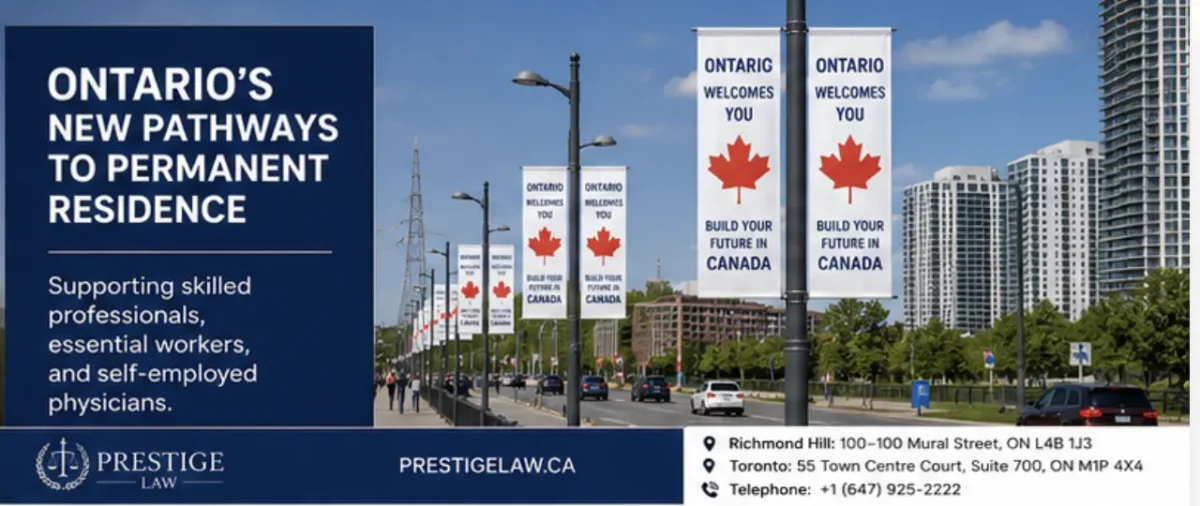
Ontario has officially rolled out the first phase of the most significant overhaul of its provincial immigration program in years, introducing three brand-new pathways to permanent residence under the newly created Ontario Workforce Priority Stream.
For skilled professionals, essential workers, and self-employed physicians hoping to build a long-term future in Canada’s largest province, this announcement marks the beginning of a completely reshaped route to permanent residency, one that replaces nearly every pathway that existed before it. If you have been waiting for clarity on how to qualify for Ontario’s provincial nomination program, this guide breaks down everything you need to know about the new streams, who is eligible, what employers must do, and how to prepare while the province finalises the reopening of its application system.
What Just Changed in Ontario’s Immigration Program
On June 26, 2026, the Ontario government confirmed that it had filed regulatory amendments creating a new framework for provincial nomination, replacing the collection of separate employer job offer streams that previously existed under the Ontario Immigrant Nominee Program, commonly known as the OINP. This change did not come out of nowhere. Ontario had already retired nearly all of its former permanent residence pathways at the end of May 2026, leaving a temporary gap while the province worked through consultations, stakeholder feedback, and regulatory drafting.Ontario Launches 3 New PR Pathways
That gap has now been filled, at least partially. The province has consolidated what used to be eight separate nomination streams into a single, unified framework called the Ontario Workforce Priority Stream. Rather than offering several overlapping employer-driven categories, this new stream is organised around three distinct pathways, each targeting a different segment of the labour market. The goal, according to the province, is to create a system that is easier for applicants to understand, easier for employers to navigate, and more responsive to the sectors of the economy that are experiencing genuine shortages of workers.
It is important to understand that while the new regulations are already in force, the province has not yet reopened the Expression of Interest system, the online portal through which eligible candidates register their profiles and receive invitations to apply. That system closed as part of the transition and is expected to relaunch later in the summer of 2026. In the meantime, prospective applicants and their employers can begin preparing documentation, arranging language testing, and confirming eligibility so that they are ready to move quickly once applications open.
The Three New Pathways Under the Ontario Workforce Priority Stream
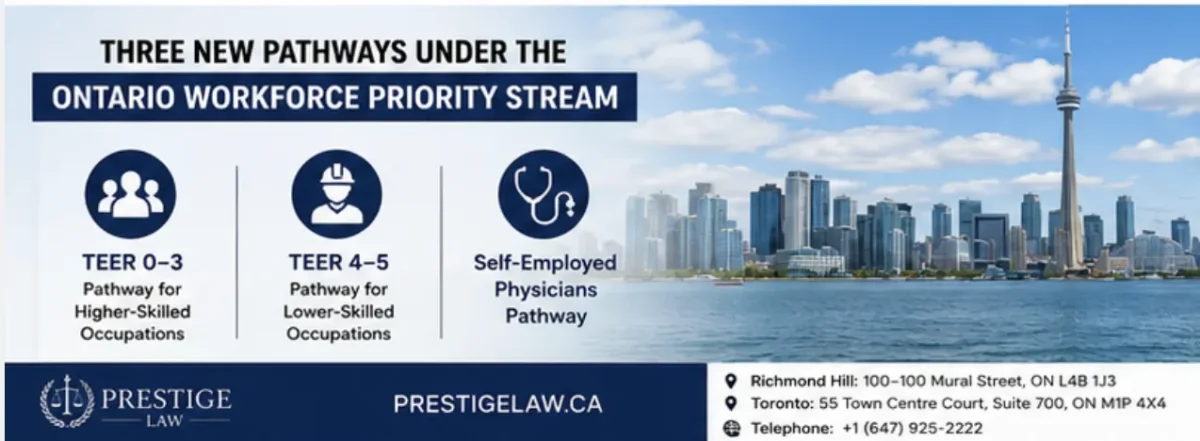
The Ontario Workforce Priority Stream is built around three distinct tracks, each with its own eligibility requirements. While they share some common features, such as the need for a genuine job offer in most cases, the specific criteria differ depending on the type of occupation and the applicant’s background.
1. The TEER 0–3 Pathway for Higher-Skilled Occupations
This pathway is designed for foreign nationals working in occupations classified under Canada’s Training, Education, Experience and Responsibilities system at levels 0 through 3. These are generally roles that call for a university degree, a college diploma, extensive apprenticeship training, or specialised supervisory responsibility. Examples include management positions, professional occupations, and skilled technical and trades roles.
To qualify under this pathway, a candidate generally needs to have:
- A full-time, permanent job offer from an eligible Ontario employer in a TEER 0, 1, 2, or 3 occupation
- Language proficiency that meets the required Canadian Language Benchmark for the occupation in question, typically CLB 6, though some occupations allow for CLB 5
- The educational credentials or licensing associated with the occupation, which for many roles means a post-secondary degree or diploma
- Sufficient qualifying work experience, either through a defined period of employment with the sponsoring employer or a broader period of experience in the same occupation within recent years
- No outstanding orders against them under Ontario’s major labour and employment regulations
Recent graduates from eligible Ontario post-secondary institutions may also qualify under adjusted criteria, recognising that new graduates may not yet have accumulated the same length of work experience as more established professionals. For these candidates, the wage and experience thresholds are often assessed differently to reflect their stage of career development.
The job itself must also meet certain conditions. It generally needs to be performed predominantly within Ontario, pay a wage that meets or exceeds published benchmarks for the occupation and region, and, if the candidate is already working for the employer, pay at least what they are currently earning.
2. The TEER 4–5 Pathway for Lower-Skilled Occupations
The second pathway targets workers in TEER 4 and 5 occupations, which typically involve secondary school education and on-the-job training rather than post-secondary credentials. These are often the essential, hands-on roles that keep supply chains, service industries, and operational sectors of the Ontario economy running.
General requirements for this pathway include:
- A full-time, permanent job offer from an eligible Ontario employer
- A minimum period of qualifying work experience with the sponsoring employer, generally around nine months
- Language proficiency at a level appropriate to the occupation, which represents a notable shift for workers in this category, since previous versions of Ontario’s employment streams did not always require formal language testing for lower-skilled roles
- A secondary school education, or its equivalent
This pathway reflects Ontario’s recognition that essential and operational roles are just as critical to the province’s economic well-being as highly specialised professional occupations, even though the qualifying criteria differ.
3. The Self-Employed Physicians Pathway
The third and arguably most distinctive pathway under this new stream is designed specifically for physicians. Unlike the other two tracks, this pathway does not require a traditional job offer, since physicians practising independently in Ontario are typically self-employed rather than salaried employees. This makes it the only pathway within the redesigned program that does not depend on arranged employment.
To qualify, a physician generally needs to:
- Be a member in good standing with the College of Physicians and Surgeons of Ontario
- Hold a valid certificate of registration in an eligible class of practice
- Be eligible to bill for their services through the Ontario Health Insurance Plan, commonly known as OHIP
This pathway responds directly to the ongoing physician shortages being felt across many Ontario communities, particularly outside the Greater Toronto Area. By creating a dedicated route for doctors who are already contributing to the province’s healthcare system, Ontario is aiming to make it easier for these professionals to settle permanently rather than facing the same job-offer-based hurdles as other occupations.
What Employers Need to Know
Employers play a central role in the TEER 0–3 and TEER 4–5 pathways, since both require a genuine job offer from an eligible Ontario business. To support a candidate through these tracks, an employer generally needs to demonstrate that their business has been:
- Actively operating in Ontario for a minimum period, generally at least three years.
- Meeting minimum annual revenue thresholds, which vary depending on whether the business is located within the Greater Toronto Area or in other parts of the province
- Employing a required number of Canadian citizens or permanent residents on a full-time basis at the location of the job offer
- Free of any outstanding compliance issues under Ontario’s labour and employment regulations
Notably, the province has introduced additional flexibility for employers located in smaller and rural communities. Businesses located in designated regions, including areas such as Ottawa, Waterloo, Hamilton, Niagara, Essex, Wellington, Greater Sudbury, Frontenac, Brant, Peterborough, Hastings, and Thunder Bay, may benefit from reduced revenue thresholds and adjusted headcount requirements compared to employers based in the Greater Toronto Area. This reflects Ontario’s broader goal of encouraging economic immigration to spread more evenly across the province rather than concentrating almost exclusively in and around Toronto.
What Happened to Ontario’s Previous PR Pathways
Understanding the new pathways also means understanding what came before them. Ontario had operated a wider set of streams for years, including separate categories for foreign workers, international students, and various employer job offer scenarios. In late 2025, the province signalled that a major restructuring was coming, and it launched a public consultation process through the Ontario Regulatory Registry to gather feedback on a proposed redesign.
That consultation closed on January 1, 2026. A few months later, on May 30, 2026, Ontario formally retired nearly all of its existing permanent residence streams, ahead of confirming exactly what would replace them. This created a period of uncertainty for many prospective applicants, since the previous pathways had closed but no new ones had yet opened.
The province has been clear that anyone who submitted an application under the old streams before they closed will continue to have that application assessed according to the rules that were in effect when it was received. In other words, existing applicants are not required to restart their process under the new criteria; only new applicants moving forward need to qualify under the newly launched pathways.

What Comes Next: A Second Phase Is on the Way
The three pathways launched under the Ontario Workforce Priority Stream represent only the first phase of a broader, two-phase redesign. Ontario has indicated that a second phase is expected to introduce three additional streams, although the province has not yet confirmed specific launch dates or finalised eligibility criteria for these upcoming categories. Based on the province’s earlier consultation proposals, the anticipated second-phase streams include:
A Priority Healthcare Stream, intended for regulated healthcare professionals who are licensed, or in the process of becoming licensed, to practise in Ontario. Unlike the employer-driven pathways, this stream is expected to be built around professional registration rather than a job offer, which would make it accessible to a wider pool of healthcare workers beyond physicians alone.
An Entrepreneur Stream, aimed at individuals who own and operate businesses in Ontario, potentially including those who have purchased and taken over the operation of an existing Ontario business through a succession arrangement.
An Exceptional Talent Stream, designed for foreign nationals with notable achievements in fields such as research, academia, science, technology, and the arts. This stream is expected to rely on a more qualitative assessment of a candidate’s contributions and their potential impact on Ontario, rather than a rigid set of numeric thresholds.
Until Ontario confirms the details of this second phase, candidates who may eventually qualify under one of these anticipated categories should focus on strengthening their professional registration, business documentation, or portfolio of achievements so they are well positioned once the streams officially launch.
How the Ontario Workforce Priority Stream Fits Into Canada’s Immigration System
It helps to understand where this program sits within the wider Canadian immigration landscape. Provincial nomination programs, often called PNPs, are one of the main routes to permanent residence in Canada, alongside federal programs administered through Express Entry, family sponsorship, and other specialised categories. Each province and territory outside Quebec operates its own PNP, allowing it to nominate candidates who meet local labour market needs. A provincial nomination is a significant advantage for a candidate, since it either grants a direct path to permanent residence or adds substantial points to a federal Express Entry profile, depending on how the nomination is structured.
To be nominated through a PNP such as Ontario’s, a foreign national must generally intend to live in that province once they receive permanent residence, and they must first be nominated by the province before their permanent residence application can proceed to the federal stage with Immigration, Refugees and Citizenship Canada. Ontario has historically been one of the most active provinces in this space, given the size of its economy and labour market, and the redesigned Ontario Workforce Priority Stream is intended to keep that role intact while making the nomination process more consistent and predictable.
This distinction matters because the Ontario Workforce Priority Stream is not a standalone or parallel route to Express Entry; rather, it works alongside it. Candidates nominated through this stream still need to satisfy federal admissibility requirements, including background and medical checks, before permanent residence is finalised. Understanding this two-step structure, provincial nomination followed by federal processing, helps applicants set realistic expectations for timelines and next steps.
A Closer Look: Comparing the Three Pathways
Because the three pathways share the same overall stream but differ in their specific requirements, it can help to see them side by side.
Feature TEER 0–3 Pathway TEER 4–5 PathwaySelf-Employed Physicians
Job offer required Yes Yes No
Typical occupation type Management, professional, technical/skilled trades Operational, essential, entry-level trades Independent medical practice
Education requirement Post-secondary degree or diploma (generally) Secondary school education Medical licensure
Minimum language level CLB 6, or CLB 5 for some occupations CLB 4 across all four skills Determined by licensing body requirements
Work experience Combination of employer-specific and occupation-wide experience Minimum of roughly nine months with the employer Not applicable in the same way; based on registration status
Employer obligations Business operating history, revenue thresholds, headcount requirements Same as TEER 0–3, with regional flexibility Not applicable
This comparison highlights just how differently each pathway is structured, even though all three fall under the same overarching Ontario Workforce Priority Stream. Candidates should be careful not to assume that meeting the requirements for one pathway automatically means they qualify for another; each has distinct thresholds tailored to the nature of the occupation involved.
Common Questions Employers Are Asking
Since two of the three new pathways depend heavily on employer participation, many Ontario businesses are still working through what this redesign means for their hiring plans. A few themes have come up repeatedly since the announcement.
Some employers are asking whether job offers extended before June 26, 2026, remain valid under the new rules. In most cases, an offer itself does not expire, but it will need to be assessed against the current eligibility criteria at the time an Expression of Interest profile is submitted, once the system reopens. This means employers should revisit older job offers to confirm they still meet the updated wage benchmarks and other conditions.
Other employers, particularly smaller businesses outside the Greater Toronto Area, are asking how the reduced revenue and headcount thresholds actually apply to them. Because these thresholds are tied to specific census divisions, it is worth confirming exactly which regional category a business falls under before assuming eligibility either way.
There is also considerable interest in how the new compliance and enforcement measures will be applied in practice, particularly the shorter response periods for certain notices. Employers who have supported nominations in the past should take note of these procedural changes, since missing a shortened deadline could have consequences for a pending or future application.
Benefits of Obtaining Permanent Residence Through Ontario
For candidates weighing whether a provincial pathway is the right route for them, it is worth stepping back and considering what permanent residence actually provides. Once granted, permanent residence allows an individual to live, work, and study almost anywhere in Canada, access most social benefits and healthcare coverage, and begin building toward eventual Canadian citizenship after meeting the required residency period. Permanent residents can also sponsor eligible family members to join them in Canada, a benefit that matters enormously to applicants who have been working and building their lives in Ontario while their families remain abroad.
Choosing a provincial pathway like the Ontario Workforce Priority Stream, rather than relying solely on the federal Express Entry pool, can also offer a more predictable and often faster route for candidates whose occupation or circumstances align closely with what a specific pathway is designed to capture. For a skilled worker with a strong job offer, a physician with an established Ontario practice, or an essential worker who has spent years building experience with the same employer, a provincial nomination can be the most direct route available.
Mistakes to Avoid During This Transition Period
With any major program redesign, there is a real risk of confusion, particularly for candidates who were following the old streams closely and may not realise how significantly the requirements have shifted. A few common pitfalls are worth flagging.
One frequent mistake is assuming that because a candidate qualified under an older, now-retired stream, they will automatically meet the criteria for the new pathway that most closely resembles it. Eligibility criteria have changed meaningfully, particularly around language testing and work experience thresholds, so a fresh assessment is essential rather than relying on outdated program details.
Another common issue is delaying language testing until the Expression of Interest system reopens. Because language results can take time to arrive and may need to meet a minimum validity period at the time of application, waiting until the last moment can create unnecessary delays.
Employers, too, should avoid assuming that a job offer drafted under the old streams will transfer seamlessly into the new framework. Wage levels, headcount requirements, and business operation thresholds have all been revised, and offers should be reviewed against the current standards rather than older guidance.
Why This Overhaul Matters
Ontario’s decision to consolidate eight separate streams into a single, more targeted framework is about more than administrative tidiness. The province has directly linked this redesign to its labour market priorities, aiming to ensure that permanent residence nominations go to candidates working in occupations and sectors where genuine shortages exist. At the same time, the federal government’s 2026 to 2028 Immigration Levels Plan increased Ontario’s provincial nominee admission target, giving the province a larger allocation to work with under its redesigned program.
For skilled workers, this means a more streamlined application experience, but also a more rigorous set of eligibility standards, including expanded language requirements that now apply even to occupations that previously had little or no formal language testing obligation. For employers, it means a renewed emphasis on demonstrating genuine, sustained business operations in Ontario before they can support a foreign worker’s nomination. For physicians, it means a dedicated, job-offer-free route that acknowledges the province’s ongoing need for medical professionals.
Taken together, these changes reflect an immigration system that is becoming more selective, more data-driven, and more closely tied to demonstrated labour market need, rather than a system built around a wide menu of loosely related categories.
Preparing for the Reopening of the Expression of Interest System
Because the Expression of Interest system is not yet accepting new profiles, the coming weeks represent a critical preparation window rather than a waiting period. Candidates who want to be ready to act the moment applications reopen should consider taking the following steps now:
- Booking or renewing language testing, since Canadian Language Benchmark results are now a mandatory component across every pathway in the redesigned program
- Gathering and organising proof of work experience, including reference letters, pay records, and documentation confirming the length and nature of employment.
- Confirming that educational credentials have been properly assessed, where required, through a recognised credential evaluation
- For employers, reviewing job offers to ensure they meet the updated wage levels, headcount requirements, and business operation history thresholds.
- For physicians, confirming registration status with the College of Physicians and Surgeons of Ontario and verifying eligibility to bill through OHIP
Being proactive during this transitional period can make a meaningful difference once the Expression of Interest portal reopens, since provincial nomination programs often move quickly and can be competitive.
How Prestige Law Can Help
Navigating a newly launched immigration framework, particularly one that has just replaced almost every pathway that came before it, can be genuinely overwhelming, even for candidates who are highly qualified. At Prestige Law, our immigration team, led by Zeesean Sheikh, works closely with skilled workers, employers, and physicians across Ontario to assess eligibility under the new Ontario Workforce Priority Stream, prepare strong supporting documentation, and build applications that are ready to move the moment the Expression of Interest system reopens.
Whether you are an employer trying to determine if your business meets the new revenue and headcount requirements, a skilled professional wondering which TEER pathway applies to your occupation, or a physician exploring the self-employed pathway, our team can walk you through your options and help you put together a clear, well-organised plan.
📍 Richmond Hill: 100–100 Mural Street, ON 📍 Toronto: 55 Town Centre Court, Suite 700, ON 📞 Telephone: +1 (647) 925-2222 🌐 Website: prestigelaw.ca
Reach out to our office today to schedule a consultation and find out how these new pathways to permanent residence may apply to your situation.
Frequently Asked Questions
What are the three new Ontario permanent residence pathways? The three new pathways are the TEER 0–3 pathway for higher-skilled occupations, the TEER 4–5 pathway for lower-skilled and essential occupations, and a dedicated pathway for self-employed physicians. Together, they form the newly launched Ontario Workforce Priority Stream.
When did Ontario launch these new pathways? The new regulations took effect on June 26, 2026, following Ontario’s decision to retire its previous permanent residence streams on May 30, 2026, as part of a broader overhaul of the Ontario Immigrant Nominee Program.
Can I apply for these pathways right now? The regulatory framework is in force, but Ontario has not yet reopened its Expression of Interest system, which is the portal candidates use to register and be considered for a nomination invitation. The province has indicated it expects to reopen this system later in the summer of 2026.
Do I need a job offer to qualify? A job offer is required for the TEER 0–3 and TEER 4–5 pathways. The self-employed physicians pathway does not require a job offer, since it is designed for physicians practising independently in Ontario.
What happened to Ontario’s old permanent residence streams? Ontario’s previous employer job offer streams and related categories were retired in May 2026. Applicants who submitted applications before these streams closed will continue to have their applications assessed under the rules that applied at the time they applied.
Will Ontario introduce more pathways in the future? Yes. Ontario has confirmed that a second phase of the redesign is planned, expected to include a Priority Healthcare Stream, an Entrepreneur Stream, and an Exceptional Talent Stream. No launch date has been confirmed for these additional pathways yet.
Does the TEER 4–5 pathway require language testing? Yes. Unlike some of Ontario’s previous programs for lower-skilled occupations, the new TEER 4–5 pathway requires candidates to meet a minimum language proficiency level across all four language skills.
Who is eligible for the self-employed physicians pathway? Physicians must be in good standing with the College of Physicians and Surgeons of Ontario, hold a valid certificate of registration, and be eligible to bill through the Ontario Health Insurance Plan.
How can an immigration lawyer help with these new pathways? An experienced immigration lawyer can help assess eligibility under the correct pathway, ensure job offers and business documentation meet the new employer requirements, prepare a complete and accurate application package, and help candidates avoid delays once the Expression of Interest system reopens.
Ontario’s launch of three new permanent residence pathways marks a genuine turning point for the province’s immigration system. While the transition has involved a temporary closure of the application portal and a period of uncertainty for prospective candidates, the new framework offers a clearer, more targeted structure built around real labour market needs. Skilled professionals, essential workers, and physicians now have defined routes to permanent residence, with a second phase of streams still to come. For anyone hoping to make Ontario their permanent home, now is the time to start preparing documentation and understanding exactly where you fit within this newly redesigned system, and the team at Prestige Law is ready to help you do exactly that.