



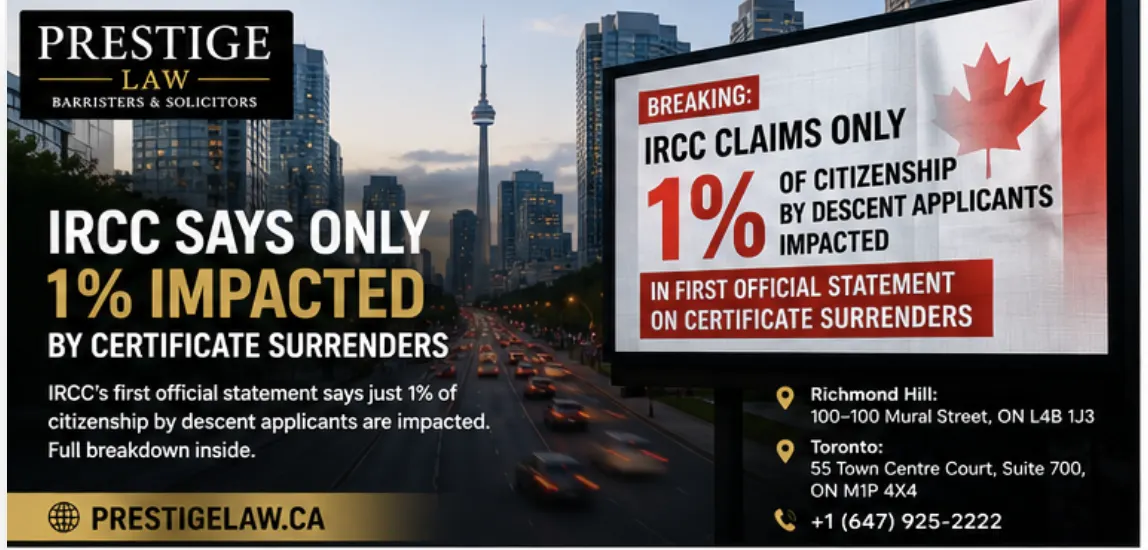
BREAKING: IRCC Claims Only 1% of Citizenship by Descent Applicants Impacted, in First Official Statement on Certificate Surrenders

]For thousands of families who spent months, and in many cases years, piecing together century-old birth records, church registries, and immigration files to prove their Canadian lineage, the last few weeks have been a rollercoaster of hope, confusion, and anxiety. After a wave of surrender letters shook confidence in Canada’s newly expanded citizenship by descent program, Immigration, Refugees and Citizenship Canada (IRCC) has finally broken its silence with a formal statement. The number at the centre of it, just one per cent, is already reshaping the national conversation around Bill C-3 and the future of citizenship by descent applications.
Table of Contents
- What Happened: A Quick Recap of the Certificate Surrender Controversy
- IRCC’s First Official Statement, Explained
- The Numbers Behind the “1%” Claim
- Why Some Certificates Were Flagged in the First Place
- What Happens to the Remaining Cases
- The Legal Questions IRCC’s Statement Doesn’t Fully Answer
- How This Affects New and Pending Citizenship by Descent Applications
- What Applicants Should Do Right Now
- How Prestige Law Can Help You Navigate This Process
- Frequently Asked Questions (Most Searched)
- Final Thoughts
1. What Happened: A Quick Recap of the Certificate Surrender Controversy
To understand why IRCC’s latest statement matters so much, it helps to rewind a few months.IRCC Says Only 1% Impacted by Certificate Surrender
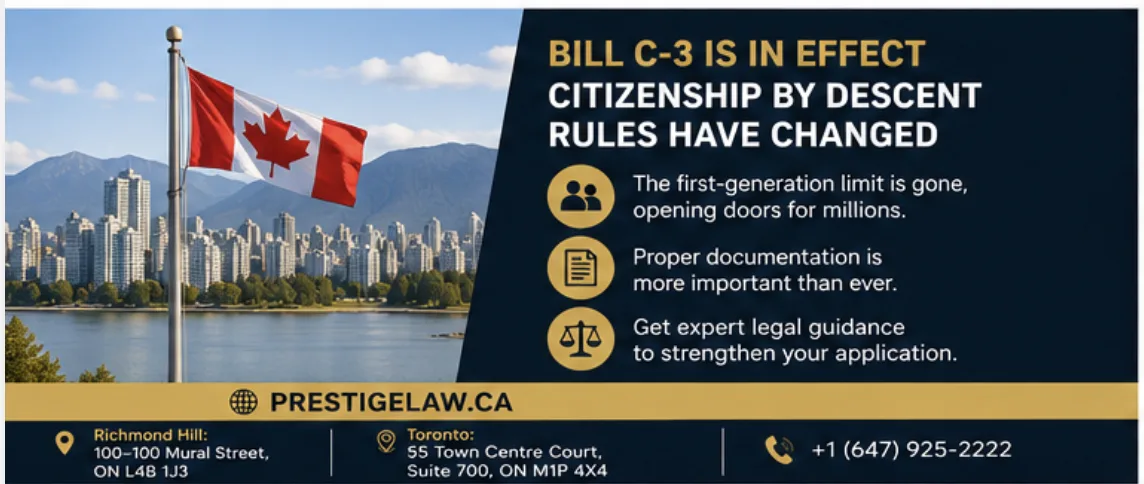
Bill C-3 came into force in mid-December 2025, finally undoing the long-criticised “first-generation limit” that had shut out countless people with Canadian ancestry from claiming citizenship simply because they were born one generation too far removed from Canadian soil. The change followed a 2023 Ontario Superior Court of Justice ruling that found the old first-generation cut-off unconstitutional, and it opened the door to potentially millions of applicants around the world, many of them Americans with French-Canadian, Maritime, or other multigenerational Canadian roots tracing back decades or even a century.
The response was immediate and overwhelming. Thousands of applications poured in from people who had spent years researching family trees, digging through provincial archives, and piecing together fragmented historical documentation to prove an unbroken line of descent from a Canadian ancestor. By the spring of 2026, IRCC had already issued thousands of citizenship certificates under the new rules.
Then, in mid-June, everything changed. Several newly approved applicants, people who believed their citizenship status was settled, began receiving letters instructing them to surrender their freshly issued citizenship certificates. The letters cited a provision in Canada’s Citizenship Regulations that allows the Registrar of Canadian Citizenship to demand the return of a certificate when there is reason to question whether the holder was actually entitled to it.
For families who had already updated passports, relocated planning, employment paperwork, or simply celebrated a long-awaited resolution to their citizenship status, the letters landed like a shockwave. Immigration lawyers, legal commentators, and advocacy voices quickly raised concerns, some arguing that IRCC had effectively shifted the evidentiary bar after already approving these files, others questioning whether a forced surrender of an already-issued certificate could even withstand constitutional scrutiny.
Within days, IRCC quietly began reversing some of the surrender orders, issuing what became known as “revalidation letters” confirming that certain certificates would remain valid after all. But the damage to public confidence had already been done, and applicants, along with the lawyers representing them, were left asking the same question: how many people were actually affected, and why did this happen in the first place?
That is the backdrop against which IRCC has now issued its first official, on-the-record statement addressing the scope of the surrender letters.
2. IRCC’s First Official Statement, Explained
According to the department’s newly released statement, an expanded review of roughly 6,500 citizenship by descent applications received under the broadened Bill C-3 eligibility rules has now been completed. That review was triggered after a routine internal audit conducted in early June flagged around 100 certificates that had already been issued but that, on closer inspection, appeared to be supported by documentation that fell short of the department’s evidentiary expectations.
In some of the flagged files, the supporting evidence relied on material sourced from open, publicly available genealogy platforms rather than from what IRCC considers source authorities, meaning provincial vital statistics offices, civil registries, or other official government bodies responsible for issuing and maintaining historical records.
Once those files were flagged, IRCC temporarily suspended a batch of certificates and issued the now well-publicised surrender letters, asking affected individuals to return their documents while their files underwent a closer secondary review.
The headline figure in the department’s statement is straightforward: of the certificates connected to this review, the vast majority have already been resolved, either reinstated outright or cleared without further action required from the applicant. IRCC describes the remaining unresolved cases, 67 in total, as representing roughly one per cent of all certificates issued so far under the expanded Bill C-3 criteria.
In other words, IRCC’s position is that this was never a mass revocation event affecting a significant share of new citizens. It was, according to the department, a narrow documentation-integrity exercise that touched a small fraction of an otherwise smoothly functioning program.
3. The Numbers Behind the “1%” Claim
Numbers matter here, because they shape how seriously the public, and the legal community, should treat this episode. Based on IRCC’s statement and independent reporting on the situation, here is how the picture breaks down:
- Roughly 6,500 applications have gone through the department’s expanded review process tied to the broadened citizenship by descent rules.
- Approximately 4,000 to 4,100 citizenship certificates have been issued under the new Bill C-3 provisions since they came into force in December 2025, with nearly half of those going to applicants born in the United States.
- Around 100 certificates were initially flagged during a routine audit in early June due to concerns about the quality or source of supporting documentation.
- 67 cases remain under active review as of the department’s latest statement, which IRCC frames as approximately one per cent of certificates issued under the new framework.
- The remaining flagged files have either been reinstated or resolved without requiring further submissions from the applicant.
IRCC has indicated that the outstanding 67 cases should be resolved within a matter of days, with affected individuals either having their certificates formally reinstated or being contacted directly if additional information is still required.
It’s worth noting that these figures reflect IRCC’s own characterisation of events. Independent estimates from immigration lawyers tracking the situation through direct client contact and online applicant communities have, at times, suggested the number of people affected could run into the hundreds, a noticeably higher figure than the department’s official tally. That gap between IRCC’s numbers and what some practitioners are seeing on the ground is likely to remain a point of discussion as the story continues to develop.
4. Why Some Certificates Were Flagged in the First Place
IRCC’s stated rationale for the surrender letters centres on two specific documentation gaps:
First, supporting evidence that did not originate from what the department considers a proper source authority. This generally means official government-issued vital statistics records, provincial civil registries, or comparable authoritative bodies, rather than transcriptions, indexes, or digitised records hosted on third-party genealogy websites.
Second, missing written explanations. When an applicant could not obtain a source document, perhaps because a record from the 1800s or early 1900s simply no longer exists, IRCC’s expectation is that the applicant clearly document that gap: what they attempted, why the original record is unavailable, and what alternative evidence they are relying on instead.
In practice, this means many of the flagged files were not necessarily fraudulent or built on inaccurate information. Rather, they were files where a real ancestor and a real family history existed, but where the supporting paperwork trail had a gap that was never formally explained to the department, or where the underlying documents came from an index or archive that IRCC’s internal reviewers did not treat as sufficiently authoritative.
This distinction matters enormously. IRCC has been clear that these notices do not amount to a formal revocation of citizenship, which is a separate, more serious legal process reserved for cases involving fraud, misrepresentation, or deliberate concealment of material facts. Instead, the surrender letters represent an administrative pause, a chance for the department to double-check its own work before finalising a certificate on a permanent basis.
5. What Happens to the Remaining Cases
For the 67 applicants whose files remain open, IRCC’s statement suggests two possible outcomes are imminent:
- Reinstatement. If the department’s secondary review confirms the applicant’s entitlement to citizenship by descent, the certificate will be reinstated without further requirements.
- A request for more information. If gaps remain, IRCC will contact the applicant directly, outlining precisely what additional documentation or explanation is needed to close the file.
IRCC has framed this as a process expected to wrap up within days rather than weeks. That said, anyone currently in this position should treat the department’s timeline as a general expectation rather than a guarantee, and should be proactive about preparing any supplementary evidence that might strengthen their file in the meantime.
6. The Legal Questions IRCC’s Statement Doesn’t Fully Answer
While IRCC’s statement provides welcome clarity on scale, it leaves several important legal and procedural questions unresolved, questions that immigration lawyers across the country have been raising since the surrender letters first went out.
Was the documentary standard changed after the fact? Several practitioners have pointed out that the published document checklist for citizenship by descent applications did not, on its face, require documents to come exclusively from a narrowly defined “source authority.” Some argue that applying this stricter standard retroactively, after certificates had already been approved and issued, raises serious procedural fairness concerns.
Is a forced certificate surrender constitutional? Because a citizenship certificate is tied to a person’s legal status, and because these individuals had already been recognised as citizens, some legal commentators have questioned whether ordering the surrender of that document before any formal finding of ineligibility is even permissible under Canadian law.
Why were certificates issued in the first place if the underlying documentation was insufficient? This is perhaps the most pointed question raised by immigration lawyers reviewing these files. If an application did not meet the required evidentiary threshold, critics ask why it was approved and a certificate issued at all, only to be pulled back weeks or months later.
Why did some family members receive surrender letters while others, relying on identical supporting evidence, did not? This inconsistency has been flagged by multiple practitioners and remains, as of now, unexplained by the department.
IRCC’s statement addresses the scope of the issue but does not, at least publicly, resolve these underlying legal questions. For applicants and their legal counsel, these remain live issues, and in some cases, the basis for formal legal challenges currently being prepared.
7. How This Affects New and Pending Citizenship by Descent Applications
Perhaps the most practically important part of IRCC’s broader guidance is what it means going forward. The department has confirmed that its updated documentary expectations, requiring certified supporting documents from verified source authorities and a clear written explanation whenever a required document cannot be obtained, will now apply to all new applicants moving forward.
In plain terms, this means the documentation bar for citizenship by descent applications has effectively been raised. Applicants who might previously have relied on transcribed genealogy records, indexed archives, or informal historical documentation should now expect closer scrutiny of where their evidence comes from and how thoroughly any gaps in that evidence are explained.
This shift comes at a time when the citizenship by descent program is already under significant strain. Provincial archives across the country have reportedly been overwhelmed with requests for historical vital records, largely driven by American applicants tracing Canadian ancestry. Processing queues for proof of citizenship applications have lengthened considerably, with wait times now stretching well beyond a year for many applicants, and tens of thousands of applications currently sitting in the pipeline.
Against that backdrop, a well-prepared, thoroughly documented application is no longer simply a matter of convenience. It has become the single most important factor separating applications that move through smoothly from those that risk being flagged, delayed, or questioned after the fact.
8. What Applicants Should Do Right Now
If you have already applied for citizenship by descent under Bill C-3, received a certificate, or are currently preparing an application, here is what matters most based on IRCC’s latest guidance:
- Review the source of your supporting documents. Wherever possible, prioritise documents issued directly by provincial vital statistics offices, civil registries, or other official government archives rather than third-party genealogy indexes.
- Document any gaps explicitly. If an original record genuinely does not exist, don’t leave that gap unexplained. Include a clear written statement describing what efforts were made to obtain the missing document and why an alternative form of evidence is being submitted instead.
- Keep everything. If you have received a surrender or suspension letter, preserve the complete letter, envelope, any reference numbers, and your original certificate. These details may become important if you need to respond to the department or seek legal advice.
- Respond within any stated deadlines. If IRCC requests additional evidence, treat the response window seriously and provide complete, well-organised documentation.
- Don’t assume silence means resolution. If your file is part of the ongoing review and you haven’t heard back, it is reasonable to follow up directly with the department or through legal counsel rather than simply waiting.
- Consider a formal request for your file notes. For applicants who want a clearer picture of exactly why their file was flagged, an access to information request can sometimes reveal internal notes that shed light on the department’s specific concerns.
9. How Prestige Law Can Help You Navigate This Process
Citizenship by descent claims under Bill C-3 involve far more than filling out a government form. They require building a legally sound documentary record that can withstand exactly the kind of scrutiny IRCC has now confirmed it is applying, both to newly submitted applications and, in some cases, to files that were already approved.
At Prestige Law, our immigration team, led by lawyer Zeesean Sheikh, works directly with applicants across Canada, the United States, and abroad to prepare citizenship by descent applications built around the documentation standard IRCC is now enforcing. That means sourcing records directly from the correct provincial or federal authorities wherever possible, and when original records genuinely cannot be located, preparing the kind of clear, well-supported explanation that IRCC’s guidance specifically calls for.
For applicants who have already received a surrender or suspension letter, our team can review the specific reasons cited in your notice, assess what additional evidence may resolve the department’s concerns, and communicate directly with IRCC on your behalf. For those still preparing an application, we can help you build a file from the outset that is far less likely to be flagged for review in the first place.
We understand how disorienting it can be to have your citizenship status called into question after you believed the matter was settled. Our goal is to give you a clear, honest assessment of where your file stands and a practical path forward, rather than generic reassurances.
Prestige Law Offices:
📍 Richmond Hill: 100–100 Mural Street, ON 📍 Toronto: 55 Town Centre Court, Suite 700, ON 📞 Telephone: +1 (647) 925-2222 🌐 Website: prestigelaw.ca
If your citizenship by descent application has been flagged, delayed, or if you are just getting started and want to avoid the pitfalls other applicants have faced, reach out to our team for guidance tailored to your specific family history and documentation.
10. Frequently Asked Questions (Most Searched)
Q: What percentage of citizenship by descent applicants were actually affected by the certificate surrender letters? A: According to IRCC’s first official statement, roughly one per cent of certificates issued under the expanded Bill C-3 rules remain part of the ongoing review, with the department describing this as a limited, targeted documentation check rather than a widespread issue.
Q: Does receiving a surrender letter mean my citizenship has been revoked? A: No. IRCC has been clear that these letters represent a temporary administrative review, not a formal revocation of citizenship, which is a separate and more serious legal process reserved for cases involving fraud or misrepresentation.
Q: Why were some citizenship certificates surrendered after already being approved and issued? A: IRCC states that a routine internal audit in early June identified certificates supported by documentation it considered insufficient, largely because some records came from open genealogy sources rather than official vital statistics authorities. This triggered a closer secondary review of those specific files.
Q: Will the new, stricter documentation standard apply to applications submitted before this controversy? A: The department has indicated that the updated documentary guidance will apply to all new applicants in the future. Applications that were already under review or recently approved were assessed as part of the specific review described in IRCC’s statement.
Q: What kind of documents does IRCC consider acceptable for proving Canadian ancestry? A: IRCC’s updated guidance emphasises certified documents issued directly by recognised source authorities, such as provincial vital statistics offices or civil registries, along with a clear written explanation whenever an original document cannot be obtained.
Q: Is Bill C-3 itself affected by this controversy? A: No. Bill C-3 remains fully in force, and the underlying eligibility rules for citizenship by descent have not changed. This situation concerns how certain applications are being documented and reviewed, not the legal basis for citizenship by descent itself.
Q: How long does it currently take to process a citizenship by descent application in Canada? A: Processing times have lengthened considerably due to high application volumes, with many applicants currently facing wait times well over a year. Applicants should expect this timeline to remain elevated in the near term.
Q: What should I do if I receive a surrender or suspension letter from IRCC? A: Preserve the original letter and certificate, review the specific reasons cited for the review, and consider seeking legal advice to help prepare a clear, well-documented response before any stated deadline.
Q: Can a lawyer help if my citizenship certificate application was flagged for review? A: Yes. An immigration lawyer can review the specific concerns raised in your file, help gather appropriate documentation from the correct authorities, and communicate directly with IRCC to help resolve the review as efficiently as possible.
11.
IRCC’s first official statement on the certificate surrender controversy offers a measure of reassurance for the vast majority of citizenship by descent applicants: according to the department’s own figures, only a small fraction, around one per cent, of certificates issued under the expanded Bill C-3 framework remain part of an active review.
But numbers alone don’t tell the whole story. For the families still waiting on a final answer, and for the broader pool of future applicants now facing a higher documentary bar, the underlying lesson from this episode is clear. Citizenship by descent claims under Bill C-3 are being scrutinised more closely than ever, and the strength of an application increasingly depends on where its supporting evidence comes from and how clearly any gaps are explained.
Whether you’re just beginning to explore your eligibility for Canadian citizenship by descent, currently waiting on a decision, or have received a letter from IRCC that has left you with more questions than answers, getting experienced legal guidance early can make the difference between a smooth approval and a prolonged, stressful review.
The team at Prestige Law is here to help you understand exactly where you stand and what steps make sense for your specific situation.
📞 Call Prestige Law today at +1 (647) 925-2222, or visit prestigelaw.ca to schedule a consultation with our immigration team.