





Alberta Launches New Online Tool to Help Foreign Nationals Assess AAIP Eligibility

Language proficiency has long been one of the cornerstones of Canada’s immigration system. Whether an applicant is pursuing permanent residence through Express Entry, sponsoring a family member, or applying for citizenship, proof of English or French ability is almost always required. For years, applicants have submitted results from approved tests such as IELTS, CELPIP, TEF Canada, and TCF Canada with relatively little additional verification beyond the test result itself. That landscape is changing. Canadian immigration authorities are now placing language test results under far greater scrutiny than before, introducing new verification measures, flagging irregular scoring patterns, and cracking down on fraudulent or coached test results. Canada Tightens Scrutiny Immigration Language Tests
For prospective immigrants, this shift carries real consequences. A language test score that was once accepted at face value may now trigger additional review, a request for retesting, or, in serious cases, a finding of misrepresentation that can result in a refusal or even a multi-year ban from applying to Canada. Understanding why this change is happening, how it affects different immigration streams, and what applicants can do to protect themselves is essential for anyone currently navigating the Canadian immigration process.
This article explains the background behind Canada’s tightened approach to language testing, breaks down what applicants need to know, and outlines practical steps to avoid delays, refusals, or allegations of misrepresentation.
Why Language Proficiency Matters So Much in Canadian Immigration
Canada’s immigration framework places significant weight on an applicant’s ability to communicate in English or French. This is not simply a bureaucratic formality. Language ability directly affects an immigrant’s capacity to integrate into the Canadian labour market, access services, participate in community life, and pursue further education or training. Because of this, language scores are tied directly to points awarded under the Comprehensive Ranking System (CRS) used in Express Entry, as well as eligibility thresholds for numerous Provincial Nominee Programs (PNPs), the Canadian Experience Class, the Federal Skilled Worker Program, and citizenship applications.
A higher language score can mean the difference between receiving an Invitation to Apply (ITA) for permanent residence and being left out of a draw entirely. Given how competitive Express Entry pools have become in recent years, even a single point gained from a stronger Canadian Language Benchmark (CLB) level can shift an applicant’s ranking substantially. This competitive pressure has, unfortunately, created strong incentives for some applicants to seek out shortcuts, including test fraud, impersonation, coaching schemes designed to game scoring rubrics, or the use of fraudulent test certificates altogether.
What Has Changed: A Closer Look at the New Scrutiny
Immigration, Refugees and Citizenship Canada (IRCC), along with designated testing bodies, has responded to a rise in suspected fraud and irregularities by tightening oversight in several key areas.
1. Stricter Verification of Test Results
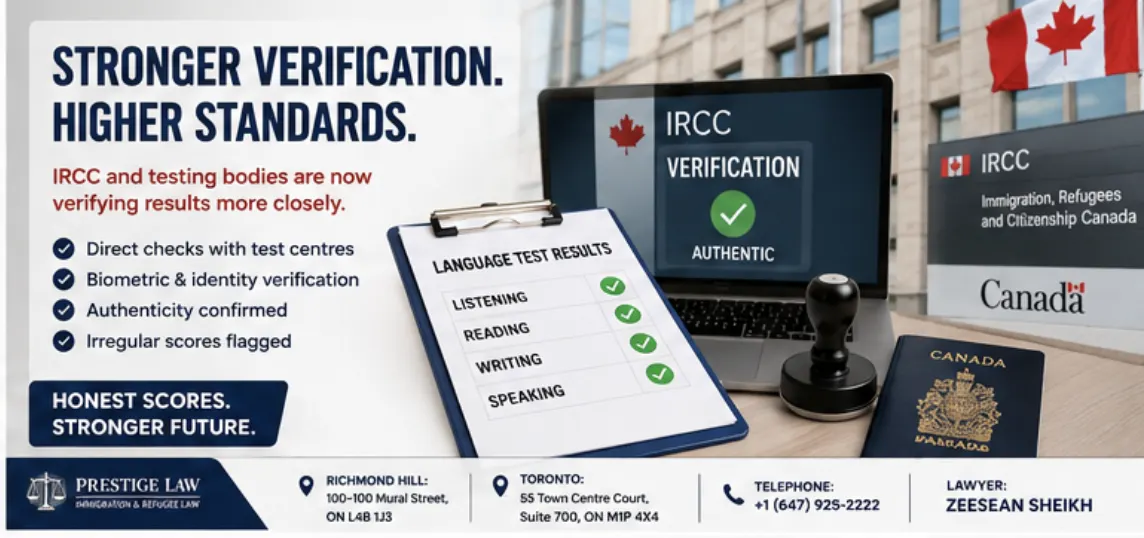
Approved language testing organisations are now working more closely with IRCC to verify the authenticity of submitted results. This includes cross-checking test report forms directly with testing centres, confirming biometric and identity data captured at the time of testing, and verifying that scorecards have not been altered or duplicated. Applicants who submit test results that cannot be verified through official channels are increasingly being asked to retake the test or provide further documentation.
2. Pattern Detection for Anomalous Scores
Testing organisations and immigration officers are using analytical tools to detect unusual scoring patterns, such as applicants achieving unusually high speaking or writing scores relative to their reading and listening results, or clusters of applicants from the same coaching centre or geographic area producing suspiciously similar score profiles. When such patterns are detected, individual applications can be flagged for secondary review, interviews, or requests for additional evidence of genuine language ability.
3. Crackdown on Test Fraud and Impersonation
There have been documented cases internationally of individuals using impersonators to sit language tests on their behalf, or using leaked test materials and coached answers designed to maximise scores without reflecting actual ability. Regulatory bodies overseeing IELTS, CELPIP, TEF Canada, and PTE Core have increased identity verification protocols, including stronger photo identification checks, biometric capture, and audio/video monitoring during testing sessions. Where fraud is suspected or confirmed, results can be cancelled, and the applicant’s immigration file can be flagged for misrepresentation.
4. Greater Scrutiny During Citizenship Applications
Language requirements are not limited to permanent residence. Citizenship applicants between the ages of 18 and 54 must demonstrate adequate knowledge of English or French. Officers reviewing citizenship files are paying closer attention to inconsistencies between an applicant’s documented language test results and their demonstrated ability during interviews, in-person interactions, or supporting documentation submitted throughout their immigration history.
5. Increased Use of Procedural Fairness Letters
When an officer has concerns about the authenticity or accuracy of a submitted language test result, applicants are increasingly receiving procedural fairness letters. These letters allow the applicant to respond to the officer’s concerns before a final decision is made. However, responding to a procedural fairness letter requires care, as an inadequate or poorly substantiated response can lead directly to refusal or a misrepresentation finding.
Why This Shift Is Happening Now
Several converging factors help explain why Canadian authorities have intensified scrutiny of language testing.
Rising application volumes. Express Entry and other points-based immigration streams have seen consistently high demand, increasing the incentive for some applicants to seek any advantage, including fraudulent or coached test scores, to improve their CRS ranking.
International fraud networks. Investigations in source countries have uncovered organised networks offering fraudulent test certificates, impersonation services, and coaching designed to exploit weaknesses in test administration. As these networks have been exposed, Canadian authorities and testing bodies have responded with tighter controls.
Protecting program integrity. IRCC has a mandate to protect the integrity of Canada’s immigration system. Allowing language fraud to go unchecked would undermine public confidence in the points-based system and could disadvantage genuine applicants who earn their scores honestly.
Technological advances in detection. Modern data analytics, biometric verification, and digital test administration have made it significantly easier for testing organisations to detect anomalies that would have gone unnoticed under older, paper-based systems.
Which Immigration Streams Are Most Affected
While language testing scrutiny touches nearly every part of Canada’s immigration system, certain streams are seeing the most direct impact.
Express Entry (Federal Skilled Worker, Canadian Experience Class, Federal Skilled Trades)
Language scores are directly converted into CRS points. Even small discrepancies or flagged results can delay processing or trigger a request for additional verification before an ITA is finalised or before permanent residence is granted.
Provincial Nominee Programs
Many PNP streams set minimum CLB thresholds for eligibility. Provinces conducting their own due diligence reviews are increasingly cross-referencing language scores against other elements of an applicant’s profile, such as work history and education credentials, to identify inconsistencies.
Citizenship Applications
As noted above, citizenship officers are applying closer scrutiny to language evidence, particularly where an applicant’s test results seem inconsistent with other parts of their file.
Family Sponsorship and Spousal Applications
While language testing is less central to spousal sponsorship, applicants who are also pursuing economic immigration streams concurrently may find that flagged language results in one application affect the credibility assessment of related applications.
Study Permit and Post-Graduation Pathways
International students transitioning to permanent residence through the Canadian Experience Class or PNP streams are also affected, since their language test results from earlier study permit applications may be compared against later test results submitted for permanent residence.
The Risk of Misrepresentation Findings
Perhaps the most serious consequence of this increased scrutiny is the risk of a misrepresentation finding under Canada’s Immigration and Refugee Protection Act (IRPA). Misrepresentation is treated extremely seriously by Canadian immigration authorities. If an officer determines that an applicant knowingly submitted a fraudulent or materially false language test result, the consequences can include:
- Refusal of the application in question
- A finding of inadmissibility for misrepresentation
- A five-year bar on applying for most immigration programs to Canada
- Potential impacts on family members included in the same application
Importantly, misrepresentation findings can sometimes arise even when an applicant did not personally intend to deceive immigration authorities, such as in cases involving unscrupulous consultants or coaching centres that submitted altered documents without the applicant’s full knowledge. This makes it critical for applicants to work only with reputable, licensed professionals and to personally verify the accuracy of every document submitted on their behalf.
What Applicants Should Do to Protect Themselves
Given the heightened scrutiny, applicants should take a proactive approach to ensure their language test results and their broader application can withstand close examination.
Take the test honestly and prepare properly. There is no substitute for genuine preparation. Legitimate study resources, practice tests, and tutoring focused on actually improving language skills are far safer than shortcuts that promise guaranteed scores.
Verify your Test Report Form (TRF) or equivalent document carefully. Before submitting any language test result, check that all personal details match your passport and other identification exactly, and confirm the result has not expired (most language test results are valid for two years from the test date).
Keep all original test documentation. Retain your original test report forms, registration confirmations, and any correspondence with the testing centre. These documents may be requested if your file is flagged for review.
Be cautious of consultants or coaching centres promising guaranteed scores. Any service that claims it can guarantee a specific test score, provide test answers in advance, or arrange for someone else to take the test on your behalf is engaging in fraud. Participation in such schemes, even unknowingly, can jeopardise your entire immigration file.
Respond promptly and thoroughly to procedural fairness letters. If you receive a procedural fairness letter raising concerns about your language test results, do not ignore it or respond hastily. A well-prepared, evidence-based response is critical, and legal guidance at this stage can significantly affect the outcome.
Maintain consistency across your entire immigration history. If you have submitted multiple applications over time (such as a study permit followed by a permanent residence application), ensure that your language ability and supporting documentation remain consistent and accurately reflect your genuine skill level.
How Prestige Law Can Help
Navigating Canada’s increasingly rigorous immigration process requires more than just submitting forms correctly. It requires a clear understanding of how IRCC evaluates evidence, how testing bodies verify results, and how to respond effectively if your application is flagged for additional review.
At Prestige Law, our immigration team works closely with clients to ensure their language test evidence and every other component of their application are accurate, well-documented, and prepared to withstand scrutiny. Led by Zeesean Sheikh, our firm provides tailored guidance for individuals and families pursuing Express Entry, Provincial Nominee Programs, citizenship, sponsorship, and study or work permit pathways.
If you have received a procedural fairness letter, been asked to retake a language test, or are concerned about a potential misrepresentation finding, timely legal advice can make a significant difference in protecting your application and your future in Canada. Our team can review your documentation, communicate with IRCC on your behalf, and help you respond to any concerns raised by an immigration officer.
We also assist applicants at the outset of their immigration journey, helping them understand which language test is appropriate for their chosen program, what CLB level they need to achieve their immigration goals, and how to build an application that is both strong and fully compliant with Canadian immigration law.
Frequently Asked Questions
Which language tests are accepted by IRCC for immigration purposes? IRCC accepts results from a limited number of designated language testing organisations. For English, this includes IELTS General Training and CELPIP General. For French, this includes TEF Canada and TCF Canada. Each test is converted into Canadian Language Benchmark (CLB) or Niveaux de compétence linguistique canadiens (NCLC) equivalencies.
How long are language test results valid for immigration applications? Most language test results are valid for two years from the date of the test. An application submitted with an expired test result will generally be considered incomplete or may be refused.
What happens if my language test results are flagged for review? If your results are flagged, you may receive a procedural fairness letter from IRCC outlining the officer’s concerns. You will typically be allowed to respond with additional evidence or explanation before a final decision is made.
Can I retake a language test if I am unhappy with my score? Yes, applicants are generally permitted to retake language tests as many times as needed. However, only the most recent valid result is typically used for application purposes, and significant inconsistencies between multiple test attempts can sometimes draw additional scrutiny.
Is it illegal to use a test preparation service? No, legitimate test preparation services that help applicants genuinely improve their language skills are entirely legal and often beneficial. The concern arises only with services that promise guaranteed scores, provide advance access to test content, or arrange impersonation, all of which constitute fraud.
What is a misrepresentation finding, and how serious is it? A misrepresentation finding occurs when IRCC determines that an applicant knowingly provided false or misleading information, including fraudulent test results. It is one of the most serious findings in Canadian immigration law and can result in a refusal and a five-year bar from applying to most programs.
Can a lawyer help if I receive a procedural fairness letter about my language test? Yes. A procedural fairness letter requires a carefully prepared, evidence-based response within a specific deadline. Legal guidance can help ensure your response directly addresses the officer’s concerns and presents the strongest possible case.
Does increased scrutiny mean honest applicants are at greater risk of refusal? Not inherently. The purpose of increased scrutiny is to identify fraudulent results, not to penalise genuine applicants. However, applicants should still ensure their documentation is accurate, consistent, and properly prepared to avoid unnecessary delays or requests for further evidence.

Final Thoughts
Canada’s decision to subject immigration language tests to greater scrutiny reflects a broader commitment to protecting the integrity of its immigration system and ensuring that fraud does not disadvantage genuine, qualified applicants. For prospective immigrants, this means that honesty, careful preparation, and meticulous documentation matter more than ever. While the heightened verification process may feel like an additional hurdle, it ultimately reinforces a fairer system for those who pursue their Canadian immigration goals the right way.
If you are preparing for a language test for your Canadian immigration application, have concerns about a flagged result, or have received a procedural fairness letter, professional legal guidance can help you navigate the process with confidence.
Contact Prestige Law
📍 Richmond Hill: 100–100 Mural Street, ON
📍 Toronto: 55 Town Centre Court, Suite 700, ON
📞 Telephone: +1 (647) 925-2222
🌐 Website: prestigelaw.ca