



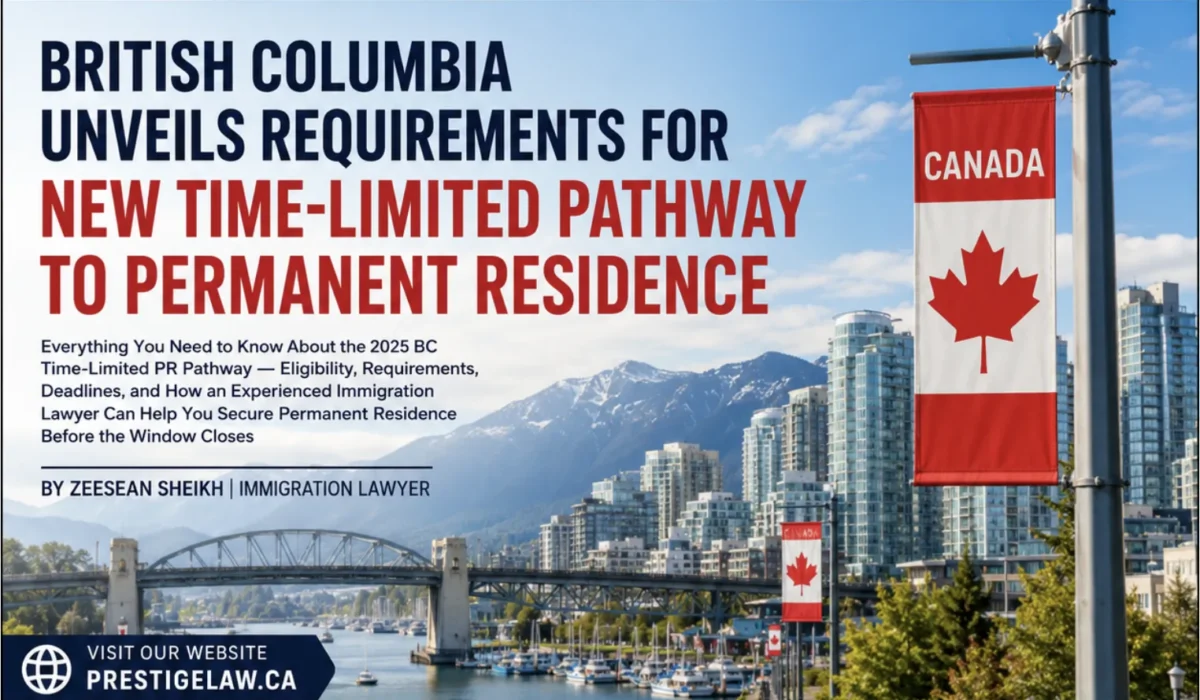
British Columbia Unveils Requirements for New Time-Limited Pathway to Permanent Residence

Everything You Need to Know About the 2025 BC Time-Limited PR Pathway — Eligibility, Requirements, Deadlines, and How an Experienced Immigration Lawyer Can Help You Secure Permanent Residence Before the Window Closes
Introduction: A Historic Opportunity for Permanent Residence in British Columbia
British Columbia has announced a bold and time-limited immigration pathway designed to allow eligible individuals and families to achieve permanent residence status in Canada — and the clock is already ticking. This new pathway, introduced through the BC Provincial Nominee Program (BC PNP), targets a specific group of applicants who meet carefully defined criteria, making it one of the most precisely structured and strategically significant immigration announcements from the province in recent years. BC New PR Pathway 2025
For many skilled workers, international graduates, entrepreneurs, and long-term temporary residents currently living and working in British Columbia, this pathway may be the most direct and achievable route to calling Canada home permanently. But the time-limited nature of this initiative means that applicants must act decisively, gather accurate documentation, and submit complete applications without delay.
At Prestige Law, our immigration legal team, led by trusted immigration lawyer Zeesean Sheikh, has been closely monitoring this development. In this comprehensive guide, we break down everything you need to know — from eligibility requirements and application procedures to timelines, common pitfalls, and how professional legal support can significantly improve your chances of success.
Why This Matters: Time-limited immigration pathways are rare. When they close, they close permanently. Missing the deadline or submitting an incomplete application can mean the difference between achieving permanent residence and starting over. Professional guidance is not optional — it is essential.
What Is the BC Time-Limited Pathway to Permanent Residence?
The BC Time-Limited Pathway to Permanent Residence is a targeted stream introduced under the British Columbia Provincial Nominee Program (BC PNP). Unlike the standard streams that run continuously throughout the year, this pathway has a defined open period, a capped number of nominations, and a specific profile of eligible applicants.
The British Columbia government designed this stream to address pressing labour market needs, support the retention of skilled temporary workers already embedded in BC communities, and create a faster route for individuals who have already contributed meaningfully to the province’s economy and society.
Successful nominees under this pathway receive a provincial nomination certificate from BC, which allows them to apply to Immigration, Refugees and Citizenship Canada (IRCC) for permanent resident status. A provincial nomination provides applicants with an additional 600 points under the federal Express Entry system, effectively guaranteeing an Invitation to Apply (ITA) for permanent residence.
Key Characteristics of This Pathway
- Time-limited: The pathway has a defined open and close date
- Targeted eligibility: Only specific occupations, education levels, or immigration statuses qualify
- Capped nominations: A fixed number of provincial nominations may be issued
- Expedited processing: Selected applications may benefit from faster review timelines
- BC-linked: Applicants must have a genuine connection to British Columbia
- Federal integration: Nominees proceed through IRCC to complete the PR process
Who Is Eligible? Detailed Requirements for the BC Time-Limited PR Pathway
Eligibility for this pathway is specific and non-negotiable. Meeting most — but not all — of the requirements will not be sufficient. Every condition must be satisfied at the time of application. Below is a detailed breakdown of the eligibility criteria as released by the BC government.
1. Residency and Location Requirement
Applicants must be residing in British Columbia at the time of application. The province is particularly focused on individuals who have established roots in BC communities — people who live, work, pay taxes, and contribute to the social fabric of the province. Applicants residing outside BC at the time of application will be considered ineligible, regardless of their prior connection to the province.
2. Employment Status and Work Authorisation
Applicants must be lawfully authorised to work in Canada. Valid work permits are typically required, and applicants must be actively employed — not between jobs — at the time of application. Open work permits, employer-specific work permits, and work authorisation under specific federal programs may all qualify, but the nature of the permit matters and must be reviewed carefully.
3. Qualifying Occupations
The BC government has specified eligible National Occupational Classification (NOC) codes under this pathway. These typically fall within the TEER 0, 1, 2, and 3 classifications — representing managerial, professional, technical, and skilled trade roles. Occupations in high-demand sectors such as healthcare, technology, skilled trades, education, and financial services have historically been prioritised in BC PNP streams.
Applicants are strongly advised to verify their specific NOC code before applying. An incorrect NOC classification is one of the most common — and most avoidable — reasons for application refusal.
4. Minimum Income Requirements
To demonstrate self-sufficiency and economic contribution, applicants must meet minimum income thresholds. These thresholds vary based on the number of dependants in the applicant’s household and the specific region of BC where the applicant resides. Income must be earned from qualifying employment and documented through official payslips, T4 slips, Notices of Assessment, and employer letters.
5. Language Proficiency
Depending on the specific stream or subcategory within this time-limited pathway, applicants may need to demonstrate proficiency in English or French. Language test results from approved testing organisations — such as IELTS, CELPIP, or TEF Canada — must meet minimum benchmark scores as specified by BC PNP guidelines. Test results must be recent, generally within two years of the application date.
6. Educational Background
A minimum level of education is typically required, though the threshold depends on the specific occupation and stream. For many positions classified under TEER 0 and 1, a post-secondary degree or diploma is required. Applicants with foreign educational credentials must obtain an Educational Credential Assessment (ECA) from a designated organisation recognised by IRCC.
7. Ties to British Columbia
This is a distinguishing feature of the BC PNP. Applicants must demonstrate genuine and meaningful ties to BC. This can include current employment with a BC-based employer, enrolment or recent graduation from a BC post-secondary institution, or a history of residing and working in the province. The BC government wants to nominate individuals who will genuinely remain in and contribute to the province after receiving permanent residence.
Important Note: Meeting the minimum eligibility thresholds does not guarantee nomination. The BC government uses a competitive selection model, and applications are ranked based on a combination of factors. A complete, well-organised application that tells a compelling story about your connection to BC is critical to success.
Step-by-Step Application Process
Understanding the application process is essential to submitting a strong, complete application. Below is a structured overview of the steps involved in applying under the BC Time-Limited Permanent Residence Pathway.
Step 1: Confirm Eligibility
Before taking any other steps, conduct a thorough self-assessment — or better yet, consult with a qualified immigration lawyer. Ensure that you meet every eligibility requirement, including NOC code, income level, language proficiency, educational credentials, and location. Submitting an application without first confirming eligibility wastes time and may negatively impact future applications.
Step 2: Create or Update Your BC PNP Online Profile
Applicants must create a profile in the BC PNP online portal. If you already have a profile from a previous application or registration, update it with your most current information. The portal requires detailed information about your employment, education, language scores, income, and personal circumstances.
Step 3: Gather and Organise Supporting Documents
Document preparation is one of the most time-consuming and error-prone parts of the process. Missing, outdated, or improperly translated documents can delay or defeat your application. Required documents typically include:
- Valid passport (all pages, including blank pages)
- Current work permit and all previous work permits
- Proof of employment: offer letter, employment contract, payslips, T4 slips
- Proof of income: Notices of Assessment from the CRA
- Language test results (IELTS, CELPIP, or TEF Canada)
- Educational credentials: degrees, diplomas, transcripts, and ECA report if applicable
- Proof of BC residency: lease agreements, utility bills, bank statements
- Tax filing history (T1 General or proof of filing)
- Reference letters from current and/or previous employers
- Proof of job duties matching the declared NOC code
Step 4: Submit Your Application
Submit your completed application through the BC PNP online portal before the stated deadline. Late applications will not be accepted. Ensure that every section is completed, every document is attached, and that all information is accurate and consistent across your application and supporting materials.
Step 5: Await BC Government Review
After submission, the BC government will review your application. Review times vary but are typically faster under time-limited pathways than under standard streams. The BC government may request additional documents or clarification at this stage. Respond to any requests promptly and completely.
Step 6: Receive Provincial Nomination
If your application is approved, you will receive a provincial nomination certificate from the Government of British Columbia. This nomination is valid for a specific period, during which you must submit your federal permanent residence application to IRCC.
Step 7: Apply to IRCC for Permanent Residence
With your provincial nomination in hand, you proceed to the federal stage. Nominees typically apply through the Express Entry system, where the provincial nomination grants an additional 600 Comprehensive Ranking System (CRS) points — effectively ensuring an Invitation to Apply (ITA). Once an ITA is received, you submit a complete federal PR application through the IRCC portal, including medical examinations, police certificates, and biometrics.
Step 8: Await Federal Decision
IRCC processes the federal PR application and renders a final decision. The typical processing time for Express Entry applications is six months or less, though complex cases or high-demand periods may take longer. Upon approval, you will receive your Confirmation of Permanent Residence (COPR) and — if applicable — a permanent resident visa.
Why You Should Work With an Immigration Lawyer for This Pathway
Immigration law is complex, constantly evolving, and deeply consequential. A single error in your application — a misclassified NOC code, an outdated language test result, or an inconsistency between your application and your supporting documents — can result in a refusal, a delay, or a permanent bar from reapplying.
At Prestige Law, we have helped hundreds of clients navigate the complexities of the BC PNP and federal immigration systems. Here is what our team brings to your application:
Accurate NOC Classification
We conduct a detailed analysis of your job duties, responsibilities, and working conditions to accurately identify your NOC code. Misclassification is the leading cause of BC PNP application rejections, and it is entirely preventable with professional guidance.
Document Review and Organisation
Our legal team reviews every document before submission to ensure it meets BC PNP and IRCC standards. We flag missing items, identify translation requirements, and ensure that every piece of evidence supports your application narrative.
Strategic Application Preparation
Beyond meeting minimum requirements, a successful application tells a coherent and compelling story about your connection to BC and your future contributions to the province. We help you frame your application strategically to maximise your competitiveness.
Deadline Management
Time-limited pathways are unforgiving. We manage your application timeline from start to finish, ensuring that no deadline is missed and that your application is submitted well in advance of any closure date.
Representation in Case of Complications
If the BC government or IRCC requests additional documentation, issues a procedural fairness letter, or makes an adverse decision, having legal representation is critical. We handle all communications on your behalf and develop a response strategy that protects your interests.
Prestige Law Commitment: We do not believe in a one-size-fits-all approach to immigration. Every client’s situation is unique, and our team takes the time to understand your specific circumstances before developing a personalised strategy for your application.
Who Should Apply? Profiles That Typically Qualify
While each application is evaluated individually, the following profiles commonly align with the eligibility criteria for BC time-limited permanent residence pathways:
Skilled Temporary Workers in BC
Foreign nationals currently employed in British Columbia under a valid work permit and working in a TEER 0–3 occupation represent the core target group for this pathway. If you have been working in BC for at least one year, have a stable employment history, and meet the income requirements, this pathway may be ideal for you.
International Graduates from BC Institutions
Recent graduates from accredited BC colleges and universities who have secured employment in their field of study are well-positioned for this stream. The BC government views local education as a strong indicator of integration and long-term commitment to the province.
Healthcare Workers
British Columbia faces persistent shortages in healthcare — from registered nurses and licensed practical nurses to medical laboratory technicians and healthcare administrators. Workers in these occupations are frequently prioritised in BC PNP streams and are likely to be well-represented in any time-limited pathway.
Technology Professionals
BC’s technology sector — particularly concentrated in the Metro Vancouver area — has grown significantly in recent years. Software developers, IT project managers, cybersecurity analysts, and data scientists are among the most in-demand technology occupations in the province.
Skilled Trades Workers
Electricians, plumbers, carpenters, heavy equipment operators, and other skilled trades professionals are critically needed across BC — particularly in construction, resource extraction, and infrastructure development. Trades workers who hold or are eligible for Red Seal certification are particularly competitive.
Understanding the Timeline: Act Now, Not Later
The most important thing to understand about any time-limited immigration pathway is that procrastination is your greatest enemy. Government-announced pathways of this nature attract a high volume of applicants, and the nomination cap — once reached — ends the intake period immediately, regardless of how much time remains on the official calendar.
Stage Estimated Time
Eligibility Assessment & Legal Consultation 1–3 business days
Document Gathering & Preparation 2–4 weeks
Application Preparation & Review 1–2 weeks
BC PNP Application Submission to BC Government Review 4–16 weeks (varies)
Provincial Nomination Issued Within 2 weeks of approval notification
Express Entry Profile Update & ITA Receipt Within days of nomination
Federal PR Application Preparation & Submission 2–4 weeks
IRCC Processing & Final Decision 4–6 months (standard)
Total estimated time from initial consultation to receiving your permanent residence status: approximately 8–12 months. Given this timeline, applicants who are considering this pathway cannot afford to delay. Contact Prestige Law today to begin your eligibility assessment.
Common Mistakes That Derail BC PNP Applications — And How to Avoid Them
Mistake 1: Submitting an Incomplete Application
Incomplete applications are returned or refused outright. Every field must be filled, every document must be included, and every certification must be signed. Our team at Prestige Law conducts a full pre-submission audit of every application before it leaves our office.
Mistake 2: Misidentifying Your NOC Code
Your NOC code determines your eligibility for specific streams. If the code you declare does not match the job duties you describe in your application, your application will be refused. This is a technical error that professional legal review can prevent entirely.
Mistake 3: Submitting Expired Documents
Language test results, medical examinations, police certificates, and certain other documents have expiry dates. Submitting an application with expired supporting documents will result in a refusal. Prestige Law tracks all document expiry dates throughout the application preparation process.
Mistake 4: Inconsistencies Across Application Materials
If the employment dates on your application form differ from the dates on your T4 slips, or if your declared income does not match your Notice of Assessment, immigration officers will flag the inconsistency. Our legal team cross-references all information before submission to ensure complete consistency.
Mistake 5: Missing the Deadline
This is the most devastating — and entirely avoidable — mistake in a time-limited pathway. Applications submitted after the intake window closes will not be reviewed, regardless of how strong they are. Start the process now.
Frequently Asked Questions (FAQs)
Q: What is the BC Time-Limited Pathway to Permanent Residence? A: It is a targeted, short-duration immigration stream launched under the British Columbia Provincial Nominee Program (BC PNP). It offers eligible individuals a pathway to Canadian permanent residence through a provincial nomination, followed by a federal application via Express Entry or a non-Express Entry paper-based stream.
Q: How long is the pathway open? A: The pathway has a defined intake period set by the BC government. Once the intake window closes — either because the deadline has passed or because the nomination cap has been reached — no further applications will be accepted. Monitor official BC government channels and contact Prestige Law for the most current information.
Q: Do I need a job offer from a BC employer to apply? A: Depending on the specific stream or subcategory, a job offer may or may not be required. Some streams require a valid job offer from a BC employer as a prerequisite, while others are open to applicants who meet qualification and residency requirements without a new employer-specific offer. Your current employment situation must be verified during the eligibility assessment.
Q: Can my family members be included in my application? A: Yes. Spouses or common-law partners and dependent children can typically be included in your provincial nomination application and subsequent federal permanent residence application. Family members will also receive permanent resident status once the application is approved.
Q: What happens if my application is refused? A: If your application is refused, you should consult with an immigration lawyer immediately to understand the reasons for refusal and explore your options. Depending on the circumstances, you may be able to reapply, appeal the decision, or pursue an alternative immigration pathway. Prestige Law provides comprehensive post-refusal consultation and support.
Q: Is there an age limit for this pathway? A: The BC PNP does not impose a hard age limit on applicants. However, age is one of the factors considered under the federal CRS scoring system. Younger applicants typically score higher under Express Entry CRS, while older applicants may benefit from other factors such as Canadian work experience, language scores, and educational credentials.
Q: Do I need to speak English to apply? A: Language requirements vary by stream and NOC code. Many streams require applicants to demonstrate English or French proficiency through standardised testing such as IELTS or CELPIP. The minimum required score depends on the specific occupation and stream requirements.
Q: Can an immigration consultant handle my application instead of a lawyer? A: While Regulated Canadian Immigration Consultants (RCICs) are authorised to assist with immigration applications, a licensed immigration lawyer provides a higher level of legal expertise, professional accountability, and the ability to represent you in legal proceedings if complications arise. At Prestige Law, Zeesean Sheikh brings both legal training and deep immigration experience to every client file.
Q: How much does it cost to apply? A: Application fees vary depending on the specific stream and the number of family members included. Government fees are separate from legal service fees charged by Prestige Law. We provide transparent fee structures at the outset of our engagement so that clients are fully informed of all costs before proceeding.
Q: What if I am currently on a Post-Graduation Work Permit (PGWP)? A: Holders of a PGWP who are employed in BC in a qualifying occupation are frequently among the best-positioned candidates for BC PNP streams, including time-limited pathways. Your PGWP status, combined with your BC education and employment, creates a strong profile for provincial nomination.

About Prestige Law — Your Trusted Immigration Law Firm in Ontario
Prestige Law is a full-service immigration law firm committed to providing exceptional legal representation to individuals, families, and businesses navigating the Canadian immigration system. Our firm is founded on the principles of integrity, precision, and client-centred advocacy.
Led by immigration lawyer Zeesean Sheikh, our team has extensive experience across all major Canadian immigration pathways, including the BC PNP, Express Entry, family sponsorship, study permits, work permits, refugee protection, and citizenship applications. We understand that immigration is not merely a legal process — it is one of the most important decisions of your life — and we treat every case with the seriousness and dedication it deserves.
We are proud to serve clients across Canada and internationally, with offices strategically located in the Greater Toronto Area to ensure accessible legal support for clients across Ontario and beyond.
CONTACT PRESTIGE LAW
Zeesean Sheikh — Immigration Lawyer
📍 Richmond Hill: 100–100 Mural Street, ON
📍 Toronto: 55 Town Centre Court, Suite 700, ON
📞 Telephone: +1 (647) 925-2222
🌐 Website: prestigelaw.ca
Schedule your confidential immigration consultation today.