



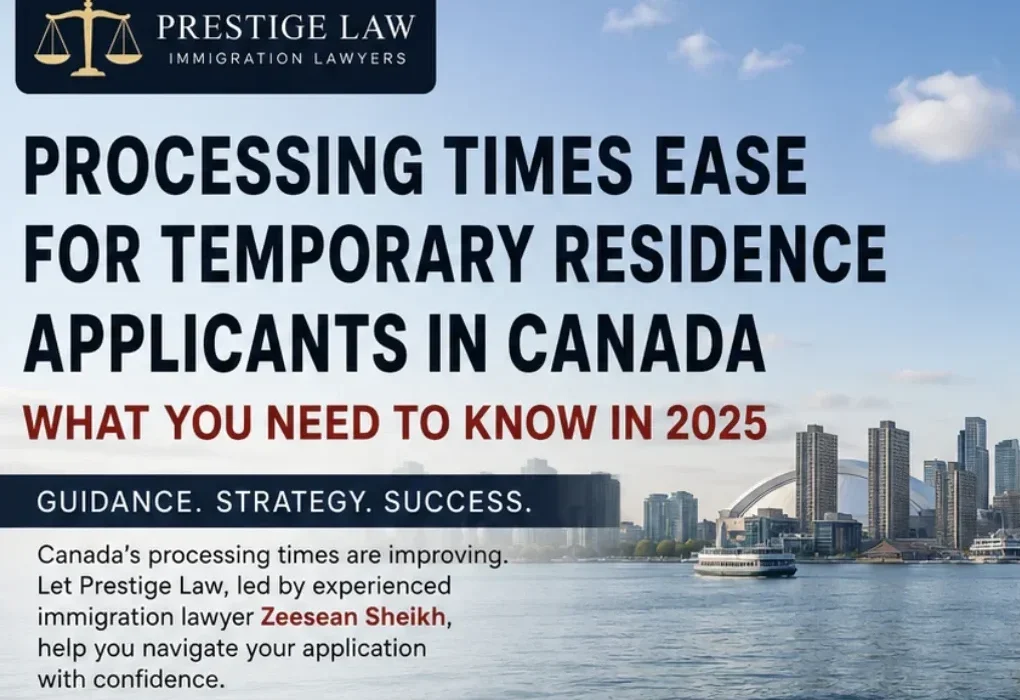
Processing Times Ease for Temporary Residence Applicants in Canada
What You Need to Know in 2026
Canada’s immigration landscape is shifting in a meaningful way. After years of prolonged backlogs, extended wait times, and mounting pressure on the immigration system, federal authorities have made measurable progress in reducing processing delays for temporary residence applicants. Whether you are applying for a visitor visa, a study permit, or a work permit, understanding what these improvements mean for you — and how to position your application for success — has never been more important.
At Prestige Law, led by experienced immigration lawyer Zeesean Sheikh, we help individuals and families across Canada and around the world navigate the complexities of Canadian immigration law with clarity, precision, and confidence. Processing Times Ease for Temporary Residents
This article provides a comprehensive, up-to-date guide on the easing of processing times for temporary residence applicants, what is driving the change, how it affects different application streams, and what you should do right now to make the most of this evolving landscape.
Understanding Temporary Residence in Canada Processing Times Ease for Temporary Residents
Before exploring the improvements in processing times, it is important to understand what “temporary residence” means in the context of Canadian immigration law.
Temporary residence refers to the legal status granted to foreign nationals who wish to enter Canada for a defined, limited period. This category includes three primary groups:
Visitor Visa (Temporary Resident Visa — TRV): Issued to individuals who want to visit Canada for tourism, family visits, or business purposes, typically for up to six months.
Study Permit: Issued to international students who wish to study at a designated learning institution (DLI) in Canada for longer than six months.
Work Permit: Issued to foreign workers who have a job offer from a Canadian employer or qualify under open work permit categories such as the International Mobility Program (IMP) or the Temporary Foreign Worker Program (TFWP).
Each of these streams has historically carried its own processing timeline, and each has experienced delays at different points over the past several years. The current improvements touch all three categories, though not uniformly.
Why Processing Times Were Delayed — And Why They Are Improving
To appreciate the significance of easing processing times, it is essential to understand what caused delays in the first place.
The Backlog Era
Between 2020 and 2023, Immigration, Refugees and Citizenship Canada (IRCC) experienced a historic accumulation of application backlogs. The COVID-19 pandemic caused processing centres to pause or operate at reduced capacity. At the same time, pent-up demand for travel, international education, and labour migration created a surge in applications once borders reopened.
By mid-2022, IRCC’s inventory had grown to millions of unprocessed applications across all immigration streams. Study permit applicants waited months. Visitor visa applicants saw timelines stretch beyond service standards. Work permit applicants faced uncertainty that disrupted employer hiring plans and individual career trajectories.
What Is Driving Improvement
The federal government and IRCC have since implemented a range of initiatives designed to reduce the backlog and bring processing times back within reasonable service standards. Key drivers include:
Digitisation and automation: IRCC has expanded its use of automated processing tools to triage applications, identify straightforward cases, and route complex files to decision-makers more efficiently.
Expanded officer capacity: IRCC has hired and trained additional visa officers, both domestically and at visa application centres (VACs) abroad, to increase adjudication throughput.
Streamlined application processes: For certain categories, IRCC has simplified evidentiary requirements or created express processing pathways for low-risk applicants.
Electronic Travel Authorisation (eTA) modernisation: Improvements to the eTA system have reduced the volume of TRV applications from low-risk countries.
IRCC service standard reviews: The department has publicly recommitted to meeting its published service standards, with improved internal performance monitoring.
The result is a system that, while not perfect, is processing many temporary residence applications faster than it has in years.
Current Processing Times by Stream (2025 Estimates)
Processing times fluctuate based on nationality, application volume, individual circumstances, and seasonal demand. However, recent IRCC data and service standards suggest the following general benchmarks for most applicants:
Visitor Visa (TRV)
Most applications from low-risk countries are now processing within 2 to 8 weeks, with some countries experiencing decisions within days for straightforward cases. Applications requiring additional documentation or interviews may take longer.
Study Permit
For Student Direct Stream (SDS) eligible countries, processing is typically completed within 3 to 4 weeks. Non-SDS applicants are seeing decisions within 6 to 12 weeks in most cases, a significant improvement from the 16-plus-week timelines of 2022 and 2023.
Work Permit
Processing times for employer-specific work permits under the Temporary Foreign Worker Program vary significantly by occupation and region. International Mobility Program (IMP) applications, including intracompany transfers and CUSMA professionals, are often processed within 2 to 8 weeks. Open work permits for eligible applicants are seeing similarly improved turnaround times.
These estimates are general guides only. Actual processing times depend on your country of citizenship, the completeness of your application, IRCC workload at the time of submission, and individual case complexity. Always check IRCC’s official processing time tool before submitting and consult with a qualified immigration lawyer.
What Faster Processing Means for Applicants
The easing of processing timelines is more than a bureaucratic convenience. It has real, tangible implications for applicants across multiple life domains.
For Students
Faster study permit processing means international students can plan with greater certainty. Enrolment deadlines, housing arrangements, and travel bookings no longer need to be made with the same degree of uncertainty that plagued applicants just a few years ago. Students can now apply closer to their program start date without risking late arrival.
For Workers and Employers
Employers who rely on foreign talent can now onboard workers more quickly, reducing the cost and disruption associated with extended hiring timelines. For foreign workers, faster processing means less time in professional limbo — waiting to begin a role, relocate, or begin earning in Canada.
For Families and Visitors
Canadians with family abroad and foreign nationals wishing to visit loved ones in Canada can now plan visits with greater confidence. Shorter visitor visa timelines reduce the stress and financial burden of booking flights and accommodations speculatively.
For Pathways to Permanent Residence
Many temporary residence streams serve as stepping stones to permanent residence. Study permit holders who graduate from Canadian institutions gain access to the Post-Graduation Work Permit (PGWP), which in turn builds Comprehensive Ranking System (CRS) points for Express Entry. Faster processing of the initial study permit sets in motion a chain of immigration milestones with less delay.
Common Reasons Applications Are Still Delayed
Even in an improving system, individual applications can still face delays. Understanding why helps applicants avoid the most common pitfalls.
Incomplete documentation: Missing documents remain the most frequent cause of processing delays. Even in a faster system, incomplete applications are paused while officers request additional information, adding weeks or months to timelines.
Mismatched information: Discrepancies between the information provided in an application and supporting documents — inconsistent name spellings, conflicting travel history, or mismatched financial figures — raise flags and slow processing.
Insufficient proof of ties to home country: Visitor visa applicants must demonstrate that they have strong reasons to return home after their visit. Failure to convincingly establish ties to one’s home country through employment, property, family, or financial assets is a leading cause of refusals and re-applications.
Criminal inadmissibility: Undisclosed or unresolved criminal records trigger additional scrutiny and may result in inadmissibility findings regardless of processing efficiencies elsewhere in the system.
Outdated biometrics: Biometric enrollment requirements apply to most applicants. If biometrics have expired or were not provided at the correct time, this can halt processing entirely.
Submitting to the wrong IRCC office or stream: Canada’s immigration application system has specific rules about where and how applications must be submitted. Errors in this regard cause misdirection and unnecessary delay.
How Prestige Law Can Help You Succeed
In a faster system, the stakes of getting your application right the first time are even higher. Faster processing means quicker decisions — and that includes quicker refusals when applications are not properly prepared.
At Prestige Law, we believe that every immigration file deserves thorough, strategic preparation. Our approach combines legal expertise with a personalised understanding of each client’s goals, history, and circumstances.
Zeesean Sheikh and the team at Prestige Law provide:
- Comprehensive eligibility assessments to determine the correct immigration stream for your goals
- Document preparation and review to ensure your application is complete, consistent, and compelling
- Letter of explanation drafting to address complex circumstances, past refusals, or inadmissibility concerns
- Employer compliance support for LMIA applications and employer-specific work permit submissions
- PGWP and post-graduation pathway planning for international students
- Representation before IRCC in the event of delays, procedural fairness letters, or reconsiderations
- Ongoing immigration strategy for clients with longer-term permanent residence goals
Our offices serve clients in the Greater Toronto Area and beyond, with the ability to assist clients internationally through secure virtual consultations.
Prestige Law: Trusted Immigration Legal Services in the GTA
Zeesean Sheikh is a dedicated immigration lawyer committed to providing high-quality, results-driven legal counsel for temporary and permanent residence matters. With offices conveniently located in Richmond Hill and Toronto, Prestige Law is well-positioned to serve the diverse immigrant communities of the Greater Toronto Area.
📍 Richmond Hill Office: 100–100 Mural Street, Richmond Hill, ON
📍 Toronto Office: 55 Town Centre Court, Suite 700, Toronto, ON
📞 Telephone: +1 (647) 925-2222
🌐 Website: prestigelaw.ca
Strategic Tips to Maximise Your Temporary Residence Application in 2025
Given the improving but still imperfect processing environment, here are practical, lawyer-approved strategies to strengthen your application:
1. Apply Early and Track Processing Times Regularly
IRCC’s online processing time tool updates regularly. Monitoring it before and after submission gives you realistic expectations and helps you flag unusual delays.
2. Use IRCC’s Online Portal
Paper-based applications are processed more slowly than online submissions. Wherever possible, submit your application through IRCC’s secure online portal for faster adjudication and easier status tracking.
3. Build a Complete Application Package the First Time
Nothing delays an application more than missing documents. Work with a qualified immigration lawyer to prepare a thorough, well-organised package before submission. The cost of professional preparation is invariably less than the cost of a refusal or a prolonged reapplication process.
4. Address Your Ties to Home Country Proactively
Do not assume a visa officer will infer your intention to return home. Provide clear, documented evidence of employment, property ownership, family ties, financial assets, or business interests in your home country.
5. Disclose Everything
Canadian immigration forms require full disclosure of travel history, criminal records, previous refusals, and more. Attempting to omit or conceal information creates far greater legal problems than transparent disclosure. An immigration lawyer can help you present sensitive information in the most favourable light.
6. Respond to Requests Promptly
If IRCC requests additional documentation, respond as quickly as possible. Delays in responding to procedural requests can cause your file to be closed or deprioritised.
7. Plan for Your Next Step From Day One
If your goal is eventually permanent residence, your temporary status is the foundation. Whether you are pursuing Express Entry, a Provincial Nominee Program (PNP), or another pathway, planning ensures you make the most of your time and status in Canada.
The Bigger Picture: Canada’s Immigration Goals and What They Mean for You
Canada continues to be one of the world’s most active immigration destinations. The federal government has set ambitious immigration targets, aiming to welcome hundreds of thousands of new permanent residents annually. Temporary residence streams are the primary pipeline that feeds permanent immigration.
This means the Canadian government has a structural incentive to keep temporary residence pathways functional, accessible, and efficient. The current improvements in processing times are not merely administrative — they reflect a policy commitment to keeping Canada competitive as a destination for international students, skilled workers, and business visitors.
For applicants, this represents a genuine window of opportunity. The immigration system is more responsive today than it has been in years. Those who are prepared, well-advised, and proactive stand to benefit significantly.
Frequently Asked Questions (FAQs)
Q1: How do I check my temporary residence application processing time?
You can check current IRCC processing time estimates using the official IRCC processing time tool at ircc.canada.ca. Processing times are updated regularly and vary by application type, country of origin, and whether your application was submitted online or on paper.
Q2: Has IRCC really reduced its backlog?
Yes. IRCC has publicly reported significant reductions in its application inventory since the peak backlog period of 2022. Digitisation, expanded staffing, and process improvements have all contributed. However, backlogs can fluctuate, and individual applications may still face delays depending on complexity and volume.
Q3: What is the fastest way to get a Canadian work permit?
The fastest work permit streams are typically those under the International Mobility Program (IMP), particularly for CUSMA professionals, intracompany transferees, and other exempt categories that do not require a Labour Market Impact Assessment (LMIA). Employer-specific LMIA-based work permits take longer due to the LMIA process itself.
Q4: Can I appeal a temporary residence refusal?
Temporary residence refusals (visitor visas, study permits, and most work permits) cannot be formally appealed. However, you can request reconsideration of certain decisions, submit a new application with additional supporting evidence, or pursue judicial review of a refusal through the Federal Court in cases of procedural errors or unreasonable findings. An immigration lawyer can advise you on the best course of action.
Q5: What is the Student Direct Stream (SDS)?
The Student Direct Stream is a faster processing pathway for study permit applicants from eligible countries, including India, China, the Philippines, Vietnam, Morocco, and others. SDS applicants must meet specific eligibility criteria and typically receive decisions within three to four weeks. Consult an immigration lawyer to determine if you qualify.
Q6: Do I need a lawyer to apply for a temporary resident visa?
While applicants may apply without legal representation, working with a qualified immigration lawyer significantly improves the quality and completeness of your application. In a faster-processing environment, errors and omissions are decided upon more quickly — meaning a poorly prepared application may be refused before you even realise there was a problem.
Q7: What documents do I need for a Canadian visitor visa?
Core documents for a visitor visa application typically include a valid passport, photographs, proof of financial support, evidence of ties to your home country (employment letter, property documents, family ties), travel itinerary, and purpose of visit documentation. Requirements vary by nationality and personal circumstances.
Q8: What happens if my work permit expires while I am in Canada?
If you have applied to renew or extend your work permit before the expiry date, you may be protected by implied status and can continue working under the same conditions while your application is pending. If your permit expires without an application in process, you may lose your status. Seek immediate legal advice to understand your options.
Q9: How can Prestige Law help with my immigration application?
Prestige Law, led by immigration lawyer Zeesean Sheikh, provides full-service immigration legal assistance for temporary and permanent residence matters. Services include eligibility assessments, application preparation, document review, employer compliance support, and representation before IRCC. Contact our Richmond Hill or Toronto office to schedule a consultation.
Q10: Is there a difference between a visitor visa and an Electronic Travel Authorisation (eTA)?
Yes. Citizens of visa-required countries must obtain a Temporary Resident Visa (TRV) to enter Canada. Citizens of visa-exempt countries (other than US citizens) who travel by air must obtain an Electronic Travel Authorisation (eTA), which is a simpler, faster, and lower-cost authorisation linked electronically to a passport.

Now Is the Right Time to Act
The easing of processing times for temporary residence applicants represents a meaningful shift in Canada’s immigration system — one that creates real opportunities for individuals, families, and employers. Whether you are planning a visit, pursuing higher education, seeking employment, or building a long-term immigration strategy, the current landscape is more accessible than it has been in years.
But improved processing times are only valuable if your application is strong. A faster decision on a weak application is still a refusal.
At Prestige Law, we are committed to making sure your application is everything it needs to be — thorough, accurate, and strategically prepared to succeed. With offices in Richmond Hill and Toronto, and a team led by trusted immigration lawyer Zeesean Sheikh, we are ready to help you take your next step with confidence.
📍 Richmond Hill: 100–100 Mural Street, Richmond Hill, ON
📍 Toronto: 55 Town Centre Court, Suite 700, Toronto, ON
📞 Telephone: +1 (647) 925-2222
🌐 Website: prestigelaw.ca
Do not leave your immigration future to chance. Contact Prestige Law today and take advantage of the best processing environment Canada has seen in years.