




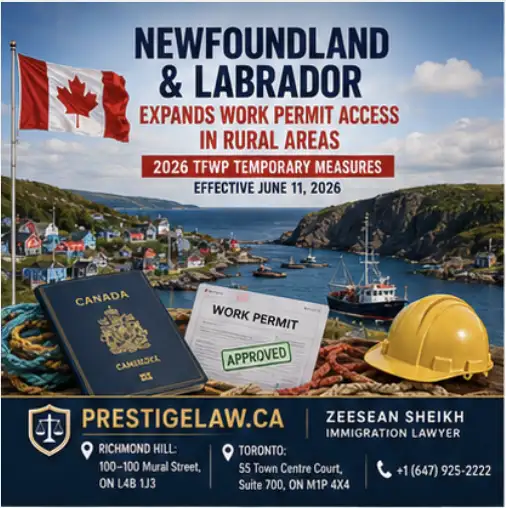
Newfoundland and Labrador Expands Work Permit Access in Rural Areas
What Employers and Foreign Workers Need to Know About the 2026 TFWP Temporary Measures Taking Effect June 11, 2026
Published: June 6, 2026 | Author: Zeesean Sheikh, Immigration Lawyer | Website: prestigelaw.ca
Introduction: A Significant Policy Shift for Rural Newfoundland and Labrador
Canada’s immigration landscape is constantly evolving, and June 2026 has brought one of the most consequential changes yet for rural employers and temporary foreign workers in Newfoundland and Labrador. The province has officially opted into the federal government’s temporary public policy under the Temporary Foreign Worker Program (TFWP), granting rural employers significantly greater flexibility in hiring low-wage temporary foreign workers. This development is not simply an administrative adjustment — it is a lifeline for businesses in rural communities across Newfoundland and Labrador that have long struggled with critical labour shortages.
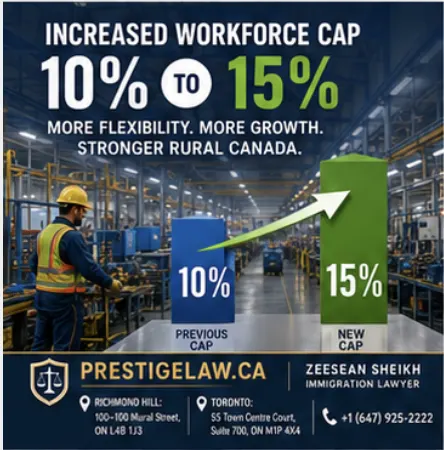
Effective June 11, 2026, and expected to remain in force until March 31, 2027, this policy expansion means that eligible employers located outside census metropolitan areas in the province can now retain or expand their current workforce of temporary foreign workers in low-wage positions, subject to a revised cap of 15 per cent rather than the standard 10 per cent. Both measures have been adopted across all sectors in the province. Newfoundland Rural Work Permit Expansion 2026
For employers, this is an opportunity to stabilise their operations and address persistent hiring gaps. For foreign workers, this represents new and expanded job opportunities in communities that genuinely need skilled and reliable people. And for both groups, navigating the legal requirements of this policy correctly from the very beginning is essential.
At Prestige Law, immigration lawyer Zeesean Sheikh and his dedicated team are committed to helping employers and foreign nationals understand and act on this change with confidence, accuracy, and full legal compliance.
What Is the Temporary Foreign Worker Program (TFWP)?
Before examining what has changed, it is important to understand the foundation upon which this policy rests: the Temporary Foreign Worker Program (TFWP).
The TFWP is a federal program administered jointly by Employment and Social Development Canada (ESDC) and Immigration, Refugees and Citizenship Canada (IRCC). It allows Canadian employers to hire foreign nationals temporarily to fill positions when qualified Canadian citizens or permanent residents are not available. Employers must typically obtain a Labour Market Impact Assessment (LMIA) before hiring a temporary foreign worker. An LMIA is a document that demonstrates the hiring of a foreign worker will not negatively impact the Canadian labour market.
The TFWP is divided into several streams based on the wage offered:
- High-Wage Stream: Positions offering wages at or above the provincial median wage
- Low-Wage Stream: Positions offering wages below the provincial median wage
- Primary Agriculture Stream
- Seasonal Agricultural Worker Program (SAWP)
- Caregiving Stream
The new temporary measures announced for Newfoundland and Labrador specifically affect the Low-Wage Stream for rural employers outside of census metropolitan areas.
The Standard 10% Cap: A Major Barrier for Rural Employers
Before these changes, one of the most significant restrictions facing rural employers under the TFWP was the low-wage cap. Since September 26, 2024, employers have been limited to filling only 10 per cent of their workforce at a given worksite with temporary foreign workers in low-wage positions. This represented a dramatic reduction from the previous 30 per cent cap.
For urban employers with larger labour pools, this cap was manageable. For rural employers in Newfoundland and Labrador — where chronic labour shortages, an ageing workforce, and significant youth out-migration have created an increasingly difficult hiring environment — the 10 per cent cap was an operational crisis.
According to data from the Canadian Federation of Independent Business (CFIB), over 55 per cent of small businesses in rural areas reported unfilled positions in 2025, compared to 40 per cent in urban centres. In communities where local talent pools are limited, and the need for labour is acute across industries such as fisheries, food processing, hospitality, healthcare support, and construction, the rigid 10 per cent cap left many rural employers without legal options.
That is precisely why this temporary measure matters so profoundly.
Newfoundland and Labrador’s Opt-In: What Has Actually Changed?
On June 2, 2026, the federal government’s official webpage confirmed that Newfoundland and Labrador had opted into both temporary measures under the federal TFWP rural policy. This makes NL one of a growing number of provinces choosing to participate in this opt-in program, which was originally launched on April 1, 2026. Other early adopters included Nova Scotia and Quebec.
The Two Measures Adopted by Newfoundland and Labrador
Newfoundland and Labrador has adopted both available measures, applicable across all sectors of employment. These are:
Measure One — Cap Retention Above the Standard Threshold: Eligible rural employers who currently have a proportion of temporary foreign workers in low-wage positions that exceeds the standard 10 per cent cap are permitted to retain that higher proportion. In practical terms, this means employers will not be forced to reduce their existing TFW workforce solely because they exceed the standard limit.
Measure Two — Elevated Cap of 15 Per cent: In addition to retention, eligible rural employers can now benefit from a 15 per cent cap on the proportion of temporary foreign workers in low-wage positions at a given worksite. This represents a 50 per cent increase over the previous standard cap and gives employers significantly more flexibility in structuring their workforce.
Both measures became operational in Newfoundland and Labrador on June 11, 2026, and are expected to remain in effect until March 31, 2027.
Who Is Eligible Under This Policy?
Eligibility is carefully defined under this temporary measure. Not every employer in Newfoundland and Labrador can access these benefits, and it is critical to understand the specific qualifying criteria before submitting an LMIA or structuring a hiring plan around these provisions.
Geographic Eligibility
Only employers located outside census metropolitan areas (CMAs) as determined by Statistics Canada are eligible. In Newfoundland and Labrador, the primary CMA is the St. John’s metropolitan area. Employers located within the St. John’s CMA, including adjacent suburban areas classified as part of the metropolitan region, are not eligible under this policy. All rural communities in the province outside this designation are eligible under the geographic criterion.
If you are unsure whether your business location qualifies as rural under Statistics Canada’s CMA definitions, seeking legal guidance before filing an LMIA is strongly advised.
Compliance with TFWP Requirements
To benefit from these measures, employers must still meet all regular TFWP requirements. This is a critical condition. Employers cannot bypass standard obligations simply because they operate in a rural area. Specifically:
- Employers must demonstrate genuine efforts to recruit Canadian citizens and permanent residents before turning to foreign workers.
- Employers must advertise the position through appropriate channels and within required timeframes.
- Employers must pay at least the prevailing wage for the occupation and location.
- Employers must meet all conditions related to workplace safety, accommodations where applicable, and non-discrimination.
Failure to meet these baseline requirements disqualifies an employer from accessing the rural temporary measures entirely.
Timing of LMIA Submission
These measures apply only to new LMIA applications submitted on or after June 11, 2026. Rural NL employers who submitted an LMIA before this date are explicitly excluded from benefiting under this policy. The elevated cap or retention measure will be applied once an eligible employer submits a new LMIA during the effective period of the measures, that is, before March 31, 2027.
What Is Excluded From These Measures?
Understanding what is not covered is as important as understanding what is. ESDC has made it clear that:
- Dual-intent LMIAs are excluded. Low-wage positions under the permanent resident dual-intent stream will not benefit from these measures. A dual-intent LMIA is one that simultaneously supports both a temporary work permit and a foreign worker’s application for permanent residence. These applications are handled under a different policy framework.
- Employers in census metropolitan areas are excluded. Businesses within the St. John’s metropolitan region cannot access these measures.
- Pre-existing LMIAs submitted before June 11, 2026 are excluded. Employers cannot retroactively apply these measures to previously approved or pending applications filed before the effective date.
Why This Policy Matters: The Labour Market Context in Rural NL
To fully appreciate the impact of this policy expansion, it is essential to understand the labour market realities driving it. Newfoundland and Labrador is experiencing a period of significant economic growth and transformation — one that is placing enormous demands on its existing workforce.
The province’s energy sector is booming. The West White Rose offshore oil project has advanced to a major milestone, and exploration drilling is ongoing. Hydroelectric development in Labrador through a Memorandum of Understanding with Quebec encompasses the Gull Island project, the Churchill Falls Expansion, and Churchill Falls Upgrades, projects expected to generate thousands of direct and indirect jobs through 2028 and beyond. The mining sector at Voisey’s Bay has completed its major expansion phase, while iron ore opportunities in Labrador West continue to draw investment. Wind and hydrogen energy are emerging as frontier sectors.
At the same time, the province faces serious structural labour challenges. Roughly 5,900 construction workers are expected to retire between now and 2033, with only approximately 4,000 local new entrants forecasted to replace them. Young residents continue to leave rural communities in search of opportunities in urban centres. In sectors like fisheries, food processing, elder care, and hospitality, positions go unfilled for extended periods, threatening the viability of businesses and communities alike.
This policy is a targeted, time-limited response to an urgent and well-documented need. It allows rural businesses to legally expand their capacity to hire foreign workers while the province works toward longer-term workforce development solutions.

How Does This Affect Foreign Workers?
For foreign nationals already working in Newfoundland and Labrador’s rural communities, or those considering opportunities in the province, this policy creates expanded access to work permit positions. More job openings in low-wage streams across all sectors means more LMIA-backed offers of employment — the critical first step in obtaining a TFWP work permit.
However, foreign workers should understand that the policy does not create new visa pathways independently. The process for obtaining a work permit under the TFWP remains the same:
- The employer must obtain a positive LMIA from ESDC.
- The foreign worker uses the LMIA number to apply for a work permit through IRCC.
- The work permit is employer-specific and tied to the approved job and location.
- Work permits under this stream are generally valid for 12 to 24 months.
Foreign workers with existing positions in rural NL should also note that their employers may now be eligible to maintain their employment even if the employer was previously at risk of exceeding the standard 10 per cent cap. This is particularly important for workers concerned about continuity of employment.
Looking further ahead, workers who secure positions under the TFWP in Newfoundland and Labrador may be eligible to transition to permanent residence through pathways such as the Atlantic Immigration Program (AIP), the Rural Community Immigration Pilot (RCIP), or Express Entry’s Canadian Experience Class, provided they accumulate the required experience and meet eligibility criteria.
Step-by-Step Process for Rural Employers in NL
If you are an employer in a rural area of Newfoundland and Labrador and want to take advantage of these measures, here is a general roadmap:
Step 1 — Confirm Geographic Eligibility: Verify that your worksite is located outside the St. John’s census metropolitan area as defined by Statistics Canada. Use the postal code lookup tool on the IRCC website or consult an immigration lawyer for confirmation.
Step 2 — Meet All TFWP Compliance Requirements: Ensure that your recruitment records, wage rates, job descriptions, and workplace conditions all satisfy standard TFWP requirements. Document your advertising efforts and outreach to Canadian citizens and permanent residents meticulously.
Step 3 — Prepare and Submit a New LMIA on or After June 11, 2026. A new LMIA must be submitted during the effective period of this policy. Applications submitted before June 11, 2026, will not be covered. Work with an immigration professional to prepare a complete and accurate LMIA application.
Step 4 — Hire the Foreign Worker and Facilitate the Work Permit Application: Once you receive a positive LMIA, provide the foreign worker with the LMIA number and relevant documentation so they can apply for their work permit through IRCC.
Step 5 — Maintain Ongoing Compliance: Continue to meet all TFWP obligations throughout the duration of the work permit, including wage compliance, workplace conditions, and any inspection or audit requirements from ESDC.
Common Mistakes to Avoid
Even well-intentioned employers make errors that lead to LMIA refusals, compliance failures, or penalties. Some of the most common pitfalls include:
- Submitting an LMIA before the June 11, 2026, effective date and expecting it to qualify under the new measures
- Failing to demonstrate adequate recruitment efforts targeted at Canadians and permanent residents
- Misclassifying a worksite as rural when it falls within the St. John’s CMA
- Applying the elevated cap to positions that are under a dual-intent LMIA
- Not updating wage offerings to meet current prevailing wage requirements
- Missing documentation requirements in the LMIA application package
Each of these errors can be avoided with proper legal guidance before submission.
How Prestige Law Can Help You
Navigating the Temporary Foreign Worker Program is complex under normal circumstances. With the addition of a new temporary policy carrying specific eligibility requirements, geographic conditions, and timing constraints, the margin for error is even narrower.
At Prestige Law, immigration lawyer Zeesean Sheikh provides comprehensive, results-driven immigration legal services to employers and foreign nationals across Canada and internationally. With deep expertise in the TFWP, LMIA applications, work permits, and permanent residence pathways, the team at Prestige Law is uniquely positioned to help you take full advantage of this policy expansion — correctly and efficiently.
Whether you are a rural employer in Newfoundland and Labrador looking to expand your workforce under the new 15 per cent cap, a foreign worker seeking a work permit through this stream, or a business owner trying to understand whether you qualify under the geographic criteria, Prestige Law is your trusted legal partner.
Services provided by Prestige Law include:
- LMIA application preparation and submission for employers
- Work permit applications for temporary foreign workers
- Assessment of geographic and compliance eligibility under the NL rural measures
- Permanent residence pathways including the Atlantic Immigration Program and Express Entry
- Provincial Nominee Program (PNP) assistance through the NL PNP
- Corporate immigration strategy and workforce planning
Frequently Asked Questions (FAQs)
Q1: When exactly do the new rural work permit measures take effect in Newfoundland and Labrador?
The measures became effective in Newfoundland and Labrador on June 11, 2026, and are expected to remain in force until March 31, 2027.
Q2: Does this policy apply to employers in St. John’s?
No. Only employers located outside census metropolitan areas as defined by Statistics Canada are eligible. The St. John’s metropolitan area is a CMA, and employers within it cannot access these measures.
Q3: What sectors are covered under NL’s opt-in to this policy?
Newfoundland and Labrador has adopted both measures applicable across all sectors. There is no restriction on industry type for eligible rural employers in the province.
Q4: Can I use this policy for a dual-intent LMIA?
No. Low-wage positions under the permanent resident dual-intent stream are explicitly excluded from these temporary measures. If your LMIA is intended to support both a work permit and a permanent residence application, the elevated cap provisions do not apply.
Q5: What if I already submitted an LMIA before June 11, 2026?
These measures only apply to new LMIA submissions made on or after June 11, 2026. Previously submitted or approved LMIAs are not covered under this temporary policy.
Q6: Do I still need to prove I tried to hire Canadians first?
Yes, absolutely. Employers must still demonstrate genuine efforts to recruit Canadian citizens and permanent residents before hiring a temporary foreign worker. This is a non-negotiable condition for all TFWP applications. The new measures provide flexibility in caps but do not remove the obligation to prioritise Canadian workers.
Q7: Can a foreign worker use this policy to apply for permanent residence?
The TFWP itself is a temporary work permit program. However, experience gained through a TFWP position can contribute to eligibility for permanent residence through programs such as the Canadian Experience Class, the Atlantic Immigration Program, or the NL Provincial Nominee Program, depending on qualifications, experience, and language proficiency.
Q8: What is the cap under the new measures, and what was it before?
The previous standard cap for low-wage TFW positions was 10 per cent of the workforce at a given worksite. Under the new temporary measures for rural NL employers, the cap is elevated to 15 per cent. Additionally, employers already at or above 10 per centper cent may retain their current proportion rather than be forced to reduce their TFW workforce.
Q9: How do I know if my business location is considered rural under this policy?
Your business must be located outside a census metropolitan area (CMA) as designated by Statistics Canada. In Newfoundland and Labrador, the St. John’s area is the primary CMA. You can use the IRCC postal code tool, review Statistics Canada’s CMA definitions, or speak with an immigration lawyer to confirm your eligibility.
Q10: How can Prestige Law help me with this process?
Prestige Law, led by immigration lawyer Zeesean Sheikh, offers full-service LMIA preparation, eligibility assessment, work permit applications, and long-term immigration strategy for both employers and foreign workers. Contact the office directly to schedule a consultation and get expert guidance tailored to your specific situation.
Conclusion: Act Now Before the Window Closes
The temporary expansion of work permit access for rural employers in Newfoundland and Labrador is a significant and time-sensitive opportunity. With an effective date of June 11, 2026, and a policy sunset of March 31, 2027, the window to benefit from these measures is real but finite. Employers who act promptly, prepare thoroughly, and comply fully with TFWP requirements will be best positioned to stabilise their workforce and address persistent labour shortages.
Foreign workers who are attentive to this development may find new employment opportunities in rural NL communities that are actively seeking reliable, skilled workers across all sectors.
At every step of this process — from confirming geographic eligibility to submitting a complete LMIA and guiding a foreign worker through the permit application — Prestige Law is ready to provide the expert legal counsel you need.

Contact Prestige Law Today
Do not leave something as important as immigration compliance or your workforce strategy to chance. The legal team at Prestige Law is here to help you take the right steps, at the right time, with the right information.
Zeesean Sheikh Immigration Lawyer
📍 Richmond Hill: 100–100 Mural Street, ON 📍 Toronto: 55 Town Centre Court, Suite 700, ON 📞 Telephone: +1 (647) 925-2222 🌐 Website: prestigelaw.ca
This article is intended for informational purposes only and does not constitute legal advice. For advice specific to your situation, please consult directly with an immigration lawyer.
© 2026 Prestige Law. All rights reserved. | prestigelaw.ca