




British Columbia invites cleaners, security staff, and entrepreneurs to apply for provincial nomination.
British Columbia has used two October 2026 selection rounds to invite cleaners and security staff who work for public health authorities in rural and remote communities, along with experienced entrepreneurs who plan to start, buy, or expand a business in the province. The BC PNP, short for the British Columbia Provincial Nominee Program, issued these invitations under its Skills Immigration and Entrepreneur Immigration categories. The rounds show how the province is using its limited nomination allocation to fill essential service roles in underserved regions while still attracting business owners who can create jobs. This guide explains what happened, who qualifies, what the draws signal, and how to prepare a strong application.
Key Takeaways BC PNP Invites Cleaners
- The BC PNP held selection rounds on October 15 and October 20, 2026.
- The first round invited 16 candidates under the Temporary Rural/Remote Health Support Initiative, with a minimum score of 54.
- The second round invited entrepreneurs through the Base Stream (10 invitations) and the Regional Stream (fewer than five).
- Eligible health support occupations are janitors and heavy-duty cleaners (NOC 65312), light-duty cleaners (NOC 65310), and security guards (NOC 64410).
- The Base Stream requires a personal net worth of at least $600,000 and a minimum investment of $200,000.
- An invitation to apply is not a nomination, and a nomination is not permanent residence.
What Happened in British Columbia’s October 2026 Selection Rounds
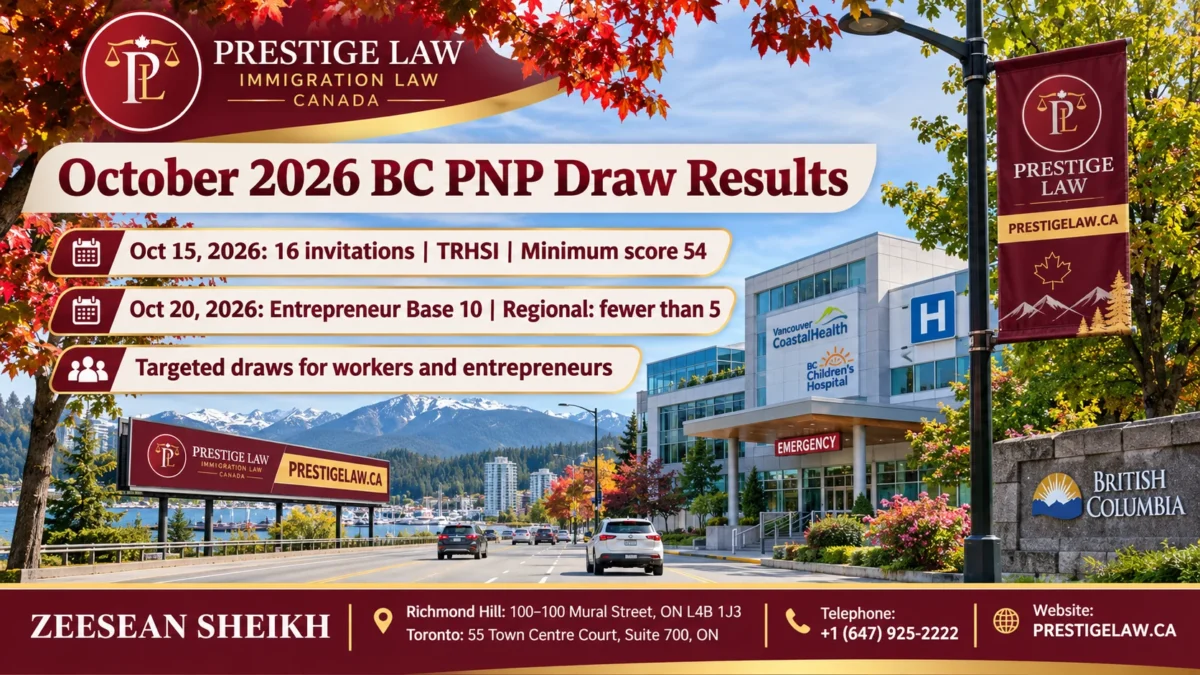
The BC PNP held two separate selection rounds in the second half of October 2026. The first took place on October 15 under the Skills Immigration category and was aimed at one narrow group of workers. The second took place on October 20 under the Entrepreneur Immigration category.
The October 15 round issued 16 invitations through the Temporary Rural/Remote Health Support Initiative, which most people shorten to TRHSI. The minimum score was 54. The province noted that this was the smallest invitation volume of the three TRHSI rounds held so far. A small round does not mean the pathway has lost value. The initiative is capped, and the province appears to be pacing invitations carefully.
The October 20 round invited 10 candidates through the Entrepreneur Immigration Base Stream. It also invited fewer than five through the Regional Stream, with a minimum score of 118. Across the two rounds, the BC PNP issued more than 27 invitations.
The numbers are modest, but the message is clear. British Columbia is selecting candidates for specific economic and community needs rather than running broad, high-volume draws. For anyone planning a move to the province, this changes how a profile should be prepared.
Understanding the BC PNP and the Look West Strategy
The BC PNP lets the province nominate people for permanent residence when their skills, experience, or investment match local needs. Canada’s federal government sets how many nominations each province may issue, so every nomination is a deliberate choice.
On April 23, 2026, British Columbia announced a major restructuring of the program. It aligned nominations with the province’s Look West economic strategy and organized its priorities under three themes: Care, Build, and Innovate. Under this approach, the province:
- Prioritises health care and skilled trades workers.
- Cancelled the planned launch of its new student streams.
- Closed several pathways that had served graduates, technology workers, and entry-level applicants.
- Announced a limited-time initiative for support workers in rural and remote health settings.
Cleaners and security staff fall under the Care theme because hospitals and clinics cannot operate safely without them. Entrepreneurs fall under the province’s wider goal of strengthening its economy through new and expanded businesses.
If you were counting on a pathway that has since closed, take the changes seriously. A strategy that worked in 2024 may not apply in 2026, and the BC PNP rewards candidates whose situation matches the province’s current priorities.
The Temporary Rural/Remote Health Support Initiative Explained
The TRHSI is a limited-time pathway for foreign nationals who work in support roles for British Columbia’s public health authorities in rural and remote areas. Most health care immigration pathways focus on physicians and nurses. This one recognises that support staff are just as necessary to keep health facilities running.
The key features are:
- A fixed cap. The province capped the initiative at 250 nominations.
- A defined window. The pathway launched in mid-June 2026, and registrations closed on October 7, 2026.
- A narrow set of occupations. Only three occupations qualify.
- A selection score. Candidates who registered are ranked and invited in rounds, and each round has its own minimum score.
The province has not published how many nominations it has issued since the launch. That uncertainty is one reason candidates who have already registered should keep their documents current and respond quickly if an invitation arrives.
Because registration is now closed, new candidates cannot join this specific pathway. The initiative remains relevant for two reasons. Registered candidates are still being invited, and the program shows how the province designs targeted pathways. Similar limited-time programs may appear again.
Who Is Eligible: Occupations, Employers, and Locations
The TRHSI is open to foreign nationals who hold permanent, full-time positions with qualifying public health authorities in rural or remote parts of British Columbia. The eligible occupations under Canada’s National Occupational Classification are:
- Janitors, caretakers, and heavy-duty cleaners (NOC 65312)
- Light-duty cleaners (NOC 65310)
- Security guards and related security service occupations (NOC 64410)
Candidates must also be direct employees of one of the province’s public health authorities. Agency staff and contractors do not meet this requirement. This is one of the most common reasons strong candidates are screened out, so confirm exactly who issues your paycheque.
Other conditions apply:
- Employment length. You must have completed at least nine consecutive months of full-time work with the same employer in the same region.
- Location. Workers based in the Central Okanagan Regional District, the Metro Vancouver Regional District, and the Capital Regional District are generally excluded.
- Island exceptions. Limited exceptions apply to positions on Galiano, Mayne, Pender, Salt Spring, and Saturna islands.
Pay attention to geography. Many people assume that working for a health authority is enough. In this pathway, the work location matters as much as the employer. A position in a large urban region may look identical on paper and still fall outside the rules.
Immigration requirements can also change, and officials interpret them in context. Before relying on any summary, including this one, check the official BC PNP program guide and consider speaking with a qualified immigration professional about your situation.
Why Cleaners and Security Staff Matter to Rural Health Care
Hospitals and clinics in remote communities already struggle to recruit and keep staff. Doctors and nurses draw most of the public attention, but a facility cannot stay open without clean, safe, and secure spaces.
Cleaners help prevent infections, support patient safety, and keep operating areas ready for use. Security staff protect patients, families, and employees, which matters more in small communities with limited emergency resources. When these roles go unfilled, clinical staff pick up the slack, and burnout follows.
For workers, the pathway offers a rare opportunity. Many immigration programs score applicants heavily on education, language results, and high-skilled work experience, and support staff often cannot compete on those terms. A pathway that recognises their contribution gives them a realistic route to permanent residence.
For communities, retention is the real prize. A worker who obtains permanent residence can plan a long-term life in a small town, buy a home, enrol children in local schools, and stay with the employer. That stability is hard to achieve with temporary status alone.
Entrepreneur Immigration: Base Stream and Regional Stream
The second October round shows that British Columbia still wants business owners who can add jobs and investment. Under the Entrepreneur Immigration category, the province has issued at least 131 invitations across its two entrepreneur pathways this year, and most came through the Base Stream.
The Base Stream suits candidates who want to start a new business or buy an existing one in British Columbia. The core requirements are:
- At least three years of experience as an owner-manager within the past ten years
- A personal net worth of at least $600,000
- A minimum investment of $200,000 in the proposed business
- Ownership of at least 33.33 per cent of the business
The Regional Stream is designed for entrepreneurs who want to establish or expand a business in a smaller community outside the main urban centres. It uses a different scoring model and lower financial thresholds than the Base Stream. The October round produced a minimum score of 118. Confirm the current financial and community requirements in the official program guide before building a plan around this stream.
Entrepreneur applicants carry a heavier burden of proof than most skilled workers. You must show where your net worth came from, how the business will operate, and how it will benefit the local economy. A vague plan or an unexplained source of funds can end an application quickly.
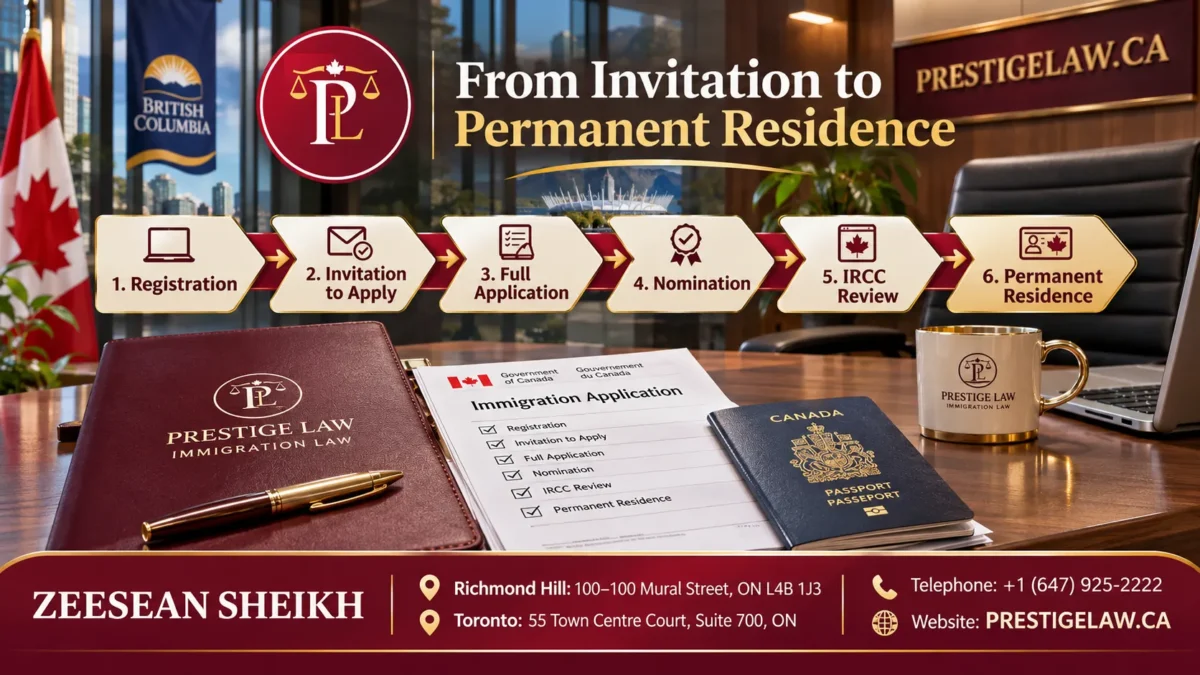
From Invitation to Permanent Residence: The Step-by-Step Path
A frequent misunderstanding is that an invitation to apply gives you permanent residence. It does not. The BC PNP works in stages, and each stage has its own review.
- Registration or Expression of Interest. Eligible candidates submit their profile, and the province scores it.
- Invitation to apply. The province ranks candidates and invites those who meet the minimum score in a given round.
- Application. The invited candidate submits a complete application with supporting documents, usually within a strict deadline.
- Review and nomination. The province assesses the application and, if it is satisfied, issues a nomination.
- Federal application. The nominee applies to Immigration, Refugees and Citizenship Canada (IRCC) for permanent residence, and federal officials review health, criminal, and security admissibility.
- Permanent residence. If IRCC approves the application, the candidate and eligible family members become permanent residents.
Entrepreneurs usually face extra steps. They may need to sign a performance agreement with the province and start the business before nomination, and they may also need a work permit while they build it.
Every step has deadlines. Missing a document deadline after an invitation can cost you the entire opportunity, so treat the invitation as the start of the real work.
Common Mistakes That Put Applications at Risk
Many refusals and delays come from avoidable errors. Watch for these:
- Misreading the employer rule. Contract or agency workers sometimes assume they qualify as direct employees. Confirm your employment type in writing.
- Overlooking the location exclusions. A job in an excluded region can disqualify an otherwise strong application.
- Weak proof of funds. Entrepreneurs must document the source of their net worth and investment funds. Gaps and inconsistent records raise concerns.
- Inconsistent information. Dates, job titles, and duties must match across your registration, employment letters, pay records, and permits.
- Missed deadlines. Provincial deadlines after an invitation are short and rarely flexible.
- Relying on rumours. Social media posts often oversimplify rules or repeat outdated information. Use official sources.
- Misrepresentation. Submitting false or misleading information can lead to refusal and a multi-year ban from applying to Canada. It is never worth the risk.
A careful review before you submit is far cheaper than recovering from a refusal.
What These Draws Signal About British Columbia’s Priorities
Reading selection rounds closely can help you plan. Several patterns stand out in October 2026.
Targeted selection beats volume. The province is issuing small, focused rounds. That suggests it knows which sectors it needs and is inviting only the candidates who fit.
Care and Build remain the core themes. The health support initiative and the continued focus on trades and health care workers show where the province places its limited nominations.
Business investment still counts. The entrepreneur rounds show that BC has not abandoned business immigration. It is, however, expecting real capital, real experience, and a credible plan.
Limited-time programs can appear and disappear. The TRHSI opened, ran for months, and closed registration within a single year. Candidates who wait for a perfect moment may miss the window entirely.
Staying informed is part of the strategy. Check official announcements regularly, keep your documents current, and act quickly when a pathway fits your profile.
Other Pathways to Consider If You Do Not Qualify
Many readers will find that they do not meet the TRHSI or entrepreneur requirements. That does not end the conversation. Depending on your background, other routes may exist.
- Other BC PNP skills streams. The province continues to prioritise health care, skilled trades, and other high-impact occupations.
- Express Entry. Skilled workers with strong language results, education, and work experience may qualify for federal selection, including category-based rounds.
- Other provincial programs. Provinces such as Ontario, Alberta, Manitoba, and New Brunswick run their own nominee programs with different priorities.
- Employer-supported work permits. A job offer supported by a labour market process can lead to Canadian work experience, which strengthens later permanent residence applications.
- Family sponsorship. If you have a qualifying spouse, partner, or relative in Canada, sponsorship may be the simplest route.
The best option depends on your age, education, language ability, work history, and family situation. A careful assessment prevents you from chasing a pathway that was never realistic.
How Prestige Law Can Help
Choosing the right pathway, documenting your history accurately, and meeting deadlines can feel overwhelming. Zeesean Sheikh and the team at Prestige Law help clients understand their Canadian immigration options, prepare complete and consistent applications, and plan the steps that follow a provincial nomination, including the federal permanent residence stage. Whether you are a worker looking for a realistic route or an entrepreneur preparing a business plan, early guidance can save time and reduce risk.
Contact Prestige Law
📍 Richmond Hill: 100–100 Mural Street, ON
📍 Toronto: 55 Town Centre Court, Suite 700, ON
📞 Telephone: +1 (647) 925-2222
🌐 Website: prestigelaw.ca
Frequently Asked Questions About the BC PNP
What is the BC PNP?
The BC PNP is British Columbia’s provincial nominee program. It allows the province to nominate foreign nationals for permanent residence when their skills or investment meet local economic needs. After nomination, the candidate applies to IRCC for permanent residence.
Who received invitations in the October 2026 BC PNP rounds?
On October 15, the province invited 16 candidates under the Temporary Rural/Remote Health Support Initiative, with a minimum score of 54. On October 20, it invited 10 entrepreneurs through the Base Stream and fewer than five through the Regional Stream.
Which jobs qualify under the rural and remote health initiative?
Three occupations qualify: janitors, caretakers, and heavy-duty cleaners (NOC 65312); light-duty cleaners (NOC 65310); and security guards and related security service occupations (NOC 64410). Candidates must work as direct employees of a public health authority.
Can I still register for the Temporary Rural/Remote Health Support Initiative?
No. Registrations closed on October 7, 2026, and the initiative is capped at 250 nominations. Registered candidates may still receive invitations, and the province could introduce similar programs later.
Do cleaners and security guards in Vancouver or Victoria qualify?
Workers in Metro Vancouver, the Capital Regional District, and the Central Okanagan are generally excluded, with limited exceptions for certain islands. Always confirm your exact work location against the official rules.
What are the main requirements for the Entrepreneur Base Stream?
You need at least three years of owner-manager experience within the past ten years, a personal net worth of at least $600,000, a minimum investment of $200,000, and at least 33.33 per cent ownership of the business. You must also provide a credible business plan and documented funds.
Does an invitation to apply guarantee nomination?
No. An invitation lets you submit a full application, and the province still reviews it. Nomination is a separate decision, and permanent residence requires a final approval from IRCC.
How long does the BC PNP process take?
Timelines vary by stream, season, and application volume, and they can change without notice. Check the official processing information for your category and plan for possible delays at both the provincial and federal stages.
Can I include my family in the application?
In most cases, a nominee’s spouse or partner and dependent children can be included in the federal permanent residence application. Requirements differ by situation, so confirm the details for your family.
Should I hire an immigration professional?
You are not required to. Many people benefit from professional review, particularly when employment history is complex, funds are hard to document, or deadlines are tight. Choose someone who is authorised to give immigration advice in Canada.
Most Searched Questions Related to British Columbia Immigration
If you are researching this topic, these are among the questions people ask most often:
- How do I immigrate to British Columbia in 2026?
- What is the latest BC PNP draw result?
- What is the minimum score for the BC PNP?
- Which jobs are in demand for BC immigration?
- Can I get permanent residence in Canada as a cleaner or security guard?
- How much money do I need for BC entrepreneur immigration?
- What is the difference between a provincial nomination and permanent residence?

The October 2026 rounds show a province that is selective, strategic, and clear about its needs. Cleaners and security staff in rural health settings gained a rare route to permanent residence, and experienced entrepreneurs continued to receive invitations through the Base and Regional streams. At the same time, the TRHSI’s closed registration and the cancelled student streams show how fast the BC PNP can change.
If you hope to build a future in British Columbia, review your eligibility early, gather accurate documents, and rely on official information. Pathways open and close quickly, and the strongest applications are the ones prepared well before an invitation arrives.
For personalised guidance on Canadian immigration options, contact Zeesean Sheikh and the team at Prestige Law through the details above.
This article is for general information only and is not legal advice. Immigration rules and program details change often, so confirm current requirements with official government sources.