





IRCC releases updated breakdown of Express Entry candidates by CRS score
Prepared by Prestige Law | Published November 3, 2026
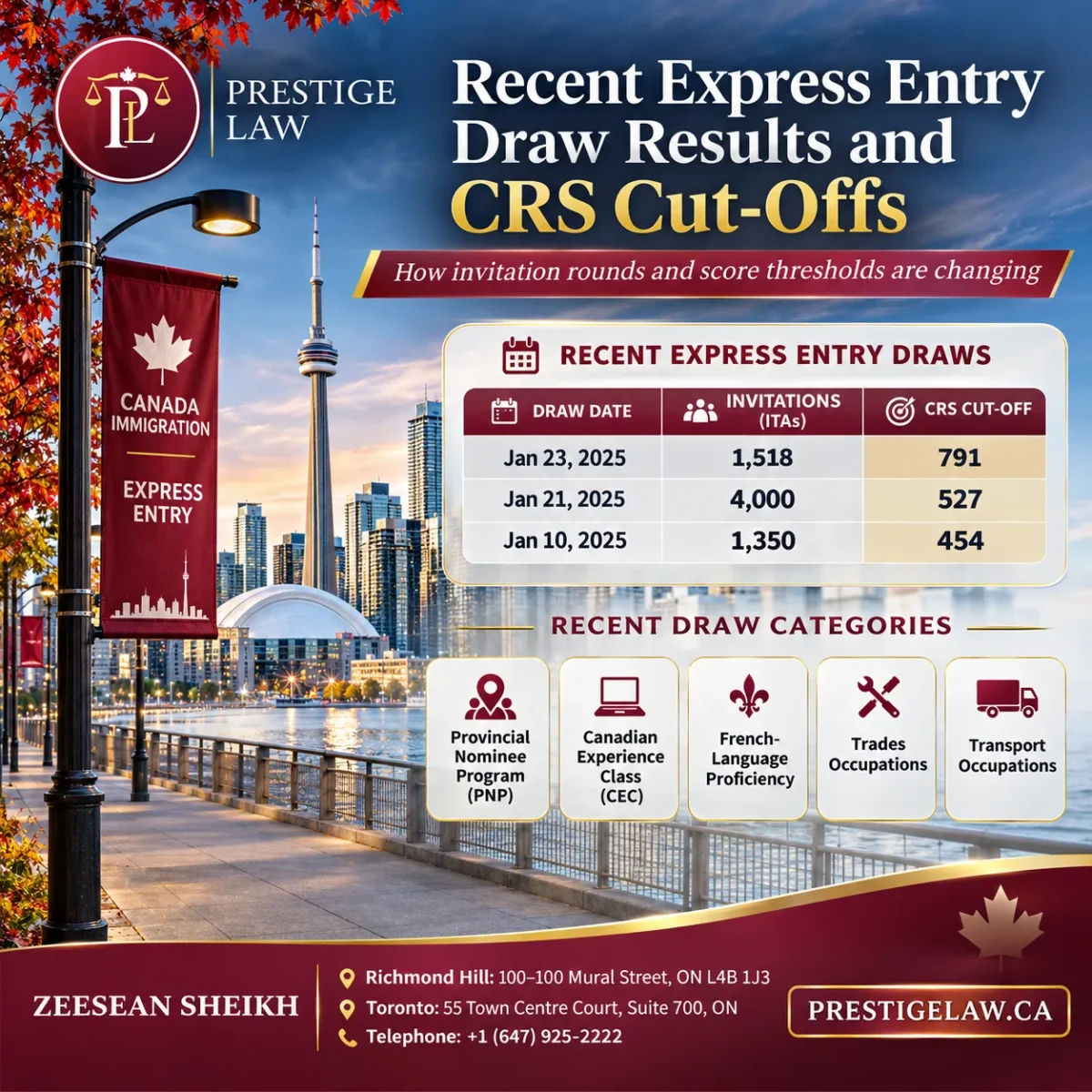
Immigration, Refugees and Citizenship Canada (IRCC) has released an updated breakdown of Express Entry candidates by CRS score, and the latest Express Entry CRS score data, dated October 25, 2026, shows 228,724 active profiles in the pool. That is 732 fewer than two weeks earlier, yet competition has not eased. High-scoring candidates were invited in large numbers, while the 301 to 430 range grew by a net 1,754 profiles. With new high-wage CRS points taking effect on November 3, 2026, this guide explains what every figure means, where your profile stands, and which steps can strengthen your position.
What the Latest Express Entry CRS Score Breakdown Tells Us
About every two weeks, IRCC publishes a snapshot of the Express Entry pool, grouping active candidates by Comprehensive Ranking System (CRS) score. The newest release is more than a statistics exercise. For anyone holding an Express Entry profile, it is the closest thing to a map of the competition. It shows how many people sit ahead of you, how many sit behind you, and where the pool is getting crowded.
At Prestige Law, we study these releases closely because clients in Richmond Hill, Toronto, and across Canada keep asking the same question: is my Express Entry CRS score good enough? There is no single answer, because the answer depends on which draw type fits your profile. What the data can do is replace guesswork with context. This article walks through the October 25 figures, compares them with the October 12 snapshot, connects them to recent draw results, and explains how the new high-wage points may change the picture.
Express Entry CRS Score Breakdown at a Glance Express Entry CRS Score Breakdown 2026
- Total pool: 228,724 active profiles as of October 25, 2026, down 732 from 229,456 on October 12.
- Largest group: the 451 to 500 range holds 71,112 candidates, about 31 per cent of the pool.
- Top scorers: 21,322 candidates (roughly 9.3 per cent) score 501 or higher.
- Lower half: 136,290 candidates (about 59.6 per cent) score 450 or lower.
- Growth at the bottom: profiles between 301 and 430 rose by a net 1,754 candidates in two weeks.
- Draw activity: IRCC held three rounds inside the reporting window and two more right after it, including a 5,000-invitation French-language round with a cut-off of 407.
- What comes next: new high-wage CRS points start on November 3, 2026, and IRCC has said invitation rounds will pause while scores are recalculated.
What IRCC Actually Released
IRCC publishes the Express Entry pool distribution through its open data on Canada.ca. The data reports how many candidates with active profiles sit in each CRS score range. Two details matter when you read it.
First, the pool figure is a snapshot, not a live count. The October 25 snapshot, released on October 26, does not reflect draws held afterwards. IRCC held a Provincial Nominee Program round on October 26 with 792 invitations and a French-language proficiency round on October 27 with 5,000 invitations. As a result, the real pool today is smaller than the table suggests.
Second, only active profiles are counted. An Express Entry profile stays valid for 12 months. Candidates who do not receive an invitation in that window must submit a new profile if they remain eligible, which is one reason the pool keeps changing even between draws.
To verify the numbers yourself, start with the Express Entry page on Canada.ca, which is the official home for program rules, rounds of invitations, and pool data.
Express Entry Candidates by CRS Score: The Full Numbers
The table below sets the October 25 snapshot beside the October 12 snapshot, so you can see exactly where the pool moved.
CRS score range
Oct. 25
Oct. 12
Change
Share of pool (Oct. 25)
0–300 7,627 7,639 −12 3.33%
301–350 17,247 17,123 +124 7.54%
351–400 47,911 47,167 +744 20.95%
401–410 11,880 11,637 +243 5.19%
411–420 12,543 12,201 +342 5.48%
421–430 12,768 12,467 +301 5.58%
431–440 13,155 13,474 −319 5.75%
441–450 13,159 13,749 −590 5.75%
451–460 14,475 14,851 −376 6.33%
461–470 15,803 16,221 −418 6.91%
471–480 16,330 16,220 +110 7.14%
481–490 12,342 12,184 +158 5.40%
491–500 12,162 12,136 +26 5.32%
501–600 20,535 21,638 −1,103 8.98%
601–1,200 787 749 +38 0.34%
Total 228,724 229,456 −732 100%
Two patterns stand out. First, the pool is heavily concentrated in the middle. The 451 to 500 range holds 71,112 candidates, and the 401 to 450 range holds another 63,505, so almost six in ten profiles (58.9 per cent) fall between 401 and 500.
Second, the bands are not equal in width. The 351 to 400 band covers 50 points and holds 47,911 candidates, while each 10-point band above 400 holds between roughly 11,900 and 16,300. Comparing a 50-point band with a 10-point band can mislead, so look at density per 10 points instead. The busiest single 10-point band is 471 to 480, with 16,330 candidates, or 7.14 per cent of the pool.
How Competitive Is Your Express Entry CRS Score?
A percentile shows the share of candidates who score at or below a given number. IRCC reports ranges rather than exact scores, so the figures below apply to the top of each range.
If your score is
Candidates at or below
Percentile
300 7,627 3.33%
350 24,874 10.88%
400 72,785 31.82%
450 136,290 59.59%
470 166,568 72.82%
480 182,898 79.96%
490 195,240 85.36%
500 207,402 90.68%
600 227,937 99.66%
In plain terms, a candidate with 480 points outranks about 80 per cent of the pool, and a candidate with 500 points outranks about 91 per cent. That sounds comfortable, but percentile is not the same as invitation odds. IRCC does not invite the top 10 per cent of the whole pool by default. It runs separate rounds for separate groups, and each round has its own cut-off. A candidate in the 90th percentile may wait a long time if no round targets their profile, while a candidate in the 45th percentile may be invited quickly if a round matches their strengths.
This is why an Express Entry CRS score should always be read together with your program eligibility, your language results, your work history, and the types of draws IRCC is running.
What Changed Between October 12 and October 25
The pool contracted by 732 profiles, but the movement beneath that total tells a more useful story.
The top end thinned out. The 501 to 600 range lost 1,103 candidates, a drop of about 5.1 per cent. That is consistent with the Canadian Experience Class round on October 15, which invited 2,500 candidates at a cut-off of 519, and with the Provincial Nominee Program round on October 13, which invited 752 candidates at 772.
The upper middle also shrank. The four bands from 431 to 470 lost a combined 1,703 candidates. That is consistent with the French-language round on October 16, which invited 5,000 candidates with a cut-off of 435.
The lower middle grew. The 301 to 430 range gained a net 1,754 candidates. IRCC’s data does not explain why, but likely causes include new profiles entering the pool, existing candidates updating language results or other details, and candidates whose scores were recalculated.
The 471 to 500 range edged up. Those three bands added 294 candidates combined, which may reflect candidates improving their scores and moving into a higher range.
The table below lists the three rounds that fell inside the window.
Date
Round type
Invitations
CRS cut-off
October 13 Provincial Nominee Program 752 772
October 15 Canadian Experience Class 2,500 519
October 16 French-language proficiency 5,000 435
Together, these rounds issued 8,252 invitations. The pool still fell by only 732 profiles, which shows how quickly new and updated profiles refill it.
Recent Express Entry Draw Results and CRS Cut-Offs
Cut-offs in recent weeks have varied widely by round type. The table below combines the rounds in the reporting window with the rounds held since.
Date
Round type
Invitations
CRS cut-off
October 1 Trades occupations 3,500 476
October 13 Provincial Nominee Program 752 772
October 15 Canadian Experience Class 2,500 519
October 16 French-language proficiency 5,000 435
October 26 Provincial Nominee Program 792 761
October 27 French-language proficiency 5,000 407
October 28 Transport occupations 150 477
A few points are worth noting. The October 13 provincial round and the October 16 French-language round both posted cut-offs described as their highest in many months, which tells us competition inside those categories is tightening. The October 26 round also issued the largest number of provincial invitations since June 2026. Through the October 27 round, IRCC had issued 149,259 invitations in 2026, and French-language rounds account for roughly 40 per cent of that total.
None of the seven rounds in the table was a general, all-program round. For candidates who do not fit a category, that matters. It means the best route to an invitation in recent weeks has been to match a profile to a targeted round rather than to rely on a raw score alone.
Why CRS Cut-Offs Differ So Much by Draw Type
It can be confusing to see a cut-off of 407 in one round and 772 in another, but the explanation is straightforward.
Provincial nominees start with a large head start. A provincial nomination adds 600 points to a profile. As a result, Provincial Nominee Program rounds produce cut-offs in the 760s and 770s, which no candidate without a nomination could reach realistically.
Canadian Experience Class rounds select people already working in Canada. The cut-off of 519 on October 15 reflects competition among candidates who already have Canadian work experience, many of whom also score well on language and education.
Category rounds target specific attributes. French-language rounds invite candidates with strong French results, trades and transport rounds invite candidates with experience in listed occupations, and each applies its own threshold. When fewer candidates qualify for a category, the cut-off can drop sharply.
In every round, IRCC ranks the eligible candidates from highest to lowest score and invites them in that order until the target number is reached. The cut-off is simply the score of the last candidate invited. If two or more candidates share that score, the tie-breaking rule decides who is invited, based on the date and time the profile was submitted or last updated in a way that affected the score.

New High-Wage CRS Points Start November 3, 2026
The October 25 snapshot arrives right before one of the most significant scoring changes in recent Express Entry history. Beginning November 3, 2026, candidates can earn additional CRS points for Canadian work experience or a qualifying job offer in a high-wage occupation.
IRCC treats an occupation as high-wage when its national median wage is at least 1.3 times the average median wage of the Canadian workforce. The department has identified 186 eligible occupations across three wage levels: at least 1.3 times, at least 1.5 times, and at least two times that average.
The new points fall under a Labour Market Integration Factor. Candidates receive the higher of two possible scores:
Route
Points available
Qualifying job offer 50, 70, or 100 points, depending on the occupation’s wage level
Canadian work experience Up to 150 points (up to 140 with an accompanying spouse or common-law partner)
The work experience score includes the existing points for length of employment, plus up to 70 additional points for at least one year of experience in a high-wage occupation. Job offer points are being reinstated after their removal in March 2025, and candidates will no longer need a Labour Market Impact Assessment (LMIA) for a qualifying job offer to earn those points. Under a temporary public policy, candidates invited on or after November 3 are also exempt from the LMIA requirement for qualifying job offers used to meet eligibility under the Federal Skilled Worker Program or the Federal Skilled Trades Program.
IRCC has said it will pause invitation rounds temporarily while it recalculates candidate scores under the revised system, a process that could take up to two weeks.
What this means for you. The October 25 figures may be among the last snapshots built entirely on the old scoring scale. Once scores are recalculated, the distribution will likely shift, and some candidates will jump several bands. Cut-offs you see before November 3 should not be treated as a reliable guide to cut-offs afterwards. If you work in a high-wage occupation or hold a job offer that qualifies, review your profile as soon as the changes go live.
What the Numbers Mean for Your Score Range
Here is how we suggest candidates think about their position, using the October 25 distribution.
Scores of 601 to 1,200 (787 candidates)
This group is made up almost entirely of provincial nominees. Their path runs through Provincial Nominee Program rounds, where recent cut-offs were 761 and 772. If you hold a nomination, accept it in your profile promptly and make sure every document is ready for the application stage.
Scores of 501 to 600 (20,535 candidates)
These candidates sit in the top 10 per cent of the pool. The October 15 Canadian Experience Class cut-off of 519 shows that this range is competitive but reachable for people with Canadian experience. Keep your profile current, and prepare your police certificates, medical information, and proof of funds early, since an invitation gives you only 60 days to submit a complete application.
Scores of 451 to 500 (71,112 candidates)
This is the crowded middle, and it contains almost a third of the pool. Many candidates here are only a few points away from a category cut-off. The trades round on October 1 closed at 476, and the transport round on October 28 closed at 477, so candidates with qualifying experience in those fields may be closer than they think. For others, small gains in language scores can move a profile past a meaningful threshold.
Scores of 401 to 450 (63,505 candidates)
For this group, French-language ability can be the most powerful lever. The French-language rounds on October 16 and October 27 closed at 435 and 407, both inside this range. If you have French skills, or can build them, test your level and see whether you meet IRCC’s category threshold.
Scores of 351 to 400 (47,911 candidates)
Candidates here usually need a larger jump than a single language retake can deliver. A provincial nomination, a stronger education credential assessment, additional Canadian experience, or the new high-wage points can each make a substantial difference.
Scores of 350 and below (24,874 candidates)
A lower score does not end your options. Many candidates in this range succeed through provincial programs, which often have their own selection criteria and do not depend on the federal cut-off. A tailored strategy matters most at this stage.
Practical Ways to Improve Your Express Entry CRS Score
No strategy guarantees an invitation, but these steps give most candidates a realistic way to move up.
- Retake your language test. Language results carry heavy weight in the CRS. Even a one-level improvement in a single ability can add points, and it can improve your skill transferability results as well.
- Add or strengthen French. French results can raise your score directly and can qualify you for French-language rounds, which have posted the lowest cut-offs in recent weeks.
- Update your education assessment. If you earned a foreign degree, make sure your educational credential assessment reflects the highest level you completed.
- Build Canadian work experience. This remains one of the strongest factors, and from November 3 it can earn extra points if the work is in a high-wage occupation.
- Explore provincial nomination. A nomination adds 600 points and, in practice, almost guarantees an invitation in the next provincial round. Each province sets its own streams and requirements.
- Review your job offer. Under the new rules, a qualifying offer can earn 50 to 100 points without an LMIA, so confirm whether your offer and occupation qualify.
- Check your spouse’s profile. A partner’s language ability, education, and experience can add points to a joint application.
- Keep your profile accurate. Any change in language results, family status, or work history should be reflected promptly, because errors can cost points or create problems at the application stage.
Common Mistakes Express Entry Candidates Make
Treating the pool breakdown as a prediction. The distribution shows where candidates sit today. It cannot tell you when a round will happen, which category IRCC will choose, or what the cut-off will be.
Ignoring category eligibility. Many candidates never check whether their work experience or language results qualify them for a category round. A quick review can reveal an opportunity that a general score comparison hides.
Letting the profile expire. A profile lasts 12 months. If it lapses without an invitation, you must create a new one, and you may lose your place under the tie-breaking rule.
Overstating information. Misrepresentation, even by accident, can lead to a refusal and a five-year ban on applying. Every claim in your profile must be supported by documents.
Waiting until the invitation arrives to gather documents. The 60-day window is strict, and late preparation is one of the most common causes of avoidable stress.
How Prestige Law Can Help With Your Express Entry Profile
A score is only a number. The strategy behind it is what turns a profile into an application. At Prestige Law, lawyer Zeesean Sheikh and the firm’s immigration team review Express Entry profiles from the ground up, checking program eligibility, language and education results, work history, and the supporting documents that IRCC will expect after an invitation.
We also help candidates weigh options beyond the federal pool, including provincial nominee programs and work permit pathways that can lead to permanent residence. With the new high-wage CRS points coming into effect, this is a good moment to confirm how your occupation and employer fit under the revised rules.
Our offices in Richmond Hill and Toronto serve clients across Ontario and beyond. Visit prestigelaw.ca or use the contact details at the end of this article to arrange a consultation. No firm can promise an invitation or a particular score, but careful preparation puts you in the strongest position the rules allow.
Express Entry CRS Score FAQs
What is a good Express Entry CRS score in 2026?
There is no fixed good score, because cut-offs change with every round. In October 2026, cut-offs ranged from 407 in a French-language round to 772 in a Provincial Nominee Program round. A score above 500 places you in roughly the top 10 per cent of the pool, but the right target depends on the round type you qualify for.
Is there a minimum CRS score to enter the Express Entry pool?
No. You do not need a minimum CRS score to create a profile. You must meet the eligibility rules of at least one federal program, such as the Federal Skilled Worker Program, the Canadian Experience Class, or the Federal Skilled Trades Program. Your score matters once IRCC ranks profiles for a round.
How many candidates are in the Express Entry pool right now?
As of October 25, 2026, the pool held 228,724 active profiles. Draws held on October 26 and October 27 have since removed several thousand candidates, so the live total is lower.
How often does IRCC update the Express Entry pool breakdown?
Recent snapshots have arrived about every two weeks, including September 27, October 12, and October 25. Check IRCC’s official pages for the latest release, because the schedule can change.
What is a CRS cut-off?
The cut-off is the score of the lowest-ranked candidate invited in a given round. It changes with each round, depending on the category, the number of invitations, and the strength of the candidates in the pool.
What is category-based selection in Express Entry?
Category-based selection lets IRCC invite candidates who share specific attributes, such as French-language ability, trades experience, or work in a priority occupation. Each category round has its own cut-off, which is why scores that miss a general round can still succeed in a category round.
How do the new high-wage CRS points work?
Starting November 3, 2026, candidates receive the higher of two scores: up to 100 points for a qualifying job offer, or up to 150 points for Canadian work experience (140 with a spouse or partner). The work experience score includes up to 70 additional points for at least one year in a high-wage occupation.
How long does an Express Entry profile stay valid?
A profile remains active for 12 months. If you do not receive an invitation in that period, you can submit a new profile as long as you remain eligible.
How long do I have to apply after an invitation?
You have 60 days from the date of the invitation to submit a complete application for permanent residence. Missing that deadline means the invitation expires.
Can a lawyer raise my CRS score?
A lawyer cannot add points your profile does not earn. A lawyer can, however, review your eligibility, correct errors, identify the factors that could raise your score, and help you decide whether a provincial or category route suits you better.
Most Searched Express Entry Topics
Candidates who read about the Express Entry CRS score often look for these related topics next:
- Express Entry draw results today.
- Latest CRS cut-off scores by category
- Express Entry pool distribution by score
- How to improve your CRS score fast
- Provincial Nominee Program and Express Entry
- French-language Express Entry draws explained.
- Canadian Experience Class requirements
- Express Entry processing times after an invitation
Each of these subjects connects back to the same question: how does your profile compare, and what is the best next step?
Final Thoughts on the Updated Express Entry CRS Score Breakdown
IRCC’s latest release confirms that the Express Entry pool remains large, competitive, and concentrated between 401 and 500 points. It also shows that the route to an invitation increasingly depends on the type of round a candidate qualifies for, not only on the raw number. Provincial nominees dominate the top end, French-speaking candidates have benefited from lower cut-offs, and candidates in trades and transport occupations have found their own paths.
The next few weeks will be unusual. New high-wage points, a recalculation period, and a pause in rounds will reshape the pool. Candidates who prepare now by checking eligibility, updating results, and gathering documents will be better positioned when invitations resume.
If you want a clear, personal assessment of your Express Entry CRS score and the options open to you, the team at Prestige Law is ready to help.

Contact Prestige Law
📍 Richmond Hill: 100–100 Mural Street, ON.
📍 Toronto: 55 Town Centre Court, Suite 700, ON.
📞 Telephone: +1 (647) 925-2222
🌐 Website: prestigelaw.ca
This article is general information based on public IRCC data and is not legal advice. Immigration rules and CRS figures change often. Please consult a qualified lawyer about your own situation.